Angra Mainyu — the Destructive Spirit, later known in Middle Persian as Ahriman — is the primary adversarial spirit of Zoroastrian dualism, first named in the Gathas of Zoroaster and reinterpreted across a millennium of Pahlavi commentary as the great antagonist of Ahura Mazda, the source of the daevas, and the doomed enemy of the good creation.
The Voice in the Gathas
Angra Mainyu appears at the very root of Zoroastrian scripture, in the hymns of Zoroaster himself. The name is Avestan, and it means the Hostile Spirit, the Destructive Spirit — a designation that is descriptive rather than merely titular, naming what the spirit does before it names who the spirit is. The Gathas are the oldest layer of the Avesta, composed in an archaic form of the language and attributed to the prophet's own voice, and it is here, in Yasna 30, that Angra Mainyu first enters the tradition — not yet as the cosmic emperor of evil that later texts would make him, but as one half of a founding choice.
The Two Spirits at the Beginning
Yasna 30, verses 3 through 5, is the theological keystone of the entire faith, and it is built around Angra Mainyu. The hymn describes two spirits, twins, present at the beginning of existence: Spenta Mainyu, the Bounteous Spirit, and Angra Mainyu, the Destructive Spirit. Each was free to choose, and each chose differently. One embraced Asha — Truth, the right order of the world — and the other embraced Druj, the Lie. This is presented not as an act forced upon them but as a genuine moral decision, made at the origin of things, and it is this choice that establishes the ethical architecture of Zoroastrianism: existence itself is organized around the possibility of choosing truth or choosing the lie, and Angra Mainyu is the eternal exemplar of the second choice. In this earliest layer of the tradition, his counterpart and opposite is Spenta Mainyu, not Ahura Mazda directly — a distinction scholars are careful to preserve, because the relationship would later shift.
A Doctrine That Moved
Between the Gathas and the great Pahlavi compilations of the Sasanian and post-Sasanian periods, the shape of Angra Mainyu's opposition changed. Later orthodoxy, expressed above all in the Bundahishn and in the Zatspram, recasts him as the direct adversary of Ahura Mazda himself, rather than of Spenta Mainyu. Scholars mark this as a real theological development, not a simple continuity — the Gathic dualism of twin spirits choosing between truth and lie is a different structure from the later cosmology of Ahriman standing opposed to the Wise Lord across the whole of existence. Both layers belong to the tradition; they are not the same claim, and the distance between them is part of what makes Zoroastrian thought on this point a living, debated inheritance rather than a fixed formula.
The Rush Upon a Perfect World
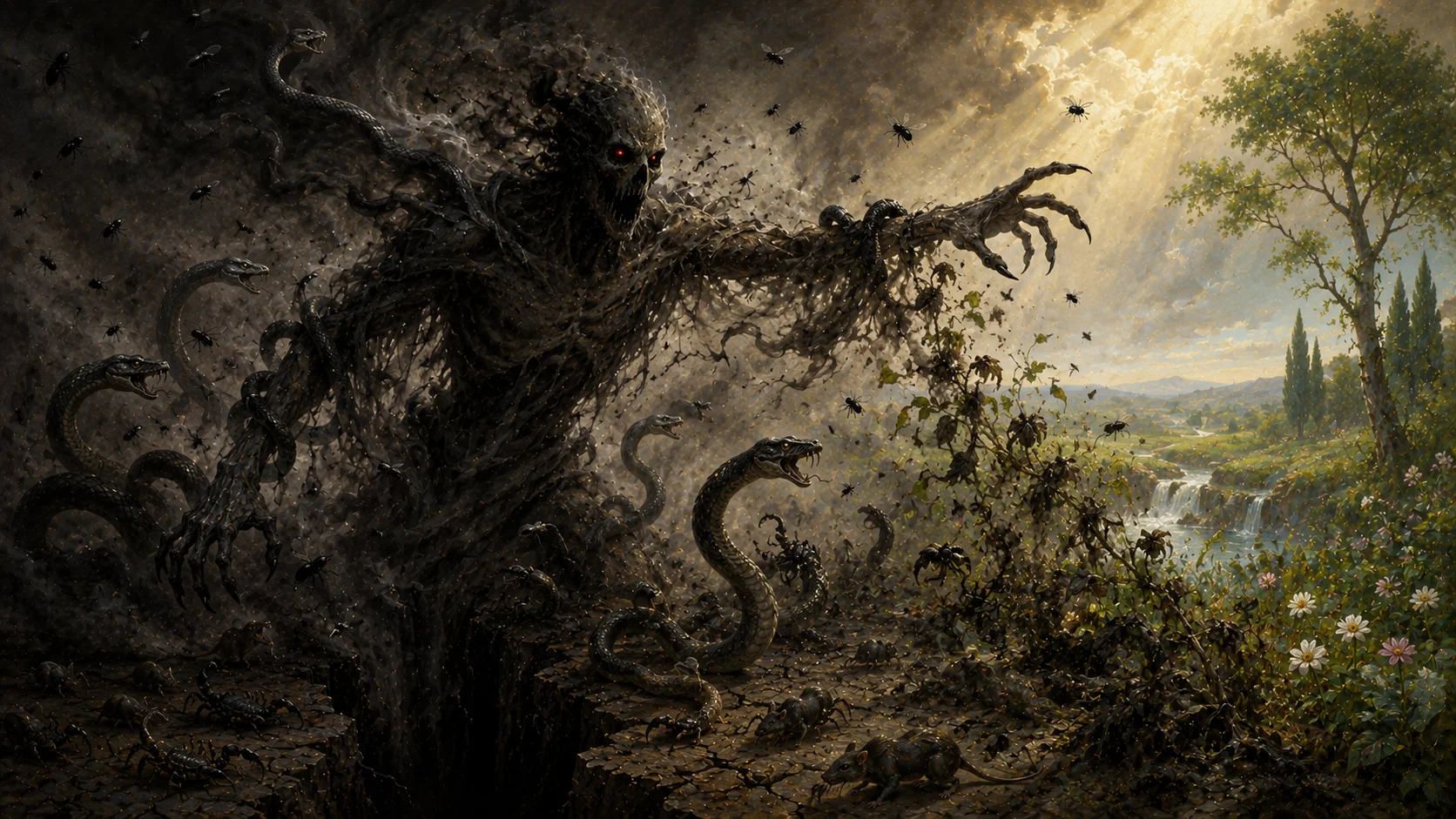
The Bundahishn preserves the central myth of Angra Mainyu's violence: the primordial assault, sometimes called the Rush, upon the world that Ahura Mazda had made whole and undamaged. Before this onslaught, creation is described as being in a pristine, undying state. Angra Mainyu's incursion is what introduces death, disease, and decay into a world that had not known them — his assault is not one evil act among many but the originating wound of the material world's suffering. Everything that Zoroastrians understand as corruption, sickness, and mortality traces, in this account, to that single act of hostile intrusion.
Father of the Daevas
Angra Mainyu is credited with generating the daevas, the demonic beings who serve as agents of the Lie within the world. The developed cosmology of the later tradition pairs many of these figures directly against the Amesha Spentas, the great beneficent entities who attend Ahura Mazda — so that the world's moral structure is mirrored, entity by entity, in opposing ranks. Aka Manah, the Evil Mind, stands against Vohu Manah, the Good Mind, in one such pairing, and other archdemons are set in the same kind of deliberate opposition against other Amesha Spentas. This is not a loose horde of monsters; it is architecture, a war organized rank against rank, with Angra Mainyu as the one who called the opposing rank into being.
Patron of the Dragon
Among the malevolent figures associated with Angra Mainyu is Azhi Dahaka, the three-headed dragon and tyrant whose defeat at the hands of the hero Thraetaona — known in the later Shahnameh tradition as Fereydun — is one of the most storied episodes to descend from the Avesta into Iranian epic. Pahlavi texts in places identify Angra Mainyu as Azhi Dahaka's ultimate patron, binding the dragon-slaying story into the larger war between the Destructive Spirit and the forces of Asha. The hero's triumph over the dragon becomes, in this light, a single victory within the much longer contest that Angra Mainyu wages and is fated to lose.
Confrontation With the Prophet
The Vendidad preserves a direct confrontation: Angra Mainyu appears before Zoroaster himself, seeking to tempt or destroy the prophet outright. Zoroaster does not defeat him with a weapon but with a prayer — the Ahuna Vairya, also known as the Ahunwar — and the recitation repels the hostile spirit. The episode is foundational for Zoroastrian ritual practice in the centuries that followed: the Ahuna Vairya's later use as an apotropaic prayer, recited for protection, draws its force directly from this scene, in which the sacred word itself is what a human being wields against Angra Mainyu when no other weapon will serve.
Names Given in Hostility
Angra Mainyu carries several epithets, and each was coined in rejection rather than reverence. He is bound to Druj, the Lie personified, so closely that the two are sometimes spoken of as one and the same force wearing different names. He is called the Destructive Spirit outright, and in Middle Persian he bears the title Ganag Menog, the Stinking or Foul Spirit — language that registers disgust as much as fear. Cosmological schemes in the tradition locate him in or emerging from darkness, and associate him with the north, so that even geography and direction were pressed into the work of naming what he is and where he does not belong.
The One Who Receives No Offering
Unlike Atar, the sacred fire, or the yazatas, the venerated beings of the faith, Angra Mainyu has no legitimate cult, no temple, and no sanctioned worship anywhere in Zoroastrianism. He is not a being one turns toward. He is, instead, the object of formal, ritual rejection — most visibly in the Fravarane, the Zoroastrian creed, in which a believer explicitly renounces the daevas and Angra Mainyu by name as an act of faith. To invoke him at all, within orthodox practice, is to invoke him only in order to refuse him. That refusal is itself a devotional act, and it is the only sanctioned relationship a Zoroastrian holds toward the Destructive Spirit.
An Unsettled Question of Origin
Whether Angra Mainyu is co-eternal with Ahura Mazda, existing from the same first moment and by the same order of being, or whether he is a lesser, ultimately created spirit destined for total annihilation, is a matter of genuine doctrinal debate within the tradition rather than a settled point handed down from antiquity. The Zurvanite current of Zoroastrian thought, which held that both Ahura Mazda and Angra Mainyu descend from a prior principle, Zurvan, or Time, stands apart from mainstream Mazdean orthodoxy on precisely this question. Neither position has been erased by the other; both are part of the historical record of how Zoroastrians have reasoned about the nature of evil and its relationship to the eternal.
The Renovation That Ends Him
Zoroastrian eschatology, set out in Pahlavi works such as the Bundahishn and the Zand-i Wahman Yasn, holds that Angra Mainyu's power is not permanent. At Frashokereti, the final renovation of the world, the long contest between the good and the hostile spirit reaches its end, and Angra Mainyu is rendered powerless. The doctrine is consistent in its outcome — the eventual triumph of cosmic good — even where the texts differ on the precise mechanism, whether his defeat means outright destruction or a more complete neutralization that leaves him stripped of all capacity to harm. What remains constant across the variations is the certainty of the ending itself: whatever form his final undoing takes, Angra Mainyu does not endure past it.
A Form Given Only Outside the Temple
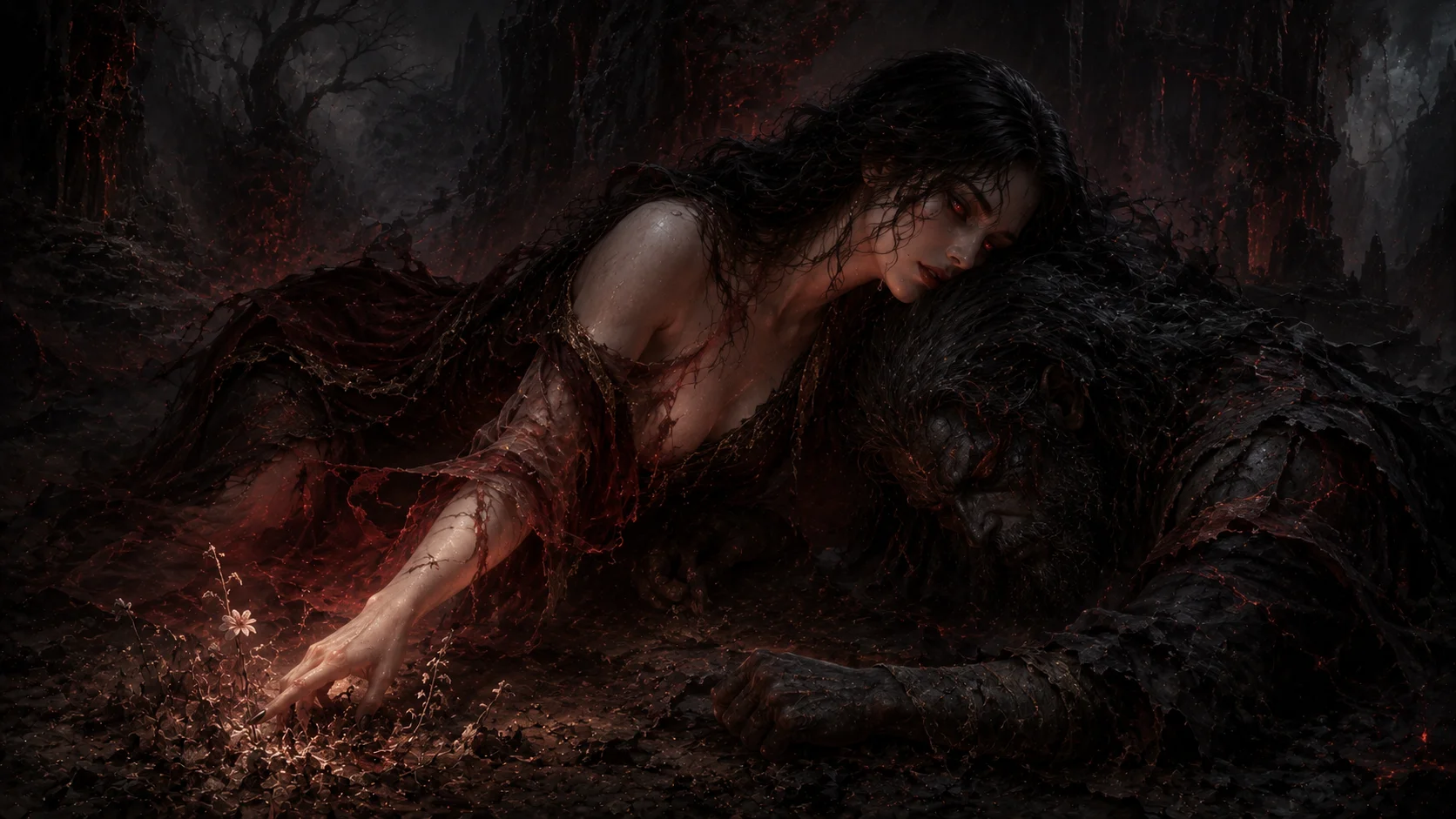
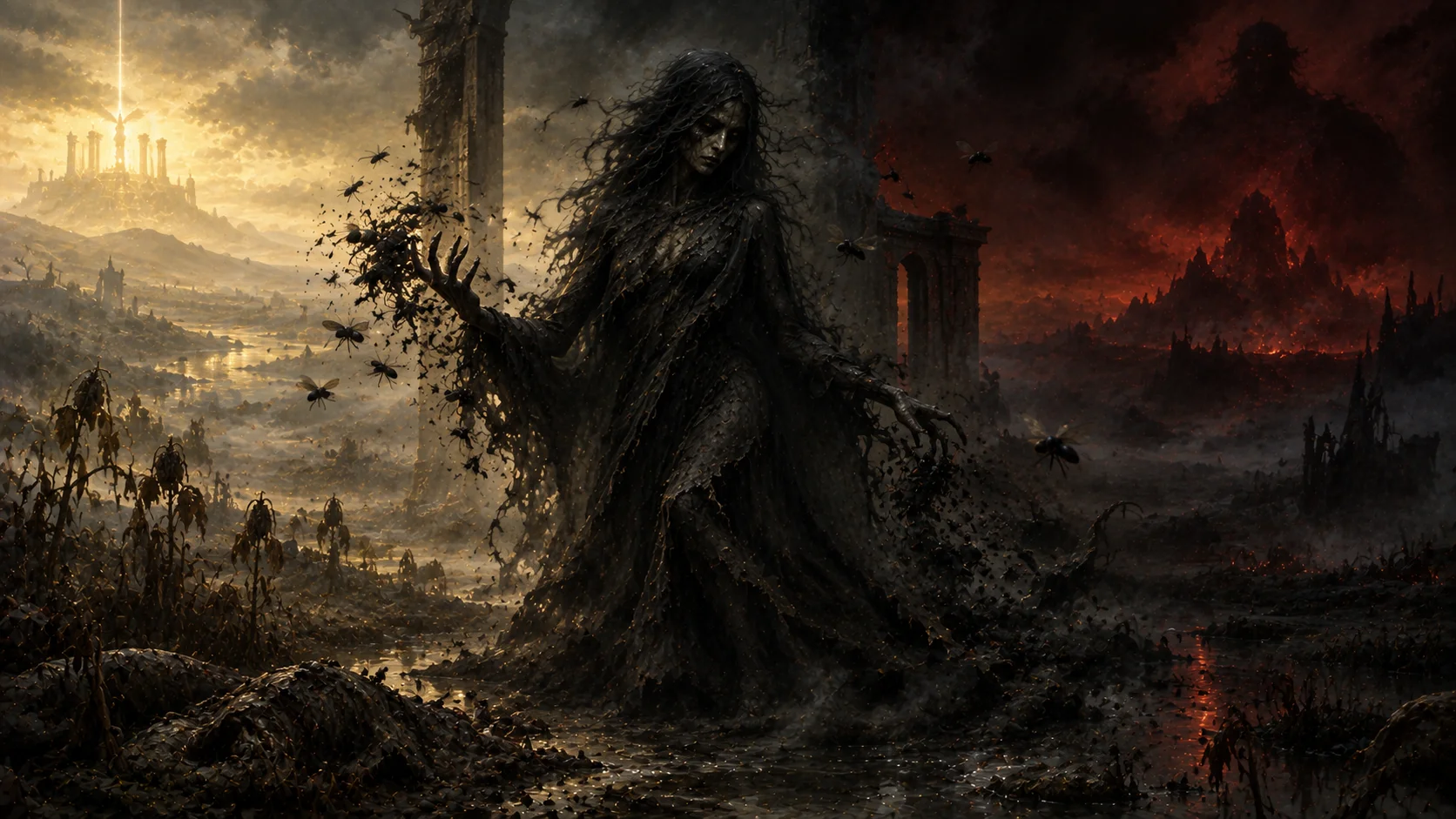
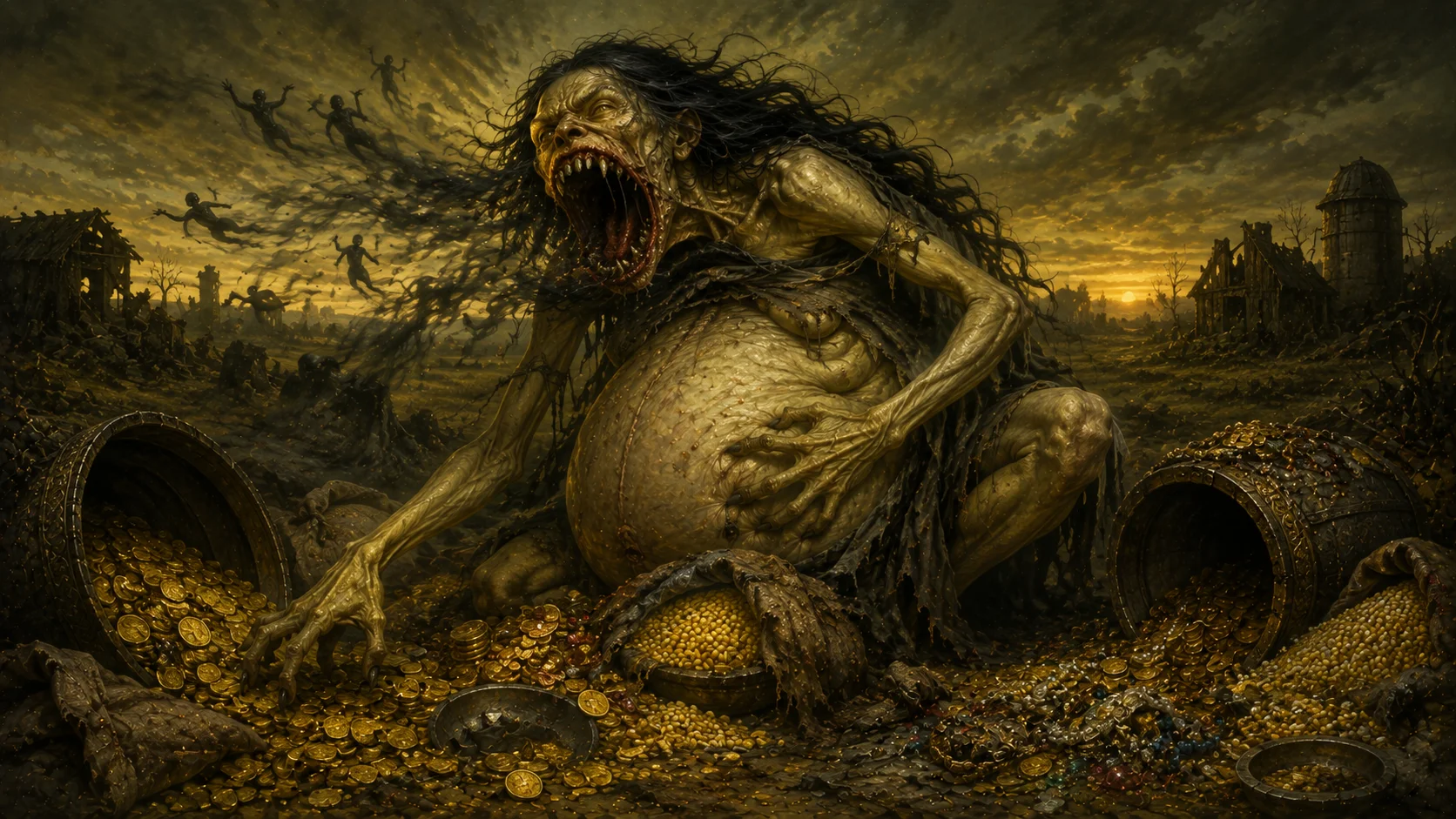
Orthodox ritual art does not depict Angra Mainyu in the way a yazata might be pictured or evoked in devotional contexts — there is no liturgical image made in his honor, because there is no honor to render. Later Sasanian and post-Sasanian works, in certain reliefs and manuscript traditions, do render him with monstrous, serpent- or demon-like features, giving visual form to the Foul Spirit for audiences outside strict temple cult. These images sit alongside the tradition rather than inside its sanctioned worship, a visual echo of a figure the faith otherwise approaches only through rejection, prayer, and the certainty of his eventual defeat.
Sources & traditions
- EncyclopediaWikipedia — Ahriman
- TraditionZoroastrian texts, grimoires and later commentary
Myths change from area to area and from time to time. This chronicle follows the most widely told versions; tellings in other villages, regions and eras may differ.