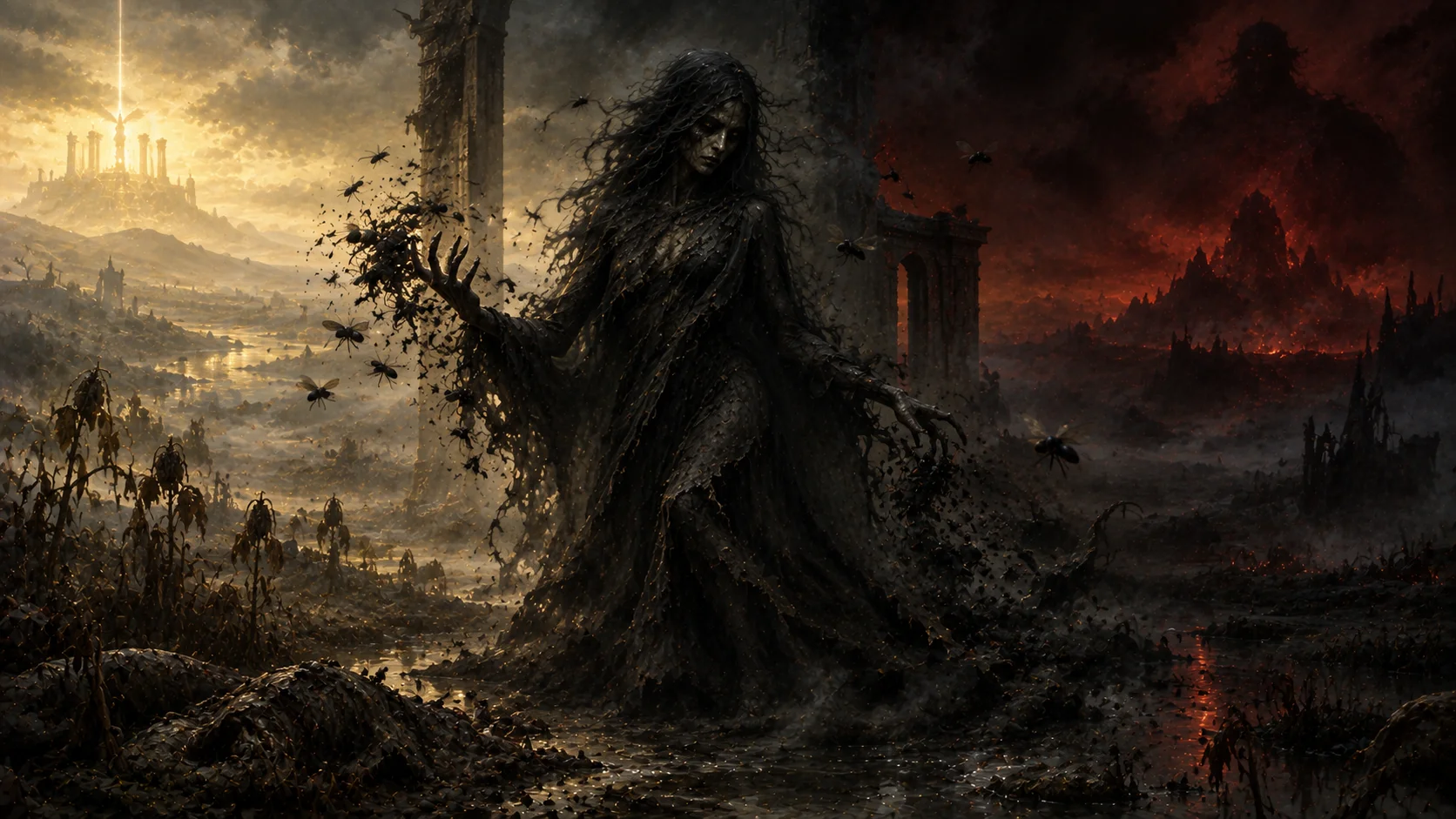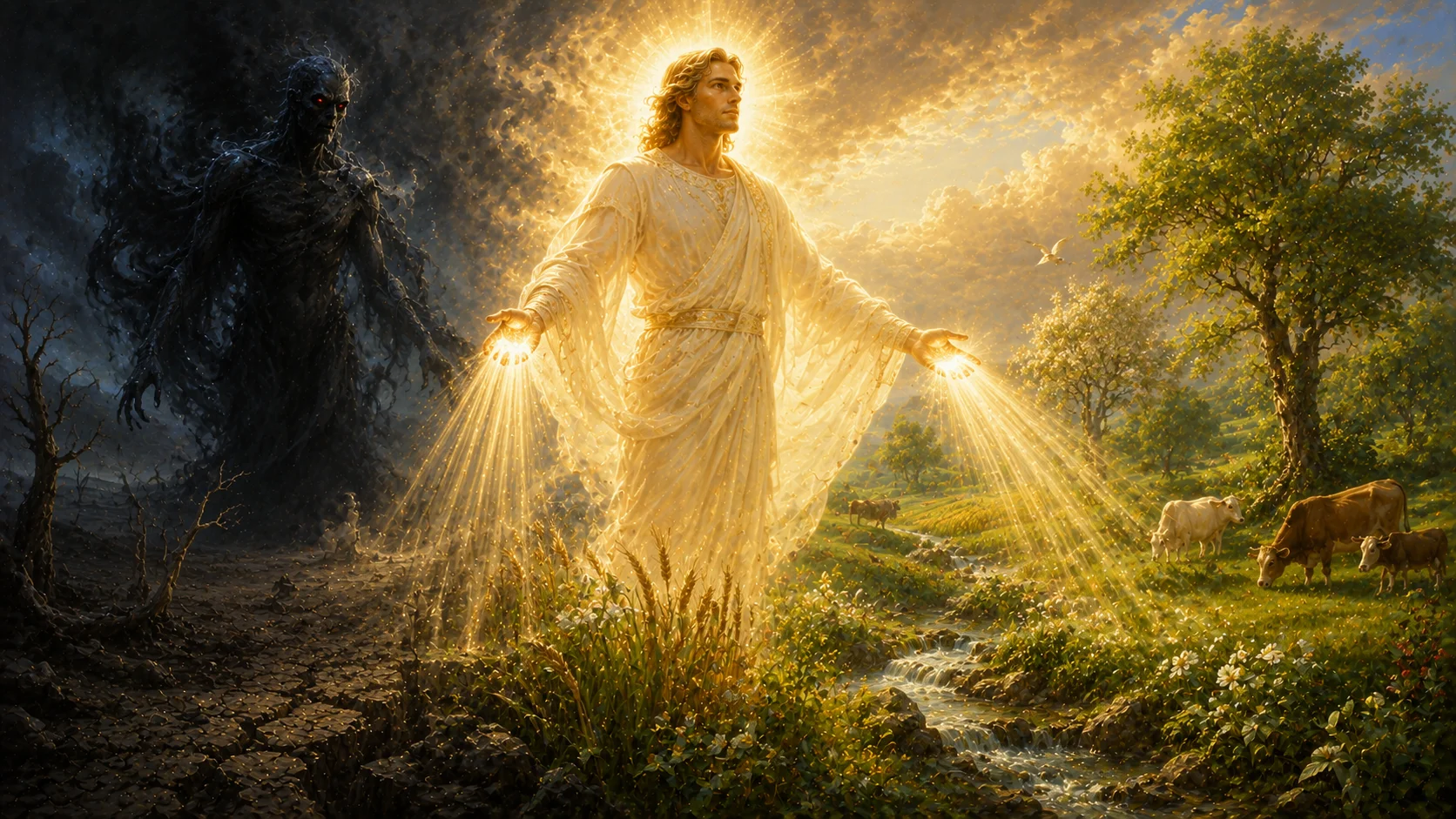
Spenta Mainyu, the Bounteous Spirit or Holy Spirit, is the beneficent, creative spirit of Zoroastrianism — the holy, life-giving power through which goodness takes form in the world. Named directly in the Gathas, the oldest hymns of the tradition, Spenta Mainyu is described there as the twin of Angra Mainyu, the Destructive Spirit, and the two are set at the very beginning of time, choosing between good and evil, truth and the lie, life and non-life. That primal choice is the foundation of Zoroastrian moral cosmology: an invitation, renewed in every human life, to side with the Bounteous Spirit against the spirit of destruction.
The Bounteous Spirit
The name itself carries the whole of the doctrine. In Avestan, spenta means holy, bounteous, or increasing — a word that describes not stillness but growth, abundance moving outward into the world. Mainyu means spirit or mentality, an inner disposition or mode of being rather than a body or a throne. Together the name names an active force: not goodness as an abstract quality but goodness as something that does, that gives, that increases. Spenta Mainyu is attested directly in the Gathas, the core hymns attributed to Zarathustra himself, which makes the concept among the oldest and most securely rooted ideas in the entire tradition. Whatever else later centuries added to the picture, this much is bedrock: from the earliest layer of Zoroastrian scripture, a Bounteous Spirit was already understood to stand at the center of how the good comes to be in the world.
Two Voices at the Beginning of Time
The foundational passage is Yasna 30.3–5, the celebrated "Twin Spirits" verses, among the most quoted and most studied lines in the whole of the Avesta. There, two primal mainyu are described as twins — Spenta Mainyu, the Bounteous Spirit, and Angra Mainyu, the Destructive Spirit. At the beginning, before the shape of the world was fixed, these twin spirits chose: one chose life, the other non-life; one chose the good, the other its opposite. It is worth sitting with the imagery a moment. These are not adversaries who happened to meet in battle; they are twins, born of the same origin, whose natures diverge entirely by an act of choosing rather than by an act of separate creation. That single image — twinship followed by divergence — carries the entire ethical architecture of Zoroastrianism on its back. The dualism that runs through the tradition, the sense that the world is a field of contest between order and its undoing, is not a story about two equally ultimate gods. It is a story about a choice, made once at the beginning, and made again, endlessly, by every soul that follows.
The Choice That Made Evil Possible
What the Twin Spirits passage protects, above all, is a particular answer to an old and difficult question: where does evil come from, if the divine is good? Zoroastrian theology's answer, carried in this very passage, is that evil is not created — it is chosen. Angra Mainyu did not receive destruction as an assignment from a higher power; the Destructive Spirit chose it, in the same moment and by the same freedom that let Spenta Mainyu choose the good. This is a theodicy of a particular and careful kind. It refuses to place the origin of evil inside the will of Ahura Mazda, the Wise Lord, and it refuses equally to suggest that good and evil arise from a single divine source indifferent to the difference between them. Instead, both spirits stand at the same threshold and choose differently — and that founding act of free choice becomes the pattern for every human choice that follows. To act with cruelty or with deceit is, in this reading, to re-enact Angra Mainyu's ancient choice; to act with truth and generosity is to walk again in Spenta Mainyu's first steps.
The Question the Gathas Leave Open
Scholars of the tradition have long debated a question the Gathas themselves do not settle plainly: is Spenta Mainyu simply another name for Ahura Mazda, a distinct being — sometimes described as a kind of first offspring or first creation of Ahura Mazda — or something closer to a mode, an active aspect through which Ahura Mazda's own nature operates in the world? This is a genuinely open question in scholarship, not a matter of settled consensus, and it deserves to be presented as exactly that. The Gathic language is ambiguous enough to support more than one reading, and later Zoroastrian tradition did not so much resolve the ambiguity as lean into one side of it. In the Pahlavi literature of the Sasanian era, Ohrmazd — the Middle Persian form of Ahura Mazda — and the Holy Spirit tend to be treated as functionally fused, or the spirit is described as Ohrmazd's direct instrument, the means by which his will becomes act. Whether that later fusion recovers what the Gathas meant all along, or resolves an ambiguity the earliest poets were content to leave standing, is not a question this record can answer for the reader. It is enough to know that the question exists, and that serious minds have sat with it rather than past it.
The Working Hand of Wisdom
Whatever their precise relationship, the two are closely paired in action. In Yasna 47, Spenta Mainyu appears as the agent through whom Ahura Mazda's own wisdom takes shape in creation — the means by which the Amesha Spentas, the great Holy Immortals, and the material world itself come into being. If Ahura Mazda is imagined as the source of wisdom and order, Spenta Mainyu is the working hand of that wisdom, the principle that gives it form, sets it in motion, and carries it out into a world that can be touched, seen, and lived in. This is why the Bounteous Spirit is so often described as a creative or generative force rather than a static attribute: creation, in this theology, is not an act completed once and set aside, but a continuous shaping and sustaining, and Spenta Mainyu is the name given to that ongoing labor of the good.
Truth Against the Lie
The cosmic opposition between the two spirits is not an abstraction confined to the beginning of time; it is enacted, moment by moment, through human moral choice. The tradition frames this choice as one between Asha — truth, order, rightness — and Druj, the Lie, the principle of chaos and falsehood. Every act of honesty, every commitment kept, every measure of order upheld against the temptation to disorder, is understood as an alignment with Spenta Mainyu and a small victory in the larger contest against Angra Mainyu. This is what gives the doctrine its ethical urgency: the great cosmic drama of the Twin Spirits is not a spectacle to be watched from a distance but a struggle that runs directly through ordinary human conduct. Humans are called, again and again, to align their thought, word, and deed with the Bounteous Spirit rather than its opposite — a call that turns everyday choices into participants in a struggle as old as the beginning of the world.
Thought, Word, and Deed
That call finds its clearest liturgical expression in the ethical triad at the heart of Zoroastrian practice: humata, hukhta, hvarshta — good thoughts, good words, good deeds. Spenta Mainyu is invoked in liturgy as the divine quality that human beings participate in precisely through this threefold discipline. It is a striking feature of the doctrine that it does not ask for belief alone, or ritual alone, but for a coherence across the inner and outer life — that what one thinks, what one says, and what one does should not pull against each other but move together toward the good. In this framing, the Bounteous Spirit is not simply an object of worship at a remove from the worshipper; it is a quality the worshipper is invited to embody, a generative and order-sustaining force that becomes present in the world exactly to the degree that it becomes present in a life.
The Holy Immortals as Kindred Spirits
Spenta Mainyu is closely bound up with the six Amesha Spentas, the Holy Immortals, whose creation and sustenance flow from the same generative principle. These Immortals are not separate from the Bounteous Spirit's own work but its extension — the specific channels through which the abstract quality of holiness becomes particular blessings distributed through the created world. Through the Amesha Spentas, Spenta Mainyu's creative reach extends outward into the structure of the cosmos itself, giving the doctrine a kind of architecture: a single generative spirit, working through several holy intermediaries, to bring an ordered and good world into being and to keep it that way against the constant pressure of its opposite.
The Seven Creations
That architecture is laid out most fully in the Bundahishn, where Spenta Mainyu's association with the Amesha Spentas extends to the seven creations that structure the whole of Zoroastrian cosmology: sky, water, earth, plants, cattle, humanity, and fire. Each of these is understood as a distinct sphere of the good creation, brought into being and sustained by the same bounteous, life-giving force. It is a cosmology built from care rather than indifference — a world imagined not as a neutral backdrop but as something deliberately and lovingly assembled, piece by piece, by a spirit whose very name means increase and holiness. To live within this cosmology is to understand oneself as standing inside one of those seven creations, humanity itself, bound by kinship to sky and water and fire and the rest, all of them equally the handiwork of the Bounteous Spirit.
Spenag Menog and the Long Reckoning
In the later Pahlavi, or Middle Persian, literature — texts such as the Bundahishn and the writings of Zadspram — the spirit is rendered Spenag Menog, and the cosmic drama sketched in the Gathas is elaborated into a fixed and detailed timeline. Spenag Menog stands opposed across that timeline to Ganag Menog, the Stinking or Foul Spirit, the developed form of Angra Mainyu known more widely as Ahriman. This Sasanian-era cosmogony works out, in far greater detail than the Gathas attempt, the stages of creation, the mixture of good and evil that follows Ahriman's assault on the world, and the long process by which that mixture is eventually to be undone. That final undoing carries a name of its own — Frashokereti, the eventual separation and restoration in which the world is set right and the struggle begun by the Twin Spirits reaches its resolution. The later texts do not abandon the Gathic vision so much as extend it into a full narrative arc, giving the ancient choice at the beginning of time a corresponding conclusion at the end of it.
A Spirit Without a Shrine
It is worth noting plainly what does not exist alongside this rich theological picture. Unlike Ahura Mazda, Spenta Mainyu has no significant independent iconography, no distinct cult of its own, and no evidence of temples or images set apart for its veneration. Devotion to the Bounteous Spirit is not separated from the broader, aniconic tradition of fire veneration that has long characterized Zoroastrian worship of Ahura Mazda more generally. There is a kind of fittingness in this restraint: a spirit defined by action rather than by form — by creating, sustaining, and choosing rather than by any fixed shape — is perhaps well served by a tradition that has never tried to give it one. The absence of a separate shrine is not an absence of importance; it reflects, if anything, how thoroughly the concept is woven into the worship of Ahura Mazda himself rather than standing beside it as a rival object of devotion.
The Human Place in a Cosmic Struggle
The doctrine's deepest implication concerns the dignity it grants to human moral agency. To side with Spenta Mainyu through ethical living — through the discipline of good thought, good word, and good deed — is understood not as passive submission to a fate already decided, but as active participation in the eventual defeat of evil at the Frashokereti. Humans, in this vision, are not bystanders to the outcome of the cosmic struggle between the twin spirits; they are combatants within it, and every honest word or generous act is a contribution, however small, to a victory the tradition holds to be assured but not yet complete. This is what separates the Zoroastrian picture from a simple story of good triumphing automatically over evil: the triumph is real, but it is worked for, across countless individual choices, by the very beings who live inside the seven creations that Spenta Mainyu first brought into being.
A Word of Caution on Borrowed Comparisons
A minority of scholars, working in comparative religion, have suggested that Spenta Mainyu functions in ways broadly similar to the Holy Spirit of Abrahamic traditions, and have drawn parallels on that basis. This is a disputed reading, and mainstream Zoroastrian studies counsel real caution before leaning on it. The theological frameworks involved differ substantially — in their histories, their surrounding cosmologies, and the questions they were built to answer — and there is a genuine risk of anachronism in reading later, unrelated categories back into the Gathic material. The comparison is worth naming honestly, as a live thread in scholarship, without treating it as settled or as a substitute for understanding Spenta Mainyu on the terms the Zoroastrian tradition itself provides.
The Bounteous Spirit Remembered
Across the whole span of the tradition — from the terse, ancient poetry of the Gathas to the elaborated cosmogonies of the Sasanian Pahlavi books — Spenta Mainyu remains recognizably itself: the holy, bounteous, creative spirit through which the good enters and is sustained in the world, twin to the spirit that chose destruction, and the standing invitation, renewed in every human thought, word, and deed, to choose as the Bounteous Spirit chose at the beginning of time. It is a doctrine that asks to be understood not merely as ancient theology but as a living claim about what it means to act rightly in a world still caught, as the tradition holds it, between truth and the lie.
Sources & traditions
- TraditionZoroastrian texts, grimoires and later commentary
Myths change from area to area and from time to time. This chronicle follows the most widely told versions; tellings in other villages, regions and eras may differ.