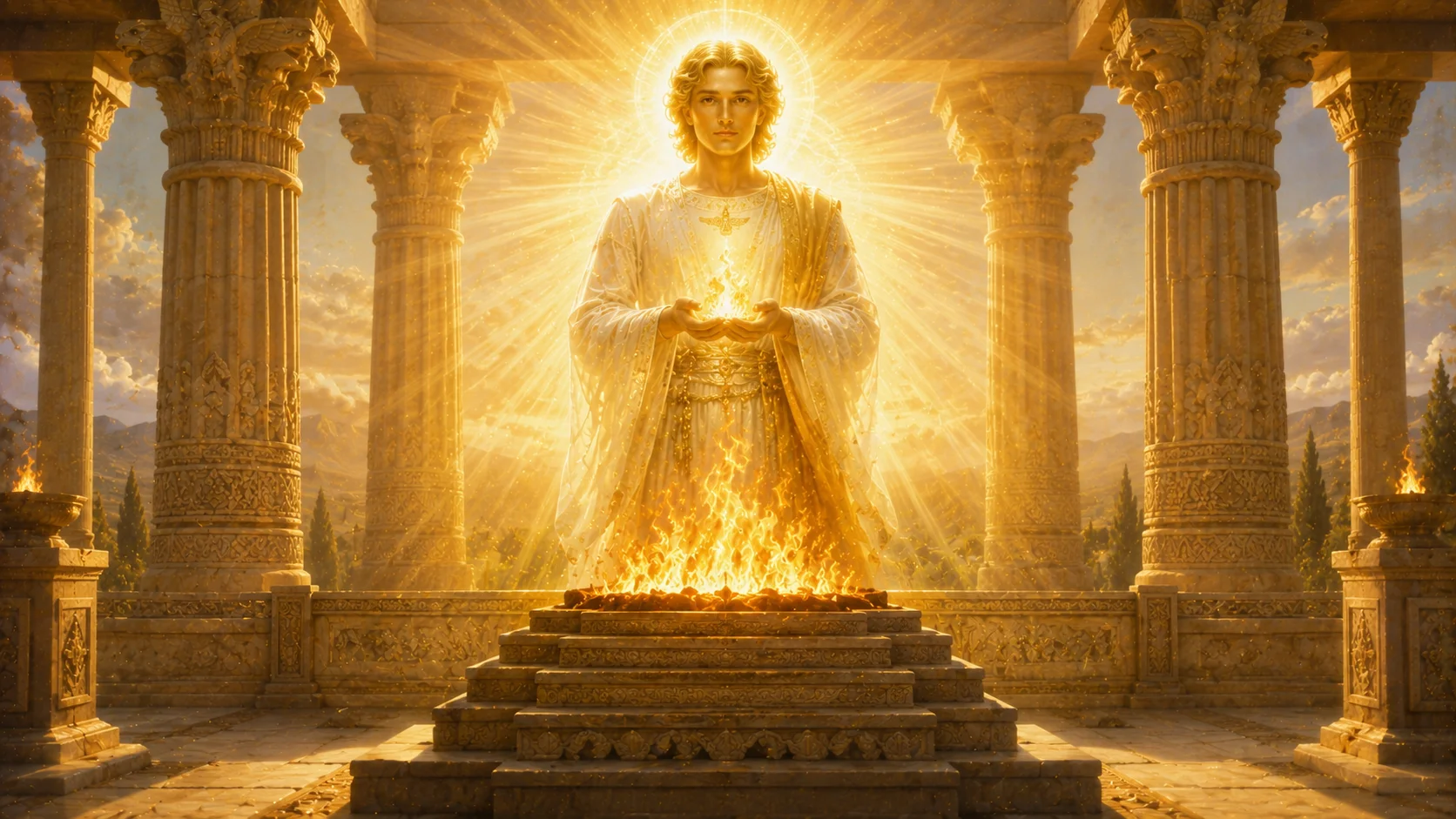
Asha Vahishta — Avestan Aša Vahišta, later Ardwahišt or Ardibehesht — is Best Truth, one of the Amesha Spentas, the Bounteous Immortals who stand as the primary emanations of Ahura Mazda. He is not merely a minor spirit assigned a portfolio; he is the personification of asha itself, the single concept most scholars agree sits at the very center of the Zoroastrian vision of reality — truth, righteousness, and the correct order of both the cosmos and the moral life, held together as one indivisible principle.
Best Truth, Named and Invoked
The title itself carries the doctrine. Asha Vahishta means Best Truth or Best Righteousness — not simply truth as the opposite of a lie in casual speech, but Truth as the very fabric by which the universe holds together, and Righteousness as the human echo of that same fabric. In Middle Persian the name became Ardwahišt, and in modern usage Ardibehesht — a name still spoken today, since the second month of the Zoroastrian calendar bears it, and the third day of every month in that calendar is dedicated to him. On that day, and throughout that month, Yasna and Sirozeh liturgies turn to invoke him by name, keeping his presence woven into the ordinary rhythm of devotional time rather than confined to festival or memory.
The Voice Zarathustra Turned To
Asha's centrality is not a later theological refinement; it is present from the very beginning, in the Gathas, the oldest hymns of the faith, attributed to Zarathustra himself. There, Asha is invoked constantly, again and again, so densely that the word becomes something close to a refrain running beneath the whole body of verse. He is most often paired with Vohu Manah, Good Mind, the two moving together as complementary aspects of the righteous life — good thought giving rise to right order, right order confirming good thought. What is striking about the Gathic material is that Asha is not treated as an abstraction to be merely described. Zarathustra addresses him, appeals to him, seeks him out for guidance, as one turns to a being who can answer. Best Truth, in the oldest layer of the religion, is already someone spoken to.
Fire in His Keeping
In the fuller cosmological scheme that develops in the Younger Avesta and is carried forward into the Pahlavi texts, each of the great Amesha Spentas is given guardianship over one part of the good creation. Asha Vahishta's charge is fire — Atar — and through fire he extends to every flame kindled in devotion, including the sacred fires tended in the temples, and to the sun itself, understood as fire's purest and highest manifestation. This is not an incidental assignment. Fire burns clean, gives light without concealment, and cannot be corrupted into something other than what it is — qualities that make it the natural and fitting emblem of a principle defined above all by incorruptibility and clarity. To tend a sacred fire, in this understanding, is to stand in active service to Asha's own domain, and the priestly discipline and purity law surrounding the fires draws its meaning from exactly that connection.
The Prayer Spoken Many Times a Day
Asha Vahishta possesses his own dedicated liturgical text, the Ashem Vohu, and its place in daily practice is hard to overstate. It is recited many times over the course of a single day, its brevity matched only by its weight — comparable, in the devotional life of the faith, to the Ahuna Vairya, the Yatha Ahu Vairyo. In a handful of lines it declares Asha, Righteousness, to be the greatest of all goods, and the source of happiness itself. That such a short prayer carries such consistent, repeated use says something about how the tradition weighs Asha: not as a doctrine reserved for scholars and priests, but as a truth meant to be held on the tongue and returned to constantly, so that righteousness is not merely believed but rehearsed.
The Line Between Order and the Lie
Asha stands opposed to Druj — the Lie — and this opposition is the central axis of Zoroastrian cosmology and ethics alike. Where Asha is order, rightness, the true functioning of things as they were meant to function, Druj is disorder, falsehood, the corruption of that true functioning. This is not confined to the physical world; it runs directly into the moral one. A society, a household, or a single human choice can incline toward asha or toward druj, and the whole of ethical life becomes, in this framing, a continuous decision about which side one's thoughts, words, and deeds will serve. Nothing about this dualism is decorative. It is the working structure beneath the entire faith.
Weighed at the Bridge
This structure reaches its sharpest expression in Zoroastrian eschatology. A soul's humata, hukhta, hvarshta — good thoughts, good words, good deeds — are weighed against Asha at the Chinvat Bridge, the crossing every soul must make. To have lived according to Asha is to have earned the epithet ashavan, one who possesses or follows Asha — a term applied to the righteous dead generally, and, tellingly, to Zoroaster himself. The aspiration to become ashavan is not a distant or abstract goal reserved for the exceptionally devout; it is described as the core ethical aim of the religion as such, the measure by which an entire life is finally read.
Second Among the Immortals
Within the structured company of the Amesha Spentas, Asha Vahishta is most often ranked second, following directly after Vohu Manah, though the precise ordering shows some variation across different textual traditions rather than standing perfectly uniform. He belongs to the great heptad that, together with Ahura Mazda, orders all of creation: alongside Vohu Manah, Good Mind; Khshathra Vairya, Desirable Dominion; Spenta Armaiti, Holy Devotion, guardian of the earth; Haurvatat, Wholeness, guardian of the waters; and Ameretat, Immortality, guardian of the plants. Each of these Bounteous Immortals holds a distinct piece of the good creation in trust, and Asha Vahishta's piece — fire, and truth itself — sits close to the very heart of the arrangement.
An Adversary Named in the Later Texts
The later Pahlavi enumeration of paired opposites sets a specific daeva against each Amesha Spenta, and in this scheme Asha Vahishta's opposing demon is named as Indra. The details of this pairing show some variation across the textual record, and scholars generally treat the full paired-opposites scheme as part of a later systematizing effort rather than something uniform across every stratum of Avestan literature. Even so, the underlying logic is consistent with everything else known of Asha: wherever supreme order is named, tradition names something set directly against it, because the struggle between the two is understood as constant and unresolved within history itself.
A Presence Without a Face
Unlike deities in image-making traditions, Asha Vahishta has no widely attested anthropomorphic iconography. Zoroastrian religious art historically avoided figural representation of the Amesha Spentas altogether, and this absence is well documented in its own right — not a gap in the record or an accident of what has survived, but a deliberate feature of how the faith chose to represent its most exalted principles. In place of a personified image, Asha is made present through the sacred fire itself and through abstract symbols such as the flame. To encounter Asha Vahishta in worship is, in a real sense, to stand before fire rather than before a face — an approach to the divine that asks for reverence through presence and conduct rather than through portraiture.
An Older Kinship, A New Shape
The concept of Asha carries a lineage reaching back before Zoroastrianism itself, cognate with the Vedic Sanskrit Ṛta, the cosmic order recognized in the related Indo-Iranian religious inheritance. The shared root reflects a common ancestral vision of a universe held together by right order. But Zoroastrian theology carried that inheritance somewhere distinct: Asha became an explicitly personified, ethically charged Amesha Spenta, set within a strict monotheistic framework beneath Ahura Mazda, rather than remaining the more impersonal principle that Ṛta represents in its own tradition. Comparative scholarship treats this divergence as well established — two branches of one root, grown toward different ends, one toward an impersonal cosmic law, the other toward Best Truth as a being who can be prayed to, appealed to, and, in the end, stood before in judgment.
The Order Behind Every Ordinary Day
What distinguishes Asha Vahishta, taken as a whole, is the sheer consistency with which the tradition returns to him — not confined to a single myth or a single festival, but present in the naming of a month, the naming of a day recurring every month, a prayer spoken repeatedly across the day, the tending of every sacred flame, and the final reckoning awaiting every soul. Best Truth is not one figure among many in the Zoroastrian world; he is the standard against which the rest of that world, seen and unseen, is continually measured.
Sources & traditions
- EncyclopediaWikipedia — Asha
- TraditionZoroastrian texts, grimoires and later commentary
Myths change from area to area and from time to time. This chronicle follows the most widely told versions; tellings in other villages, regions and eras may differ.