Atar, whose name in the Avestan tongue means simply "fire," is the yazata of fire in Zoroastrianism, and the son of Ahura Mazda — Atar puthra Ahurahe Mazdao, as the Avesta names him. In Middle Persian he is called Adur or Ataš. He is not a distant abstraction but a living, active agent, the visible presence of the Wise Lord's truth and light in the world, and it is through Atar that the faithful turn their devotion toward Ahura Mazda rather than toward fire as an end in itself — a distinction Zoroastrian theology has always insisted upon, against the outsider label of "fire-worshippers" that the tradition itself rejects.
Son of the Wise Lord
To call Atar the son of Ahura Mazda is to place him in the closest possible filial relationship to the supreme deity of the faith. This is not a poetic flourish but a doctrinal statement carried directly in the Avesta's own language, and it shapes how Atar is approached in prayer and ritual: not as an intermediary to be bargained with, but as kin to the divine, an extension of Ahura Mazda's own nature reaching into the created world. Where Ahura Mazda is light itself, unseen and supreme, Atar is that light made present and tendable, encountered wherever flame burns.
Five Faces of a Single Flame
The Avesta does not describe Atar as confined to the hearth alone. In Yasna 17 and in the Atash Niyayesh, the Litany to Fire, Atar is described as manifesting in five distinct forms. There is the fire that burns in the presence of Ahura Mazda himself. There is the fire that lives within the bodies of humans and animals, the warmth of life itself. There is the fire held within plants. There is the fire hidden in the clouds, seen by mortals as lightning. And there is the ordinary fire of hearth and ritual, the ground-level flame tended daily by human hands. Together these five forms describe fire not as one substance among many but as a principle running through the whole of creation, from the body's own warmth to the storm overhead to the flame on the altar.
The Litany Recited at Every Turn of the Day
The Atash Niyayesh, preserved within the Khordeh Avesta, is the primary liturgical prayer addressed directly to Atar. It is not reserved for rare or exceptional occasions; observant Zoroastrians recite it multiple times each day, a rhythm of devotion that keeps the presence of the sacred fire, and through it the presence of Ahura Mazda, continually before the worshipper. In this daily repetition, Atar is less a distant mythic figure than a companion of ordinary time, invoked morning and evening as naturally as breath.
The Seat of Worship
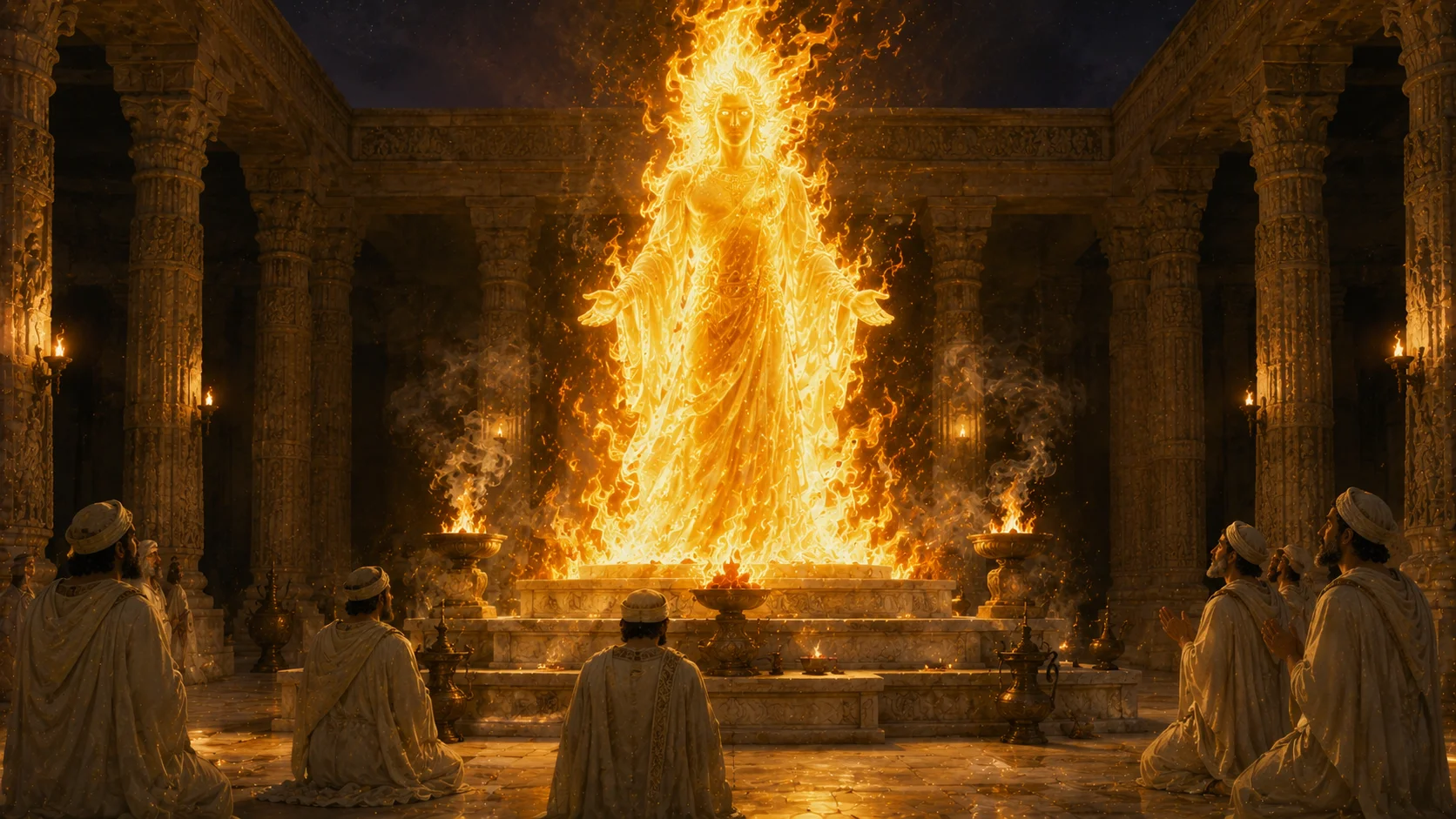
Atar's central place in devotion is made physical in the fire temple, the Atash-kadeh, where a consecrated flame is kept perpetually burning as a physical seat of the yazata himself. Zoroastrian tradition recognizes three grades of consecrated fire. The Atash Behram stands highest, the most elaborately consecrated of the three. Below it is the Atash Adaran, and below that the Atash Dadgah, each grade distinguished by the complexity of its consecration and the weight of devotion it carries. In every grade, the fire is understood not as a symbol standing in for Atar but as the very place where Atar is present.
No Image but the Flame Itself
Orthodox Zoroastrian tradition has never given Atar an anthropomorphic cult image. There is no statue, no painted face, no carved likeness set up for veneration. Atar is represented aniconically, by the consecrated flame and by nothing else. The priests who tend that flame, the mobeds, wear a cloth covering called a padan across the mouth precisely so that their own breath cannot reach and contaminate the sacred fire. This aniconic discipline is itself a form of reverence: it refuses to reduce the divine fire to a human shape, keeping the worship fixed on the flame's own living presence rather than on any image of it.
Guardian Against the Serpent's Theft
The Zamyad Yasht, the nineteenth Yasht of the Avesta, preserves one of the great narrative episodes of Atar's mythology: his contest with the dragon Azhi Dahaka over the xvarenah, the divine glory or farr belonging to the Kayanian kings. In this account, Azhi Dahaka seeks to seize the xvarenah as it rests in or near the Vourukasha Sea, and it is Atar who drives the dragon back, refusing to let the divine glory fall into the serpent's grasp. The episode casts Atar not merely as a passive presence to be tended but as an active defender, standing between a monstrous adversary and a treasure that belongs to rightful kingship.
Fire and Water, Never to Be Defiled
In Zoroastrian ritual cosmology, Atar is paired closely with Apas, the yazata of the waters. Fire and water occupy a singular place among the elements: they are the two that ritual law forbids ever being defiled. This pairing is not incidental but structural, running through the purity laws that govern Zoroastrian practice. The conjunction of the two — fire that must never be polluted by breath or corpse-matter, water that must never be fouled — sits at the very center of what ritual purity means in the tradition, and Atar's role cannot be fully understood apart from this partnership with the waters.
Fire as the Witness to Truth
Atar carries a deep symbolic bond with Asha, the principle of Truth and Order that stands at the heart of Zoroastrian ethics. In the Yasna liturgy, Atar functions as a witness and judge figure, invoked in the ordeals by fire known as var — trials by molten metal or by fire itself, in which the flame's judgment was understood to expose truth or falsehood in a matter under dispute. That fire should serve this function follows directly from what fire already is in this tradition: the visible sign of Asha, and so the fitting agent before which truth is tested and revealed.
A Creation Defended in the Cosmic Struggle
The Bundahishn, the Pahlavi cosmological text that sets out the Zoroastrian account of creation, places Atar among the beings associated with the Amesha Spentas whose task is to guard a particular creation against the assault of Angra Mainyu, the destructive spirit also called Ahriman. Fire, in this cosmology, is not a neutral resource but a front in the great battle between the forces of the Wise Lord and the forces of the Lie, and Atar stands as the guardian charged with protecting the element of fire itself from that assault, so that the world's light does not go out.
Names That Gather Around the Flame
Atar is known by more than one epithet across the textual tradition. He is called Atar of Ahura Mazda, an epithet that reaffirms the direct bond already established by his title as the Wise Lord's son. In certain Pahlavi sources he is also associated with Adar, one of the attendant yazatas linked to the Amahraspands who oversee the creation of fire. These are not competing or contradictory names so much as different facets of the same reverence, each emphasizing a different aspect of Atar's place within the wider order of divine beings.
The Symbol Mistaken for the God
Because fire stands as the visible symbol of Ahura Mazda's Asha and of his divine light, and because the fire temple is the visible center of Zoroastrian worship, outsiders have long applied the label "fire-worshippers" to the faith's practitioners. Zoroastrian theology itself has always rejected this characterization as a misunderstanding of what the flame is for. Fire is not the object of worship but its focus — the point toward which devotion is directed so that it may reach Ahura Mazda, in the same way that a person might face a particular direction in prayer without worshipping the direction itself. Atar makes this distinction bearable to hold: he is the son, not the father; the presence, not the source; the flame through which the Wise Lord is approached, not a deity complete and sufficient in himself.
A Devotion Carried in Care
What runs through every part of Atar's presence in Zoroastrian life — the five forms described in the Avesta, the daily litany, the tended flame of the fire temple, the padan-covered mouths of the mobeds, the pairing with the sacred waters, the judgment of the ordeal, the guardianship in the cosmic struggle, the contest with the dragon over the glory of kings — is the same underlying act: care. Atar is not honored through spectacle but through the unglamorous, continuous labor of keeping a flame clean, fed, and unbroken, generation after generation. In that quiet persistence, the son of Ahura Mazda remains, as he has always been, the light by which the faithful find their way toward the Wise Lord.
Sources & traditions
- EncyclopediaWikipedia — Atar
- TraditionZoroastrian texts, grimoires and later commentary
Myths change from area to area and from time to time. This chronicle follows the most widely told versions; tellings in other villages, regions and eras may differ.