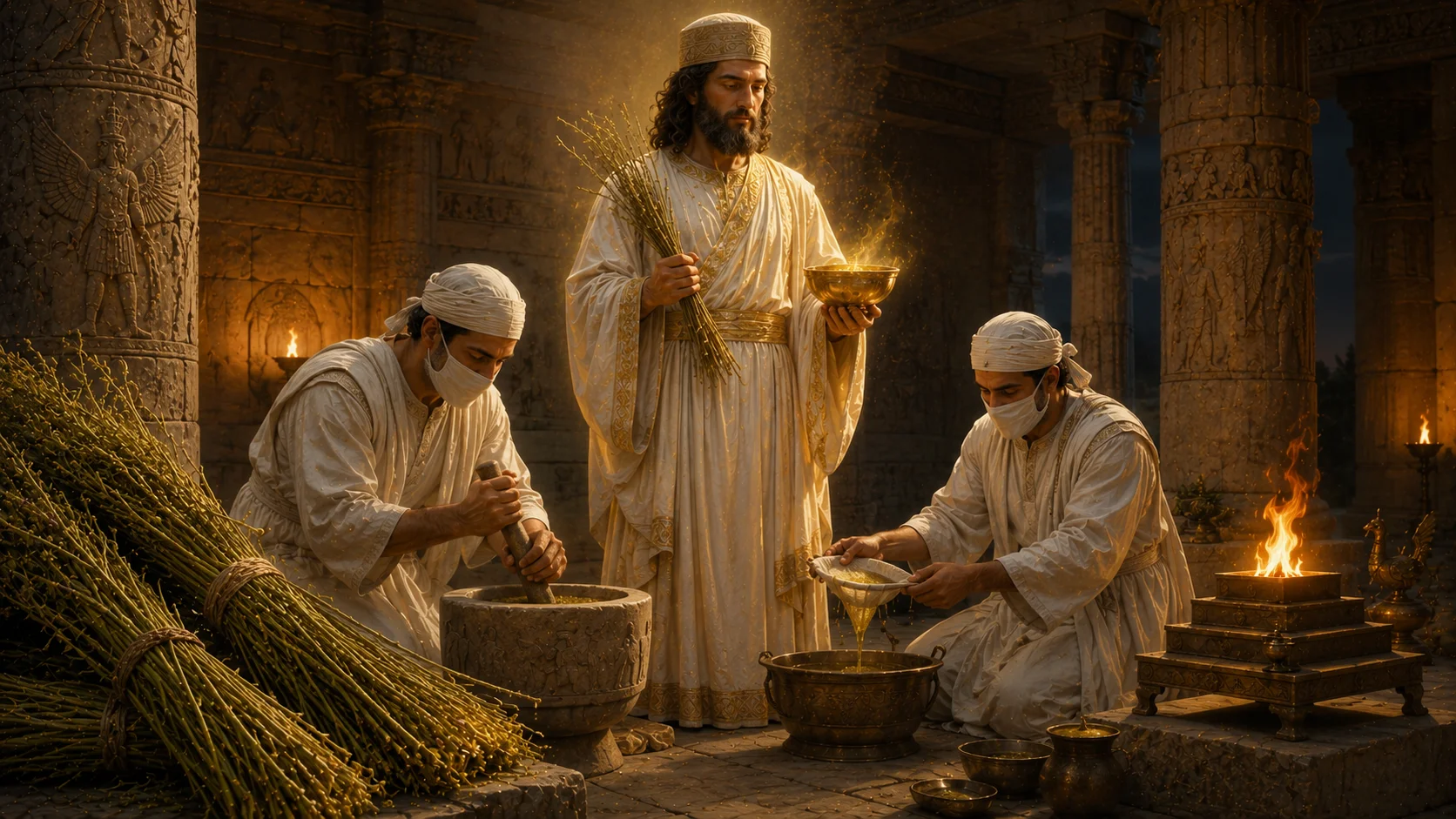
Haoma, Avestan Haoma, later Persian Hōm, is at once a sacred plant, the ritual libation pressed from it, and the divine being, the yazata, who is worshipped as both. In the theology of the Good Religion he stands as living proof that matter itself can be made holy: a plant of the earth, taken up into the highest liturgy, and honoured there as a god worthy of praise. To speak of Haoma is to speak of three things that Zoroastrian thought refuses to fully separate — the stem in the priest's hand, the golden juice in the mortar, and the being who answers when Zarathustra addresses him.
A God Who Speaks in the Yasna
Haoma's own voice is preserved in the Hōm Yašt, the hymn that fills Yasna 9 through 11 of the Younger Avesta. There, at the moment of pressing the sacred juice, Haoma appears in person before Zarathustra himself. He does not wait to be described by others; he speaks, recounting his own lineage and powers and asking, directly, to be worshipped. Few figures in the Avesta are given so immediate a presence — Haoma steps into the ritual as a participant in it, not merely as its object. The hymn does not describe an offering made to a distant god; it stages an encounter, voice answering voice, at the exact instant the stems are crushed.
The Four Who Pressed Him Before the Prophet
In Yasna 9, Haoma tells Zarathustra that four mortal men pressed him before this hour, and that each pressing was answered with a gift to the world. Vivanghvant pressed him first and was given a son, Yima — known later as Jamshid — who ruled a golden age in which neither death nor old age touched his people. Athwya pressed him next and was given a son, Thraetaona, remembered as Fereydun, who slew the three-headed dragon Azhi Dahaka. Thrita pressed him and received, for the line of the Saoshyants still to come, the gift of healing. And Pourushaspa pressed him last of the four — and was given Zarathustra, the prophet who now stood before Haoma in turn. The hymn folds the history of the Iranian world into a single lineage of pressings, each one answered from above, culminating in the very man to whom Haoma is now speaking. Zarathustra's own birth, in this telling, belongs to the same chain of pressing and gift that produced the golden age and the slaying of the dragon.
Duraosha, Who Holds Death at a Distance
Haoma carries the epithet Duraosha, keeping death and decay far off, and his worship is bound tightly to ameretat, immortality itself. The pressed juice, mixed with milk into parahaoma, is drunk by the officiating priests during the Yasna liturgy as a rite that invokes strength, healing, and long life at once. To drink is not simply to receive a blessing; it is to take into the body a substance understood to resist the very decay that ends mortal life. The name itself carries the claim: Haoma is not merely associated with holding death off, he is defined by it, his very epithet a statement of what his presence in the liturgy is meant to accomplish.
Named Beside the Amesha Spentas
Haoma is called ashavan, the righteous, furtherer of the world, and the hymns invoke him repeatedly alongside the Amesha Spentas — most often Ameretat, Immortality, and Haurvatat, Wholeness, the two who preside over the plant kingdom and the waters. This placement is not incidental. Haoma belongs to the same order of blessing as these great Bounteous Immortals, standing at the point where the growing world and the promise of wholeness meet. A hymn that names Haoma beside Ameretat and Haurvatat is drawing a map of what the plant accomplishes: growth answered by wholeness, wholeness answered by the deathlessness that is the whole point of pressing him in the first place.
The First Priest of the Rite
The Avesta styles Haoma a yazata, a being worthy of worship, and at times the priest of the gods, said to have been the first to perform the Haoma ritual for Ahura Mazda in the material world. Every human priest who presses the twigs at the mortar afterward is understood to reenact something Haoma himself first did — the earthly liturgy mirrors an act that belongs, in its origin, to Haoma alone. This doubling, a god who is also the first celebrant of his own rite, gives the Yasna liturgy an unusual weight: the priest at the mortar today is not inventing an offering but repeating one, standing in a line that reaches back past Pourushaspa, past Thrita, past Athwya and Vivanghvant, to Haoma's own first act of worship before Ahura Mazda.
The White Tree in the Cosmic Sea
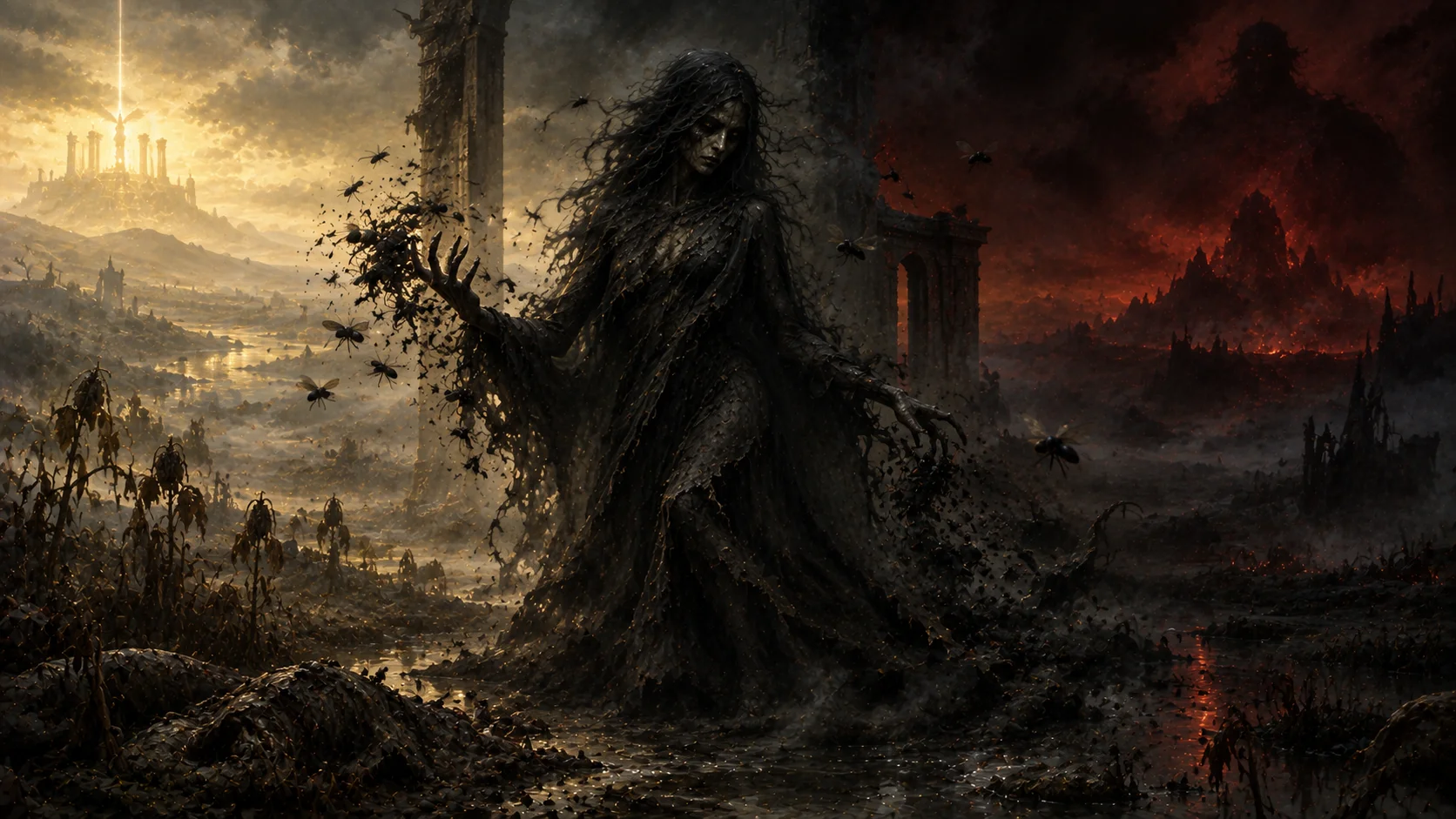
Beyond the plant pressed in the mortar stands a greater tree: the White Haoma, Gaokerena, called in later Pahlavi texts such as the Bundahishn the tree of the cosmic sea Vourukasha. It is guarded there against a lizard, a demon sent by Angra Mainyu to destroy it. Zoroastrian eschatology holds that at the final renovation of the world, frashokereti, the sap of Gaokerena will be mixed into the resurrection rite and will grant universal immortality to all. Scholars often treat this cosmic Gaokerena as a mythic doublet, distinct from the ordinary haoma plant pressed in the temple — the same name and the same promise of immortality, but operating on two different scales, one earthly and repeated, one final and singular. The lizard set against it by Angra Mainyu makes plain what is at stake: even the tree that will one day grant the world's last immortality is not exempt from the struggle between the two spirits that runs through every layer of Zoroastrian cosmology.
A Reform, Not an Abolition
Haoma and the Vedic Soma are cognate figures, both descending from a shared Indo-Iranian plant-deity, and the two names are themselves linguistic cognates, both carrying the sense of pressing. But where the Vedic Soma cult leaned toward ecstatic and intoxicating excess, the Avestan hymns take a different tone. Yasna 10 explicitly praises sobriety and warns against drunkenness, reflecting the broader reform Zarathustra brought to the older Indo-Iranian plant-cult. Haoma's worship survives in the Good Religion not because it went unquestioned, but because it was purified — kept, and made moral, rather than discarded. The kinship with Soma is close enough that the shared root of the two names is visible on its face, yet the two traditions diverge sharply in what they ask of the worshipper: ecstasy on one side, sobriety insisted upon on the other.
Sanctifying the Material World
This choice to reform rather than abolish reflects a doctrine at the center of Zoroastrian thought: that the material world, the getig, plants and ritual substances included, can itself be sanctified and turned into an instrument of asha, truth and order, in the struggle against death. Haoma is the clearest embodiment of that principle. Unlike the ecstatic mystery cults of other ancient religions, which Zoroastrianism did not simply absorb, the Haoma cult was retained because the plant itself could be made holy rather than renounced. Where other traditions might have set the physical world against the spiritual one, Haoma stands as the doctrine's proof that a stem crushed in a mortar can be an instrument of asha rather than a distraction from it.
The Plant Nobody Has Named With Certainty
For all the reverence surrounding it, the precise botanical identity of the haoma plant has never been settled by scholarship. Ephedra is the most widely favored candidate among researchers, but the identification remains genuinely disputed, and no consensus has closed the question. In practice, and depending on regional availability, the twigs used in the ceremony have often been supplemented or substituted with pomegranate twigs or ephedra. The uncertainty has not interrupted the rite — priests still press what is called haoma, whatever its exact species, in the mortar known as the hāvana, as they have for centuries. It is a striking fact about a tradition built so entirely around one plant: the ritual has outlasted certainty about what, botanically, that plant even is.
A Presence Uncertain in Stone
Some scholars have looked to Achaemenid and later Zoroastrian-influenced reliefs — figures holding barsom-like bundles near a stylized tree — and proposed these as images of Haoma. But direct, undisputed depictions of Haoma as a personified figure are sparse, and much of this identification remains inferential rather than certain. Haoma's clearest presence is not carved in stone but spoken in the hymns, where he needs no uncertain image because he speaks for himself. Where the god of the Hōm Yašt announces his own lineage and powers in his own voice, the stone reliefs offer only a bundle and a stylized tree, and the connection between the two has to be argued rather than simply read off the carving.
The Rite That Has Not Stopped
The Haoma ceremony, the Hom-yašt or Hom-drōn performed within the Yasna, endures in Zoroastrian ritual practice today. The officiating priest still pounds the twigs in the hāvana, still prepares the pressed juice, still performs the pressing that Haoma himself is said to have performed first, before any mortal did. Across the long distance from the Younger Avesta to the present, the mortar and the twigs remain the point where an ancient god, a disputed plant, and a living community of worship continue to meet. Nothing about the uncertainty over the plant's identity, or the sparseness of any confident image of the god, has interrupted the rite itself — the pounding of the mortar continues regardless, exactly as it is described happening in the hymns themselves.
One Name, Three Things Held Together
What makes Haoma difficult to summarize in a single sentence is also what makes him central to Zoroastrian worship: the same word names the plant on the altar, the drink in the cup, and the god who is addressed by it. The Hōm Yašt does not ask the worshipper to choose among these three; it moves between them without pause, so that pressing the stem, drinking the parahaoma, and worshipping the yazata are treated as a single continuous act rather than three separate ones. That refusal to separate substance from divinity is, in the end, the doctrine the Good Religion draws from him — that the material world, rightly pressed and rightly offered, does not merely represent the sacred but participates in it.
Sources & traditions
- EncyclopediaWikipedia — Haoma
- TraditionZoroastrian texts, grimoires and later commentary
Myths change from area to area and from time to time. This chronicle follows the most widely told versions; tellings in other villages, regions and eras may differ.