Rashnu, Avestan Rashnu, later Persian Rashn, is the yazata — the divine being "worthy of worship" — of justice, truth, and judgment in Zoroastrianism. He is the straightest of judges, favoring neither the powerful nor the humble, who stands with Mithra and Sraosha at the Chinvat Bridge to weigh the deeds of the dead upon golden scales. Where other yazatas carry warrior aspects or preside over fire, waters, or the wide created world, Rashnu's domain is narrow and exact: he is judgment itself, incorruptible and unbending.
The Name That Means Straightness
Rashnu's name is bound, at its root, to the Avestan idea of straightness or rectitude — the quality of a thing, a statement, or a verdict that does not bend. This is not incidental to his character; it is the whole of it. Where a human judge might be swayed by rank, by kinship, by fear, or by bribery, Rashnu is described as immovable in exactly the way a straight line is immovable: there is no direction for it to lean. His standing epithet, Rashnu razishta, "Rashnu the most just," restates the same idea in superlative form. He is not merely just among the yazatas; he is the measure by which justice itself is recognized. Later Zoroastrian communities carried this etymological weight forward into the Middle Persian Rashn, and the sense of the name as a description of function, rather than merely a label, persisted through the tradition's long transmission.
His Voice in the Avesta
The principal scriptural witness to Rashnu is Yasht 12, the hymn dedicated to him within the Avesta, the Zoroastrian sacred canon. It is a shorter hymn than many of the other Yashts devoted to major yazatas, and this brevity is itself worth noting rather than glossing over: Rashnu's textual presence is concentrated and specific rather than expansive. He also appears within the Sraosha Yasht and the Mihr Yasht, the hymns to Sraosha and Mithra respectively, which is fitting, since in the theology of judgment he is rarely invoked wholly alone. His identity in scripture is defined largely through his relationships and his function — as judge, as oath-witness alongside Mithra, as one of the three met at the bridge — rather than through an extended independent narrative cycle of his own such as exists for some other yazatas.
The Bridge of the Separator
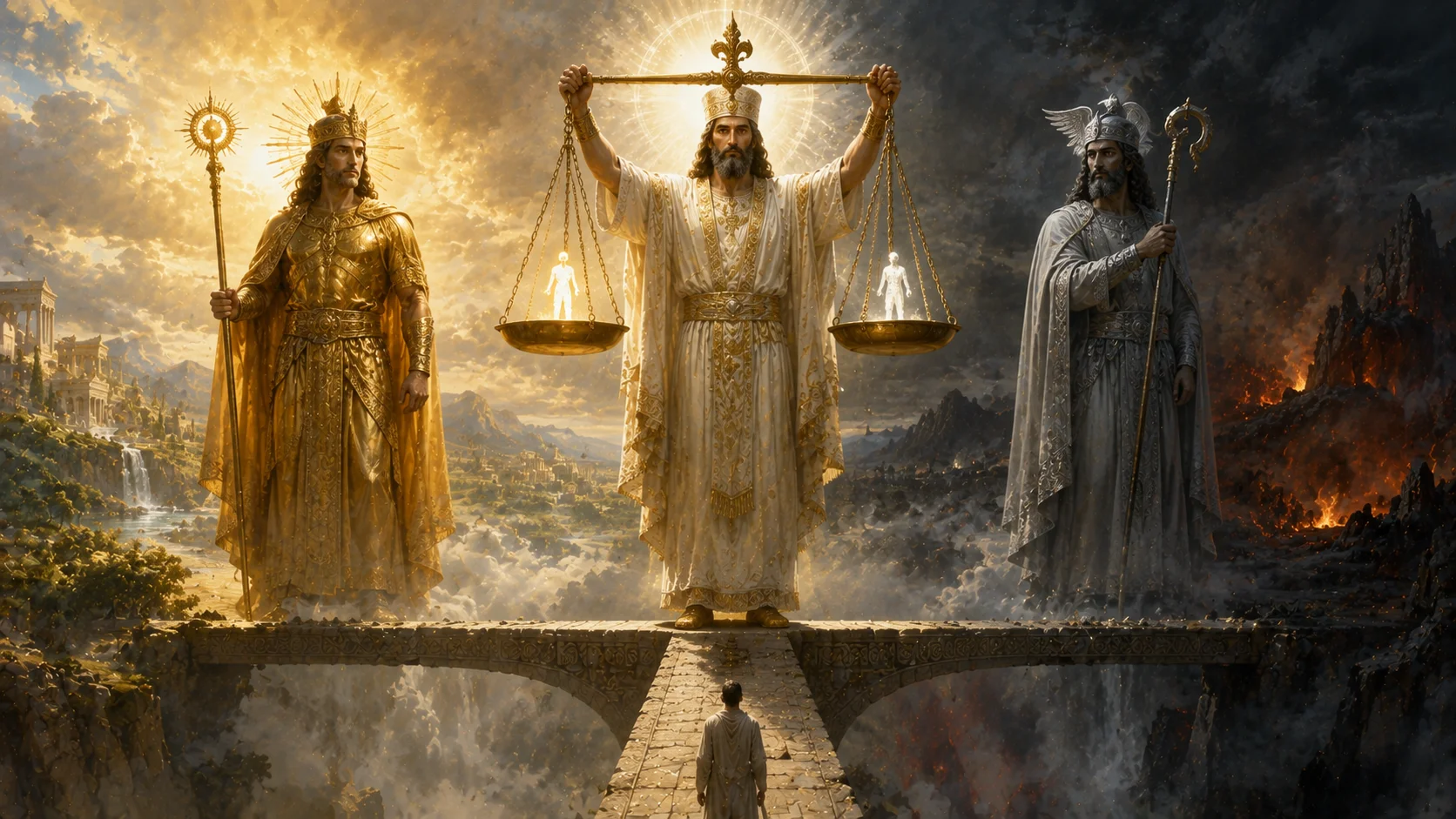
Rashnu's best-known and most consequential role unfolds at the Chinvat Bridge, the "Bridge of the Separator," which every soul must cross after death to reach its fate in the world beyond. Zoroastrian eschatology holds that the soul's thoughts, words, and deeds — the totality of a life's moral record — are weighed there, and it is Rashnu who is entrusted with the weighing. He is described as holding, or being attended by, golden scales upon which good is set against evil with total precision. This is not judgment by impression or by the general reputation a soul carried in life; it is judgment by exact measure, deed answering deed, on a balance that cannot be tipped by pleading, status, or deception.
Companions at the Reckoning
Rashnu does not preside at the bridge alone. He forms a fixed triad there with Mithra and Sraosha, and the three together constitute the tribunal before which the departed soul stands. Mithra, the great yazata of covenant, contract, and the sun, presides as the divine witness and guarantor of oaths — the one whose domain concerns the truthfulness of a person's word given to others across a lifetime. Sraosha, the yazata of obedience, discipline, and religious conscience, represents the soul's submission to the sacred order and its willingness to hear and heed what is right. Rashnu's contribution is distinct from both: he is neither the witness to promises kept nor the embodiment of discipline observed, but the impartial instrument of measurement itself — the one who takes what Mithra and Sraosha attest to and renders it into an exact verdict. The three are complementary rather than redundant, and Zoroastrian thought seems to have found it necessary that judgment require all three functions together: testimony, conscience, and impartial weighing.
A Justice Without a Sword
It is worth dwelling on what Rashnu is not, because the distinction is doctrinally meaningful. Mithra, his frequent companion, carries strong warrior and covenant-guardian aspects in the wider Avestan tradition — he is a figure who can act, who can punish the oath-breaker, who has a martial dimension bound up with the defense of truth. Rashnu has none of this. His justice is adjudicative rather than punitive or martial: he does not smite, pursue, or enforce. He measures. This narrowness of role is not a diminishment; within Zoroastrian theology it is precisely what makes him necessary as a distinct figure rather than an aspect of Mithra. Justice, in this conception, requires a moment of pure, disinterested measurement that is conceptually separable from the guarding of oaths and the punishing of their violation — and that separable function is Rashnu's alone.
The Guarantor Beside Mithra
Within Yasht 12 itself, Rashnu is invoked alongside Mithra as a guarantor of oaths and contracts, and this pairing reflects a deep concern running through the whole of Zoroastrian ethics: the sanctity of truth-telling and promise-keeping, and the gravity of their opposite, druj — "the Lie" — which Zoroastrian thought treats not as a minor failing but as the fundamental moral and cosmic wrong. Where Mithra watches over the keeping of the spoken word between persons, Rashnu's presence in the same invocation signals that truthful speech and just judgment are treated as two faces of a single concern. A society, and a soul, that deals honestly in life is preparing the very record that Rashnu will later weigh without alteration or mercy-by-exception.
Rectitude's Companion
In some Avestan groupings Rashnu is invoked in close proximity to Arshtat, the yazata of Rectitude or uprightness, the two names appearing together as complementary forces of truth and justice. The pairing is a natural one: if Rashnu is the exact instrument of judgment, Arshtat represents the quality of uprightness that judgment is meant to recognize and reward. Together they suggest a theology in which justice is not a single undifferentiated idea but has, even within the pantheon of yazatas, more than one face — the state of being upright, and the act of being justly measured for it.
The Scene as the Later Tradition Told It
The image of Rashnu at the bridge, sketched in the Avesta, is given fuller narrative treatment in the later Zoroastrian literature composed in Pahlavi, Middle Persian. The Menog i Khrad, the "Spirit of Wisdom," names him explicitly as one of the three — with Mihr and Srosh, the Middle Persian forms of Mithra and Sraosha — who meet the soul at the Chinvat Bridge. The Arda Wiraz Namag, the Book of Arda Viraf, goes further still, offering one of the most detailed narrative depictions surviving anywhere in the tradition of this post-mortem judgment scene: a visionary account of a righteous man's journey through the realms beyond death, in which the weighing at the bridge is described with a vividness the terser Avestan hymns do not attempt. Across these later texts, Rashnu's role remains consistent with what the Avesta establishes — he holds the scales, and the scales do not lie.
A Judge Who Cannot Be Bought
Avestan hymns return repeatedly to a single theological insistence regarding Rashnu: that he cannot be deceived by false witness and cannot be bribed. This is stated not as incidental praise but as a load-bearing doctrine. Zoroastrian cosmology rests on the opposition between asha, truth and cosmic order, and druj, the Lie and disorder, and the ultimate judgment of a soul has to be seen as an expression of asha itself — exact, uncorrupted, and immune to the very falsehood it exists to weigh against. A judge who could be deceived, or who might favor a soul for its rank or its cleverness in argument, would undermine the entire moral architecture the tradition builds around individual responsibility. Rashnu's incorruptibility is therefore not merely a character trait ascribed to him; it is close to the theological point of his existence.
A Face Left Largely Undrawn
Unlike Mithra or Anahita, who appear across a richer body of surviving Zoroastrian art and iconography, depictions of Rashnu specifically are sparse. What can be said with confidence about his "appearance" comes almost entirely from text rather than from any robust independent iconographic tradition — chiefly the image of the scales he holds or is attended by. Scholars have noted this scarcity directly rather than attempting to fill the gap with speculative reconstruction, and it is worth preserving that honesty here as well: Rashnu is known far more as a function and a presence at a threshold than as a pictured figure, and the tradition's own record reflects that.
His Day in the Turning Calendar
Rashnu holds a fixed place in the Zoroastrian liturgical calendar: the eighteenth day of the month is dedicated to him, and his name is invoked on that day within the Siroza, the liturgical roster naming the thirty yazatas across the days of the month. This calendrical dedication is a small but telling detail — it means Rashnu is not solely a figure encountered in the drama of the afterlife but a presence woven into the ordinary rhythm of Zoroastrian devotional life, invoked and remembered on his appointed day the way each yazata is remembered on theirs.
How a Judge Was Set Apart
Scholars of Zoroastrianism, Mary Boyce among them, have proposed that Rashnu likely developed as a specialized judicial figure emerging from within the broader Mithra-centered complex concerned with oaths and covenants. On this reconstruction, as Zoroastrian eschatology grew more elaborated over time — as the picture of individual judgment after death became more precise and more central to religious life — the specific function of judging, of weighing, came to require its own dedicated figure distinct from Mithra's wider role as covenant-guardian and witness. It is worth stating plainly what kind of claim this is: the precise chronology of that specialization is not preserved directly in surviving texts but is a matter of scholarly reconstruction, built from the pattern of the evidence rather than handed down as an explicit historical record. The hypothesis is offered here as scholarship, not as settled fact, in keeping with how the tradition itself has been studied.
The Measure at the End of Every Life
What endures across every layer of this tradition — the compressed hymn of Yasht 12, the triadic scene at the bridge, the later Pahlavi narrations, the calendar that gives him his own day — is a single, coherent picture of what Rashnu is for. He is the assurance, built into the structure of Zoroastrian belief, that a life's deeds are not lost, blurred, or judged unevenly at its end. Every thought, every word, every act is set upon the scale, and the scale answers to nothing but itself. In a tradition that places such profound weight on the individual's free moral choice between asha and druj, between truth and the Lie, Rashnu is the guarantee that the choice, once made across a lifetime, will be recognized exactly as it was.
Sources & traditions
- EncyclopediaWikipedia — Rashnu
- TraditionZoroastrian texts, grimoires and later commentary
Myths change from area to area and from time to time. This chronicle follows the most widely told versions; tellings in other villages, regions and eras may differ.