Tishtrya, the Avestan Tištrya, is the yazata of the star Sirius in Zoroastrian tradition: the divine being of the bright and glorious star who leads the fixed stars in the great cosmic contest against the wandering planets, and who each year, in the form of a white stallion, must do battle with the drought-demon Apaosha to win the rains for the thirsting earth. He is invoked at length in the Tir Yasht, the eighth Yasht of the Avesta, as the giver of good pasture, abundance, and prosperity to the Aryan lands, and his name endures in the Persian calendar month Tir and in the summer festival of Tiregan.
The Bright Star Above the Waters
Tishtrya is, in the most literal and astronomical sense, the divine person of Sirius, the brightest star visible from the earth. Modern scholarship, most notably the work of Antonio Panaino, treats this identification as one of the more secure findings in the whole of Avestan star-lore, grounded in the observed fact that the heliacal rising of Sirius over the Iranian plateau coincided with the turn toward the rainy season. For a people whose fields and herds depended on rain arriving on time, the reappearance of this star in the pre-dawn sky was not a poetic image but a working calendar, and the yazata who bore its name was accordingly approached as a power with direct bearing on survival. The Tir Yasht calls him "Tishtrya, the bright and glorious star," a title that carries both the plain description of a brilliant point of light and the reverence due a being capable of deciding whether the year would be fertile or barren.
Three Forms Across Thirty Days
The Yasht describes Tishtrya as manifesting to the world in three successive shapes, each held for ten days in turn. For the first ten days he appears as a youth of fifteen years, radiant and dressed in gold, embodying the vigor and promise of early manhood. For the next ten he takes the form of a bull with golden horns, a shape that in the Avestan world reliably signals strength joined to fertility and the wealth of herds. For the final ten days of the month he becomes a white horse with golden ears and golden trappings, and it is in this last and most martial of his three forms that he goes down to the shore of the cosmic sea to meet his enemy. The progression from youth to bull to horse reads as a deliberate escalation, each shape more suited than the last to the trial that closes the sequence, so that by the time Tishtrya reaches the water's edge he has already, in a sense, armed himself.
Apaosha, He Who Causes Want
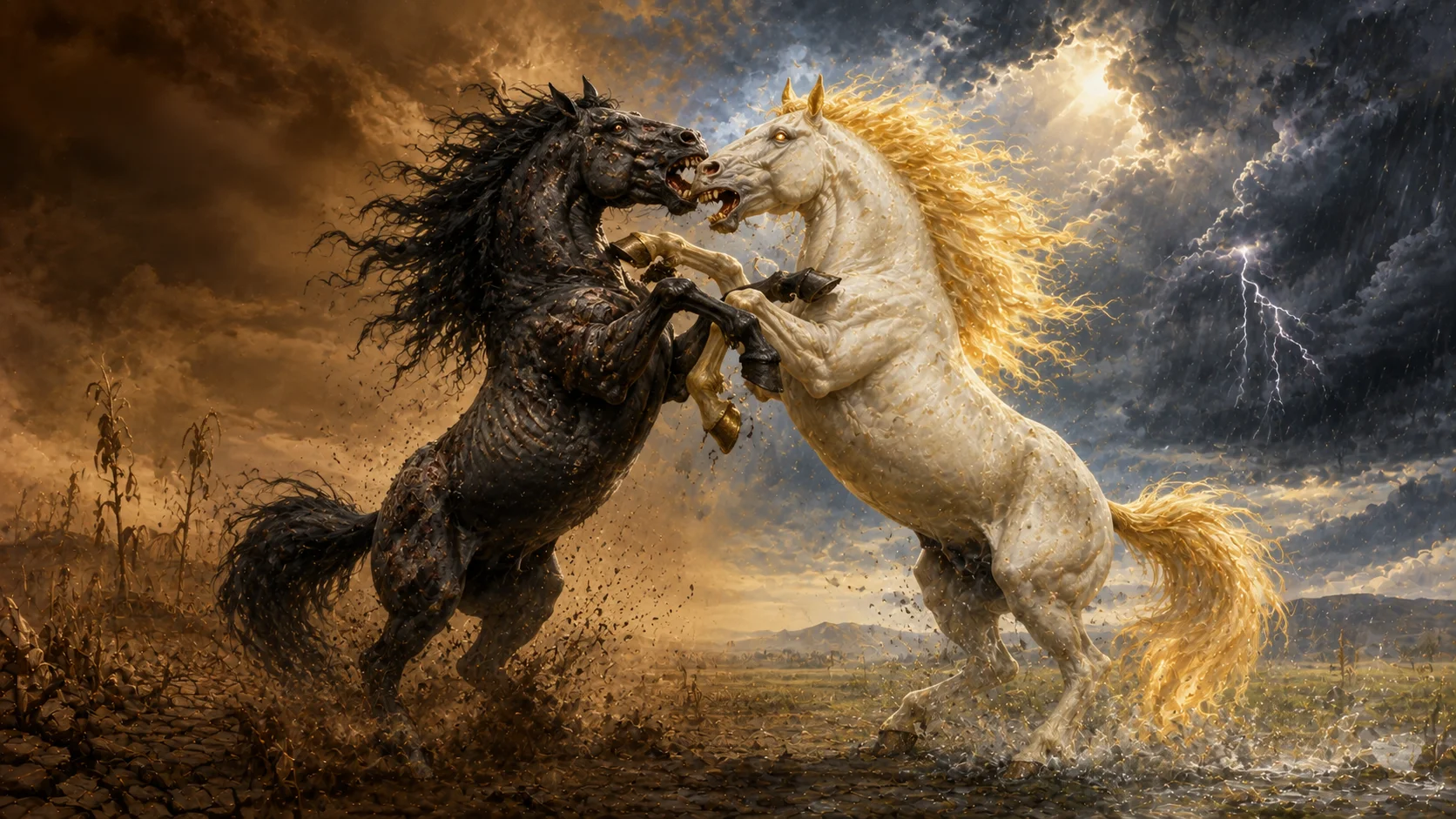
Standing against Tishtrya is Apaosha, whose very name in Avestan means something close to "he who causes want" or "he who causes drought." Apaosha appears in the myth as a black horse, ugly and threatening, the visual and moral inversion of Tishtrya's white and golden radiance. The two meet at Vourukasha, the mythical sea that in Zoroastrian cosmology gathers and holds the primal waters of the world, and there they fight as horse against horse, a contest of strength and endurance rather than of weapons or spells. The confrontation is not framed as a chance skirmish but as the recurring, necessary crisis of the year: without it, and without its resolution in Tishtrya's favor, the rains simply do not come, and the black horse's name is a plain statement of what his victory would mean for every field and every animal that depends on water.
The First Defeat
In the account preserved in the Tir Yasht, Tishtrya does not win at once. In their first encounter Apaosha overpowers him and drives him back from the sea, and the Yasht is explicit about the reason: the people have not offered Tishtrya the worship and the sacrifice that are properly his due. This is one of the sharpest and most consequential statements in the whole hymn, for it makes the outcome of a cosmic battle contingent on human ritual conduct. Tishtrya's strength is not simply given; it is built, in part, out of the libations and reverence directed toward him, and when that offering is withheld or given carelessly, the god who exists to bring the rain is left weaker than the demon who exists to deny it. The drought that follows from his first defeat is therefore never presented as arbitrary misfortune. It is shown as a consequence with a traceable cause, and that cause runs back through the ritual life of the community as much as through the will of the gods.
Strengthened by Right Sacrifice
The Yasht then turns to the remedy. Ahura Mazda himself offers sacrifice to Tishtrya, and this offering, made rightly and by the highest authority, restores and multiplies the star-yazata's strength. He is described as being filled with the power of ten horses, ten camels, ten bulls, ten mountains, and ten rivers, an image that piles up the great sources of strength and abundance known to the pastoral and agricultural world of the hymn's composers and pours all of them into a single being. This is the doctrinal heart of the myth, restated so that no listener could miss it: potency and worship reinforce one another, and a being who might otherwise be overmatched can be made equal to his task when the correct rites are performed with the correct portion of libation. The lesson states outright a governing principle of Zoroastrian ritual life, that the sacred and the human sides of the world act upon each other, and that neither is complete without the other's proper conduct.
The Second Encounter at Vourukasha
Fortified in this way, Tishtrya returns to the sea and meets Apaosha a second time. Where the first duel ended in retreat, the second ends in victory, and the black horse of drought is driven off. The Yasht treats this reversal as the pivotal event of the agricultural year, the moment on which every subsequent blessing depends, and scholars reading the myth as a whole have generally understood the two-part duel, defeat followed by triumph, as a seasonal allegory: the dry stretch of the year given the shape of a battle actually lost, and the eventual arrival of the rains given the shape of a battle eventually won. Read this way, the myth does more than entertain; it explains, in terms available to its own age, why the rains sometimes seem to arrive late, and it locates the fix for that lateness not in resignation but in the renewed and proper worship of the god responsible for them.
The Waters Released Upon the World
Tishtrya's victory does not end with Apaosha's retreat. Having overcome the demon of drought at the shore of Vourukasha, Tishtrya causes the waters of that great mythical sea to rise, and from it the rain, cloud, wind, and mist are described as spreading the released water out over the seven continents, the karshvars, into which Zoroastrian cosmology divides the inhabited earth. This is the payoff toward which the entire duel has been building: a cosmic sea, a cosmic battle, and finally a cosmic distribution of the one resource without which no field can bear grain and no herd can be watered. Tishtrya is honored in the Yasht precisely for this generosity of scale. He is not a god of some single spring or river but of the mechanism by which water reaches every corner of the world at once, and the hymn's language of continents and seas is the register appropriate to a benefaction of that size.
Companion of the Waters' Goddess
Within the wider company of Avestan divinities concerned with water and fertility, Tishtrya stands in close relation to Aredvi Sura Anahita, the goddess of the waters, and the two are frequently invoked together within the same rain-fertility complex of hymns. The exact shape of their pairing, whether the two share the work as something like equals or whether one role is understood as subordinate to the other, is a matter scholars continue to weigh rather than a point the surviving texts settle outright, and nothing here should be taken to resolve that question further than the sources themselves do. What the texts do make plain is the association itself: a star-yazata whose triumph releases the rain, and a goddess whose domain is the waters that result, invoked side by side by worshippers for whom the two functions were, in practice, part of one continuous blessing.
Leader of the Stars Against the Wandering Powers
Beyond the yearly drama of the duel with Apaosha, Zoroastrian doctrine assigns Tishtrya a still larger role, describing him as leading the fixed stars in a struggle against the planets, spoken of as the "wandering stars" and associated with the forces of disorder. This casts Tishtrya's local, seasonal battle for rain as one expression of a far wider conflict running through Zoroastrian cosmology, the struggle between asha, truth and right order, and the druj, the lie and chaos that opposes it. Apaosha's drought is one instance of disorder among many, and Tishtrya's yearly victory one recurring instance of order reasserting itself against it. The rain that falls after his triumph is thus not only water for the fields; it is a visible, seasonal sign that the ordered world has, once again, held.
Guardian of the Aryan Lands
The Tir Yasht calls upon Tishtrya directly as a giver of good pasture, of abundance, and of prosperity to the Aryan lands, the airyana, and ties this communal welfare explicitly to his double function as opponent of drought and opponent of the daevas, the demonic forces understood to stand behind it. This is the practical face of the cosmic myth: worshippers were not chiefly interested in Tishtrya as a figure in an abstract contest between order and disorder, but as the being whose favor determined whether their pastures would be green and their communities fed. The hymn's repeated emphasis on abundance and prosperity as the fruits of his victory shows a religion that held its grandest cosmology and its most immediate agricultural anxieties in the same breath, asking the same god to hold back chaos in the largest sense and to fill the granaries in the most literal one.
Tir, and the Turning of the Calendar
In later Middle Persian, Pahlavi, tradition, Tishtrya continues under the name Tir, and this later name also came to be attached to the planet Mercury within the naming conventions of Iranian astronomy, a development scholars note as a shift or conflation whose exact history remains debated rather than settled fact. What is not in question is that Tishtrya's presence was written directly into the structure of Iranian religious time. The fourth month of the calendar bears his name, Tir, and the thirteenth day of every month is dedicated to him, so that his worship was not confined to a single yearly festival but recurred as a regular part of the ritual month. In later Persian tradition this culminates in the mid-summer festival of Tiregan, which commemorates his rain-bringing victory over Apaosha and gives the ancient myth a fixed place in the lived, seasonal calendar of the community that continued to honor him.
The Bond Between Worship and Power
What runs through every part of Tishtrya's Avestan portrait, the youth, the bull, the white horse, the first defeat, the strengthening sacrifice, the second victory, and the waters spread across the continents, is the single doctrinal thread that his power is not detached from the devotion of those who call upon him. A god can be weakened by neglect and restored by right offering; a demon can prevail specifically because a due sacrifice was withheld. In Tishtrya, the tradition gives lasting shape to the yazata of Sirius, the bright and glorious star who year by year meets the demon of drought at the edge of the cosmic sea, loses when honor is withheld, wins when it is rightly given, and pours the released waters of Vourukasha out over the seven climes of the earth, the divine bringer of the rains upon which the Aryan lands were understood to depend.
Sources & traditions
- EncyclopediaWikipedia — Tishtrya
- TraditionZoroastrian texts, grimoires and later commentary
Myths change from area to area and from time to time. This chronicle follows the most widely told versions; tellings in other villages, regions and eras may differ.