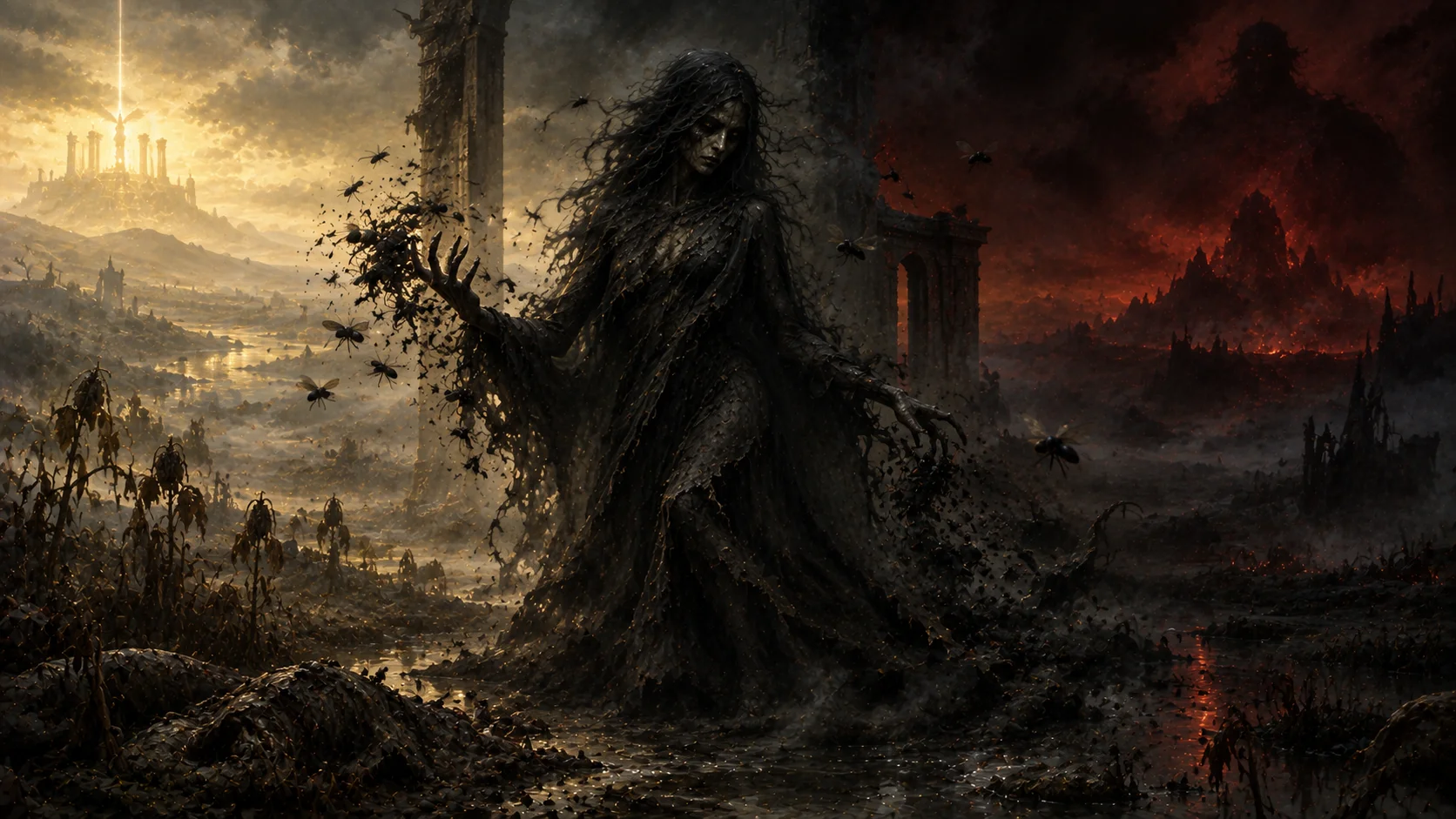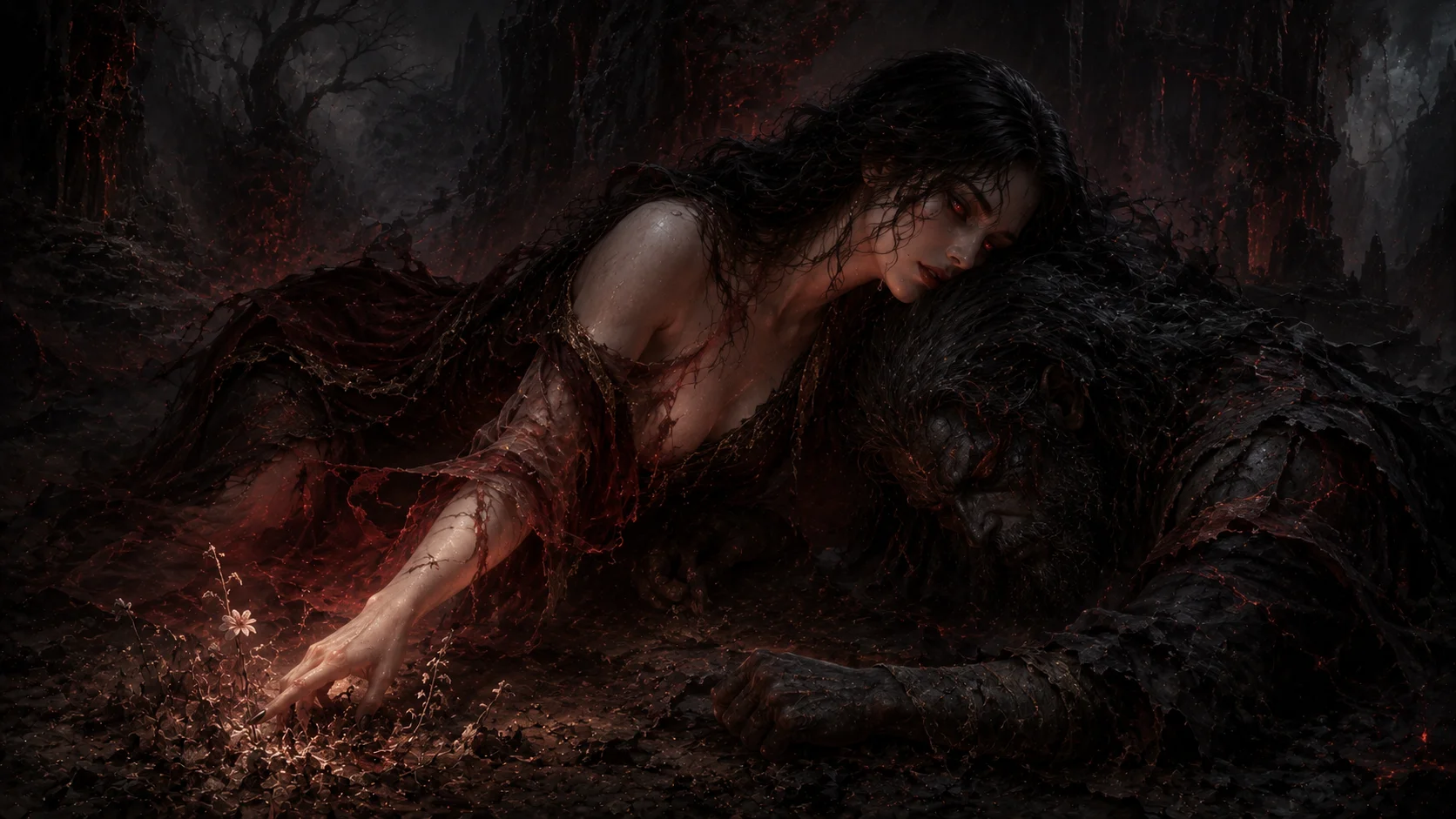
Jahi, called Jeh in the Pahlavi books, is reckoned among the female dēvs of Zoroastrian scripture: the demoness of menstruation and of the ritual impurity the tradition associates with unchastity. She belongs to the company the texts name the jeh, the whore-demons, and she is remembered above all for a single episode in the Bundahishn, the Pahlavi account of creation and cosmic conflict, where she alone among the assembled demons finds the will to act at the darkest moment of the story.
A Name Read as "Vile"
Her Avestan name, Jahika, and its Pahlavi form Jeh, are glossed by scholars of Zoroastrian demonology, among them Mary Boyce, as deriving from a root carrying the sense of "vile" or "low." The name itself is doctrinal shorthand: it does not describe a person so much as label a category of ritual degradation, and Jahi stands as the personification of that category rather than as an individual with a biography in the ordinary sense. In Pahlavi usage, jahika or jeh denotes a woman held to be promiscuous or ritually impure; Jahi is that noun raised to the rank of archdemon, the figure in whom the abstraction is given a name, an appetite, and, in one passage, a decisive act.
Her Place Among the Dēvs
The Zoroastrian demonic hierarchy is populated by figures with distinct portfolios of harm — Az, Concupiscence, and Aeshma, Wrath, chief among them — and Jahi belongs in that company as one of the agents who serve the destructive purpose of Angra Mainyu, the Hostile Spirit, known in Pahlavi as Ahriman. Where Az governs greed and insatiable craving, and Aeshma governs violent fury, Jahi's charge is impurity and sexual license, and specifically the impurity the tradition locates in menstruation. She is not the most frequently mentioned of the dēvs in surviving text, but the episode that does survive gives her a weight in the mythology out of proportion to her brief appearance.
The Stupor After the First Assault
The Bundahishn, compiled in the ninth century of the Common Era from earlier Avestan material, tells that when Angra Mainyu first assaulted the good creation of Ohrmazd — the Wise Lord, Ahura Mazda in the older Avestan naming — the onslaught did not proceed smoothly for the assailant. Having struck at the light and the goodness of the created world, Angra Mainyu fell into a stunned inertness, a stupor lasting three thousand years, in which he lay inactive and unable to press the attack further. Around him the demons he had gathered fell into despair, seeing their lord fallen silent and their assault stalled at its outset. None of them found a way to rouse him.
The One Who Woke Him
It is Jahi alone, in the Bundahishn's telling, who breaks that impasse. Where the other dēvs despair, she comes forward and speaks to the inert Angra Mainyu, and what she offers him is not comfort but a promise of harm still to be done: she vows to bring decrepitude, lust, and other injuries upon the righteous man, Gayomard, the primordial human, and upon the Bull, the Gavaevodata, the primordial Ox from whom, in the Zoroastrian creation account, animal life descends. It is this promise — of fresh corruption still within reach, of damage yet to be inflicted on the two great archetypes of Ohrmazd's creation — that revives Angra Mainyu's resolve. He rises from his stupor and renews the assault the demons had thought stalled for good.
Structural Weight in a Brief Appearance
The scene is one of the few places in the Bundahishn where a female demon, rather than Angra Mainyu himself, carries the narrative forward by her own initiative. The text does not credit any other dēv with the act of rousing the Hostile Spirit; it is Jahi's word, and Jahi's alone, that turns three thousand years of stalled despair back into active cosmic war. In a text whose central conflict is otherwise driven by the two great antagonists, Ohrmazd and Angra Mainyu, Jahi's brief scene gives a secondary figure real narrative agency at the hinge of the whole story — a distinction scholars of the material have noted as structurally significant even though her textual appearance is short.
The Kiss and Its Consequence
The Bundahishn frames what follows as both reward and consequence: Angra Mainyu, roused by Jahi's promise, kisses her upon the head, in some renderings embraces her. The text presents this act as an origin — the mythic point at which menstruation entered the experience of women. In the theology of the Bundahishn, this is Jahi's aetiological function: she is not merely a demon who happens to be associated with menstrual impurity, she is the figure through whom the text explains why that impurity exists at all, tracing it back to this one moment of contact between the roused Hostile Spirit and the demoness who woke him.
Impurity as Druj, Not as Sin
Scholars examining this material stress a distinction worth holding onto: in Zoroastrian doctrine, the impurity Jahi represents is understood as belonging to the domain of Druj, the Lie, the principle of disorder and corruption opposed to Asha, truth and right order — rather than as a matter of personal sin. Menstruation, in this reading, is not treated by the doctrine as a woman's individual moral failing; it is classed among the phenomena the tradition attributes to the intrusion of Druj into the created world, on the same conceptual footing as other forms of ritual pollution the Avesta legislates against. Jahi is the etiological figure for that classification — the myth-figure who explains why the impurity exists — rather than a device for condemning women in general, a point scholarly treatments of the Bundahishn are careful to keep separate from a simpler misogynistic reading of the passage.
The Corruption of the First Pair
Beyond the scene with Angra Mainyu, some passages of the Bundahishn associate Jahi with the corruption of Mashya and Mashyana, the first human couple in Zoroastrian cosmology, tying her to the broader spread of moral corruption that follows in the wake of Angra Mainyu's assault on creation. Here again her role is consistent with her larger portfolio: she is not a demon of violence or of theft, but one whose harm travels through defilement, temptation, and the erosion of purity, extending the damage of the primal assault into the conduct of the first human beings themselves.
Doctrine Made Practice: The Purity Laws
The theological weight Jahi carries is not confined to myth; it underlies practice. The concept of nasu-related pollution in Avestan and Pahlavi thought — impurity understood as a contaminating force requiring active ritual management — gives rise to the strict purity laws recorded in the Vendidad, the Zoroastrian legal and ritual text most concerned with defilement and its remedies. Under these laws, a menstruating woman was to be isolated in a dashtanistan, a menstruation hut set apart from the household, and required to undergo ritual purification before rejoining ordinary religious and domestic life. Jahi's episode in the Bundahishn stands behind this practice as its mythic charter: the demoness who woke Angra Mainyu and received his kiss is, in the doctrine's own logic, the reason the purity laws exist in the form that they do.
A Debated Passage
The Jahi episode has drawn sustained scholarly attention precisely because its status is not settled. In treatments of the Bundahishn by scholars including R. C. Zaehner and Mary Boyce, the passage is discussed as one of the more debated moments in the text: whether it is meant to be read as literal cosmological event — something that, within the tradition's own terms, actually happened at the founding of the world — or as a symbolic narrative constructed to explain and justify the purity laws after the fact, remains a matter of scholarly discussion rather than settled consensus. The passage resists a single confident reading, and that resistance is itself part of what scholars find significant about it.
A Figure Without a Face
Unlike Angra Mainyu himself, who accumulated a visual tradition in later Zoroastrian and Persian art, Jahi left no comparable body of surviving iconography from antiquity. She remains, so far as the evidence shows, a textual and doctrinal figure rather than one who was widely depicted. What is known of her comes from the words of the Bundahishn and the scholarship built around them, not from image or artifact — a demoness defined entirely by what she says and does in a handful of lines, and by the practice those lines were understood to justify.
The Shape of Her Legend
Taken together, the fragments concerning Jahi describe a demoness whose significance rests on a single act at the hinge of Zoroastrian cosmic history: alone among the despairing dēvs, she rouses the fallen Angra Mainyu with a promise of harm to come, and the doctrine that grows from that scene — impurity as Druj, menstruation requiring ritual management, the ongoing struggle between Asha and Druj playing out in the smallest particulars of daily religious life — traces itself back to her. She is remembered less for a catalogue of deeds than for one decisive moment, read by the tradition as the origin point of a practice its adherents observed for centuries afterward.
Sources & traditions
- EncyclopediaWikipedia — Jahi
- TraditionZoroastrian texts, grimoires and later commentary
Myths change from area to area and from time to time. This chronicle follows the most widely told versions; tellings in other villages, regions and eras may differ.