Vohu Manah, called in later Persian tradition Bahman, is one of the Amesha Spentas, the Holy Immortals who surround Ahura Mazda in Zoroastrian theology. His name, Avestan for "Good Mind" or "Good Purpose," names him as the personification of right thinking, the divine faculty of benevolent thought through which a person turns toward Ahura Mazda and toward Asha, the truth and cosmic order that Zoroastrian teaching holds sacred. He is attested directly in the Gathas, the oldest hymns of the Avesta, traditionally attributed to Zoroaster himself, and he is traditionally ranked second among the Amesha Spentas, immediately after Ahura Mazda — a rank that reflects the primacy given to good thought at the very foundation of Zoroastrian ethics.
The Naming of Good Purpose
To render Vohu Manah into another language is already to make a small act of interpretation, and Zoroastrian scholarship has offered several careful attempts: "Good Mind," "Good Purpose," "Good Thought," "Good Intention." Each translation, from scholars such as Insler, Humbach, and Boyce working directly from the Gathic verses, captures a facet of the same reality — not simply intelligence or cleverness, but a disposition of the mind that is oriented toward goodness, toward benevolence, toward the truth that Zoroastrian teaching calls Asha. The Middle Persian form of his name, Wahman, and its later Persian descendant, Bahman, carried this meaning forward across the centuries, surviving even into the Islamic era in the pages of the Shahnameh, where the name Bahman appears as an onomastic legacy of the old faith rather than as a theological statement in its own right.
First Among the Immortals of Creation
The Amesha Spentas are traditionally counted as six, or as seven when Ahura Mazda himself is reckoned as their head: Vohu Manah, Asha Vahishta, Spenta Armaiti, Khshathra Vairya, Haurvatat, and Ameretat, each one a Holy Immortal presiding over an attribute of the divine and a portion of creation, together forming the structured heptad at the center of Zoroastrian cosmology. Within this company Vohu Manah is described as close to Ahura Mazda from the very beginning — some tellings hold that he was first among the created, standing nearest to the source of all being. His rank as second among the Amesha Spentas is not incidental. In a faith whose ethics rest on the correct ordering of thought, word, and deed, it is fitting that the Good Mind should stand closest of all to the Wise Lord.
What It Means to Think Well
Zoroastrian ethical life is often summarized in a single triad: good thoughts, good words, good deeds. Vohu Manah governs the first and, in a sense, the root of the other two, for the tradition holds that righteous speech and righteous action flow from a mind already turned toward the good. To think with Vohu Manah is to align the inner self with Asha, with truth and cosmic order, and to set oneself against Druj, the Lie, which is the great adversary of Zoroastrian moral thought. In this framework, good thinking is not merely a private virtue but the starting point of a person's whole ethical life — the place where righteousness either begins or fails to begin.
The Guide Who Meets the Prophet
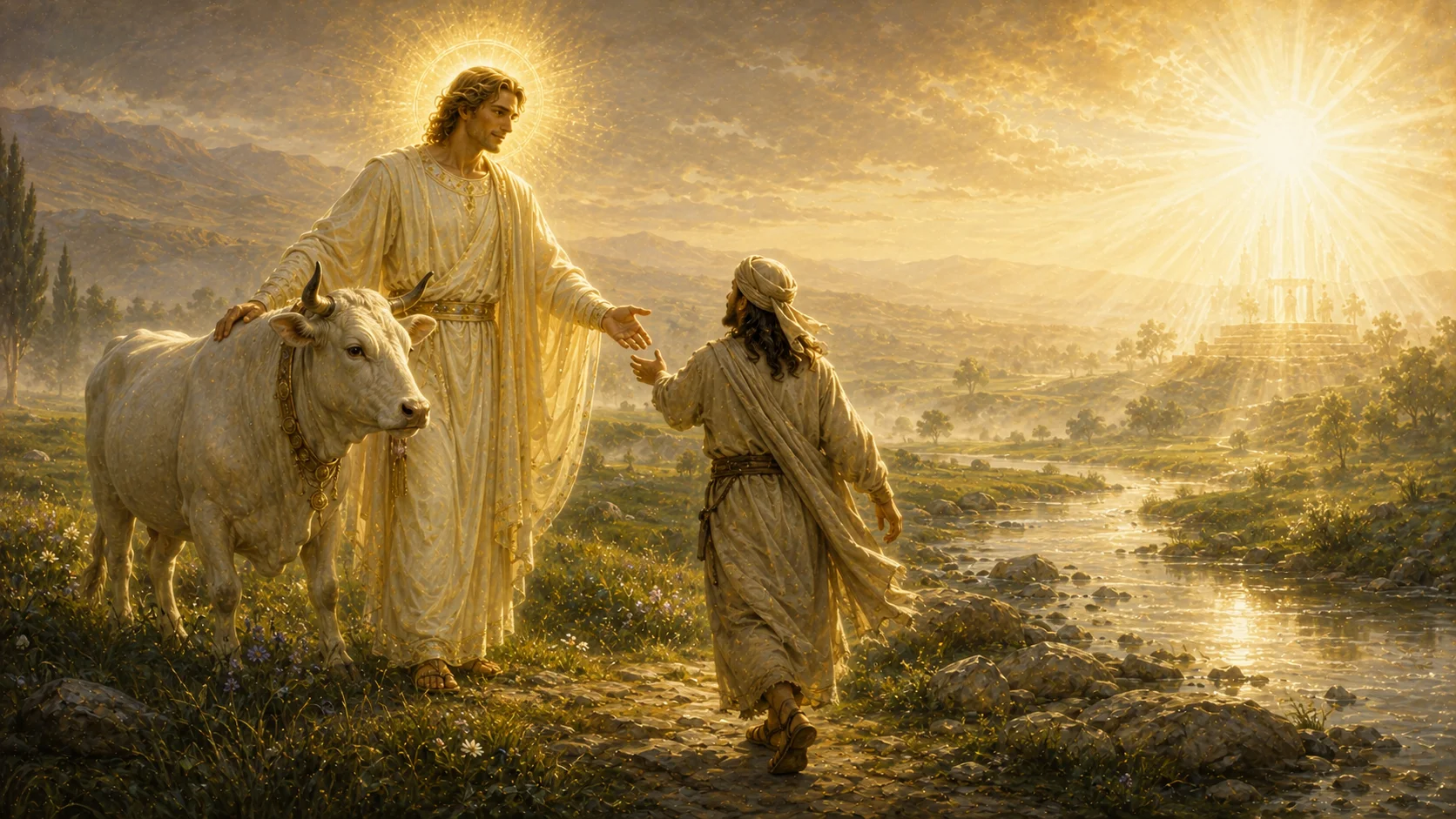
Within the Gathas, Vohu Manah occupies a role of particular intimacy: he is remembered as the one through whom Zoroaster receives vision of and communion with Ahura Mazda. The Gathic verses describe the prophet's soul ascending toward the divine and being greeted along that path, and later tradition has understood Vohu Manah as the mediating presence in that meeting — the Good Mind who leads the seeker toward the Wise Lord and stands as companion at the threshold of revelation. This is one of the most tender images preserved of any Amesha Spenta: not a distant abstraction but a guide who receives the prophet's soul and opens the way to Ahura Mazda's presence.
Watcher at the Chinvat Bridge
The eschatological role of Vohu Manah is elaborated more fully in the later Middle Persian literature than in the Gathas themselves. In texts such as the Bundahishn and the Arda Wiraz Namag, it is Vohu Manah who greets the souls of the righteous dead as they cross the Chinvat Bridge, the bridge of judgment that every soul must pass, and welcomes them onward into paradise. Where the Gathas speak of the soul's ascent toward Ahura Mazda in the company of the Good Mind during life, these later Pahlavi sources extend that same companionship to the moment after death — the Good Mind meeting the good soul at the very gate of the world to come. It is worth noting, in reverence for the sources themselves, that this fuller picture of the Bridge and its welcome belongs more properly to these later Middle Persian texts than to the Gathic hymns, even as the two layers of tradition speak with one voice about who Vohu Manah is.
Keeper of the Herds
Alongside his place in thought and judgment, later Middle Persian sources associate Vohu Manah with the guardianship of cattle and the beneficent animal creation, a role fitting for a faith that took shape among pastoral communities for whom the cow and the herd represented sustenance, wealth, and the visible goodness of creation. In this pastoral dimension, Vohu Manah's care extends beyond the human mind to the animal world that shares in the good creation of Ahura Mazda, a reminder that in Zoroastrian thought the good and the useful in the natural world are themselves worthy of divine protection, not merely instruments for human use.
The Shadow of Evil Thought
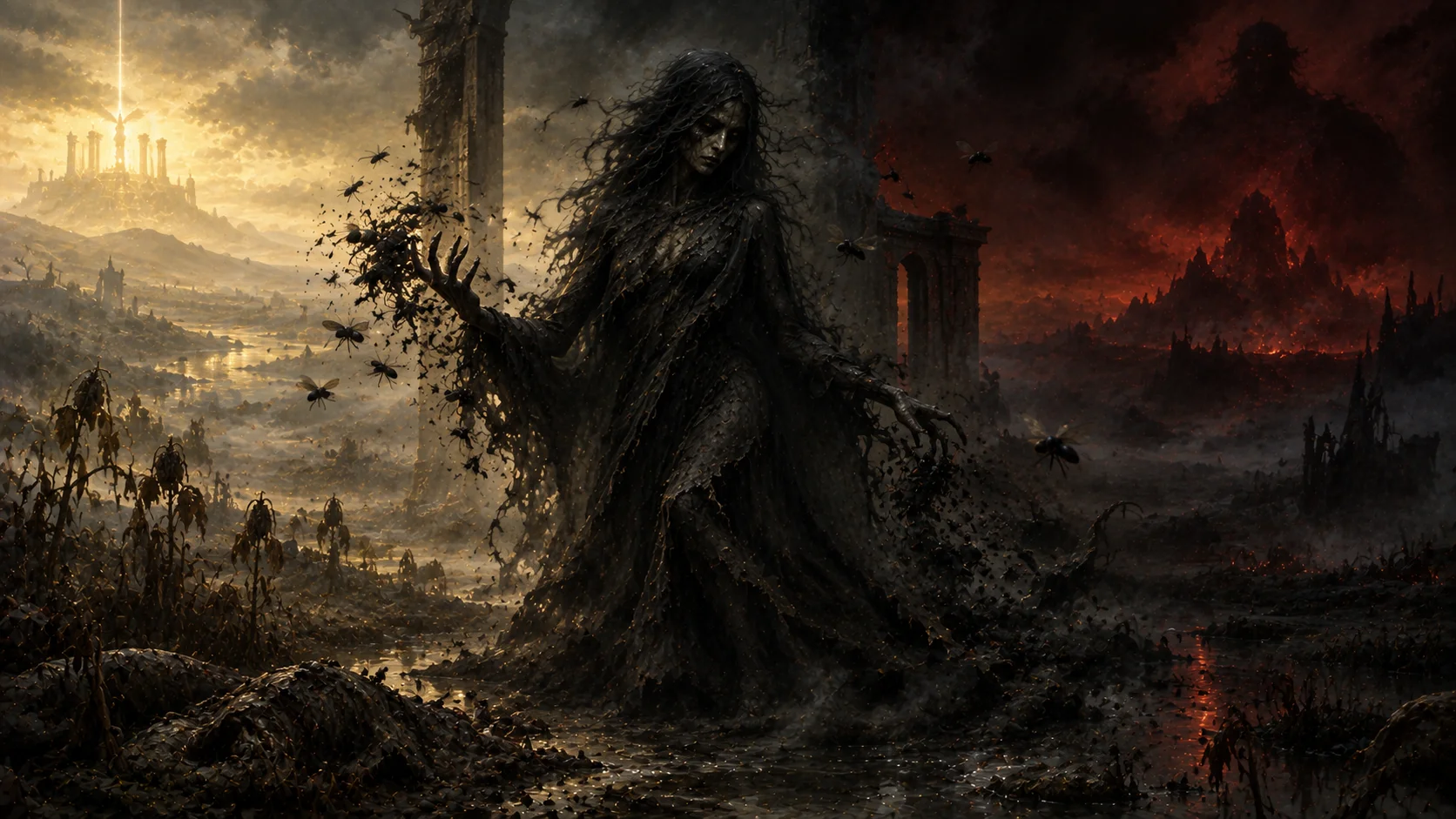
Zoroastrian cosmology is built on a fundamental dualism, and Vohu Manah's opposing force in this scheme is Aka Manah, the "Evil Mind" or "Bad Purpose," a daeva embodying malicious thought and standing as the direct inversion of everything Vohu Manah represents. Where Vohu Manah draws the mind toward Asha and toward Ahura Mazda, Aka Manah draws it toward the Lie. This opposition is not merely a colorful pairing of names; it sits at the very center of the ethical triad of good thought, word, and deed, since the choice between Vohu Manah and Aka Manah is, in Zoroastrian teaching, the choice each mind makes at every moment between righteousness and its opposite.
A Presence Without a Face
Zoroastrianism has traditionally been an aniconic faith, one that does not fashion cult images of its divine beings, and Vohu Manah is no exception. There is no standard anthropomorphic icon of the Good Mind in the core of Zoroastrian religious practice. Later Persian literature did, in places, offer personifications of Bahman as a literary figure, but these belong to poetry and storytelling rather than to doctrine, a secondary flowering of the name rather than a departure from the faith's aniconic character. To hold Vohu Manah in the mind, then, is to hold a quality of thought rather than a face — an approach to the divine that asks the worshipper to look inward rather than toward a carved or painted image.
A Day and a Month Set Apart
The traditional Zoroastrian calendar honors Vohu Manah by name: the second month of the year and the second day of every month are named for Bahman. This calendrical placement echoes his rank as second among the Amesha Spentas, weaving the Good Mind into the ordinary rhythm of time itself, so that the turning of each month carries a small, recurring invitation to good thought. In a religious life organized around such observances, this naming is itself a form of devotion, marking time in a way that keeps Vohu Manah's presence within reach of daily life rather than confined to scripture alone.
An Open Question Among Scholars
Scholars of Zoroastrianism continue to debate, in good faith and without final resolution, the degree to which Vohu Manah and the other Amesha Spentas should be understood as fully personified deities in their own right, as opposed to personified ethical abstractions — vivid names given to qualities of mind and creation rather than independent divine persons in the fuller sense. This question applies to the whole company of the Amesha Spentas and remains genuinely unsettled; it is not resolved by any single passage of the Gathas or the later Pahlavi texts, and Zoroastrian tradition itself has sustained both readings across its long history. Raising the question honestly, rather than forcing an answer either way, is part of treating this living tradition with the care it deserves.
The Good Mind as First Step
Taken together, the strands of Vohu Manah's identity point toward a single, coherent center: he is the Good Mind through whom right thought becomes possible, the guide who leads the prophet's soul toward Ahura Mazda, the presence who welcomes the righteous at the Chinvat Bridge, the guardian of the beneficent herds, and the second-ranked of the Holy Immortals who surround the Wise Lord. In every one of these roles, the same principle recurs — that the good life begins in the mind, in the quiet, deliberate turning of thought toward truth, and that this turning, however small it may seem in a single moment, is the first and necessary step of the whole Zoroastrian ethical path.
Sources & traditions
- EncyclopediaWikipedia — Vohu Manah
- TraditionZoroastrian texts, grimoires and later commentary
Myths change from area to area and from time to time. This chronicle follows the most widely told versions; tellings in other villages, regions and eras may differ.