Zurvan — Avestan and Pahlavi Zurwān, "Time" — stands at the center of Zurvanism, a theological current within Zoroastrianism that reached back before the great contest of Ohrmazd and Ahriman and asked what came first. Where the Gathic hymns of Zarathustra know Ahura Mazda as uncreated and supreme, with Angra Mainyu as his independent, co-eternal adversary, the Zurvanite current proposed a single prior principle: Infinite Time itself, the father from whom both the constructive spirit and the destructive spirit came. No Avestan scripture that survives names Zurvan as supreme god; what is known of this tradition comes chiefly through Pahlavi Zoroastrian writings and through the reports — often hostile, often external — of Armenian, Syriac, and Greek and Manichaean heresiographers. It should be read, from the outset, as a current within a living faith, not a settled or singular doctrine, and one whose surviving voice is largely the voice of others describing it.
The God Who Precedes the Twins
The distinguishing claim of Zurvanism is deceptively simple: before Ohrmazd and Ahriman, there was Zurvan. Time, in this telling, is not a stage on which the drama of good and evil unfolds but the very source of the actors themselves. This is a significant theological move, and later Zoroastrian thinkers recognized it as such. To make Zurvan the father of both spirits is to place their conflict inside a larger, prior unity — a unity that does not itself take sides. Scholars of the tradition, most notably R.C. Zaehner in his 1955 study Zurvan: A Zoroastrian Dilemma, have characterized this as a monist or fatalist reworking of the dualism at the heart of Zoroastrian religion. Whether Zurvan should be understood as a rival theology or as a speculative elaboration growing out of Mazdean thought remains a question scholars continue to weigh, and it is offered here as a live question rather than a settled conclusion.
Zrvan Akarana: Time Without Boundary
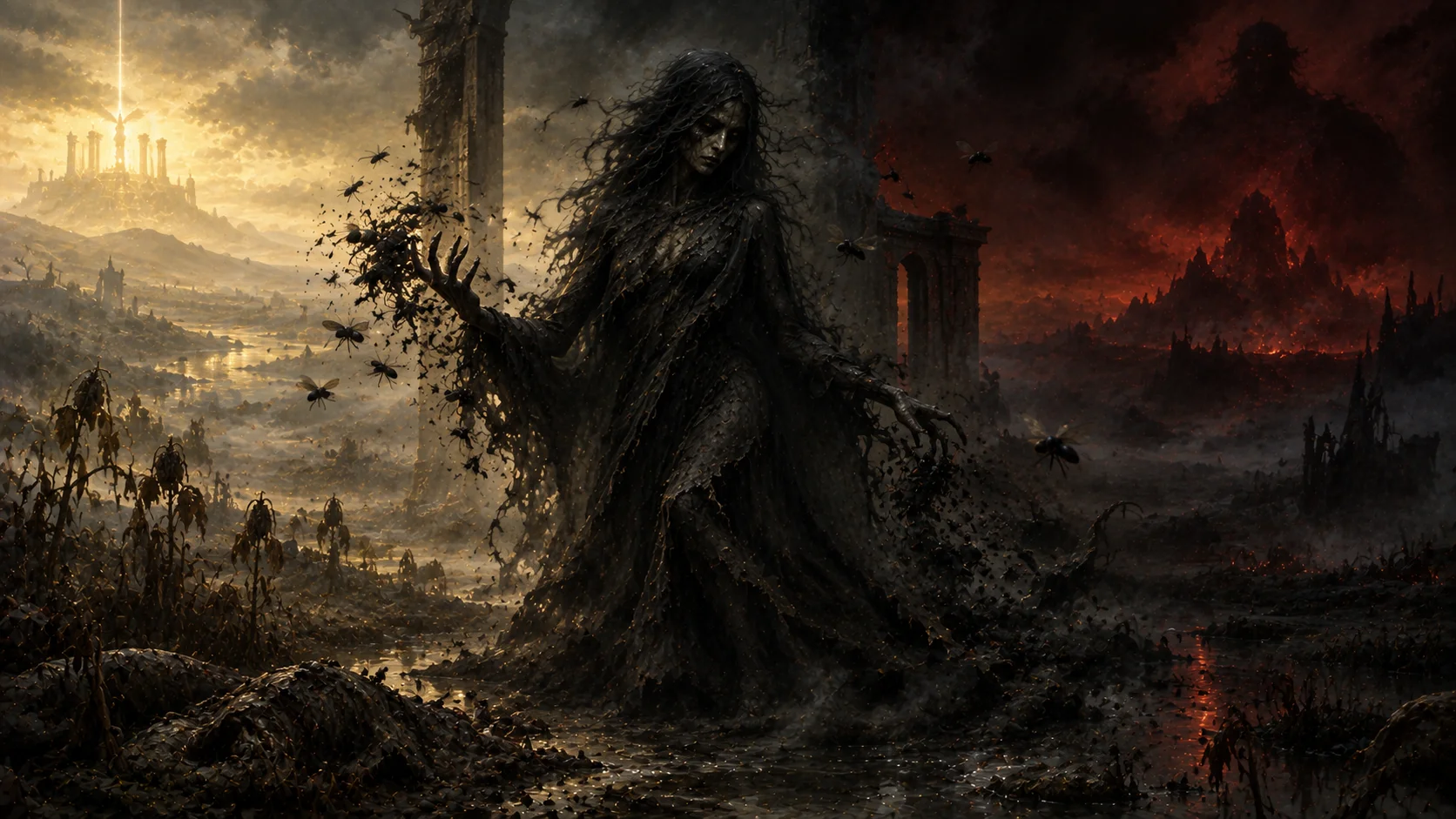
Pahlavi cosmological writing preserves a phrase that carries the weight of this whole current: zrvan akarana, Boundless or Infinite Time. It stands opposite another phrase, zaman ī kanārōmand, the Time of Long Dominion — bounded time, the finite world-age of nine thousand or, in some reckonings, twelve thousand years within which the drama of creation, conflict, and eventual restoration unfolds. Some Pahlavi passages, including material within the Bundahishn, preserve Time as a cosmological category in its own right even in places where the text does not go so far as to make Zurvan the ultimate god. This distinction — between Time as an honored cosmological concept and Zurvan as a personified, worshipped deity — is one that any respectful account of this tradition must hold onto, because the evidence for the two is not the same in kind or in strength.
A Thousand Years of Sacrifice
The myth for which Zurvan is best remembered is preserved in two principal sources: the Armenian bishop Eznik of Kolb's fifth-century work De Deo, and the eighth-century Syriac Book of Scholia of Theodore bar Konai. In this account, Zurvan existed alone, and desired a son. For a thousand years he offered sacrifice toward this end, an act of sustained devotion stretched across a span of time almost too large to hold in the mind — itself a fitting labor for the god who is Time. It is a story about patience and about longing, about a solitary god reaching toward the possibility of offspring, of continuation, of a world beyond himself.
The Doubt That Divided the Womb
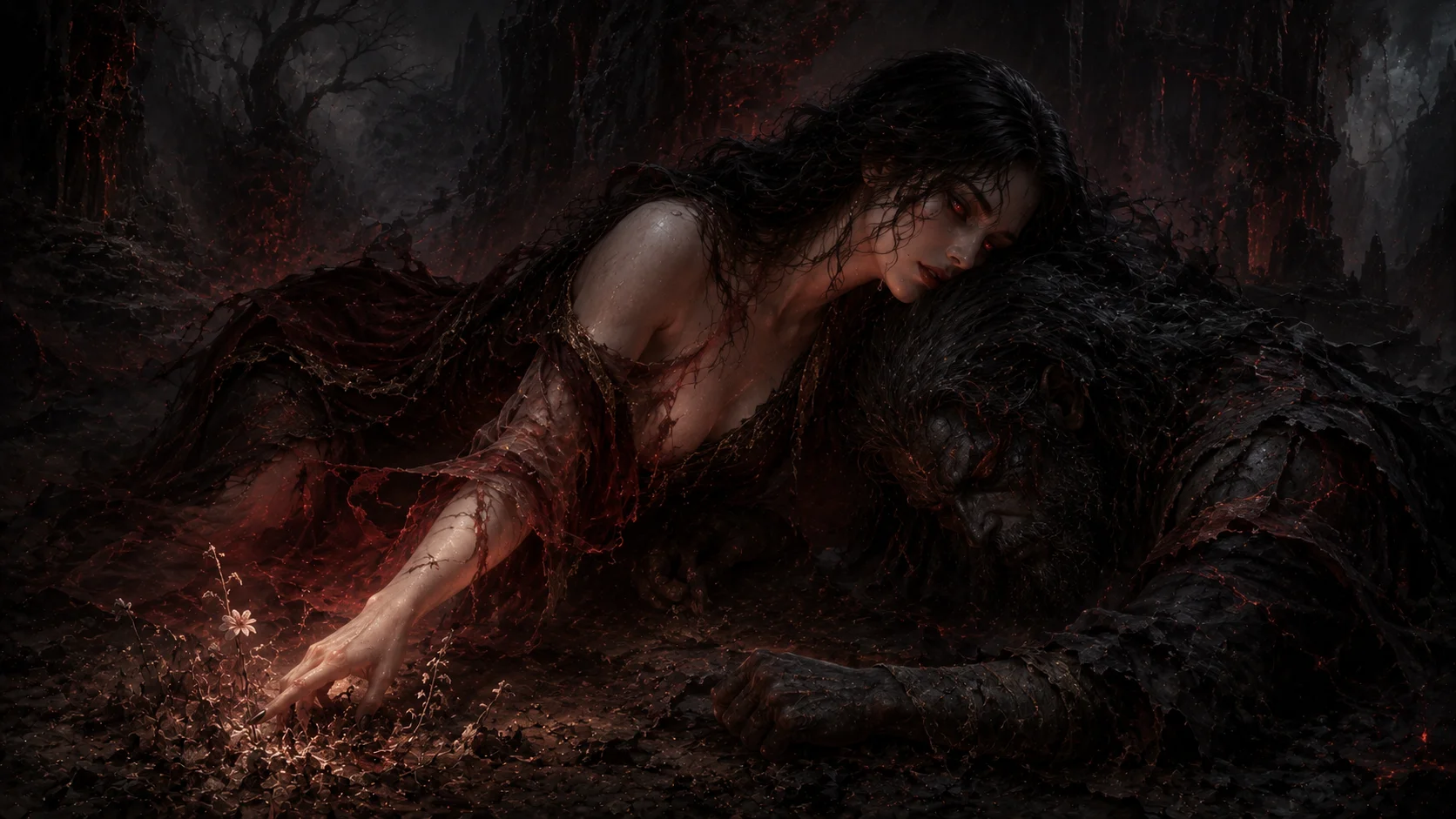
Near the end of that millennium of sacrifice, Zurvan's resolve wavered. He doubted — the sources preserve this plainly — whether the sacrifice would truly bring forth a son. In that moment of doubt, the myth holds, two beings were conceived at once rather than one: Ohrmazd, conceived from the sacrifice itself and from the intention that had sustained it, and Ahriman, conceived from the doubt that had intruded upon it. The theological weight of this detail is considerable and was not lost on later readers: it makes Ahriman's origin a consequence of a moment's uncertainty in the mind of Time, rather than an independent, self-existing principle of evil standing eternally opposite the good. It is precisely this point that made the myth difficult for more orthodox Zoroastrian thought to accept, and that difficulty deserves to be named rather than smoothed over.
The Vow of the First-Born
Aware that twins were coming, Zurvan made a vow: whichever of the two was born first would receive kingship over creation. It is a vow given in the ordinary language of succession and inheritance, the kind a father might make regarding any two sons — and it is precisely this ordinary, binding shape of the vow that drives the rest of the story. A vow made by Time itself cannot be unmade by Time itself; even the god of boundless duration is, within this myth, bound by his own given word.
Ahriman's Theft of the Threshold
Ahriman, the sources report, came to know of his father's doubt and of the vow that followed from it. Rather than wait his turn, he tore his way out of the womb first, seizing by force the primacy that the vow had promised to whoever emerged first. Ohrmazd, the child of the sacrifice, was left to follow. Zurvan, bound by the vow he himself had spoken, could not simply set it aside — and so he was compelled to grant Ahriman a share of dominion, though not the dominion Ahriman had hoped to seize outright. Even here, forced into an uncomfortable concession, Zurvan remains bounded by his own word in a way that gives the myth its particular, almost tragic architecture: a god of infinite time, constrained by a promise made in time.
Nine Thousand Years, and No More
The concession Zurvan granted was not unlimited. Ahriman would hold nominal rule for a bounded period — nine thousand years, in the traditional reckoning — after which dominion would pass irrevocably to Ohrmazd. This is the detail that gives the myth its resolution and its hope: evil's reign, however real and however painful within the world's long age, is not eternal. It is a lease, not a possession, and the term of that lease is set and known. Because it is Zurvan — Time itself — who grants and bounds this reign, the entire cosmic contest between the constructive and destructive spirits is, within Zurvanite thought, subordinated to and resolved within Time's own dispensation. The struggle that Gathic dualism treats as an open contest between two co-eternal principles becomes, here, a drama with a fixed beginning, a fixed duration, and a fixed and certain end.
A Single Root for a Divided World
What Zurvanism offers, taken as a whole, is an answer to a question that dualism by its nature struggles to close: if Ahura Mazda and Angra Mainyu are both eternal and both independent, what unites the world they contend over, and why should the good ultimately prevail rather than the two simply continuing forever in balance? By making both spirits sons of a single father, and by bounding Ahriman's reign within a term that Time itself sets and will one day close, the Zurvanite myth answers both questions at once. It is worth sitting with this as a serious piece of theological reasoning rather than a curiosity: it is an attempt, from within the tradition, to ground the reality of evil and the certainty of its eventual defeat in one and the same principle.
Zurvan and the Kinship of Vayu
Some strands of Zurvanite thought place Zurvan in relation to Vayu, the Avestan god of wind, of open space, and of the liminal — a figure who, like Zurvan, does not sit comfortably on either side of the strict moral axis that divides the forces of Ohrmazd from those of Ahriman. Certain schemes also associate Zurvan with a companion or aspect referred to as Asar Akarana. The degree to which worship or veneration of Zurvan actually overlapped with the older cult of Vayu is a matter scholars continue to debate rather than a settled fact, and it is presented here as such: both figures inhabit a similar conceptual space, as forces that stand outside the good-and-evil axis proper, morally ambiguous by the nature of what they represent — time and space, duration and openness — rather than by any moral failing of their own.
The Sasanian Question
Zurvanism is generally understood to have flourished particularly during the Sasanian period, the third through seventh centuries of the common era, and some sources have suggested that it enjoyed a degree of state patronage during that era. This point, however, is genuinely contested among scholars: Mary Boyce, among the most influential historians of Zoroastrianism, argued that Zurvanism was a heterodox current held by a minority rather than the orthodoxy of the Sasanian state itself. The honest position is that the extent of Zurvanism's official standing under the Sasanians remains an open question in the scholarship, not a settled matter, and any account that presents it as certainly the state religion — or certainly a marginal sect — is overstating the evidence in one direction or the other.
Voices That Preserved Him: Eznik and Theodore bar Konai
Because no Zurvanite scripture survives in its own voice, what is known of Zurvan comes down through those who described the tradition from outside it, often in order to argue against it. Eznik of Kolb, writing in Armenian in the fifth century in his refutation of rival beliefs, preserved the core myth of the sacrifice, the doubt, and the twins. Theodore bar Konai, writing in Syriac in the eighth century, preserved a parallel account in his Book of Scholia. That the fullest surviving versions of this myth come from Christian heresiographers writing to refute it is itself an important piece of context: it means the story reaches us filtered through polemical purpose, and it is right to hold the details with appropriate care rather than treat them as a neutral transcription of Zurvanite belief in its own words.
The Four-Faced Question: An Unconfirmed Image
Time, by its nature, resists the kind of fixed cult image that a god of the hearth or the harvest might receive; Zurvan has no conventional cult statue or settled iconography comparable to the winged-disk imagery associated with Ahura Mazda in Zoroastrian material culture. Some scholars have proposed that certain Sasanian-era four-faced or Janus-like figures — images that might correspond to a fourfold concept of seasons or directions bound up with the idea of zrvan — could represent Zurvan in visual form. This proposed identification remains speculative and unconfirmed, offered as a scholarly hypothesis rather than an established fact, and it deserves to be presented that way: an intriguing possibility, not a settled likeness of the god of Time.
The Orthodox Rejection of the Father of Two Sons
The very feature that gives the Zurvanite myth its theological power — a single father for both the good spirit and the destructive spirit — was exactly what more orthodox Mazdean thinkers could not accept. To make Ahura Mazda begotten, and to make him the sibling rather than the sole and unbegotten sovereign of existence, was seen by these thinkers as a compromise of Ahura Mazda's absolute supremacy. Pahlavi materials in the Denkard tradition, including the ninth or tenth century Zand-i Wahman Yasn, reflect this pushback, though direct and systematic anti-Zurvanite polemic has not survived evenly across the textual record. This tension between the two currents — one holding Ahura Mazda as first and unbegotten, the other placing Time before him as father — is not a minor footnote but the central fault line running through the entire history of how Zurvan has been understood, and it is offered here without resolving it in either direction, since the tradition itself did not resolve it uniformly.
Zurvan's Afterlife Among the Manichaeans
The concept of Zurvan reached beyond the boundaries of Mazdean religious communities. Manichaean texts in Middle Persian use the name Zrwan for a supreme Father of Greatness within their own cosmology, and Manichaean and Zoroastrian polemical writings alike sometimes speak of a figure described as Zurvan, King of Paradise, absorbed into that separate cosmological system. This should be understood as a distinct and later development — a testament to how far the idea of a primordial Time-god traveled across religious boundaries in late antiquity — rather than as part of core Zoroastrian orthodoxy or as evidence about what Zurvanites within Zoroastrianism itself believed. Syncretism of this kind speaks to the reach of the concept; it does not describe the Zurvanite current in its original religious home.
Time in the Watches of the Faithful
Even where cultic worship of Zurvan as a personified god cannot be firmly attested — and the evidence for such worship remains comparatively thin, and mostly polemical or external in origin — the vocabulary of time retained a place within Zoroastrian ritual life more broadly. The gahs, the watches into which the Zoroastrian day is divided, are conceptually tied to divisions of time in ways that echo the reverence the tradition has long held for time as a meaningful, almost sacred, structure of existence. This liturgical use of the language of time should be held apart from the specific claim that Zurvan was worshipped as supreme god; the two are related by theme, but they are not the same evidence, and a careful account keeps them distinct. What remains, across scripture, polemic, and the quiet architecture of the daily watches alike, is a tradition that took with great seriousness the question of what Time itself might mean before a good and just world, and before the long contest between the spirit that builds and the spirit that destroys, had even begun.
Sources & traditions
- EncyclopediaWikipedia — Zurvanism
- TraditionZoroastrian texts, grimoires and later commentary
Myths change from area to area and from time to time. This chronicle follows the most widely told versions; tellings in other villages, regions and eras may differ.