Mihr is the Armenian reflex of the Iranian god Mithra, carried into the Armenian highlands through Achaemenid and, above all, Parthian-Arsacid religious and cultural influence. Worshipped as a god of light, fire, and the sun, he continued Mithra's ancient Iranian associations with celestial radiance, the keeping of oaths, and the cosmic order the Iranian tradition called asha, or arta. His principal cult center stood at the temple of Bagayarich, in the district of Derjan, one of the handful of great pre-Christian temple-cities of Armenia, ranked alongside Ani-Kamakh, Til, Artashat, and Ashtishat. The chronicler Agathangelos names him among the sons of Aramazd, part of the same divine household as Anahit and Nane, and records that King Trdat III himself performed rites at Mihr's temple in the years before his conversion to Christianity.
A Light Carried Across the Mountains
Mihr did not arrive in Armenia as a foreign import grafted awkwardly onto native soil. He arrived the way a river arrives at a new course: following channels already carved by centuries of contact. The Achaemenid Persian administration first brought Iranian religious forms into the Armenian highlands, and the Parthian Arsacid dynasty, which for centuries held the Armenian throne through a cadet branch of its own royal house, deepened that influence into something closer to shared religious vocabulary than borrowed custom. Mithra's cult had never been confined to Iran proper; wherever Iranian political and cultural authority reached, the god of light and covenant tended to be honored in some form suited to the place. In Armenia, that form became Mihr.
The God of the Radiant Sky and the Sacred Flame
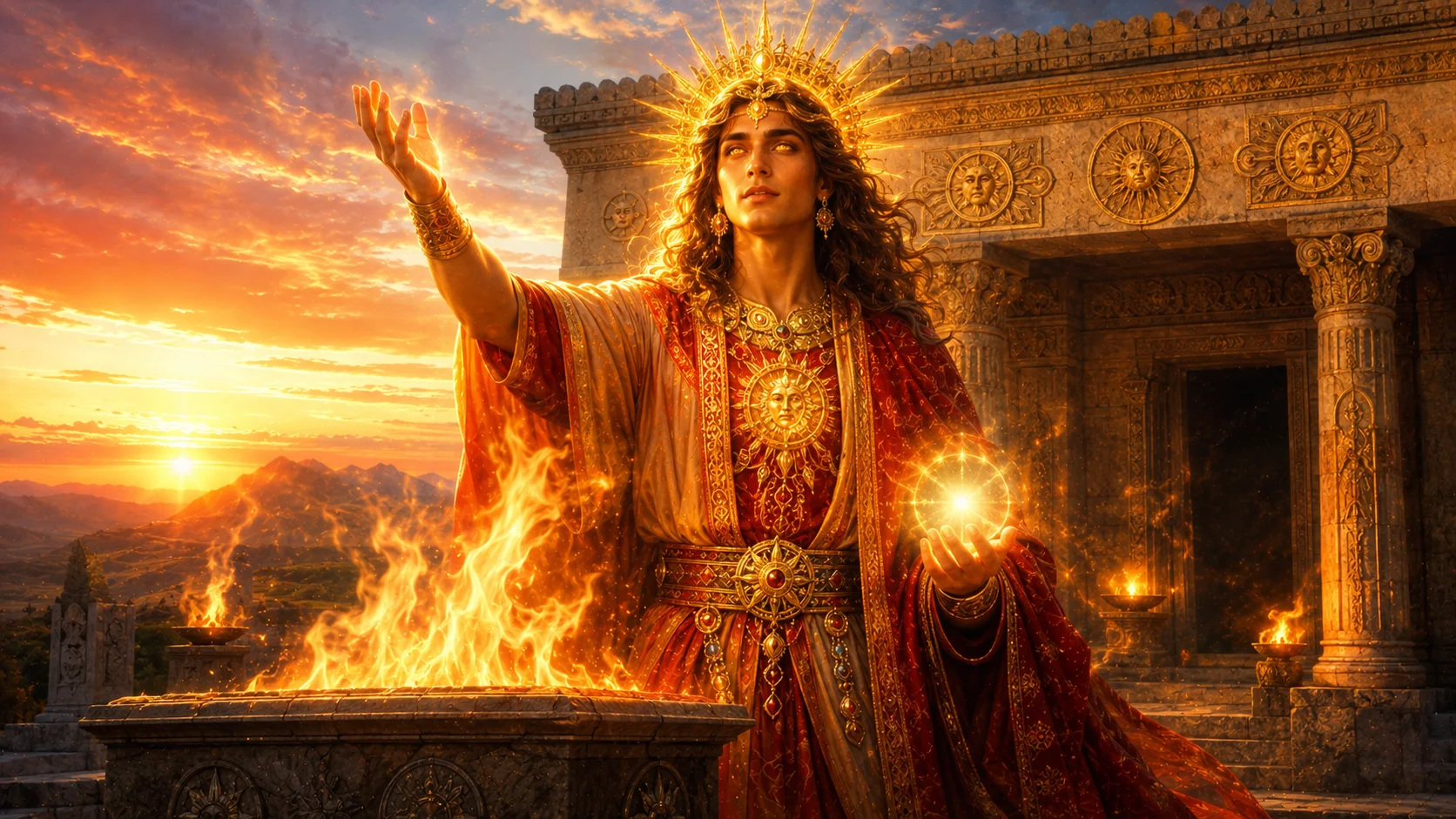
To call Mihr a sun god understates what he was. In the Iranian conception that Armenia inherited, Mithra governed the great, visible workings of the ordered cosmos: the light that fills the sky between dawn and dusk, the fire that burns on the hearth and the altar, and the invisible bond that holds an oath together once it has been sworn. These were not three separate provinces awkwardly assigned to one deity but a single continuous idea — that truth, light, and order are the same substance seen at different scales. Mihr watched over the sun's course because the sun was the most visible proof of cosmic order functioning correctly, day after day. He watched over fire because fire was that same order made available to human hands, kindled on an altar rather than fixed in the heavens. And he watched over oaths because a broken promise was, in this understanding, a small tear in the same fabric that held the sun in its course.
Fire as the Living Medium of His Worship
Where other gods might be approached through image, libation, or sacrifice alone, Mihr's worship centered on fire itself as the working medium of contact between the human and the divine. This connects Armenian cultic practice to the broader current of Zoroastrian fire veneration that ran through the Iranian world, in which flame was not merely symbolic of a god but was treated as inherently sacred, requiring careful tending and a dedicated architecture to house it. The temple at Bagayarich is thought to have combined Hellenistic architectural form — the columned, templar style that had spread through the region since Alexander's conquests — with ritual fire practice of Iranian derivation. The precise liturgical details of what occurred within its walls are far less documented than comparable Iranian fire cult practice, a gap that reflects how much of Armenia's pre-Christian religious life survives only in fragments, filtered through the pens of later Christian chroniclers who had every reason to describe such rites sparingly.
Bagayarich, House of the Flame in Derjan
The temple of Bagayarich, sometimes rendered Bagaharich, stood in the district of Derjan as Mihr's principal sanctuary, one node in a network of great temple-cities that structured pre-Christian Armenian religious life. Ani-Kamakh, Til, Artashat, and Ashtishat each held their own patron cults and their own ceremonial weight; Bagayarich's distinction was that it belonged to the god of the sacred fire. Agathangelos records that Trdat III, the king who would later become Christianity's champion in Armenia, performed rites there as part of the state-patronized pagan religious order of Arsacid Armenia — a detail that testifies to how thoroughly Mihr's cult was woven into royal and civic life, not confined to private devotion but bound up with the legitimacy of the crown itself. Bagayarich's temple did not survive the transformation that swept Armenia at the turn of the fourth century. Agathangelos describes it as destroyed in the anti-pagan campaigns that followed Trdat's conversion, one casualty among many as the old temple-cities were dismantled under the direction of Gregory the Illuminator.
A Day of the Month Set Aside in His Name
Some scholars, notably James Russell, have argued that the Armenian calendar itself preserves evidence of how deeply Mihr's cult had taken root. In the Zoroastrian calendrical system, the sixteenth day of every month was dedicated to Mithra by name. Russell's proposed link between Armenian calendar-naming conventions and this same practice is offered as evidence of institutional cult depth — the idea that a god embedded merely at the level of folk devotion rarely leaves a mark on something as formal and administratively maintained as a civic calendar. A calendar that sets aside a recurring day for a god implies priesthoods, temple schedules, and a populace that structured ordinary time around his observance, not simply a deity invoked in moments of personal need.
Distinguished From, Yet Standing Beside, Vahagn
Mihr is sometimes loosely grouped in the popular imagination with Vahagn, the great dragon-slaying warrior god of the Armenian pantheon, but the two are conceptually and genealogically distinct figures who happen to share a family tree rather than a function. Vahagn descends from the Iranian Verethragna, the god of victory and martial triumph, a figure of storm and violent heroism. Mihr descends from Mithra, a god of light, oath, and order rather than of the specific work of battle. Both are counted among the sons of Aramazd in Agathangelos's account, and both carry forward distinct threads of Iranian religious inheritance into Armenian form, but conflating them collapses two separate strands of that inheritance into one, losing the particular character each god was understood to hold.
Cousin, Not Child, of the Roman Mysteries
It is worth stating plainly what Mihr is not: he is not a derivative of the Roman mystery cult of Mithras that spread through the legions and cities of the Roman Empire in the first centuries of the common era. Armenian Mihr and Roman Mithras are cognates, not parent and offspring — both descend independently from the same original Iranian god Mithra, following separate historical paths of transmission into two very different religious cultures. The Roman mysteries developed their own elaborate iconography, initiatory grades, and cave-sanctuary architecture largely within a military and urban Roman context; Armenian Mihr developed within a Zoroastrian-influenced highland kingdom with its own temple-city structure and its own royal patronage. They are, in the truest sense, distant relatives who never met.
A Face Reconstructed, Not Recovered
No securely attested Armenian cult image of Mihr survives. This absence is worth sitting with rather than rushing past, because it shapes everything that can honestly be said about his appearance. When modern accounts describe him with a radiate crown, or note solar and bull associations, these details are drawn from comparative evidence in Iranian and Mithraic religious art elsewhere, not from any Armenian artifact excavated at Bagayarich or any other Armenian site. The reconstruction is reasonable, given how closely Armenian Mihr tracks his Iranian original in every attribute that is attested, but it remains inferential — a portrait assembled from a cousin's likeness rather than his own.
The Gate at Van and the Rock That Would Not Open
Near Van stands a monumental rock-cut sanctuary known as the Portal of Mher, or Mheri Dur — a site whose scale and situation mark it as a place of real cultic significance in its own era. Over time this physical site became bound up with a separate, later strand of tradition: the epic figure of Mher found in the Armenian national epic cycle. The rock sanctuary near Van gave a fixed, monumental location to a name and a set of associations that would eventually be absorbed wholesale into epic narrative, giving the epic hero a literal address in the landscape rather than a purely legendary one.
Younger Mher and the Long Wait Inside the Stone
In the Sasna Tsrer, the Daredevils of Sassoun, the great Armenian national epic, a hero known as Younger Mher appears in the epic's final movement. Scholars widely regard this figure as a euhemerized folk-epic continuation of the god — meaning that a once-divine figure has, over generations of retelling, been reshaped into a human hero within a genealogical, heroic narrative, his divinity submerged but not entirely erased. Younger Mher's story ends not in death but in a singular and haunting suspension: he is imprisoned within the rock at Van, sealed away rather than allowed to die or to remain free, and tradition holds he will emerge only at the world's end. It is a fate that echoes, whether by direct inheritance or by later reinterpretation, the older god's own association with light that returns without fail, day after day, never extinguished for good.
What the Rock Actually Proves, and What It Does Not
Folklorists remain genuinely divided on exactly how much theological continuity runs between the temple-god of Bagayarich and the epic hero imprisoned at Van. One position holds that this is real cultic survival — that communities who once brought offerings to Mihr's flame continued, in some transmuted form, to carry his memory forward through story after the temples themselves had been razed. The opposing position holds that the connection is largely onomastic and topographic: that a shared name and a shared monumental site were enough, on their own, for later tradition to weave a new hero's tale around an old location, without any unbroken thread of devotion connecting the two. Both readings take the evidence seriously; neither claims certainty the sources do not support. What can be said without dispute is that the name endured, that the rock endured, and that whatever passed between the god and the hero across the centuries of Armenia's Christianization did not sever the place from its memory.
Standing at the Edge of a Vanished Order
Christianization under Trdat III and Gregory the Illuminator brought the formal end of Mihr's public cult, traditionally dated to 301 CE, though scholars continue to debate the exact decade with more precision than the sources themselves can bear. What is not in question is the scale of the change: temple-cities that had structured Armenian religious, civic, and calendrical life for generations were dismantled within a single royal generation, their fire-altars extinguished, their priesthoods disbanded. Mihr's own sanctuary at Bagayarich went the way of the others. And yet the god's name did not vanish with his temple. It survived in a calendar day, in a monumental rock face above Van, and in the sealed, waiting figure of a hero who — like the sun the old god once governed — was never understood to be gone for good, only withheld until the world was ready to see him again.
Sources & traditions
- EncyclopediaWikipedia — Mihr (Armenian deity)
- TraditionArmenian folk and village traditions
Myths change from area to area and from time to time. This chronicle follows the most widely told versions; tellings in other villages, regions and eras may differ.