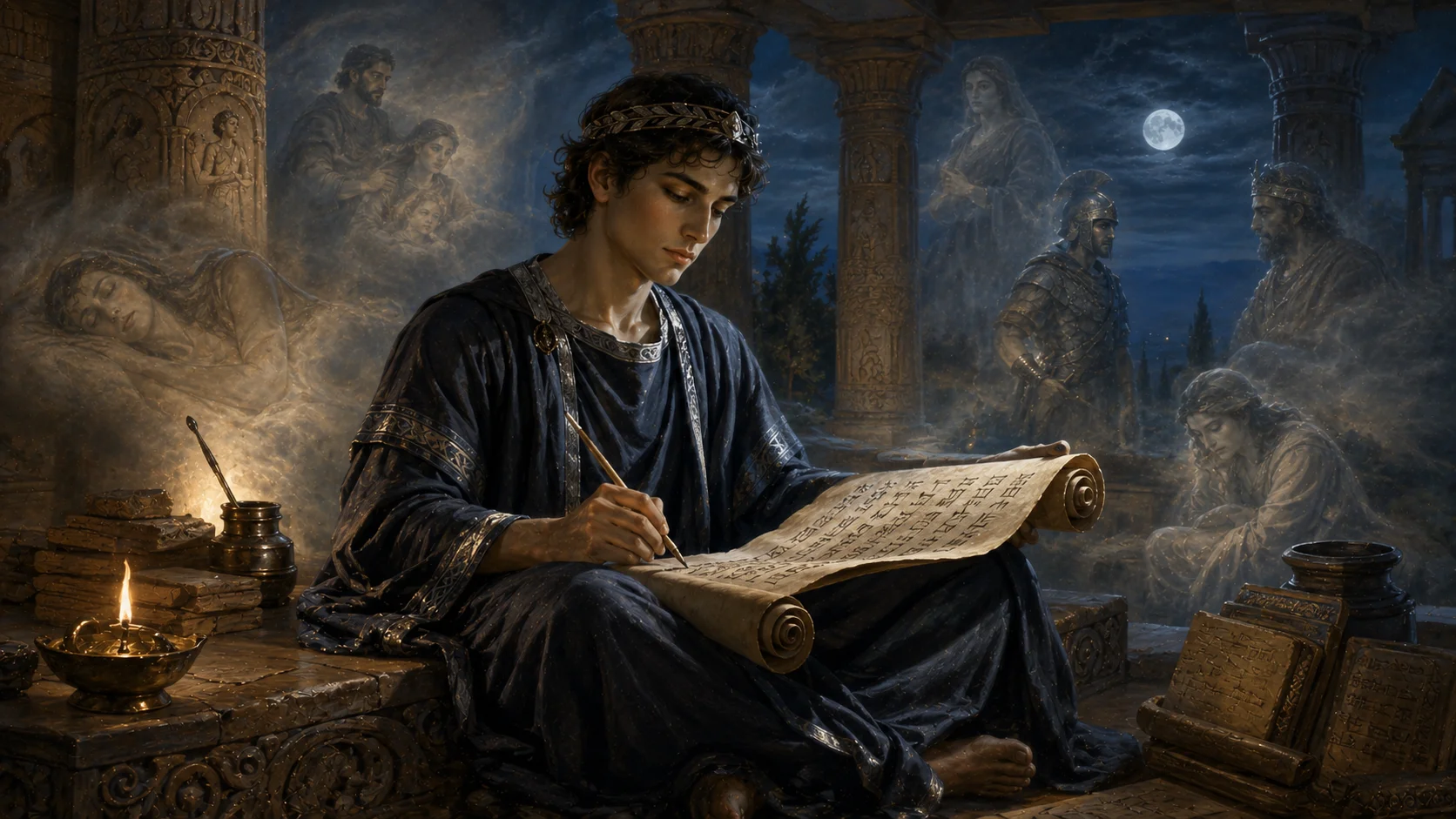
Tir, also rendered Tiur or Tʻir, was the Armenian god of writing, wisdom, learning, and the interpretation of dreams, and served as scribe to the chief god Aramazd within the pre-Christian Armenian pantheon. Honored as the recorder of human deeds and the guide who received petitioners' dreams as messages from the divine, Tir occupied a position of genuine standing among the gods of ancient Armenia, not a minor or purely local one.
The Scribe Who Stood Beside Aramazd
In the hierarchy of the Armenian pantheon, Tir held a defined and subordinate office: he was Aramazd's scribe, attested in classical Armenian sources under the designation Tir Aramazday Dpir, "Tir, scribe of Aramazd." This was not a poetic flourish but a functional title, describing a god whose task was to serve the supreme deity directly, recording what needed to be recorded and carrying what needed to be carried between the divine and human worlds. The structure recalls the broader Zoroastrian-influenced shape of the reconstructed Armenian pantheon, in which lesser gods and spirits attend a supreme figure much as the Amesha Spentas and Yazatas attend Ahura Mazda in Zoroastrian belief. Armenia's religious world, especially under Parthian and Arsacid influence, absorbed this Iranian sense of celestial hierarchy, and Tir's placement as secretary to Aramazd is one of its clearest surviving expressions.
An Iranian Inheritance, Imperfectly Traced
Scholars widely connect Tir's name and functions to the Iranian deity Tir of Zoroastrian religion, a figure associated in Middle Persian tradition with the planet Mercury and with astral and scribal roles. The connection reflects the deep and lasting Iranian religious influence on Armenia across the Achaemenid and especially the Parthian and Arsacid periods, when Zoroastrian-descended cults left a durable mark on Armenian worship. Yet the exact line of descent is not settled. Iranian religion itself preserves more than one figure bearing the name or function of Tir across different periods, and some scholars caution against too readily equating the Armenian god with Tishtrya, an Iranian deity of rain and the star Sirius who is technically distinct from the Mercury-associated, scribally inclined Tir of later Zoroastrian tradition. Which Iranian prototype most directly shaped the Armenian Tir remains an open question in Armenological philology, and it is more honest to present it that way than to resolve it definitively.
The Shrine Where Dreams Were Read
Classical sources, chiefly the fifth-century writer Agathangelos, record a temple or shrine to Tir near Artashat, the ancient Armenian capital, in a location associated with the name Erazamoyn and the site called Grits. This shrine functioned as a center for the interpretation of dreams and for oracular consultation. Petitioners are reported to have come there to sleep, seeking dream-oracles thought to convey the will of the gods, a practice that invites comparison with the incubation rites of Greco-Roman antiquity, such as those performed at the temples of Asclepius. The comparison is useful for picturing the general shape of the practice, but it should not be mistaken for a claim that Armenian incubation followed the same ritual forms as its Greek counterpart. The Armenian textual record preserves the fact of dream-interpretation at Tir's shrine without the layered ritual detail that survives for other ancient incubation cults, and that gap in the evidence is worth stating plainly rather than filling in with invention.
Recorder of Deeds, Carrier of the Gods' Will
As scribe to Aramazd, Tir's defining task was to record: to set down the deeds of mortals and, in his role interpreting dreams, to communicate the will of the gods to human beings. This dual function, writing and revealing, made him something more than a court secretary; he was the channel through which divine intention became legible to people. In this sense his cult joined two things that ancient Armenian religious life treated as related: the discipline of writing and the practice of divination. A person who wished to know what the gods intended, or who sought insight into a troubling dream, turned to the god whose office was precisely to hold and transmit that knowledge.
A Psychopomp Among the Pantheon's Principal Gods
Tir was also associated with escorting the souls of the dead, a psychopomp function that situates him alongside comparable figures in neighboring religious traditions, such as Hermes Psychopompos in Greek religion, or Mercury, with whom the Iranian Tir was himself astrally linked as the god of that planet. Classical-influenced writers sometimes glossed Tir as an Armenian counterpart to Apollo or to Hermes, a reflection of Hellenistic syncretism rather than a native one-to-one Armenian equivalence, and that distinction matters: the Greek names were an interpretive convenience for outside observers, not titles the Armenian cult used of itself. According to Movses Khorenatsi's account of the temple complex at Ashtishat in Taron, Tir belonged to the same major cultic grouping as Vahagn and Astghik, a placement that confirms his standing among the pantheon's principal gods rather than at its margins.
Grogh: The Writer Who Endured Past the Old Religion
Tir carried the epithet Grogh, Armenian for roughly "the Writer" or "the Scribe," and this title is thought to have survived into the post-Christian folk imagination in the figure of Grogh Հրեշտակ, the "Recording Angel" or "Writing Angel," believed in later Armenian folk belief to appear at the hour of death and to record a person's deeds. Scholars treat this as a Christianized folkloric survival of the earlier pagan Tir, and the connection is a probable reconstruction drawn from folklore rather than an unbroken textual chain that can be traced document to document. It is nonetheless a striking case of how a divine function, the recording of human deeds by a scribal figure who meets the soul near death, persisted in altered form long after the formal cult of Tir had ended.
Patron of a Culture Not Yet His Own
Tir's domain over learning and the arts led some later commentators to see him as a patron of literacy and scribal culture in the broadest sense. This reading gains resonance from Armenia's later, distinctly Christian-era reverence for the written word, which followed Mesrop Mashtots's invention of the Armenian alphabet in the fifth century and which shaped Armenian cultural memory profoundly. It is worth being precise here: that later flowering of literary devotion belongs to Christian Armenia and to Mashtots's achievement, not to Tir's pagan cult itself. The two are related only by a shared reverence for writing across very different religious worlds, and collapsing them into a single continuous story would overstate what the pagan cult of Tir actually held.
A Month Bearing His Name
Indirect evidence for how deeply Tir's cult was woven into ordinary Armenian life comes from the old Armenian calendar, whose eighth month, Trē, is generally connected by philologists to Tir's name. A god embedded in the calendar itself, marking time for an entire society rather than presiding only over a single temple, speaks to a cult that reached well beyond a priestly or scholarly elite into the everyday rhythms of pre-Christian Armenian religious life. As with the Iranian derivation of his name, the precise etymological chain linking the month to the god is treated by Armenologists as probable rather than beyond dispute, but the convergence of calendrical and textual evidence gives the connection real weight.
What the Silence of the Ground Tells Us
Unlike Anahit, whose bronze cult image survives to give her a tangible archaeological presence, no securely identified cult statue or temple architecture belonging to Tir has been recovered with certainty. What is known of his worship rests almost entirely on the textual witness of Agathangelos and Movses Khorenatsi, supplemented by comparison with Iranian religious data. This is a real limitation on how fully his cult can be described, and it is better to name that limitation directly than to reconstruct ritual detail the sources do not actually provide. The absence of physical remains does not diminish the coherence of what the texts do preserve: a scribe-god, subordinate to Aramazd, presiding over writing, dream-interpretation, and the passage of souls, embedded enough in daily life to lend his name to a month of the year.
A God Defined by What He Carried
Taken together, the surviving evidence describes Tir less as a god of abstract wisdom in the manner of a philosopher-deity and more as a god of transmission: the one who moved knowledge from the divine sphere into human hands, whether as a written record of deeds, a dream carrying the will of the gods, or a soul being guided onward at the end of life. His office beside Aramazd, his shrine of dream-interpretation near Artashat, his membership among the principal gods honored at Ashtishat, and his long afterlife in the folk figure of the Recording Angel together sketch a deity whose authority lay not in thunder or war but in the quieter, no less essential work of writing things down and making them known.
Sources & traditions
- EncyclopediaWikipedia — Tir (god)
- TraditionArmenian folk and village traditions
Myths change from area to area and from time to time. This chronicle follows the most widely told versions; tellings in other villages, regions and eras may differ.