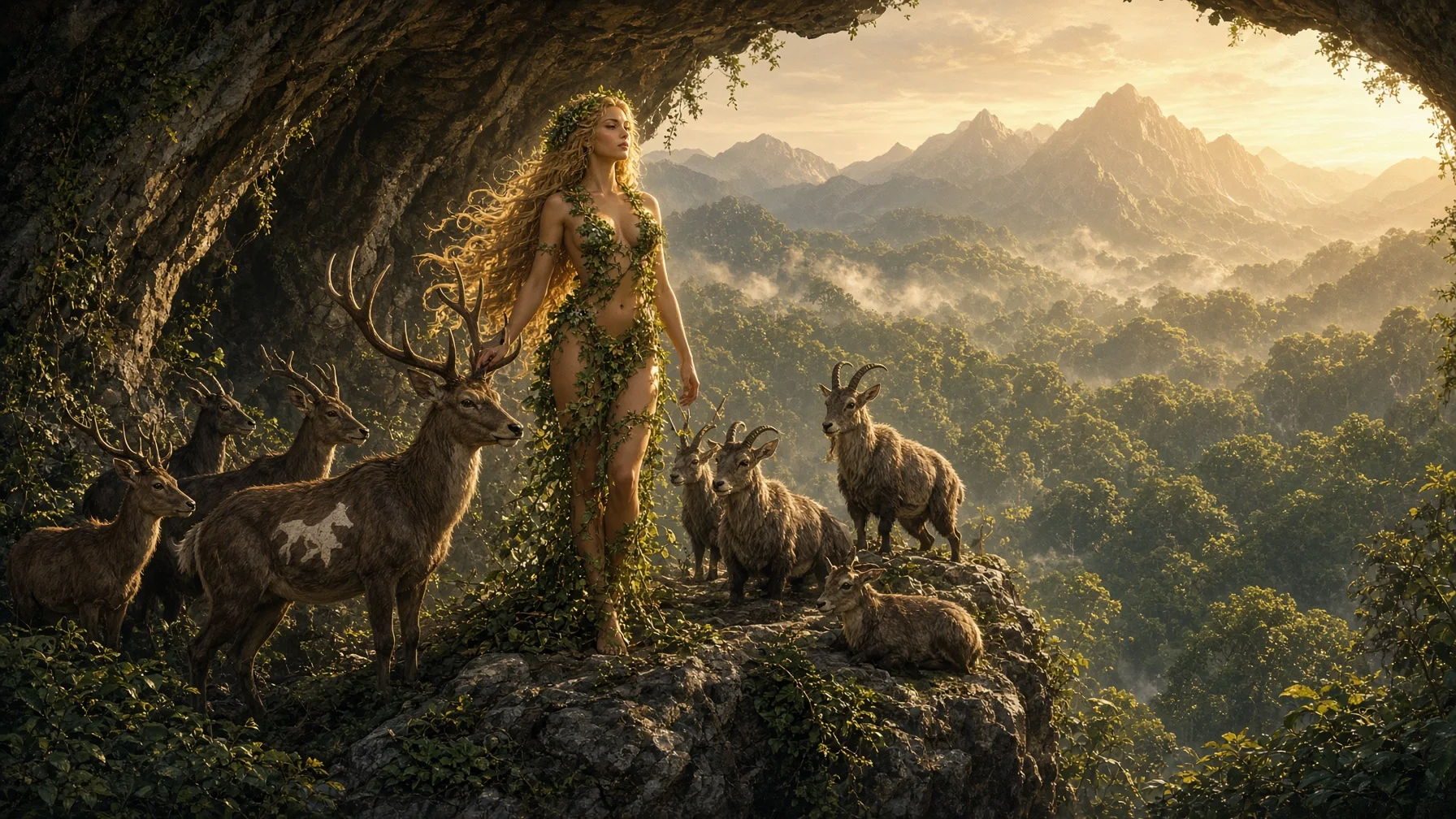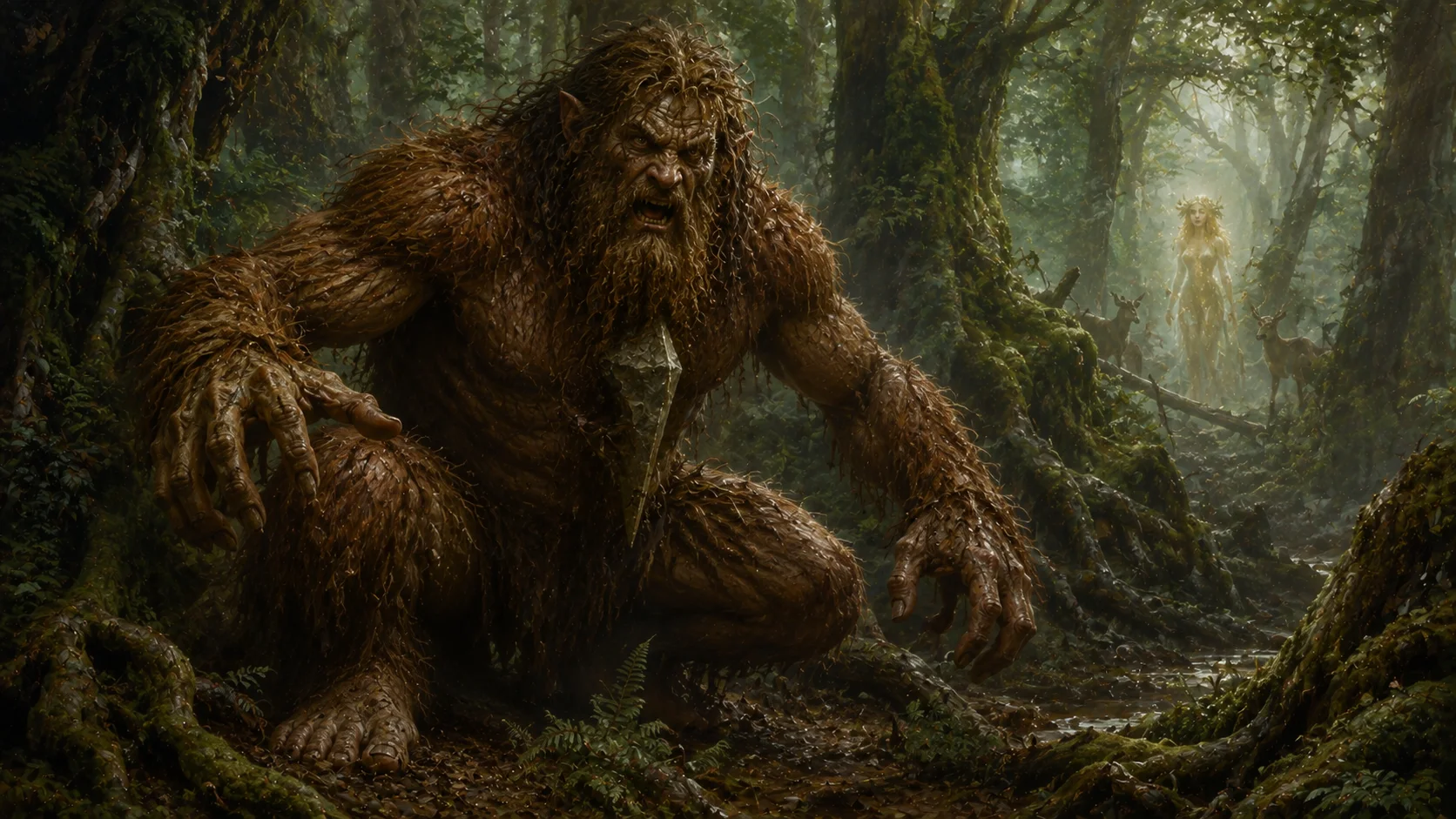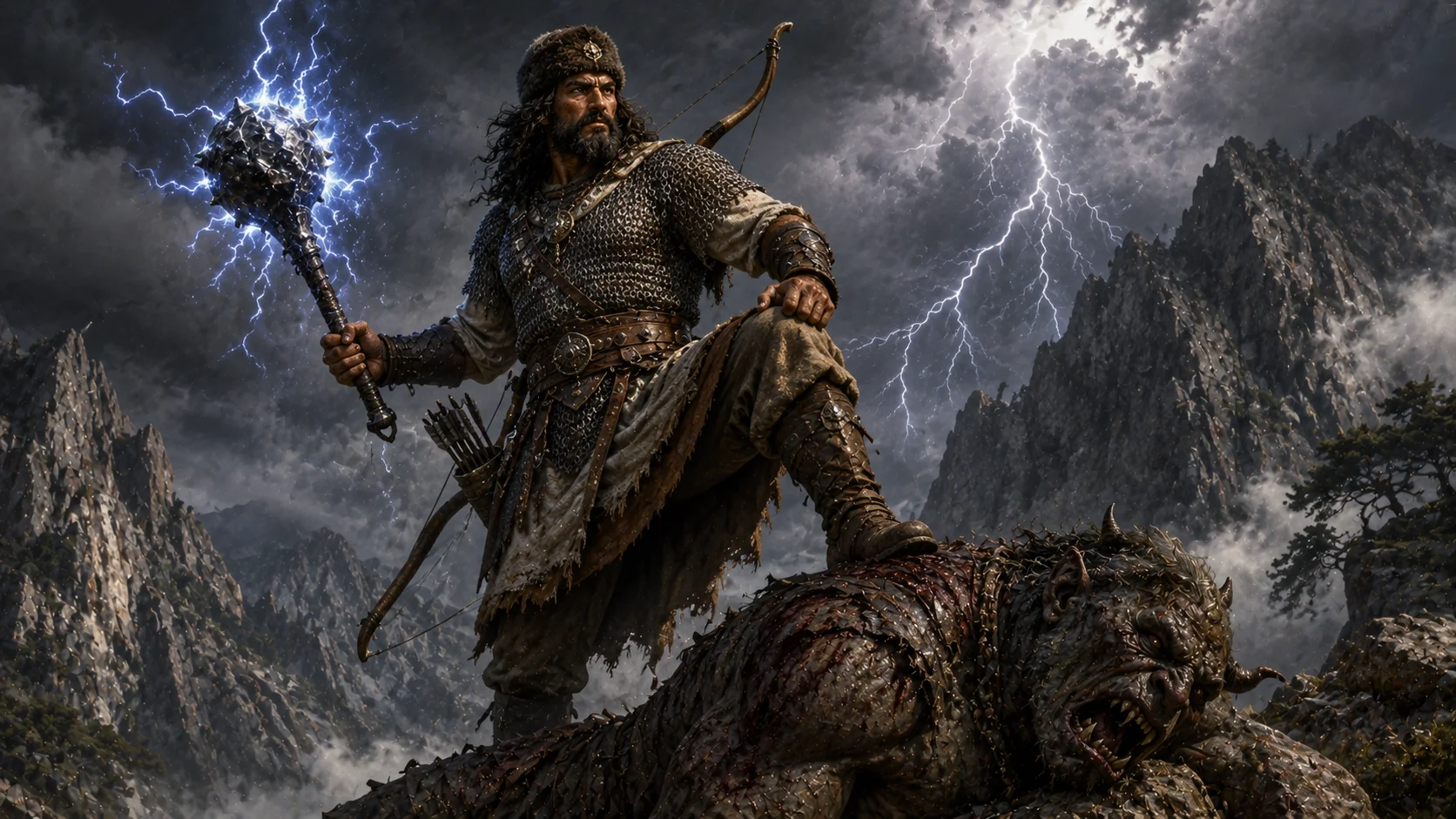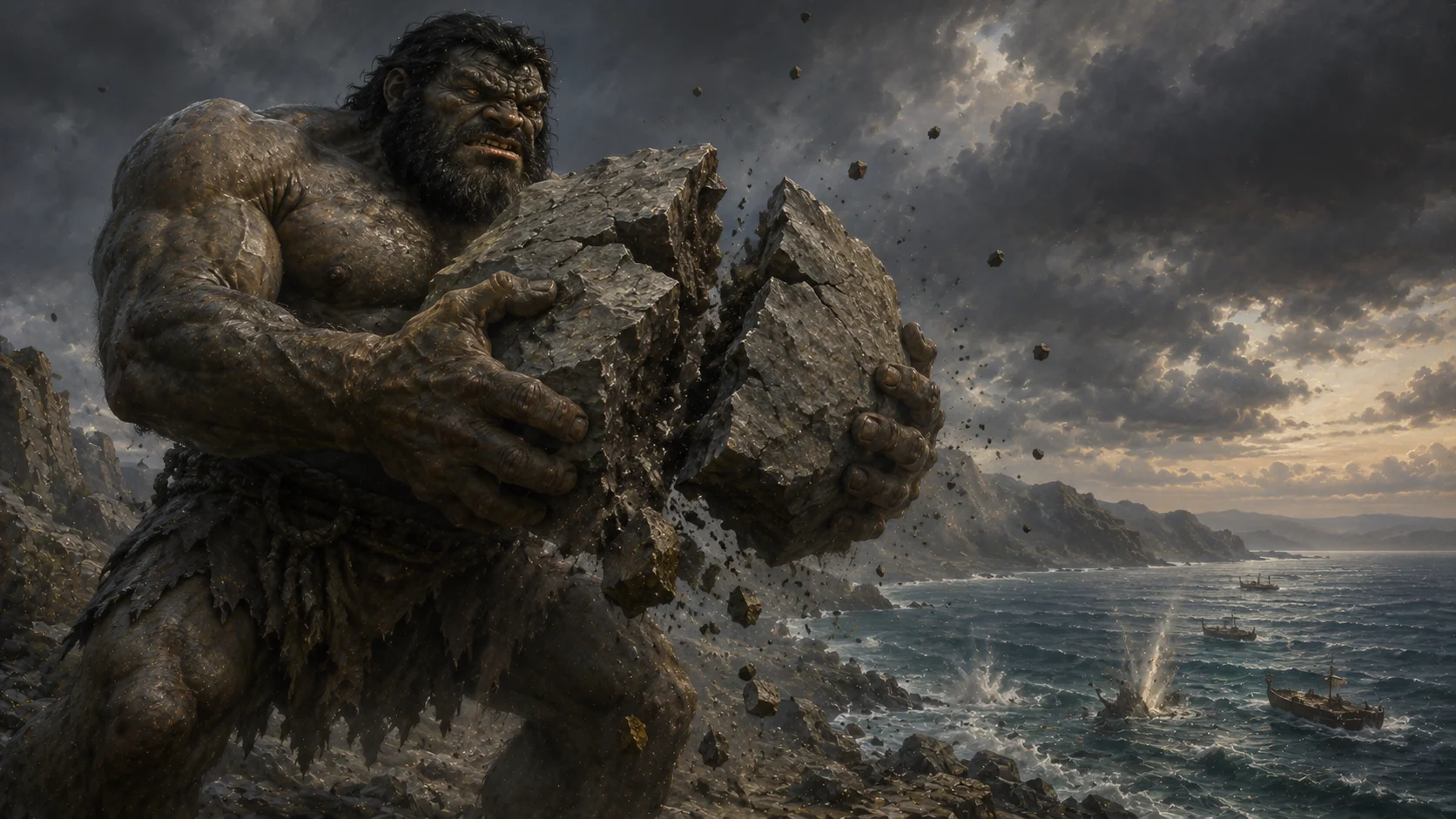
Tork Angegh — rendered also as Torkʿ Angeł, Tork of Angeł, or Turk' Angegh — is a figure of pre-Christian Armenian tradition remembered as a being of colossal strength, rough craftsmanship, and grotesque physical form: a giant who tore stone with his bare hands, carved images into rock with his fingernails, and hurled boulders from the highland cliffs to break enemy ships upon the water. He is known to us chiefly through the fifth-century historian Movses Khorenatsi's History of Armenia, and through the folk memory of later Armenian ethnography, rather than through a wide scatter of surviving cult inscriptions — which makes him a harder figure to fix in place than the great gods of the classical Armenian pantheon, and a more quietly haunting one.
A Name Carried Down Through a Royal Line
Khorenatsi's account situates Tork Angegh within the legendary genealogy of Armenia's early kings, the line that descends from the eponymous patriarch Hayk, Armenia's founding progenitor. In this telling Tork Angegh appears as a grandson of a figure named Angegh, placed within the dynastic-mythic descent of the House of Haik rather than among the "high" gods headed by Aramazd. Scholars of Armenology read this placement carefully: Khorenatsi had a documented tendency to euhemerize older gods, folding them into the royal genealogy as ancestors and kinsmen of the kings rather than preserving them as independent objects of cult. What this means is that Tork Angegh's position in the king-list may say more about how a Christian-era historian chose to organize inherited pagan memory than about where Tork Angegh actually stood in the older, pre-literate religious imagination of the Armenian highlands. The genealogical frame is real and worth honoring as the earliest written witness we have — but it should be held as an interpretive layer laid over something older, not mistaken for a transparent record of original belief.
The House of Angeghtun and the High Country
The epithet "Angegh" ties the figure to Angeghtun, a district associated with the province the Armenians called Barjr Hayk, "High Armenia." Tradition locates him particularly in the country around Lake Van and across the wider Armenian Highlands — a landscape of volcanic stone, steep massifs, and cold high lakes that seems to have shaped the character given to him: not a sky-god or a hearth-god, but a being of rock and altitude, whose power belongs to the mountains themselves. To speak of Tork Angegh is, in a real sense, to speak of a particular stretch of Armenian ground, and the old audiences who told his stories would have heard in his name an echo of the district and the house that claimed him, the Angeghtun, before they heard anything else.
A Face Built for Fear, Not Beauty
Where other Armenian deities of the same broad pantheon were rendered in the graceful, Hellenized idiom of their age — Vahagn recast in the mold of Herakles, Astghik in the mold of Aphrodite — Tork Angegh was remembered as something else entirely: a being of immense, almost monstrous physical strength paired with a fearsome, ungainly ugliness. Some scholars have linked the root of "angegh" itself to a sense of ugliness or deformity, though this etymology remains debated rather than settled among Armenologists. What the tradition preserves unambiguously is the contrast at the heart of his figure — grotesqueness set directly against the polished grace expected of gods and heroes — and this contrast is not incidental. It is the axis the whole character turns on: a being too strange and too powerful to be beautiful, and precisely because of that, cast as the one who stands at the border and holds it.
Hands That Worked Stone Like Clay
The feats attributed to Tork Angegh are feats of raw, almost incomprehensible physical power exercised upon rock. He is remembered as a giant who could tear apart cliffs and split boulders with his bare hands, and who carved images and inscriptions directly into hard stone using nothing but his fingernails — as though the hardest material of the highlands were as yielding to him as clay to a potter. This rock-carving motif has led some Armenologists to describe him, by extension, as a kind of patron of stonework or of an early, unpolished art of sculpture. It is worth being honest about what kind of claim this is: it is a scholarly extrapolation built outward from the folk motifs of rock-carving, not a directly attested cultic title inscribed anywhere as such. The image is nonetheless a striking one, and it has stayed in the Armenian imagination for a reason — a god or hero whose creative power and his destructive power are the same hands doing the same thing.
Boulders Thrown Against the Sea
The best-known episode attached to Tork Angegh is martial rather than artisanal: when enemy ships appeared off the Armenian coast or upon the lake, Tork, in his fury, tore boulders from the cliffs and hurled them down upon the vessels, sinking the fleet and breaking the attack before it could reach the shore. This is the image that has traveled furthest in Armenian storytelling — the giant defender standing on high ground, answering an invading fleet not with a weapon forged by hands but with the mountain itself, thrown. It marks him as something more than a monster to be feared: a protector whose ugliness and violence are placed entirely in service of the homeland and the people under his watch.
Loyalty Wearing a Fearsome Shape
Across the Khorenatsi narrative, Tork Angegh's monstrous strength and unlovely appearance sit beside an unwavering loyalty to the Armenian royal line he was reckoned to descend from and serve. He is not a rival to the throne or a danger the kings must contain — he is remembered as a defender bound to them, his terrible power turned outward against Armenia's enemies rather than against Armenia itself. This is what makes him a liminal figure in the fullest sense: standing at the threshold between monster and hero, between something to be feared and something to be thanked, and never fully resolving into either. The tradition does not ask its audience to decide whether Tork Angegh is safe. It asks them to be glad he is theirs.
A Question the Sources Do Not Settle
Unlike Vahagn or Aramazd, Tork Angegh is not clearly attested as having held a major dedicated temple among the classical lists of pagan Armenian cult sites. This absence has left his exact status genuinely disputed among scholars: some read him as an old god who was demoted and folded into the royal genealogy by later, Christian-era retelling; others read him as originally a folk-heroic giant, a figure of oral storytelling about the land itself, who was drawn into the dynastic mythology only secondarily, without ever having been the object of a formal cult in the way Vahagn or Aramazd were. Both readings have serious scholarly defenders, and neither can be declared the settled answer on the evidence that survives. The honest position is to hold the ambiguity itself as part of what is known about him, rather than to force a resolution the sources do not support.
An Older Stratum Beneath the Later Pantheon
Comparative mythologists have also proposed a connection between Tork Angegh and the storm-and-mountain god traditions associated with Tarhu and the Teisheba-adjacent religious world of Urartu, the kingdom that occupied the Armenian Highlands before the emergence of historical Armenia. The suggestion is that Tork Angegh may preserve, in folk form, a thread of continuity reaching back into Urartian religious life — a substrate hypothesis rather than a settled identification. It is an intriguing proposal precisely because it would place Tork Angegh among the oldest layers of religious memory native to this specific ground, older than the more Hellenized figures who came to stand beside him in the later pantheon. But it remains a hypothesis, actively debated, and it should be carried with the same caution given to every other unresolved question in his history — offered as a real possibility, not asserted as fact.
Stones That Remember His Throw
Beyond Khorenatsi's history lies a second, later layer of memory: the folklore gathered by Armenian ethnographers of the nineteenth and twentieth centuries, who recorded Tork Angegh surviving in the countryside as a folk-giant associated with megaliths, dolmens, and the unusual rock formations scattered across the Armenian highlands. Local place-legends in this tradition attribute particular standing stones to his throws — the landscape itself read as a kind of physical record of his strength, long after the formal genealogical account had receded into literature. This ethnographic layer is distinct from, and considerably later than, the classical account preserved by Khorenatsi, and it deserves to be recognized as its own stratum of tradition rather than folded silently into the older one. Two different generations of Armenians, centuries apart, each found their own way to keep Tork Angegh present in the land they walked on.
Strength Without Apology
Taken as a whole, Tork Angegh symbolically pairs raw, ugly, elemental strength with unwavering protective loyalty to homeland and dynasty — a combination that sets him apart from the more classically beautiful, Hellenized deities of the same broad Armenian religious world. Where Vahagn carries the polish of Herakles and Astghik the polish of Aphrodite, Tork Angegh carries none of that inherited grace at all, and the tradition never asks him to. He preserves, in this way, an older and less Hellenized stratum of Armenian mythological imagination — one where power did not need to be beautiful to be trusted, and where a defender's worth was measured by what he threw at the enemy fleet, not by how he looked doing it.
A Name Kept More by Scholars Than by Song
Tork Angegh has not traveled into the present day with the wide popular recognition given to Vahagn. He survives today chiefly as a name invoked in discussions of Armenian literary and folkloric heritage concerning the pre-Christian giants and hero-figures of the highlands, and as a recurring point of comparison in Armenological scholarship on the possible continuity between Urartian religion and later Armenian folk-mythic figures. This narrower survival is not a diminishment of what he represents — it reflects, if anything, the particular character of the figure himself: a being who was never fully a courtly god of temples and inscriptions, and never fully a simple folk-giant either, but something standing in the space between, remembered in fragments, carried by scholars and by mountain place-names alike, waiting in the stone he is said to have carved.
Sources & traditions
- EncyclopediaWikipedia — Tork Angegh
- TraditionArmenian folk and village traditions
Myths change from area to area and from time to time. This chronicle follows the most widely told versions; tellings in other villages, regions and eras may differ.