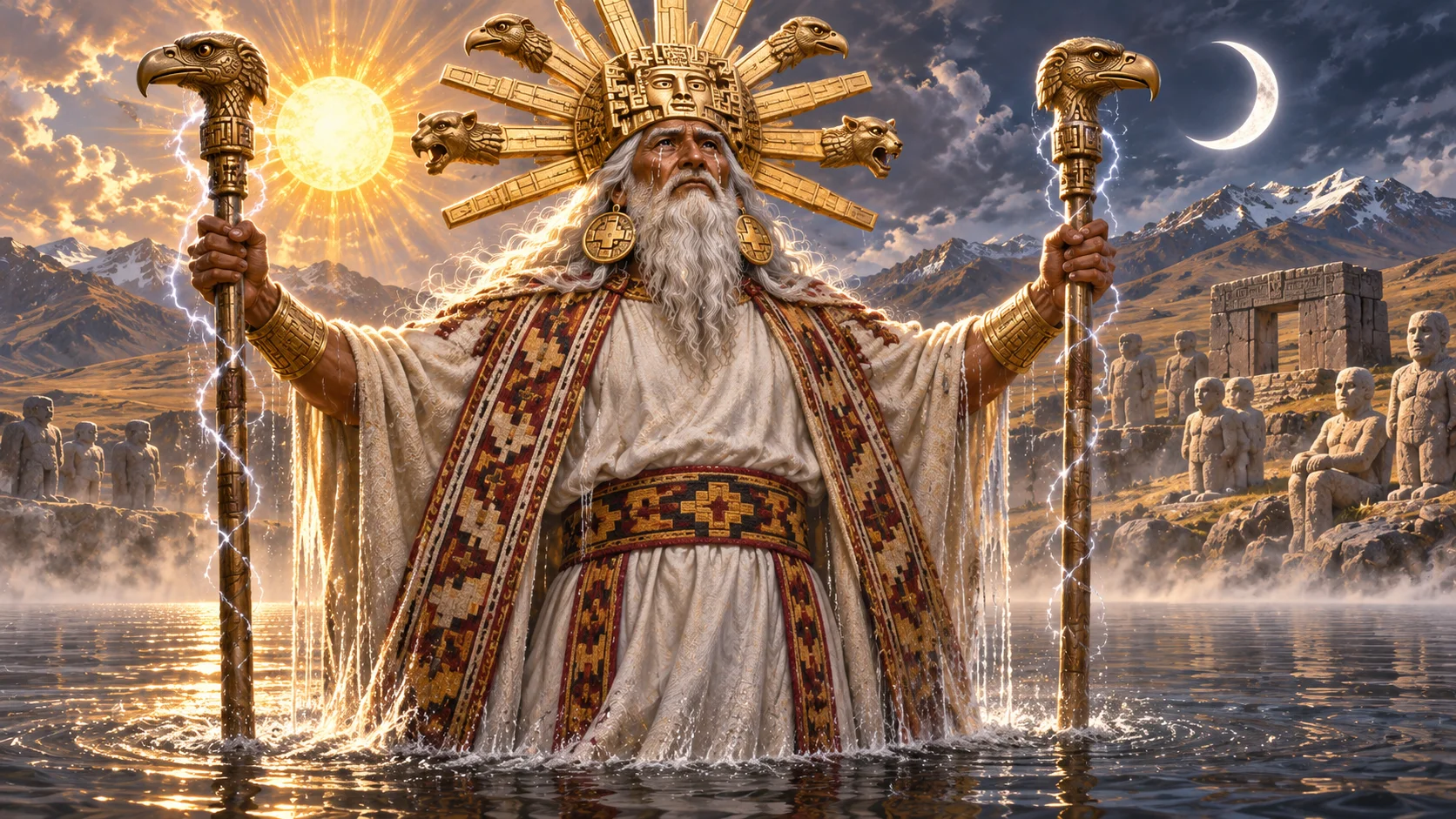
Viracocha — in modern Quechua spelling Wiraqocha, in Aymara-influenced writing sometimes Wiraqucha — is the creator figure of the Inca and of the older Andean peoples whose traditions the Inca inherited. In the accounts written down after the Spanish invasion he rises from Lake Titicaca (Titiqaqa), makes the sun, the moon and the stars, shapes the nations of the Andes, and then walks away along the roads of the highlands, teaching, before setting out across the Pacific from the coast of present-day Ecuador. He is one of the most discussed figures in Andean religion, partly because almost everything we know about him passes through the pens of Spanish writers who had their own ideas about what a creator god should be.
Name and etymology
The name is written Viracocha, Wiracocha, Huiracocha, Uiracocha and Wiraqocha, depending on whether the writer follows sixteenth-century Spanish spelling or a modern Quechua alphabet. The second element, qocha (cocha), means lake, sea or reservoir of water. The first element is less certain. The old explanation, repeated by some Spanish writers, was that wira means “fat” or “grease” and that the name therefore meant something like “sea-foam” or “fat of the lake”. The reading is already in Pedro de Cieza de León, who wrote in the early 1550s that the name was understood as “sea-foam” (espuma de la mar), explaining that vira is a word for fat or grease and cocha for sea. Most modern linguists reject it on grammatical grounds. Other derivations have been proposed, but none is settled, and a careful reader should treat the etymology as open.
The god carries a cluster of epithets in the sources. Ticsi or T’iqsi means origin, foundation or beginning, so Ticsi Wiraqocha is roughly “Wiraqocha, the foundation”. Pachayachachic, glossed by the Spanish as “teacher of the world”, is found in the ecclesiastical writings of the period and in a famous cosmological drawing by the native writer Joan de Santa Cruz Pachacuti Yamqui. Juan de Betanzos writes the compound as Con Tici Viracocha, with the spelling varying from writer to writer; it joins Ticsi to a word Con or Kon whose meaning is unknown. Some later writers speak of a being called Con who belongs to the coast, and it is not settled whether Con was a separate coastal figure or part of a single fused title. The name Kon-Tiki, famous from Thor Heyerdahl’s 1947 raft voyage, was the form Heyerdahl gave to this name, and the migration theory he built on it has no support among specialists in Pacific or Andean prehistory.
Within Quechua, wiraqocha also became a respectful title for powerful persons, and after 1532 it was applied to the Spaniards themselves. Several chroniclers, including Garcilaso, record that Andean people called the newcomers viracochas, and the account dictated by the Inca ruler of Vilcabamba, Titu Cusi Yupanqui, uses the word in that way. Cieza gives his own explanation, taken down from Inca nobles in Cusco: partisans of Huascar, hearing that Atahualpa had been taken, hailed the newcomers as sent by the creator and as his sons, and so called them viracochas. This later usage is one reason the name is so tangled: the god, the honorific and the foreigners share a single word.
Sources, and how far to trust them
There are no Inca-authored texts about Viracocha in the strict sense, because the Inca kept records on knotted cords (khipu) and in oral performance. The written record is colonial. The principal witnesses are these.
- Pedro Cieza de León, who travelled through the highlands in the 1540s. The first part of his Crónica del Perú appeared in 1553; his account of Ticiviracocha and of the temple at Cacha belongs to the second part, El señorío de los Incas, which circulated in manuscript and was printed only in the nineteenth century. He is often cited as the first writer to describe the creator as a tall white man.
- Juan de Betanzos, who wrote in the 1550s, spoke Quechua and was married to an Inca noblewoman of the Cusco aristocracy. His account of how Viracocha made the world, and of the career of Pachacuti, is the closest the record comes to the perspective of the Cusco elite, though it is still a Spaniard’s version.
- Pedro Sarmiento de Gamboa, whose Historia Indica was finished in 1572 for the viceroy Francisco de Toledo, collected testimony from Inca elders in Cusco, but wrote with an openly political purpose: to show that the Inca were tyrants.
- Cristóbal de Molina, a priest in Cusco, wrote about rites and prayers in the 1570s, including a prayer to Viracocha.
- Polo de Ondegardo, a magistrate who investigated Inca religion for the colonial administration, left reports that later writers, including Bernabé Cobo, used.
- Garcilaso de la Vega, el Inca, born in Cusco in 1539 to an Inca noblewoman and a Spanish captain, wrote his Comentarios Reales in Spain decades after leaving Peru. He is eloquent, and he is also writing in defence of his mother’s people from within a Catholic and humanist frame.
- Felipe Guaman Poma de Ayala and Joan de Santa Cruz Pachacuti Yamqui, both native Andean authors writing in the early seventeenth century, who offer an Andean voice but already live inside a Christian world.
The point that matters most is this: all of these writers were looking for a supreme god, and a creator deity who made the world in a sequence of acts fitted their expectation very well. When a Quechua informant described an ancient being associated with origins, a Spanish listener could easily hear the Christian God. Cieza himself reports that Spaniards were saying the stone figure at Cacha might be an apostle, which shows how readily a Christian frame was laid over Andean figures. The ease with which Viracocha could be glossed as “God” is exactly the kind of drift that makes modern scholars cautious about how close the written god is to the god actually worshipped before 1532.
The creation story
The versions differ in detail, but a skeleton is shared across the principal accounts. In the beginning the world was dark. Viracocha came out of Lake Titicaca, in Betanzos’s telling, and made the sky and the earth. At a place near the lake that the sources call Tiwanaku (Tiahuanaco, Tiaguanaco) he made the sun, the moon and the stars and set them on their paths. In several accounts he first made a race of people who displeased him. They are called giants in some tellings. He destroyed them, in some accounts by a flood known as unu pachakuti, “water-overturning”, and in others turned them to stone, which is sometimes given as the explanation for the large carved stones of Tiwanaku.
He then shaped a second people, using stone or clay, and gave each nation its dress, its language and its songs. He sent them below the earth, and they emerged at distant places, from caves, springs, lakes, hills and trees, the origin-places called pacarinas (paqarina). This detail makes the myth quite special: it is not a single human couple but many peoples, each with its own origin place, and it is the origin place, not descent from a single ancestor, that makes a community what it is. Some versions mention companions or helpers of the god, and the names given to them differ from account to account.
After this the god travelled. Sarmiento describes him as a wanderer of middle height and white complexion, in a long robe, carrying a staff and a book, a figure who walked through the provinces teaching people how to live, and who was sometimes mocked or attacked by those who did not recognise him. The book is a detail that sounds suspiciously like a Christian missionary and is treated by many scholars as a Spanish embellishment. Cieza’s version has a tall white man who came from the south and went north through the highlands, healing and teaching, and he places the best-known episode at Cacha, south of Cusco: the people rose to stone him, fire fell from the sky and burned the hillside, and they begged for mercy until he made the fire stop. Cieza went to see the great stone figure in the temple built there afterwards. The local lord, a Christian named don Juan, told him it was Ticiviracocha. Cieza adds that Spaniards were claiming it might be an apostle holding beads, and that, looking closely, he saw no beads, only a figure with its hands on its hips. His doubt deserves more attention than it usually gets: it comes from a first-hand witness and shows the Spanish reading a foreign identity into an Andean image.
The end of the story, in Cieza’s wording, is that Viracocha reached the sea, spread out his cloak and went away over the waves, and was never seen again. Betanzos and Sarmiento place his departure on the coast of present-day Ecuador, at Manta or Puerto Viejo, and have him walk over the water with his companions. Whether he promised to return is a different matter, and is discussed below.
Other Viracochas: the Huarochirí manuscript
The Huarochirí Manuscript, a Quechua text compiled around 1608 in the mountains east of Lima in the circle of the extirpator of idolatry Francisco de Ávila, contains a different figure bearing the same name: Cuniraya Wiraqocha. He does not behave like a remote creator. He is a trickster who goes about in the guise of a ragged beggar, and who by his words and powers shapes the land, makes terraces and irrigation channels, and pursues the goddess Cavillaca across the country to the sea after she has borne his child. The story reads more like a local origin tale than a cosmic creation. The Huarochirí text suggests that “Wiraqocha” was, in at least some regional traditions, a name or title attached to powerful beings, and not necessarily the unique supreme maker. It is also a reminder that the Inca Viracocha, as we meet him in Betanzos or Sarmiento, is a composite assembled in Cusco and then rewritten in Spanish.
Pachacuti, the Chanka war, and the question of supremacy
The Cusco accounts of Viracocha are tied up with the story of the Inca ruler Pachacuti Inca Yupanqui. According to Betanzos and Sarmiento (and the later chroniclers who drew on them), the eighth Inca ruler, who bore the name Wiraqocha Inca, fled when the Chanka army attacked Cusco. His son Cusi Yupanqui stayed to defend the city, and a vision promised him victory. Betanzos and Sarmiento tell it in different forms: Sarmiento places the vision at a spring called Susurpuquio, and the accounts do not agree on how the apparition is to be identified. Cusi Yupanqui defeated the Chanka, took the name Pachacuti (“he who overturns the world”), and became the architect of the empire’s expansion. Some writers add that a temple to Viracocha was raised in Cusco in this period. In this setting Viracocha becomes the god of victory and of the legitimacy of a new beginning.
Was Viracocha therefore the supreme god of the Inca, as the Spanish writers claimed? The honest answer is that scholars disagree. One line of interpretation, heavily influenced by the chroniclers, treats him as a high creator who stood above the sun, with Inti serving as the state’s active, dynastic deity. A second line argues that the elevation of Viracocha was itself an act of state under Pachacuti, a theological reform that gave the new empire a universal creator who could stand above the many local gods of conquered peoples. A third, more sceptical line stresses that the notion of an all-powerful, remote creator was easier for Spanish listeners to hear than to find: it argues that Viracocha’s rank in Inca worship was lower than the chroniclers suggest, and that the Sun, the thunder god Illapa, the coastal oracle Pachacamac and the mountains were more present in daily ritual. Garcilaso, for instance, reserves the idea of an unseen supreme being for Pachacamac and treats Viracocha as the name of a vision that appeared to a prince, the son of the Inca Yahuar Huacac, who was thereafter called by it. The Inca temple complex at Raqchi (Cacha), with its monumental central wall, shows that Viracocha was certainly honoured with architecture. How supreme he was, and whether “supreme” is the right category for an Andean deity at all, remains disputed.
Archaeology: Tiwanaku and the staff-bearing figure
Archaeology can speak to what the chroniclers could not. Tiwanaku, on the high plain south of Lake Titicaca, was a major ceremonial and political centre in the first millennium CE, centuries before the Inca. The carved lintel known today as the Gateway of the Sun shows a central figure holding a staff in each hand, with a radiating head, flanked by rows of winged attendants; the name “Gateway of the Sun” is modern. A similar staff-bearing figure appears on Wari ceramics and textiles from the same era. Because the Inca told stories placing the creation at Tiwanaku, and because the figure holds staves, many writers have identified it as Viracocha. That identification is an inference across several centuries, and some archaeologists regard it as unproven. What can be said is that a staff-bearing, solar-associated deity belonged to the visual language of the south-central Andes long before the Inca, and that the Inca, who claimed Tiwanaku as a sacred origin place, may have absorbed it into their own cosmology.
Titicaca itself carried sacred weight in the Inca period. The Inca built shrines on the Island of the Sun and the Island of the Moon, and the stories of Viracocha’s emergence from the lake lent those places an additional dimension. What the archaeology cannot determine is how much of the Viracocha narrative preceded the Inca and how much was constructed by them. The Inca habitually appropriated older holy sites and wove them into the story of their own rise.
Cult and image
Accounts of Viracocha’s cult disagree. Some writers say that he had no statue and was honoured without an image, which fits the portrait of a remote maker. Others mention a stone statue at Cacha, and some Cusco writers describe small images of a creator among the sacred objects of the capital and a temple dedicated to him in the city; descriptions are inconsistent, and some images may have represented a different being under the same name. The ceque system of sacred lines radiating out from Cusco, recorded by Bernabé Cobo in the seventeenth century, lists many shrines, among them places linked to Viracocha; such a list shows that worship existed, not what rank it held.
One of the most useful sources is the drawing by Pachacuti Yamqui, made in the early seventeenth century, which shows an oval diagram of the cosmos associated with the altar of the Coricancha. In it the name of Viracocha sits at the top, with the sun, moon, Venus and the earth arranged below. It is a native author’s attempt to render Inca cosmology on paper, but it was made under Christian influence, and the arrangement of a single high name above the heavenly bodies may reflect the Christian hierarchy of Creator over creation as much as anything pre-conquest.
The returning god: a conquest-era story
One of the best-known assertions about Viracocha, that he was a bearded white god whose return the Inca awaited and who therefore mistook Pizarro’s men for divinities, is now regarded by most scholars as a post-conquest construction. The sixteenth-century Andean sources do not describe the creator as white. The beard and the pale skin appear in Spanish accounts, with Cieza usually credited as the first to couple the god with the idea of foreign appearance, and the parallel with the story told of Quetzalcoatl in Mexico has often been drawn by later writers, in a European tradition that wanted conquered peoples to have expected their conquerors. The word viracocha being applied to the Spaniards is real. What it shows is that Andean people reached for a word of respect and awe for the astonishing strangers, not that they identified them as the returning maker. The conquest was explained afterwards in the language of prophecy, by both sides.
Colonial suppression and survival
After the conquest, Viracocha’s name was quickly assimilated into Christian preaching: missionaries often used Wiraqocha or Pachayachachic as words for “God” in the first generations, and the line between the pre-Christian creator and the Christian one was never quite clean in the minds of those who heard the sermons. Later Church practice preferred the Spanish Dios, precisely because the older word had pre-Christian meaning.
In the twentieth and twenty-first centuries, Viracocha is much less visible in living Andean ritual than Pachamama or the mountain spirits. Ethnographers who work with Quechua-speaking communities near Cusco have generally reported that people give offerings to the earth and the apus far more than to a creator by this name, and that the name is mostly known through school history, tourism and political symbolism. It appears in place names and institutions. This should be said plainly: the creator is, in lived practice, a more distant figure than the earth-mother.
Kindred figures
Viracocha belongs to a family of Andean beings concerned with origins and with order. Beside him in the Inca picture stand Inti, the sun and ancestor of the ruling dynasty; Mama Quilla, the moon; Illapa, the thunder; and the creator-oracle Pacha Kamaq (Pachacamac) of the central coast, whose cult predates the Inca and who in some accounts is a rival to Viracocha and in others an equivalent. Beside him also stands Tunupa, a figure of the Aymara highlands, sometimes presented as a messenger or aspect of the creator and sometimes as a separate preacher-hero, whose stories vary widely from place to place. Further afield, writers have drawn comparisons with Bochica of the Muisca and with Mesoamerican culture heroes, but such comparisons have to be made with caution because they were first invited by the Spanish habit of seeing one pattern everywhere.
A closing reflection
The Viracocha of the books is a layered creation: a pre-Inca staff-bearing deity of the lake basin, a local wandering hero, a Cusco state god raised by an ambitious ruler, and a Christianised creator reshaped by priests and chroniclers. Each layer is partly visible. The oldest layer is the story of the lake and the stones and the peoples sent out to their own origin places, a story that gives every community its own beginning rather than a single human ancestry. That idea — that the landscape itself is where a people begins — is perhaps the most durable thing the figure of Viracocha carries, and it is an idea that survives in the Andean attention to springs, caves, hills and lakes to this day.
Sources & traditions
- EncyclopediaWikipedia — Viracocha
- TraditionIncan texts, oral tradition and village tellings (Andes)
Myths change from area to area and from time to time. This chronicle follows the most widely told versions; tellings in other villages, regions and eras may differ.