Mama Allpa is a name given in modern reference lists to an Inca and Andean earth goddess, usually described as a goddess of fertility and the harvest and often as a figure shown with many breasts. She is treated as the earthly, fertilising face of the great earth mother Pachamama. The name itself is real Quechua: mama is “mother” and allpa is the soil or earth. What is much less secure is the goddess. Almost nothing about her can be traced to a sixteenth- or seventeenth-century source, and the most memorable detail attached to her, the many breasts, cannot be traced to any early source at all. This chronicle therefore does two things: it sets out what the Spanish writers and the later ethnographers actually say about the Andean earth, and it marks plainly where a modern name has outrun the evidence.
What the Name Says
Three Quechua words carry the whole idea. Mama means mother, but it also names something that generates and sustains. Pacha means world, earth, time and place together; Garcilaso de la Vega, the Cuzco-born writer who published the Comentarios reales in 1609, explains it as the world or universe. Allpa is narrower and more material: the soil, the dust, the cultivable ground underfoot. A goddess called Allpa Mama, or Mama Allpa, would on the plain meaning of the words be the Mother Soil, while Pachamama is the Mother of the whole world and its seasons.
That difference matters, because modern writers often flatten the two. Some describe Mama Allpa as the earthly manifestation of Pachamama, the form in which she is met in a field, and say that Pachamama holds the larger, more cosmic ideas of space and time. That is a reasonable reading of the vocabulary, but it is a modern interpretation, built from the meaning of the words rather than from a recorded cult.
The only early text that puts allpa into a religious phrase is Garcilaso’s. In the chapter where he explains how the Inca wise men, the amautas, understood the soul and the resurrection of the body, he reports that they taught that the body is made of earth, because the dead are seen to return to earth, and so they called it allpacamasca, which he translates as “tierra animada,” animated or ensouled earth. This is a word for the human body, not the name of a goddess. It is nonetheless the best-attested early use of the root, and it shows the kind of thought that may lie behind the later name: earth is not dead matter but something that has been given life.
The Earth in the Chroniclers
When the Spanish writers describe the worship of the earth, they use the word Pachamama, not Mama Allpa. The Jesuit Bernabé Cobo, who finished his Historia del Nuevo Mundo in 1653 and relied on earlier Cuzco inquiries, wrote in his book on the religion of the Andean peoples that all of them also worshipped the earth, which they called Pachamama, glossed by him as the mother earth. He adds that people set a long stone in the middle of their fields and plots as an altar or statue of this goddess, and prayed to it and invoked her to keep and fertilise their crops; the more fertile a field, the greater the respect paid to her. It is a short passage, but it is precise about the practice: a stone, a field, a spoken request.
The same Cobo, in his long inventory of the shrines of the Cuzco district, lists a plain called Ayllipampa, where there was a farm, and says that it was held to be the goddess earth, Pachamama, and that small women’s clothing was offered to her there. Offerings of cloth shaped like a woman’s garments fit an earth conceived as a woman, and as a mother.
A second early witness is Polo de Ondegardo, the lawyer who governed Cuzco and wrote a report on Inca administration in the second half of the sixteenth century. In the English rendering that Clements Markham published in 1873, his report says that in each settlement a portion of the land was set apart for religion and divided among the Sun, the Creator, the thunder, the Pachamama and their ministers, and that women were assigned to the service of the Pachamama as well as of the Sun. The earth, in other words, held land and attendants like the other great powers of the Inca state.
Neither Cobo nor Ondegardo, as far as the printed texts show, names a goddess called Mama Allpa. A search of the printed edition of Cobo’s religious books and of the English translation of Ávila’s Huarochirí report finds the name and its variants in neither, and the Quechua Huarochirí manuscript, in the Salomon and Urioste translation, does not use it either. Such a search cannot prove a negative, since a scanned text can be misread and other chroniclers exist, but the silence is consistent across the writers most interested in the earth cult.
The Many-Breasted Mother
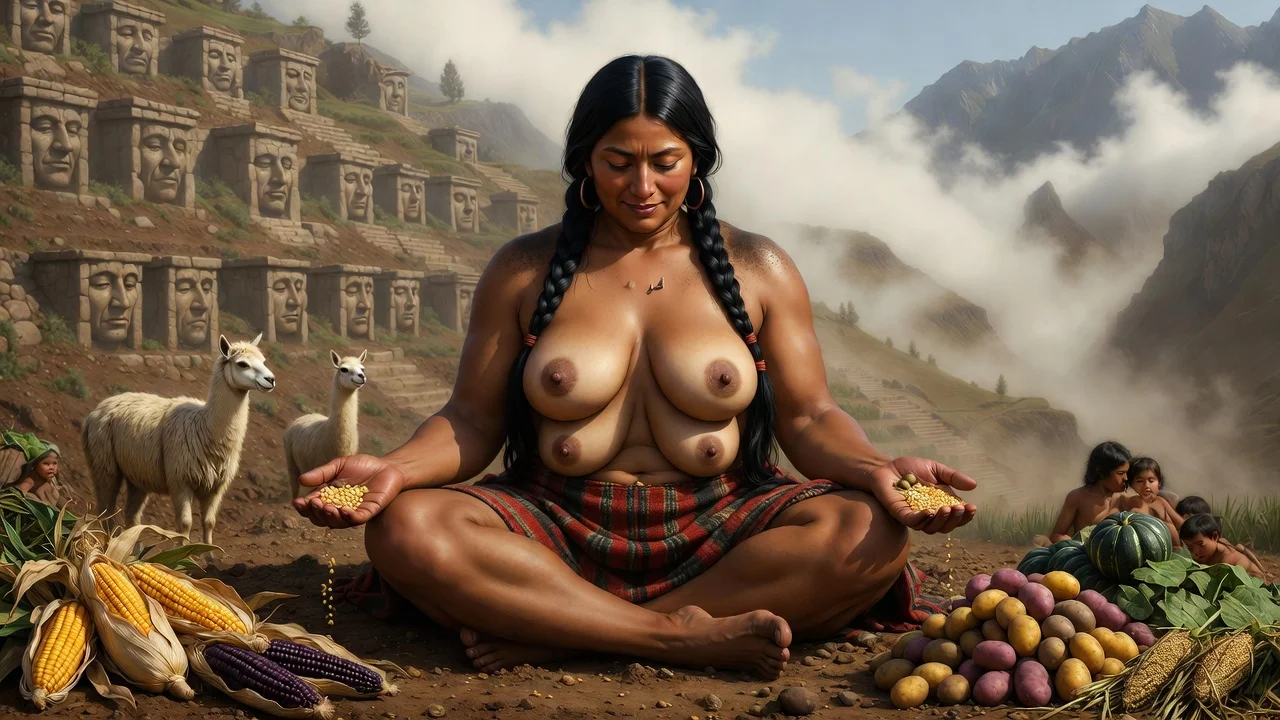
The image of a goddess with many breasts is the part of the Mama Allpa entry that readers remember. It is also the part for which no source can be found. Modern lists of Inca deities, in English and in Spanish, repeat that she was a fertility goddess represented with multiple breasts, and they do so without a footnote. No sixteenth- or seventeenth-century chronicler is known to describe such a figure, no colonial drawing is captioned with her name, and no archaeological object is identified by specialists as her.
It is worth being clear about what this does and does not show. It does not show that no Andean earth image ever had a nurturing, breast-centred iconography; Andean art is large, and much of it was destroyed or never described. It shows only that the specific claim, a many-breasted Inca goddess called Mama Allpa, is not supported by a text that can be checked. The step from “the Andean earth was worshipped as a mother” to “there was a named many-breasted goddess” is a step the evidence does not take, and the image is best treated as a modern convention, not as Inca doctrine.
Blas Valera and a Contested Document
When the English-language Pachamama literature reaches for an early authority for the form Allpamama, it points to the Jesuit Blas Valera, a Peruvian-born mestizo scholar of the late sixteenth century whose own history of Peru is almost entirely lost; what survives of it is chiefly what Garcilaso quotes. A manuscript called Exsul immeritus Blas Valera populo suo, among the so-called Naples documents, is cited as the source for a deity named Allpacamasca or Allpamama, glossed as the animated earth. I have not been able to check the wording of that manuscript itself, so the attribution is reported here at second hand. The gloss echoes the allpacamasca of Garcilaso’s chapter on the soul.
Two cautions apply. The Naples documents are disputed. Their defenders, among them the Italian scholar Laura Laurencich Minelli, hold that they are early seventeenth-century papers; other specialists reject them, and a 2021 study by Erika Valdivieso in the American Journal of Philology argues on textual grounds that the Exsul immeritus letter is a forgery of the later twentieth century. A claim that rests on these papers alone should not be presented as established. And even taken at face value, a single word glossed as “animated earth” does not amount to a recorded cult, a temple or an image, and none of the accounts of this document that I could consult mentions breasts.
Archaeology and the Landscape of the Earth Cult
Archaeology cannot name a goddess without a text, and for Mama Allpa there is none to match. What it can do is show where the earth cult left its marks. Stones set upright in fields, springs and fountains, boulders, ravines and hilltops were all treated as places where the powers of the earth could be addressed. Both Cobo and Ondegardo stress this: in their telling, nearly every notable thing in the landscape, springs, streams, stones, valleys, and the mountain passes with their heaps of stones that the Spaniards called apachetas, was an object of reverence, and each had its allotted offerings. The earth was not one temple but a world of small, local places.
Cobo also reports something that bears on the word mama itself. Describing the people who went to mines, he says that they revered the mountains of the mines and the mines themselves, held vigils of drinking and dancing before them, and revered the ore as well: the metals, which they called mama, and the stones of the metals, which they called corpas, were kissed and given ceremonies. Here the word for mother is the word for the matrix of the ore. It suggests that in Andean speech mama could name the generative source inside a thing as well as a goddess above it.
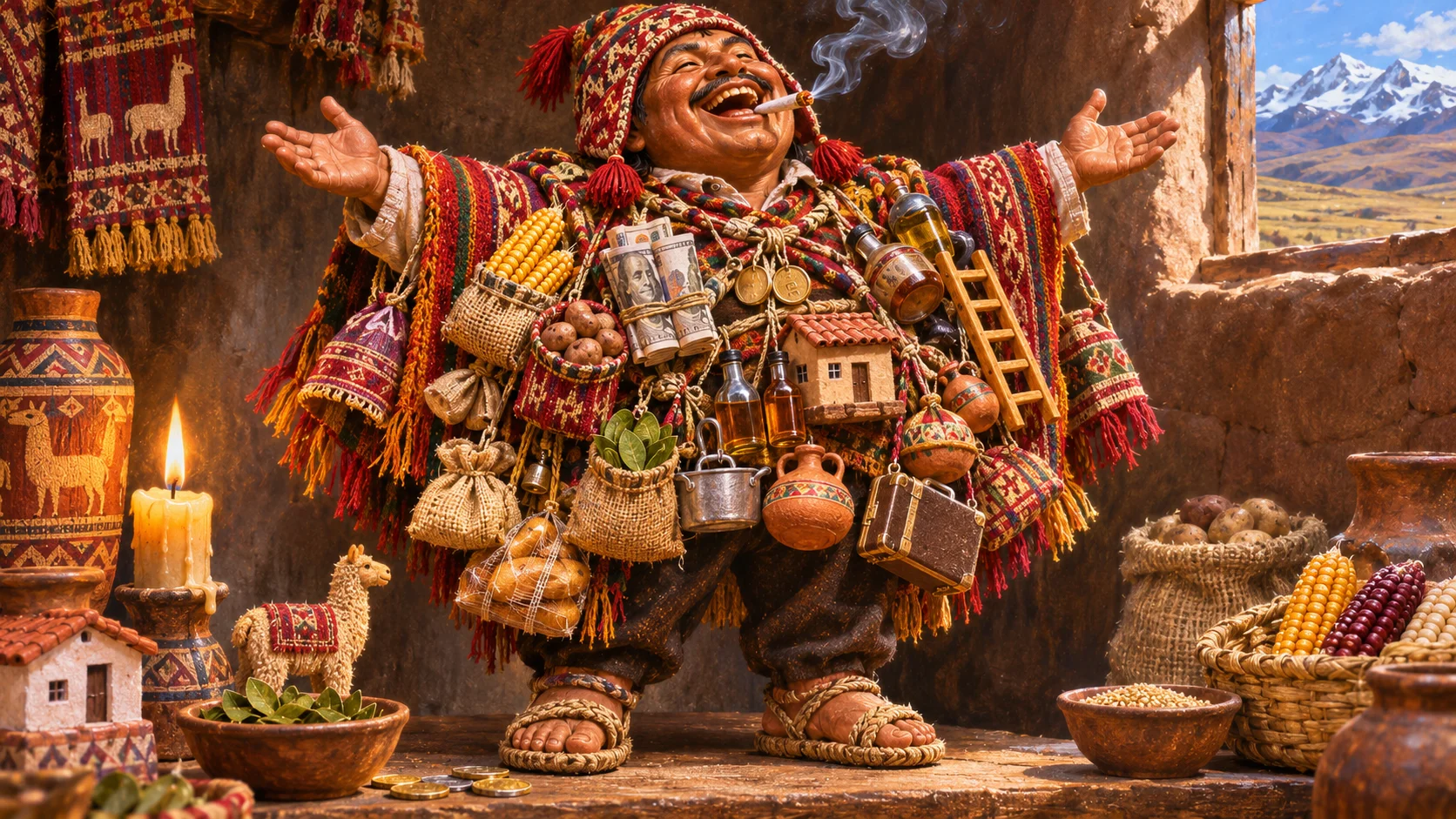
Several of the practices that the chroniclers describe, libations of maize beer poured on the ground, offerings of coca, cloth and shell, and the setting aside of land and animals for the earth’s service, are reflected in what ethnographers record today. The continuity should be stated with care. It is a continuity of gesture and of idea, the feeding of the earth so that the earth will feed, and not proof that a particular goddess named Mama Allpa was worshipped under that name by the Incas.
Living Practice
In the highlands of Peru and Bolivia, offerings to the earth are made today under the name Pachamama and often in August, when the ground is understood to be open and hungry. Ethnographers describe the earth as a being who must be fed: if she is not given her share, if she is offended or neglected, the balance between people and the world suffers. Herders of the southern highlands are described as owing her part of what they receive, a debt of the kind that Andean life calls reciprocity.
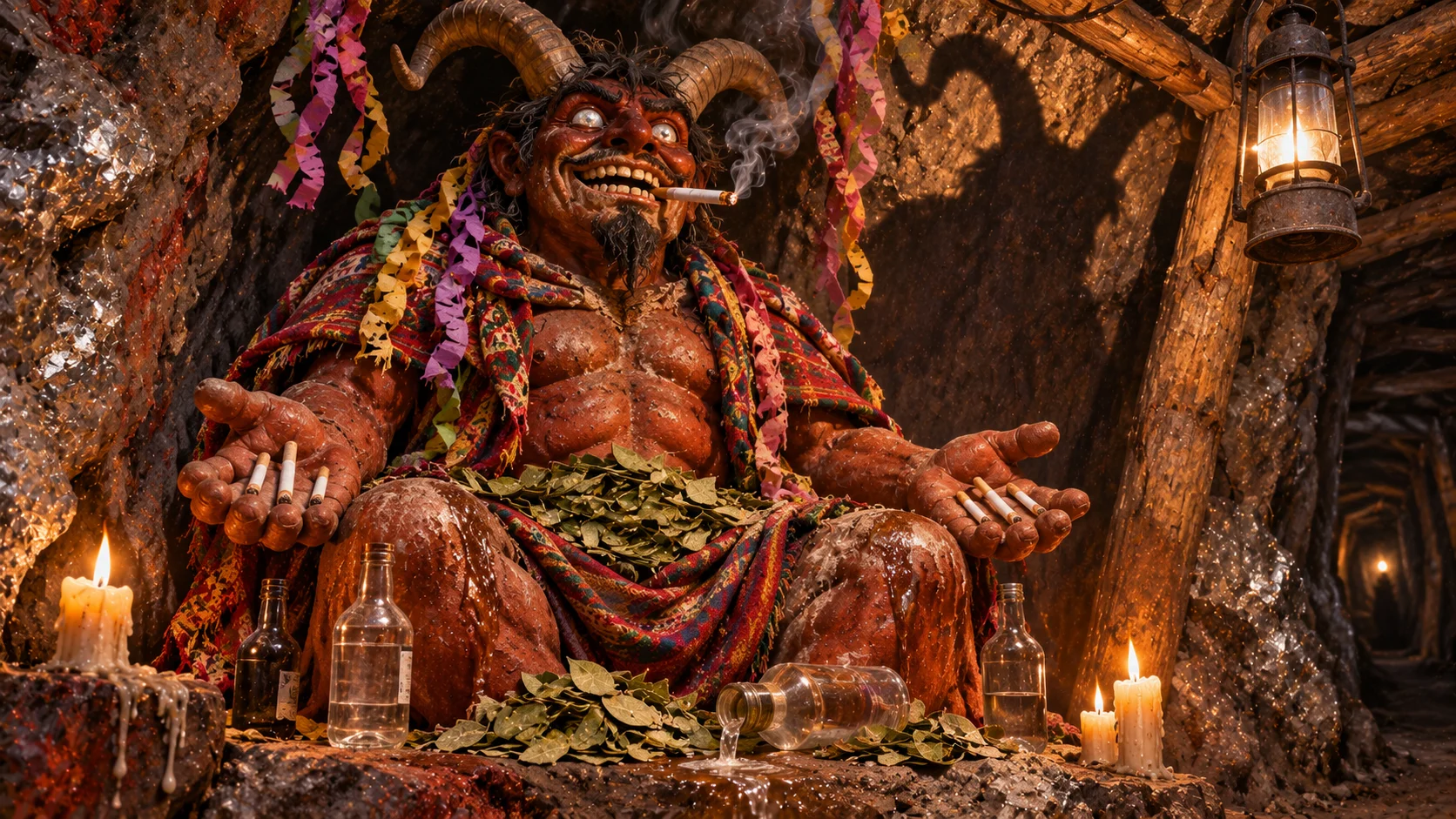
The French anthropologist Pascale Absi, who studied the silver miners of Potosí in Bolivia, gives one of the clearest recent accounts of how the earth is addressed in a working community. Among the miners of the Cerro Rico she records that the Pachamama is called Vieja, the old woman, and appears in dreams as a peasant woman, a lady in Western dress, or a woman in a pollera. The mountain is imagined as a pregnant womb in which minerals grow and ripen, and the Pachamama of Potosí is spoken of as the one with twelve skirts, each skirt a mineral, so that taking ore is metaphorically lifting the skirts of the mountain. Identifying a particular mountain with the Pachamama is, in her account, a feature of Potosí; at other mining centres such as Porco and Julcani the Pachamama and the mountain are invoked as separate beings.
On the first of August the miners make an offering, a quwa, to the Pachamama and the protective mountains, and August is described as the month when the underworld powers are hungry and the mountain opens to receive offerings. In Potosí the Pachamama has also been identified with the Virgin, whom the miners call Our Lady; the colonial Spanish placed altars of the Virgin on the mountain, and the Quechua word koya, which means both a vein of ore and a queen, helped the two figures to merge.
This living tradition is not a survival of a lost Inca text. It is a contemporary religion with its own logic, and it speaks of the earth as Pachamama. In the field accounts consulted here, the form Mama Allpa does not appear as a separate named being.
How to Read the Name
It helps to sort the evidence by type. From the colonial writers, Cobo, Ondegardo and Garcilaso, comes a well-attested earth cult addressed as Pachamama, with stones in fields, a shrine in the Cuzco district, land set aside, and the word allpacamasca for the human body as animated earth. From archaeology comes the landscape of small shrines, but no image that can be tied to the name Mama Allpa. From modern practice comes a Pachamama who is fed, who is addressed as an old woman or a mother, and who in Potosí is merged with the mountain and the Virgin.
Mama Allpa sits in the gap between these. It is a plausible compound, and it may be a scholarly or popular way of speaking of the earth as soil, but it is not a documented deity in the way that Inti, Viracocha or Pachamama are. A careful encyclopedia can say that the name is used, say what it means, and say that it appears in modern lists; it should not describe her rites, her temples or her many breasts as though a chronicler had seen them.
One further point of respect applies. The earth is not a museum subject. Miners in Potosí still pour libations and make their offerings, and the earth is still addressed as a living mother. Whatever the name of a goddess in an English list, the thing it points at is alive.
Sources & traditions
- TraditionIncan texts, oral tradition and village tellings (Andes)
Myths change from area to area and from time to time. This chronicle follows the most widely told versions; tellings in other villages, regions and eras may differ.