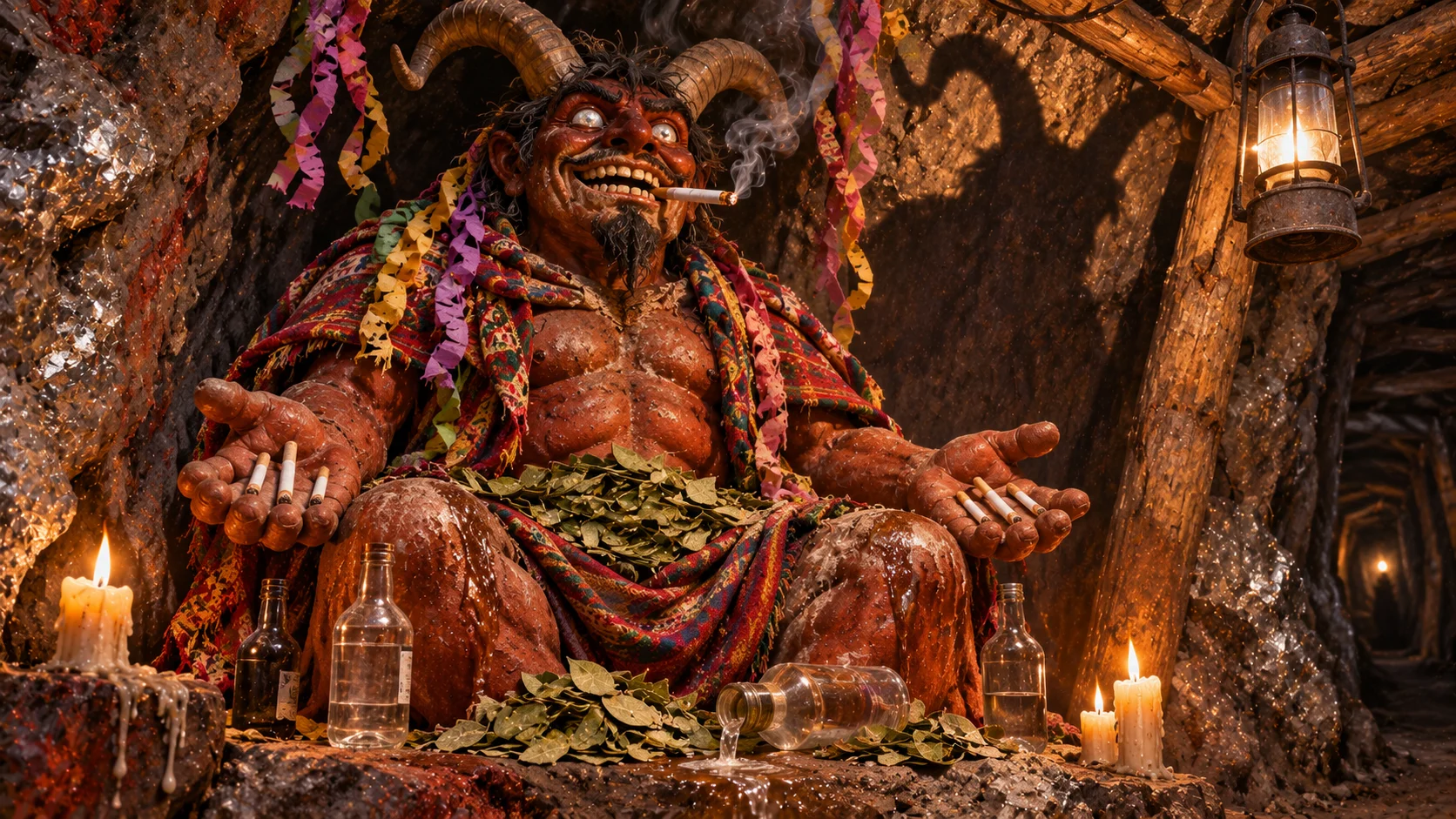
Ekeko, also written Ekkeko (and Ekhekho), in Aymara iqiqu, is one figure under several spellings: the small, smiling, burden-laden household figure of the Aymara and Quechua peoples of the Andean altiplano, honoured as a giver of abundance, good fortune and the means of a household’s prosperity. It is celebrated above all at the Alasitas fair of La Paz, Bolivia, which opens every year on 24 January, when people buy miniature versions of the things they hope to have in the coming year, have them blessed, and give them to the figure and to one another.
This is a living practice, not a vanished cult. In 2017 UNESCO inscribed “Ritual journeys in La Paz during Alasita” on its Representative List of the Intangible Cultural Heritage of Humanity.
The Name and Its Spellings
The word is written many ways because it comes from Aymara, a language whose sounds were never fitted tidily to the Spanish alphabet. Modern Aymara orthography gives iqiqu, and early and regional spellings include Ecaco, Ekhekho and Ekeko; the doubled k of Ekkeko, the form found in some older English-language books, is one more Latin-alphabet attempt at the same word. Nothing in the sources consulted separates Ekeko from Ekkeko by region, by ritual or by iconography.
Several explanations of the word are in circulation, and the honest summary is that they are unproved. One derives it from Aymara iqiqu, “dwarf”. The Puno scholar Juan Carlos La Serna Salcedo notes that a researcher named Calcín proposed a Puquina origin, with the word meaning roughly “this father or this lord”, while Urbano linked the early form Ecaco to the Quechua sami, “fortune”. None of these is settled.
The word “god” also needs care. Writers in English habitually call Ekeko the “god of abundance”, and tourist and encyclopaedic writing repeats the label. Some twentieth-century ethnographers preferred a humbler term, calling the figure a good-luck fertility spirit. Aymara practice is itself layered with Catholic observance, so a person may bless an Ekeko at a church and a ritualist’s table in the same morning. It is respectful to follow how practitioners speak rather than to impose a single label.
Three Kinds of Source
As with all Andean material, the sources fall into three kinds, and they are easily run together in tourist literature. Spanish colonial writers record words and disapproval. Archaeology and museum scholarship describe objects. And the people who keep an Ekeko in their homes today say what it is for. The three are kept apart below, and where a description rests on a tourist article rather than on a scholar or a practitioner, it is marked as such. The survey used throughout is the long study that La Serna Salcedo produced for the Peruvian Ministry of Culture.
Origins and the Early Record
The Colonial Paper Trail
The earliest written traces of the name come from Spanish clergy collecting Aymara words in order to evangelise. La Serna’s survey of the documents lists several. The Jesuit Ludovico Bertonio, in his Aymara vocabulary of 1612, is reported to give the form Ecaco for a dwarf about whom the ancient Indians told many tales, and the clerical hostility of the period is plain. The 1608 Quechua dictionary of González Holguín has an entry that La Serna connects with a joker or liar. La Serna also reports that scholars have associated passages in Guaman Poma (c. 1613) and in Arriaga (1621, a son of Wiracocha said to protect fortune) with the ekeko; these are scholarly interpretations, not statements by the authors that the figure is the Ekeko of today, and the passages were not checked here.
The cautious conclusion is that a dwarf-like figure of fortune and tales was known in the early seventeenth century in the Aymara-speaking area, and that Spanish clergy treated it as something to suppress. Whether it was identical to the modern figure with its plaster body and miniatures is not demonstrable from these entries.
Miniatures Before the Ekeko
The practice of making small replicas of desired things is better documented in the deep past than the Ekeko is. Prehispanic ritual miniatures, called illas, are described by sixteenth- and seventeenth-century writers, and evangelisers classed them as idolatry. The Austrian-born Bolivian scholar Arthur Posnansky suggested, in the early twentieth century, that around the southern summer solstice the people of Tiwanaku worshipped their deities for luck and offered miniatures of what they hoped to obtain; the Bolivian folklorist Antonio Paredes Candia likewise thought the miniatures were survivals of ancient summer-solstice celebrations. These are hypotheses by scholars writing long after the fact, not texts from Tiwanaku, which left no written language.
Carlos Ponce Sanginés, the archaeologist who excavated at Tiwanaku, linked hunchbacked, phallic figurines from Tiwanaku and Inca sites with the later Ekeko in 1969; the survey relied on here describes that link as unproven. Others have argued for the Pucará culture of the northern Titicaca basin, which flourished in roughly the last centuries before the Common Era, as the home of the type. The truth is that no continuous chain from a named ancient figure to the Ekeko of the market stall has been documented.
The Statuette from Tiwanaku
One object stands at the centre of the debate. In 1858 the Swiss naturalist and diplomat Johann Jakob von Tschudi removed a small stone figure, about 15 centimetres tall, from the sacred site of Tiwanaku. According to Tschudi’s own published account, the local people made regular offerings to it and lit candles for it, and he compared it to a Catholic saint; retellings add that the owners parted with it reluctantly. Its style has been described by the museum that held it as Pucará in character, and its age is estimated at roughly 2,000 years.
The Historical Museum of Bern acquired Tschudi’s collection in 1929 and exhibited the piece for many years. Bolivian diplomatic efforts, associated with the Bolivian diplomat Elizabeth Salguero Carrillo, sought its return; the museum is reported to have questioned at first whether the object was an Ekeko at all, and in 2014 it left Switzerland for La Paz. For Bolivia, the piece is sacred.
The statuette is therefore best described as an ancient sculpture that Bolivians regard as embodying the spirit of the modern Ekeko, even though it may not depict the same figure. It does not look like the modern plump trader. It is carved of stone. The point of the story is not that the object proves a lineage but that Bolivia regarded a figure removed from a sacred place as its own to ask for back, and that after its return the statuette travelled across La Paz during the Alasitas celebrations.
The Monolith Question
A frequent claim in popular writing is that the Ekeko descends from one of the great stone figures of Tiwanaku. The two best known are the Bennett Monolith, about 7.3 metres tall and some 20 tons, exhumed in 1932 from the Semi-Subterranean Temple, and the Ponce Monolith, about three metres high, found in 1957 in the Kalasasaya by a team led by Carlos Ponce Sanginés. The Ponce figure is shown holding a ceremonial drinking vessel, the qiru, and a snuff tray.
No source consulted makes a documented link between either monolith and the Ekeko. What the evidence does support is a thematic neighbour. Recent scholarship reads the monoliths through Andean ideas of sharing food and drink with stones and mountains, and the cup and the snuff tray belong to the same tradition of offering that the cigarette and the libation given to the Ekeko today continue. That is a shared habit of giving, not a line of descent. It is also worth remembering that the Tiwanaku monoliths are monumental ritual sculptures, a temple’s solemn figures, while the Ekeko is a household object; and that the Tschudi statuette, the piece usually offered as the link, is the one the Bern museum described as Pucará-style, a different and older tradition from the Tiwanaku of the monoliths. Ponce Sanginés’s own link was to small figurines, not to the monoliths.
The Legend of Paulita and Isidoro
The story that people of La Paz tell about how the Ekeko came to be loved in the city is set in 1781, when Aymara forces under Tupac Katari besieged La Paz and the city starved. In the version attributed to the Bolivian writer Antonio Díaz Villamil, an indigenous young woman named Paulita Tintaya, who served a lady of the city, was loved by Isidoro Choquehuanca. Before she left their hacienda he gave her a small statue, the Ekeko, for protection. Isidoro, serving among the besieging forces, secretly left food by the statue outside her house every week, and the food saved Paulita and her mistress. That, the legend says, is the origin of the belief that the Ekeko brings abundance.
Tourist retellings change the cast: in some, the person fed is the governor of the city, Sebastián de Segurola, who is said to have been sustained by a servant and then to have authorised the indigenous custom. The Bolivian scholar Rigoberto Paredes, in a work first published in 1920, is reported to have recorded a tale about Isidro Choquehuanca, a La Paz artisan. These accounts lack documentary support in the sources consulted. They are best read as urban folklore, valuable for what they show of how the city narrates the figure: as a protector in famine, an Aymara object accepted by Spanish households.
Alasitas: The Fair of Miniatures
The word alasita is Aymara for “buy from me”, and the fair is a great street market in the centre of La Paz where stalls sell miniature houses, vehicles, banknotes, diplomas, tools, food, livestock, passports, air tickets, and the figure of the Ekeko himself. People buy what they hope to obtain in the coming year, since the miniature is understood as a seed of the real thing. UNESCO’s description says that the “journeys” begin on 24 January and last two or three weeks, in two stages: acquiring the miniatures and then consecrating them, either with Andean ritualists or by having them blessed by the Catholic Church. Blessings are given around midday on 24 January. Once people have invested the miniatures with faith, they are believed to help wishes come true. People also give miniatures to one another to settle debts symbolically, and the file describes this as easing tensions between individuals and social classes.
The UNESCO text says the practice promotes social cohesion, intergenerational transmission and better family relationships, that children usually accompany their parents, so that it passes mainly within families, and that municipal contests for the craft production of miniatures have seen rising participation. The element was inscribed at the twelfth session of the Intergovernmental Committee. Some sources mention 2011; that year was not confirmed here as an inscription, and the inscribed element is the “ritual journeys”, not the figure.
How old is the fair itself? A common account says that when La Paz was moved from Laja to the Choqueyapu valley, a Mass was said to which indigenous people brought small stone idols and miniatures to exchange for stone coins, and that the governor Segurola shifted the celebration to 24 January, in honour of Our Lady of Peace, patroness of La Paz. No documentary source for the stone-coin Mass or the Segurola move was found, and both are treated here as tradition.
The Figure as an Object
Its Body
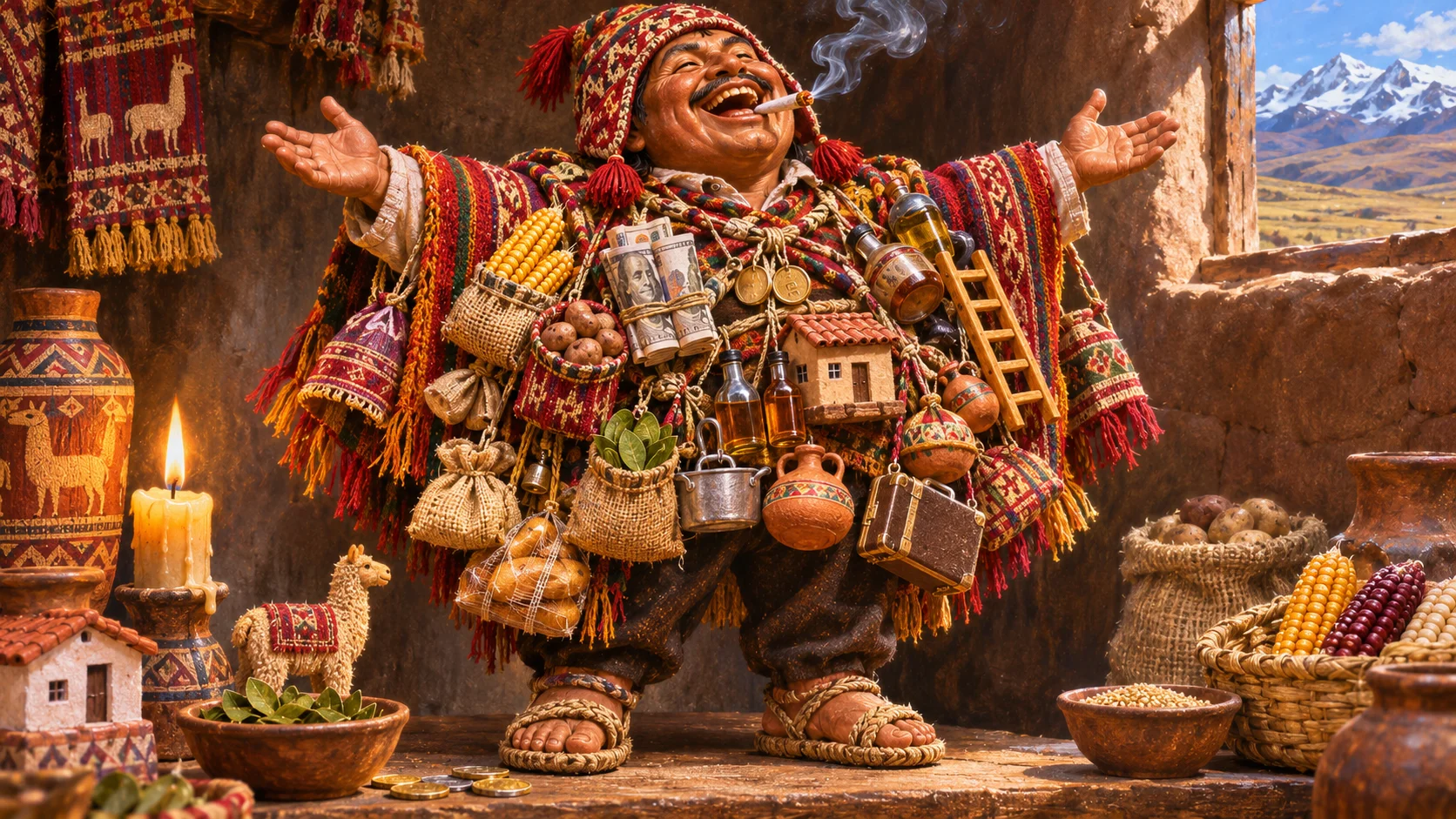
The modern Ekeko is a small figure, usually of plaster painted in bright colours. Writing on the Alasitas of La Paz records that the first figures were modelled in clay and are now commonly cast in plaster; a survey of the Puno trade describes it as a smiling, plump man, often wearing a chullu, the knitted Andean cap with ear flaps, with arms slightly spread and a prominent belly. He is sometimes shown with a moustache and always in highland dress, notably a poncho. The Peruvian physician Hermilio Valdízan described and photographed the figure in his 1922 book on Peruvian folk medicine, and later writers have described the body as that of a dwarf. Some observers find an echo of the cornucopia in the way the figure is hung with goods.
Two other features are worth noting. The first is the paleness of the face and the trader-like air. A tourism writer says colonists gave the figure a more Western appearance, a paler face and clothes that hide the nudity of the older figure. The Peruvian scholar Barrionuevo proposed that the Ekeko is an indigenous version of the colonial mercachifle, the itinerant pedlar, a Spanish-looking figure in the Andean marketplace; another retelling holds that the features imitate a particular Spaniard. These are all interpretations, and the figure may be a layered object in which each of them has a part.
The second is that the figure is a vessel. Some figures are made with an open mouth, so that a cigarette can be placed in it, and the whole body is treated as a frame for the goods that are hung on it. Craftspeople continue to reinterpret the form, so it is not a fixed icon.
What It Carries
An Ekeko is hung with miniatures of things its keeper wants: sacks and baskets of grain and food, household utensils, tools, bundles of cloth and coloured bags, money in the form of miniature banknotes clipped to the body, and symbols of larger aspirations such as a house, a vehicle, a university diploma, a passport or a plane ticket. A tourism account says the packages on his back stand for the wishes of the year, and that a wish may also be written on a slip of paper and stuck to the body. Common wishes include household goods, lottery tickets, a car, a house, food and a baby. At the Puno fair the miniatures sold include breads, sweets, sugar, flour, rice, bottles of alcohol, baskets of coca leaves from the Yungas region, soap, clothing, animals, houses and furniture.
The principle is a form of what anthropologists call sympathetic magic, but the participants speak of it differently. The illas that early writers described show that the idea is old: a small thing is given in the belief that the large thing will follow. The Ekeko is the one into whom the miniatures are collected, so that he carries a household’s whole year. A ritualist or priest then blesses the figure with its load.
What It Is Offered
The offering most often mentioned is the cigarette, placed in that open mouth, and tradition holds that the Ekeko “smokes” once a year to ensure a prosperous year. A popular belief reported by a tourism writer is that if he smokes the whole cigarette the wish will be granted, while a cigarette that burns out early means the wish will not come. This is folk belief reported at second hand, not an established rule of Aymara ritual.
Other offerings are mentioned in the sources consulted. Alcohol is sprinkled on the figure and on the ground in the ch’alla, the common Andean libation; coca leaves are offered, and modern accounts mention bottled drinks among the offerings. Grain is said to bring good harvests. An offering is generally expected before the Ekeko will do anything, and he is to be kept in a place of honour in the house, preferably a warm and comfortable spot. Beyond these points the sources tend to repeat each other, and no detailed ethnographic account of household practice that goes further was found.
Places: La Paz, Puno, Cusco and Beyond
The same figure is found in several settings, and the festivals around it differ by region.
- La Paz. The Alasitas fair opens on 24 January, as described above. Elsewhere in Bolivia, alasitas are reported at other feasts, such as that of the Virgin of Copacabana (5 August).
- Puno. The main Peruvian fair is on 3 May, the feast of the Holy Cross, on the Machallata hill in the Bellavista district. A local promoter, José Morales Serruto, said the older local rite was called Alaka and was practised on the Azoguini and Machallata hills before moving to the Cross. According to that account it began as a single afternoon, was made official in the 1960s, and today lasts several days under the provincial municipality; it has also been reported as declared part of Peru’s national cultural heritage.
- Cusco region. No evidence was found of a large dedicated Ekeko festival in the city of Cusco itself. What the survey reports for the region is smaller: fairs of miniatures along the pilgrimage route to the sanctuary of Qoyllur Rit’i (a movable date between Ascension and Corpus Christi) and on the ascent to the sanctuary of Huanca, south of the city, on 14 September.
- Elsewhere in Peru. The same survey lists miniature fairs in Ilave, Moho, Huancané, Juliaca, Lampa, Azángaro, Sicaya near Huancayo (August), Cerro Baúl in Moquegua (Holy Week), Cerro de Pasco (late November) and craft fairs in Lima.
Because the sources do not give the same weight to each place, the picture above is lopsided towards Puno, where La Serna Salcedo’s study was produced. Bolivia has more writing on the legend than on the object.
Commerce, Old and New
The relationship of the Ekeko with money is old and is in the figure. The Aymara plateau was a trading country: its limited agriculture sent people to exchange with other ecological zones, and the markets of Puno were tied in colonial times to the Potosí silver circuit. The clergy did not like what they saw. The survey reports that a nineteenth-century church decree complained of indigenous markets held at an apacheta, the cairn at a mountain pass, and that newspapers mention the Puno fair from the late nineteenth century and the Ekeko at the Machallata fair of the Cross in the early twentieth.
The modern forms are various. Besides the plaster figure, the Ekeko is made as small statues, as amulets on key rings and as a pendant on a necklace, and it is sold to visitors as a souvenir in Peru and in Bolivia. The municipal contests of miniature craftsmanship that UNESCO mentions in La Paz mean the market is also a craft economy. Whether a keychain Ekeko carries the force of a household one is a question for those who keep them. What can be said is that the figure sits comfortably between a market and a shrine, and has done for as long as anyone has written about it.
An Icon and Its Tensions
Because it was made visible by tourism, the Ekeko has become a national emblem of Bolivia, printed on souvenirs and posters, and an urban symbol of Puno, where La Serna lists it with the Candelaria festival and the diablada as part of regional identity. La Serna’s survey reports that white and mestizo buyers also take the figure up, so it has crossed the boundaries of who is considered indigenous. Some writers see a tension between the acquisitive side of the fair and Aymara values of balance, reciprocity and harmony with Pachamama; others read the exchange of miniatures, and the debt-settling that UNESCO describes, as itself a reciprocal act. Both views are held by people who take part.
For a visitor the useful courtesy is simple: this is not a toy shop. The figure and its miniatures are treated by those who buy them with seriousness and humour at once, and a blessing is a real act to the person who asks for it.
Sources & traditions
- EncyclopediaWikipedia — Ekeko
- TraditionIncan texts, oral tradition and village tellings (Andes)
Myths change from area to area and from time to time. This chronicle follows the most widely told versions; tellings in other villages, regions and eras may differ.