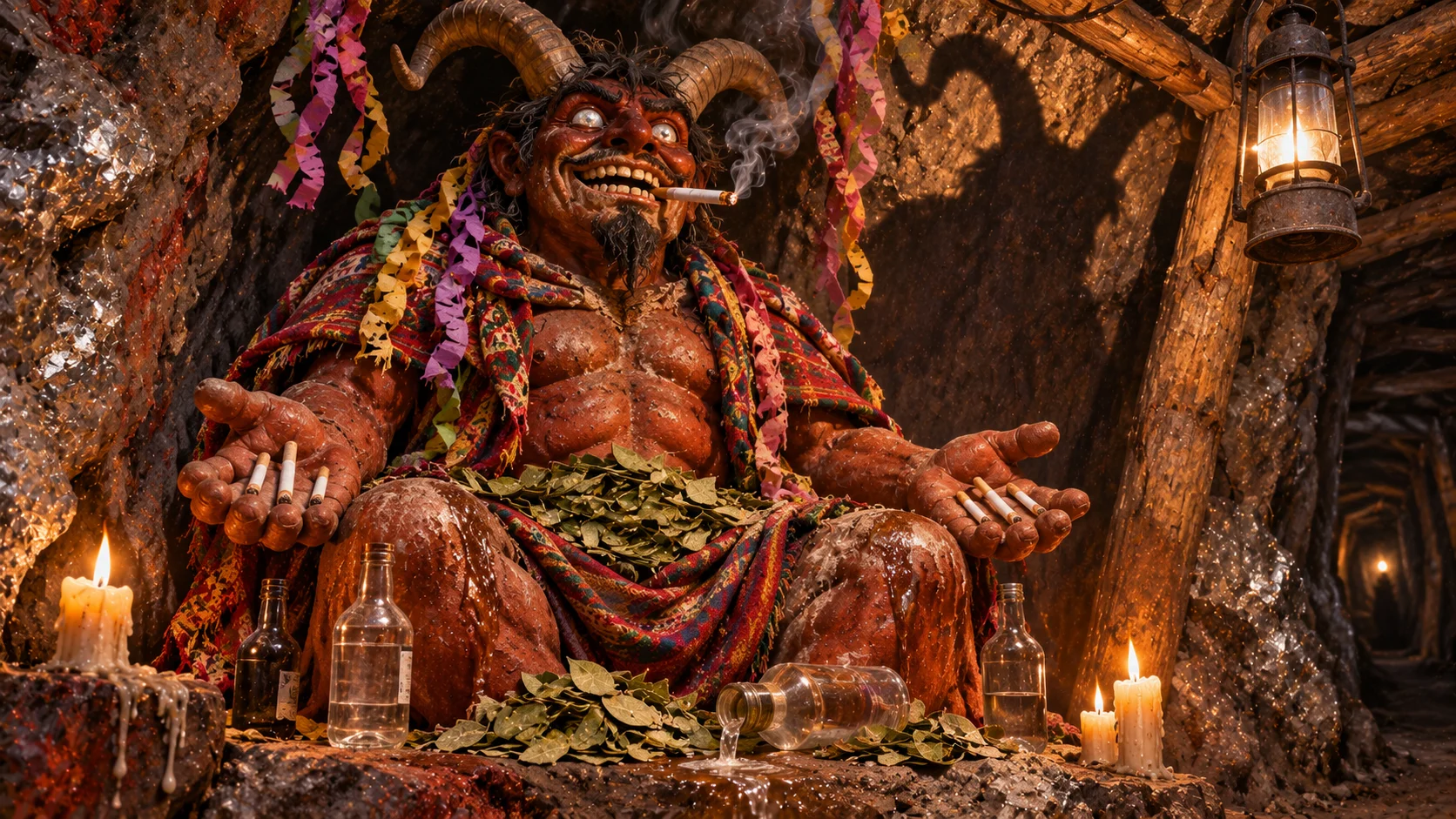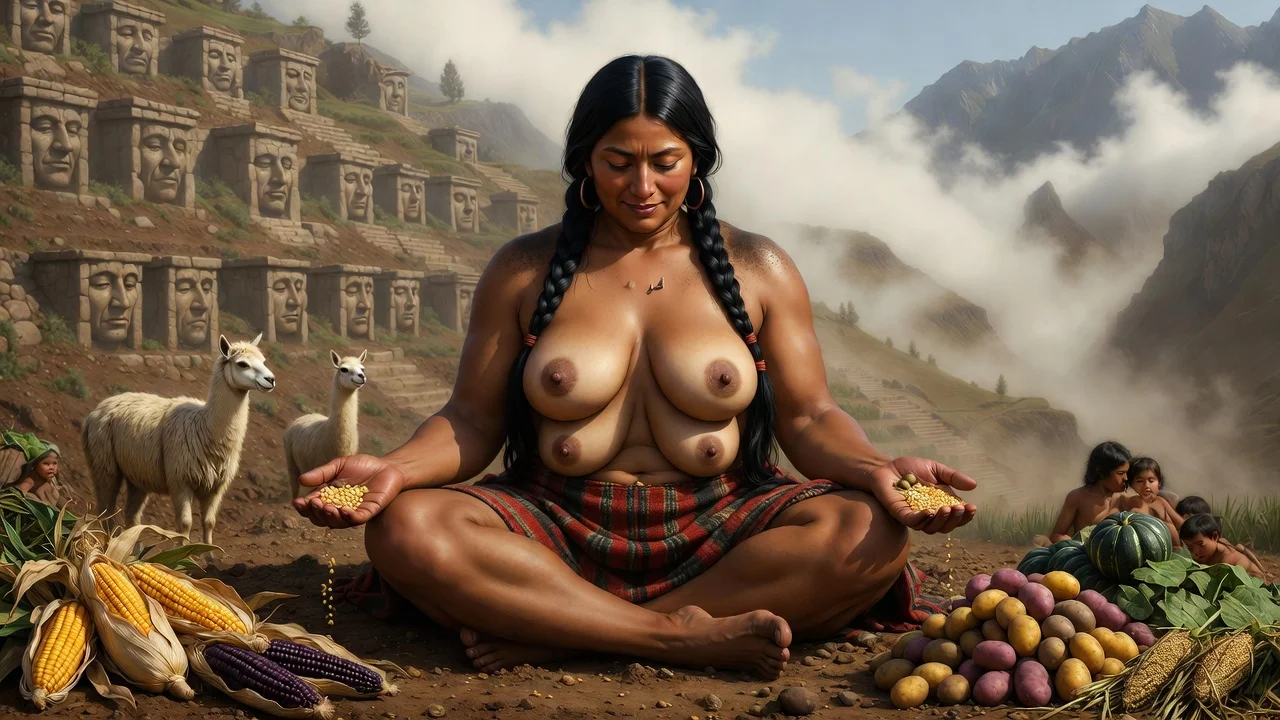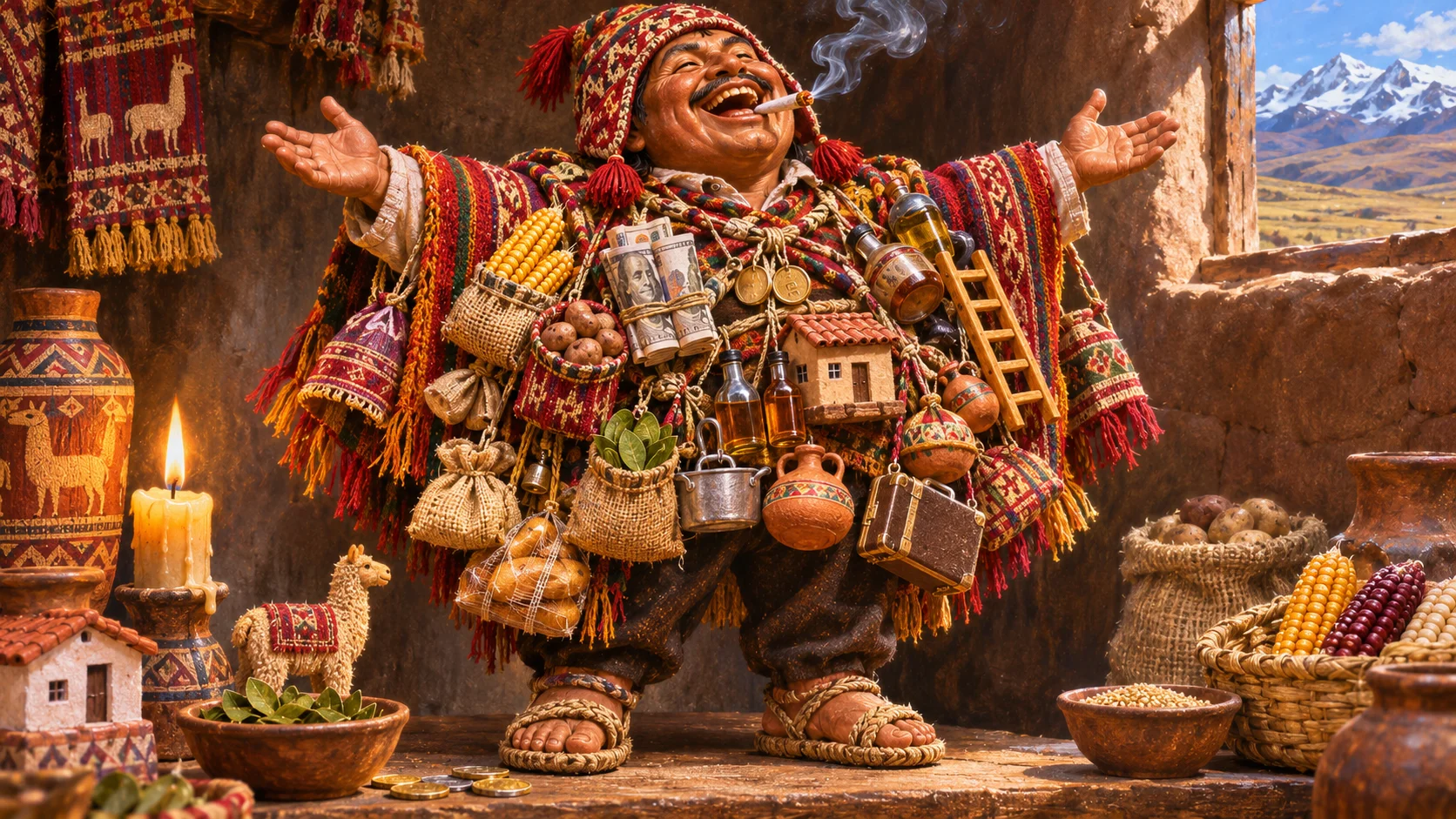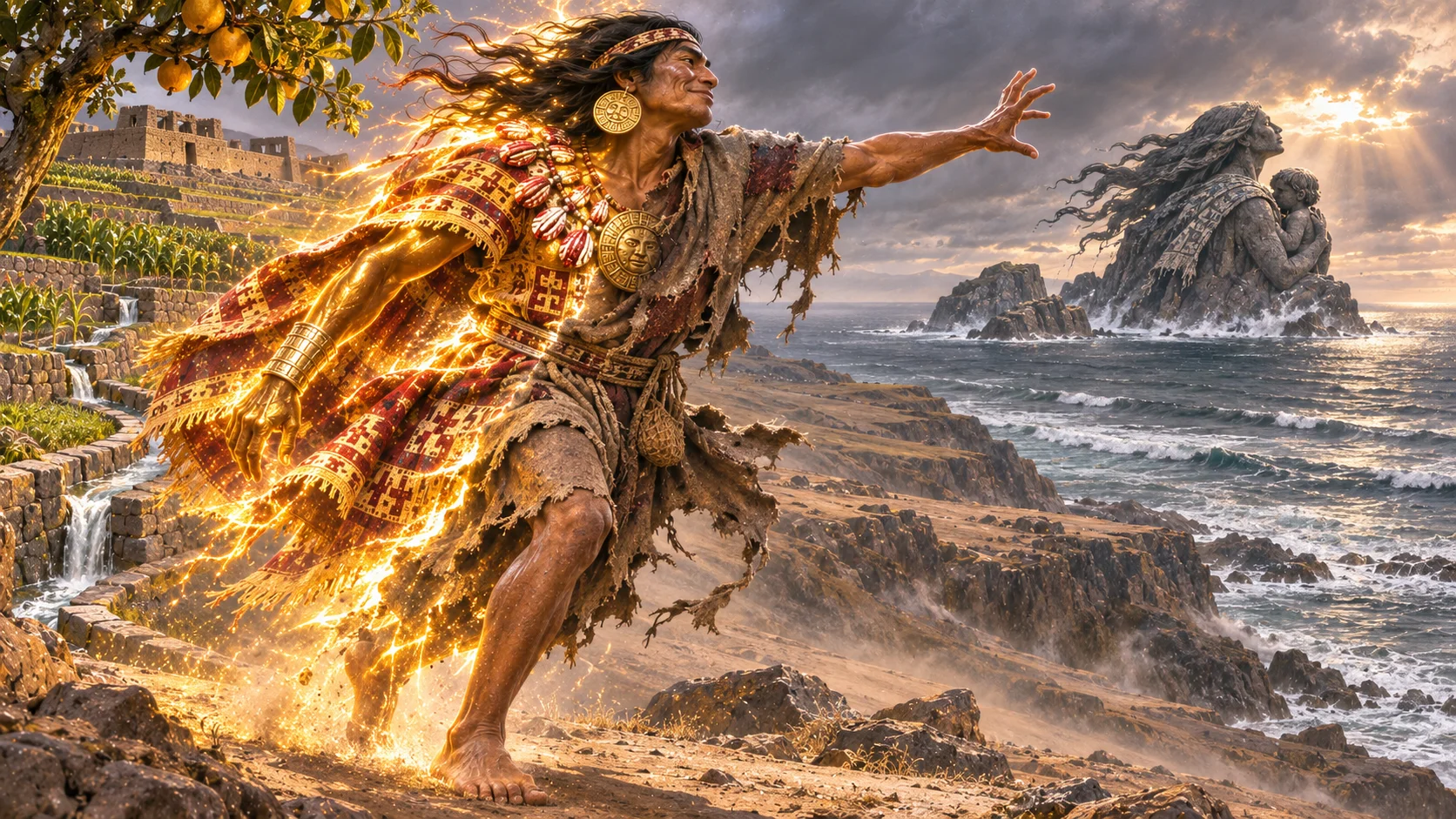
Coniraya, more fully Cuniraya Viracocha (also Cuniraya Huiracocha, Coniraya Viracocha, Cuni Raya), is a creator-trickster of the central Peruvian highlands and coast. He is known above all from the Quechua-language Huarochirí Manuscript, where he appears first in the guise of a ragged, despised beggar, shapes terraces and irrigation channels with a word, seduces the virgin huaca Cahuillaca (the name is also written Cavillaca) by means of a lucuma fruit, chases her and her child to the Pacific shore at Pachacámac, and, in a second quarrel with the goddess Urpayhuachac, is said to have scattered the first fish into the sea. He is both a generous maker and a dangerous guest, and few figures of Andean tradition are drawn with such sharp and humorous detail.
Two things need saying at the outset. The story comes down to us through a text assembled under the supervision of a Spanish priest whose career was spent persecuting the religion it records; and the Coniraya of the manuscript is already the product of overlapping layers, a local huaca and the pan-Andean creator Viracocha fused into one name. Both facts shape what can and cannot be said about him.
The Manuscript and Its Making
The Huarochirí Manuscript is the only surviving substantial text recording a pre-Hispanic Andean religious tradition in an Andean language. It is written in Quechua and describes the myths, rites and beliefs of the people of Huarochirí, a highland province east of Lima in the upper valleys of the Lurín and Mala rivers. It was compiled at the direction of Francisco de Ávila, a Cusco-born priest who made his career as an extirpator of idolatry, between the late sixteenth and early seventeenth century; it is commonly dated to about 1608. The irony noted by every scholar is that a document gathered to help destroy the old religion became its best record. The manuscript lay little known in Madrid until the German ethnologist Hermann Trimborn published a German translation in 1939. José María Arguedas issued the first Spanish translation and a bilingual edition in 1966; Gérald Taylor produced his Quechua-Spanish study and edition in 1987 (with a French version later); and Frank Salomon and George Urioste published the English edition with the Quechua original in 1991. The text is divided into some thirty chapters, with supplementary material.
The editors differ in emphasis. Taylor’s edition is the main base for the Cahuillaca story in Spanish; Salomon and Urioste’s English rendering and notes stress how the myth is tied to places on the ground, so that a sea islet, a boulder or a canal is the proof of a story. Chapter and page numbers vary between editions, so references below are by episode, with chapter numbers given where scholars agree.
Name and Layers
The name joins two elements. Cuniraya appears to be the name of a local huaca; Viracocha is the title of the creator deity known across the Andes and, under the Incas, promoted to the supreme position. The combined name is therefore a historical sediment. Scholars such as Franklin Pease have argued that the state Wiracocha of the Inca imperial cult was in part a later systematization of regional figures. The linguist Rodolfo Cerón-Palomino has proposed a link between “Cuniraya” and the epithet Contiti, a suggestion that remains a specialist hypothesis. In the manuscript itself the name Viracocha is also used for Spaniards, which gives some of the text an unplanned doubleness.
The God in Rags
The story begins with Coniraya walking the land as a poor man, in torn clothing, and those who did not know him held him in contempt. This is the key to the figure. His divinity is hidden in poverty, and everyone around him is being tested by how they treat the beggar. He humbles other huacas who think themselves above him. In the chapter that tells these episodes (Chapter 2 in the standard numbering), he is also credited with preparing fields and building terraces by his word alone, and with opening an irrigation channel by throwing a cane flower, the pupuna, like a spear. A creator in Andean terms is first of all a maker of cultivable ground and flowing water; the beggar’s staff is a surveyor’s tool.
Cahuillaca and the Fruit
Cahuillaca is described as a huaca and a virgin of great beauty who refused every suitor. All the huacas wanted her. While she was weaving beneath a lucuma tree, Coniraya, who had turned himself into a bird, dropped his seed into a ripe fruit, which fell beside her. She ate it and became pregnant, though she had known no man. She bore a son and raised him alone.
When the boy was about a year old she called all the huacas to a gathering at a place named Anchicocha, to find the father. Each man was asked to claim the child; none did. Coniraya had come and was sitting apart, still in his ragged clothes, and Cahuillaca did not even ask him, because he looked wretched. When the child crawled, he did not go to any of the finely dressed lords; he crawled past them all and climbed onto Coniraya’s legs. In disgust that she had borne a child to such a man, Cahuillaca seized the boy and fled towards the sea. Only then did Coniraya put on his golden clothing and shine out over the land; he called out to her as he followed, and she would not look back.
The common summary says that she and the child ran into the ocean at Pachacámac and became two stone islands. Retellings differ in detail: some have the mother and boy throw themselves into the water, others have them turned to stone on reaching the shore, and some popular versions make the child a daughter, though the accounts consulted give a son. The islets are real and visible from the sanctuary coast, which is what makes the story a charter of the place: the sea tells the story, and the story names the sea.
The Animals Along the Road
On the pursuit Coniraya met animals and asked each whether it had seen Cahuillaca and how far ahead she was. Those who said she was far away he cursed; those who said she was near he blessed. The blessed and cursed, in the usual reading, are the following.
- The condor was blessed: it would feed on the animals of the high puna, including the ones that died.
- The puma was blessed: it would be honoured, and llamas would be sacrificed to it.
- The falcon was blessed and promised good fortune.
- The skunk was cursed: it would be hated, foul-smelling, and go abroad only at night.
- The fox was cursed: it would be despised, and its skin discarded when it was killed.
- The parrots were cursed: they would be driven off and shouted at for raiding the maize fields.
Peter Eeckhout has read the pattern as reflecting a highland point of view: the condor and puma are the animals of the mountains and are honoured there, whereas the fox, a figure of standing on the coast, is the one who is cursed. On that reading the story is also a map of whose country the narrators belong to; it is an interpretation, not a statement of the text. Each of these explanations is an etiology of the kind found throughout world mythology, and each quietly reinforces the view that blessings and curses are a creator’s way of fixing the nature of the world.
Pachacámac, Urpayhuachac and the Fish
When Coniraya reached the coast, near the sanctuary of Pachacámac south of present-day Lima, he found two girls, daughters of the goddess Urpayhuachac, whose name is usually understood as “she who gives birth to doves”. The girls were guarded by a serpent, an amaru; one writer has suggested that the serpent stands for the Lurín river that flows past the sanctuary. Urpayhuachac herself was away, visiting Cahuillaca. In her absence Coniraya assaulted the elder daughter. When he tried the younger, she turned into a dove and flew away, which is why Urpayhuachac is called the one who bears doves.
Then comes the episode for which the story is most often cited. Before this time there were no fish in the sea. Urpayhuachac kept them in a small pond at her home. Angered, Coniraya threw the fish into the sea, and there they multiplied; that, the story says, is why the sea is full of fish. The goddess, in the text, is left to answer for what had been done in her house.
The fish episode is a gift that is also a theft: in the story, the sea becomes bountiful because a god lost his temper in a goddess’s house, and the abundance of the coast is traced to a quarrel between two divine persons.
Other Appearances
Coniraya is named elsewhere in the manuscript as well, as a figure of the old world whose acts are cited in the telling of other huacas’ stories. Secondary summaries mention further episodes, including one later in the text that touches the coming of the Spanish and the Inca Huayna Capac, but those passages were not checked against the text here and no claim is made about them. Where a text is assembled from the traditions of several communities, each of which told the old stories in its own way, inconsistency between episodes is what one expects.
How Scholars Have Read Him
One reading makes Coniraya a solar figure: dawn is the beggar in rags, noon the golden figure shining over the land, and the westward chase to the ocean the sun’s course. Other readers treat him as a trickster who mediates between opposed categories: poverty and splendour, highland and coast, are the kinds of pair he moves between. He is at once a creator and a disruptor, since his anger itself produced the fish. The editors Salomon and Urioste emphasise a different point: that the myth is fused with the landscape, so that its truth lives in places a person can still visit.
A Careful Word
This is a story from a living landscape, written down by a priest who collected it to uproot it, and it should not be flattened into a children’s fable. One episode turns on the deception of a woman who had refused every suitor and another on an assault; they are reported here plainly and are not presented as models. The text’s own worldview is not that of the Christian friar who commissioned it, and the modern reader gains most by taking it as the surviving voice of an Andean community, with its humour, its fear of the powerful and its love of the particular rock and stream.
Coniraya is not worshipped as a deity in any documented modern cult that could be confirmed. He lives as a character of Peruvian literature and national memory, with the two islets off the coast at Pachacámac as the lasting sign of the story, and with a manuscript that, against its compiler’s purpose, is read today as a testament of what the people of Huarochirí believed.
Sources & traditions
- TraditionIncan texts, oral tradition and village tellings (Andes)
Myths change from area to area and from time to time. This chronicle follows the most widely told versions; tellings in other villages, regions and eras may differ.