Pacha Kamaq is the name of a god and of a place. The god was the great power of the central coast of Peru, honoured at a vast sanctuary on a bluff above the Pacific in the Lurín valley, a short way south of modern Lima, where pilgrims came for many centuries to consult an oracle. The place, Pachacamac, is among the largest and longest-lived religious sites of the ancient Andes. The Inca did not destroy this cult when they took the coast in the later fifteenth century; they honoured it, built beside it, and in some accounts consulted it. The Spanish, who first came in 1533, treated it as a source of gold and as a seat of the Devil. Between these three attitudes, a god who is known to us chiefly from his enemies and his converts must be reconstructed with care.
Name and etymology
The name is Quechua in form. Pacha is a wide word: earth, world, time, the ordered universe. Kamay is the verb at the centre, usually glossed “to create” or “to animate”, but in practice meaning something nearer to “to infuse with the force by which a thing lives and does its work”; its agent form, kamaq, names one who gives that force. Common renderings are therefore “animator of the world”, “he who sustains the universe” or “maker of the earth”. The Spanish of the sixteenth century wrote it Pachacama or Pachacamac. The sense of kamay is broader than the English “creator”, and the translation “World-Maker”, though common, can mislead: in Andean usage a kamaq is less a maker out of nothing than the power that charges something with its vitality.
The sources, and how far they can be trusted
Three bodies of evidence need to be kept separate.
The first is colonial writing. The earliest witnesses were soldiers: Hernando Pizarro, in a letter of 1533, and Miguel de Estete, who accompanied Hernando Pizarro and wrote an account of the expedition. They saw the sanctuary in the middle of a looting raid, and Hernando in particular was concerned to present his actions as the exposure of a deception. Pedro Cieza de León, who travelled through Peru in the 1540s, describes the place and its priests as a seat of diabolical oracles. Later chroniclers, among them Garcilaso de la Vega, Bernabé Cobo and the Augustinian Antonio de la Calancha, add philosophical and mythological material, filtered through learned Christian ideas. Hernando de Santillán (1563) and Cristóbal de Albornoz (writing in the 1570s and 1580s) add other details, Albornoz as an extirpator of idolatry. The Huarochirí Manuscript, written in Quechua about 1608 in the highlands behind Lima and compiled under the priest Francisco de Ávila, has several references to Pachacamac and is the closest we have to a native voice, though it speaks from a valley that was in rivalry with the coast and not from the sanctuary itself.
The second is archaeology. Max Uhle excavated at Pachacamac in 1896, and later work by Julio C. Tello and others, down to the recent projects led by Peter Eeckhout, has mapped a site of several hundred hectares with phases extending from about the third century AD until the Spanish conquest. This is the independent check on the chroniclers, and it does not always agree with them.
The third is living memory: the place name, the oracle remembered in local tradition, and the way the site is visited today. It is not a continuation of the ancient cult, and it should not be written as one.
The sanctuary and its long history
Pachacamac was not an Inca foundation. The oldest monumental buildings, the Old Temple among them, are of raw adobe and belong to the early centuries of the first millennium, in a style associated with the Lima culture of the central coast. During the Wari period, roughly 600 to 800 AD, the site was remodelled, probably as a regional centre of the highland Wari state, and Wari designs appear on its textiles and ceramics. After the Wari declined, Pachacamac continued as a religious centre under the local Ychsma (or Ichma) polity, whose lords built the stepped, ramped pyramids of the later period. Eeckhout has argued that at least some of these pyramids were palaces of the Ychsma elite rather than purely religious “embassies” for outside groups, a reading that has changed how the site is understood.
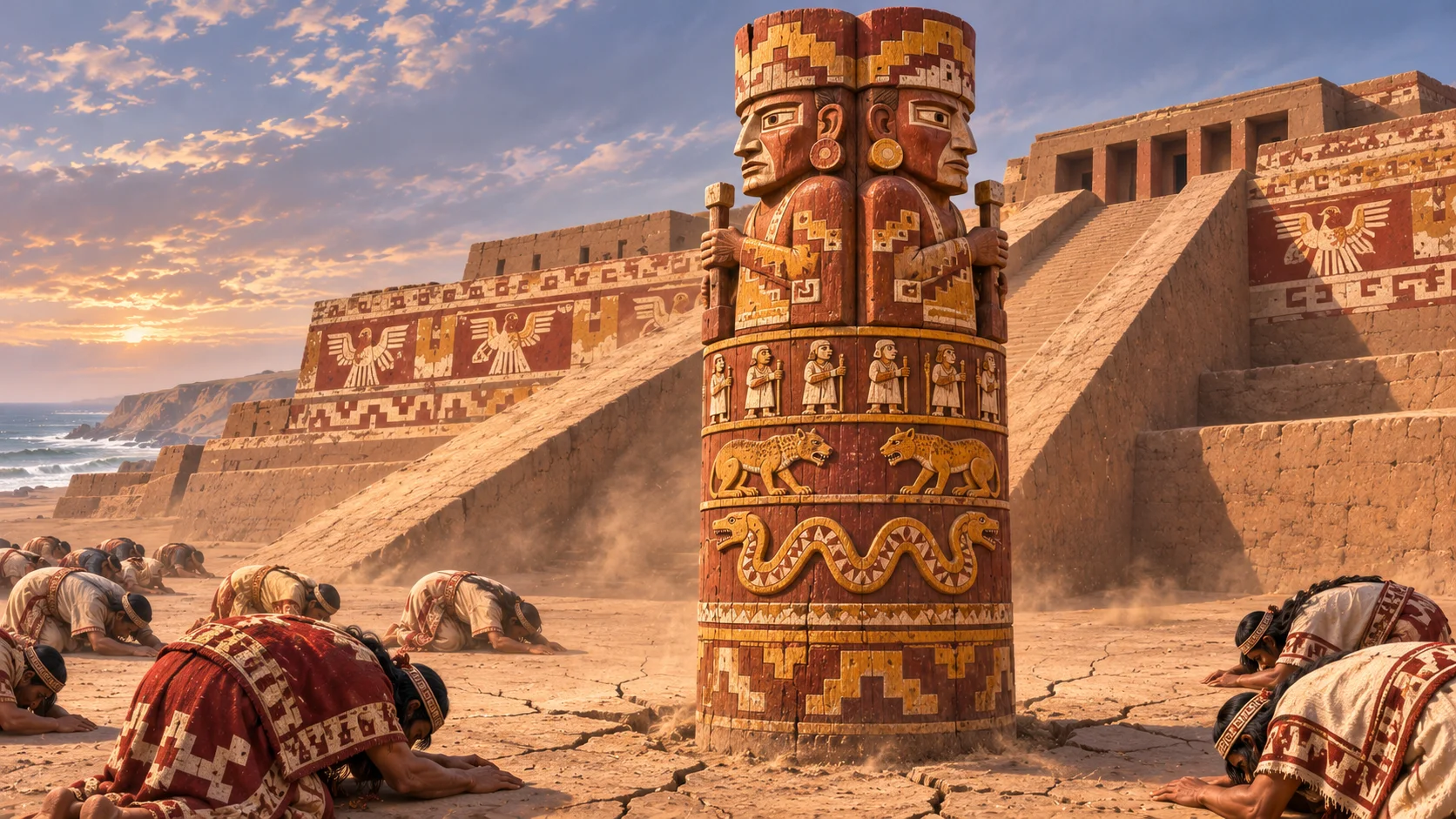
The core of the cult was the Painted Temple, so called because of the murals on its walls. In 1938 excavations in the atrium of the Painted Temple (work associated with Albert Giesecke and Arturo Jiménez Borja) recovered a carved wooden post about two and a third metres high, with figures on its faces, which has been called the Pachacamac idol. A study published in 2020, led by Marcela Sepúlveda, dated the wood by radiocarbon to about 760–876 AD, in the Wari period; Jiménez Borja had earlier reported cinnabar pigment on it. Whether this is the very image the Spanish saw in 1533, one of the many wooden images that their accounts say stood throughout the site, or an earlier object preserved there, is unknown. The Spaniards’ account was that the oracle was kept in a dark, enclosed room, and that few people were permitted to see it; the question cannot be settled on present evidence.
Myths of Pacha Kamaq
The best-known story of the god is a creation tale that comes to us through colonial authors, notably Calancha (1638), and is not found in the Huarochirí text; the summaries I could consult do not always name which author gives which detail. In outline, as modern summaries give it, Pacha Kamaq created the first man and woman but gave them no food, and the man died. The woman, in her grief, appealed to the Sun, who impregnated her with his rays and she gave birth to a child. In the summaries, Pacha Kamaq, angry that the Sun had been honoured in his place, killed the child and cut up the body, and from its teeth, bones and flesh came the staple crops of the coast, maize, manioc and others. The Sun then sent another child, the hero Wichama or Vichama; while he was away Pacha Kamaq killed his mother, and in some versions Wichama restored her to life and drove the god into the sea. The tale can be read as a story of rivalry between the coastal creator and the solar power that would later be the god of the Inca, and it explains the origin of food through sacrifice. I must stress that the story is recorded by a seventeenth-century Augustinian, not from a native source of the coast, and that the details differ in different summaries.
The Huarochirí Manuscript places Pachacamac in a different light. It makes him the husband of Urpay Huachac, the keeper of fish, whose story is entwined with that of the trickster Cuniraya Viracocha and the woman Cavillaca. In the second chapter the pursuit of Cavillaca ends at the sea by the temple of Pachacamac, and Cuniraya, in his anger at the woman who guarded fish in a pond, pours them into the ocean and so peoples it. In a later chapter, as summarised by commentators, the Inca Tupac Yupanqui summons the huacas and none answers; Pachacamac is then said to explain that he stays silent because if he spoke the earth would shake. This is the best direct evidence that the god was believed to cause earthquakes, and it matches what the chroniclers say, that he moved the world when he was angry. I am relying on a summary of the chapter and not on a close reading of the Quechua.
The oracle and pilgrimage
Pachacamac was above all an oracle. Pilgrims came from far, with offerings, to seek the god’s counsel, and the Inca are reported to have consulted it on matters affecting the state. The Spanish accounts describe priests who spoke for the god from within, and Cieza and others call the voice the Devil’s. Hernando Pizarro’s letter mentions the dark and filthy chamber of the idol, and the early Spanish accounts speak of a wooden image. Albornoz writes of a handmade golden fox that stood on a hill by the town, and of a dead fox, which he names Tantanamoc, at the god’s door. The meaning of the fox is unclear; the animal is prominent in Andean tales, and the connection to earthquakes in some summaries of the Huarochirí text is thin.
The oracle’s fame had an enduring echo in the name of a city. Spanish writers describe a second, smaller oracle in the neighbouring Rimac valley that was known as the “speaker”, rimaq, and its name, passed through Spanish pronunciation, is the usual origin given for “Lima”.
The Inca and Pachacamac
The Inca took the central coast, by the usual reckoning, around the 1470s, in the reigns associated with Pachacuti and Tupac Yupanqui. Santillán (1563) reports that Tupac Yupanqui’s mother spoke from the womb to say that the maker of the earth was in the valley of Irma; the Inca went there, fasted (some summaries say for forty days), and the god is said to have spoken to him, after which the valley’s name changed from Irma to Pachacamac. Garcilaso says that the Inca nobility venerated Pachacamac inwardly, without temples or sacrifice, as an unknown god whom the Sun himself could not match. This last statement is controversial. Garcilaso was educated in Spain, was familiar with Renaissance Neoplatonism, and had every motive to show the Inca as natural monotheists; modern scholars tend to treat his “unknown god” as an idealisation shaped by his own reading rather than as Inca doctrine.
Archaeology gives a more concrete picture of a compromise. The Inca built a Temple of the Sun, a large stepped platform, on the main plaza at Pachacamac, and added a house for the chosen women who served the cult. They left the oracle in place. This was the usual Inca method: to place their own cult beside the older one, and to take the old shrine under their patronage. An Inca-period cemetery of women, found in early excavations near the house of the chosen women, has been read by some scholars as evidence of sacrifice, though interpretations differ.
Pachacamac and Viracocha
The comparison with the creator Viracocha was drawn almost at once in the colonial sources. Colonial writers and modern scholars have treated Pacha Kamaq as a coastal counterpart, or a lesser rival, of Viracocha. Santillán’s anecdote has the maker of the earth speak to the Inca. But there are differences. Viracocha is a creator who arises from the lake, walks the land and goes away over the sea; Pacha Kamaq is rooted at a place and acts through an oracle. Viracocha’s story is told as a series of events; Pacha Kamaq’s is told as an ongoing presence that moves the ground. Some scholars see the two as one idea expressed in two local forms, others as separate traditions that the Inca made equivalent for administrative convenience. The sources do not settle the matter.
Conquest and its aftermath
Francisco Pizarro sent his brother Hernando to Pachacamac in January 1533, with a small mounted company, to collect gold; Hernando’s return to Cajamarca is dated to mid-April. The Spanish found less than they had hoped. Cieza states that the priests had removed a very large quantity of gold, which he gives as more than four hundred loads, and hidden it, and the treasure has never been located. Hernando had the local lords brought into the sanctuary and lectured them on the deception of their religion. Accounts of what happened to the oracle image are conflicting: some say it was destroyed, others that a lesser object was shown.
The cult did not die in an instant. In the 1560s, the movement known as Taki Onqoy, which arose in the highlands of Ayacucho, preached that the huacas, among them Pachacamac and Titicaca, would overcome the Christian God, and Albornoz was sent to suppress it. The sanctuary decayed with the collapse of the coastal population, which suffered terribly from epidemic disease.
Modern remembrance
Today the ruins are an archaeological park, and Pachacamac is also the name of a district and a town. In Lima, the memory of the oracle is preserved in the place name and in regional history. The scholar María Rostworowski devoted a long study to the cult and its relations with the later cult of the Señor de los Milagros, the painted Christ of Lima, linking the earthquake-god of the coast to the devotion of a city that has repeatedly been shaken. That study argues for a connection between the older earthquake cult and the later devotion, a thesis that is her interpretation and not a settled finding; I mention it as a reminder that coastal earthquakes are the context in which the old god lived. As far as I can verify, there is no continuous present-day cult of Pacha Kamaq; the living practices of the Andes are addressed to the apus, to Pachamama and to other powers, and some of those are related, but they are not his.
Kindred powers
Viracocha is the obvious companion, and the Huarochirí Manuscript, whose central figure is the highland huaca Pariacaca, who in that valley’s tradition overcame the older local power Huallallo Carhuincho, belongs to the same body of sources. Cuniraya Viracocha is a related trickster-creator. Urpay Huachac is the fish-keeper and the god’s wife in Huarochirí; in some modern retellings the wife is Pachamama, an equation that I could not trace to an early source. Illapa, the thunder of Cusco, and Supay, a word the colonial church turned into “devil”, belong in the same neighbourhood of the unsettling forces. Finally, the sea, whose Mama Cocha was honoured by the coast, is the setting of the god’s retreat into the sea in some versions of the Wichama tale.
A closing reflection
Pacha Kamaq is a god whose temple outlived the Wari, was kept by the Inca, and was emptied by the Spanish, and whose name has survived on a map. The sources show him from outside, as a rival, a convert and an enemy. What shows through is a coastal people’s sense that the ground itself is alive and may turn, and that someone must be asked. The oracle is silent, but the earth still shakes, and the question that people put to him is still a reasonable one.
Sources & traditions
- EncyclopediaWikipedia — Pacha Kamaq
- TraditionIncan texts, oral tradition and village tellings (Andes)
Myths change from area to area and from time to time. This chronicle follows the most widely told versions; tellings in other villages, regions and eras may differ.