Supay is the Quechua word that Spanish missionaries chose to translate “devil”, and it is today the usual word for the Devil in Quechua and, in the form supaya, in Aymara. For that reason it is often described as the Inca god of death and lord of the underworld. The truth is more careful and more interesting. What we know of the word before the Spanish arrived is very thin; what we know of its use after they came is plentiful and shaped by Christian purpose; and what miners in Bolivia now say of their “Uncle” underground is a living tradition with its own logic, which is not a simple relic of anything. This article tries to keep those layers apart and to say, at each step, how much weight the evidence will bear.
Name and etymology
The earliest dictionaries give supay (spelled zupay or çupay in the older orthography) a range of senses. The first Quechua lexicon, by the Dominican Domingo de Santo Tomás in 1560, glosses the word as an angel, good or bad, a demon, or a household spirit, and distinguishes a good supay from a bad one by adding modifiers (allisupay and mana allisupay, “the good” and “the not good”). The lexicon compiled by Diego González Holguín in 1608 gives both the sense of shadow and the sense of the Devil, and modern dictionaries of Quechua list shadow, spirit and possessed or sick as meanings of the root. The scholar Gérald Taylor has argued that supay originally meant something like “shadow” or the soul of a dead person, and that the sense “devil” was imposed by translation.
The significance of the dictionary evidence is this: a word that the first Spanish lexicographer could attach to both a good angel and a bad one was not, to that lexicographer, a name for a single evil being. The historian Juan Carlos Estenssoro has argued that the later hardening of supay into “devil” was a product of the politics of translation as evangelisation intensified, in the catechisms of the later sixteenth century; I give his argument as I have it from secondary accounts, and the point stands as a plausible reading and not as a settled finding.
What the pre-colonial evidence is, and is not
The evidence from before the Spanish conquest is nearly nothing. There is no Inca-period writing, because the Inca had none in our sense. There is no archaeological image that can be labelled Supay. Every statement about a pre-Hispanic Supay comes from texts written under Spanish rule, by people who had already decided what the word should mean. The modern claim, repeated in many popular sources, that Supay was an Inca god of death, a lord of Uku Pacha, a trickster created by Viracocha, or a guide of souls like the Egyptian Anubis, rests on summaries of those colonial texts, and several of these popular statements trace to uncited books or tourist websites. I regard them as unverified.
The better-supported picture is more modest. Andean peoples did have beliefs about the dead and the place where they went. The dead were honoured as ancestors, their mummies kept and fed by their kin, and the dead were thought to continue to live in a place or state, the sources describe as a land of silence or darkness. Arriaga (1621) records, from his investigations in the central highlands, a belief that the dead went to a place he writes Ypamarca; Taylor argues that the correct form is upamarca, with upa meaning mute, silent or foolish, a land of the silent, and notes that some of this rests on Arriaga’s own spelling and Quechua. Cieza, writing in the 1540s and 1550s, is cited for the statement that the devil was known across Peru as Supay, which is already a Christian reading. These accounts do not describe a ruler of the dead.
The three worlds and Uku Pacha
A frequent claim is that the Inca divided the cosmos into three levels: Hanan Pacha, the upper world, Kay Pacha, this world, and Uku Pacha, the inner or lower world, over which Supay presided. The names are real and appear in the sources. But the neat triad has attracted scepticism: it looks, to some scholars, like the Christian pattern of heaven, earth and hell laid over the Andean material, and the writers do not use the terms alike. Inca Garcilaso sets out three worlds, Hanan, Hurin and Ucu Pacha, and says the lowest was also called the house of the devil (cupaypa huacin in his spelling); other colonial writers describe a subterranean place of torment. All are filtered through the idea of hell. In traditional Andean thought the inner world is also the place from which seeds grow, water rises and ancestors emerge, and is therefore not simply a place of punishment.
The chroniclers and the colonial reframing
Seen in this light, the chroniclers are not neutral reporters but participants in a translation project. Guaman Poma de Ayala, an Andean Christian writing his great letter to the king about 1615, uses supay for the Devil. Garcilaso writes that the word was the Indians’ name for the Devil, and argues that the Spaniards wrongly took Pachacamac himself for a demon. Arriaga’s manual for the extirpators states that huacas are the work of the Devil. The Church’s own catechisms and sermons in Quechua, produced in the wake of the Third Council of Lima in 1583, used supay in the sense of the Christian Devil, and it is this usage, repeated in every Quechua sermon for four centuries, that fixed the modern meaning. The cleric Bartolomé Álvarez (1588) is reported in secondary literature to have questioned the equation by noting that it would make the Devil a dead person; I could not check this in his text and give it as a pointer only.
It should be said plainly that none of this proves that Supay was not a significant pre-colonial being, nor that he was. The possibility that there was a lord of the dead of that name in Inca belief cannot be excluded, but the evidence is the evidence of the people who replaced him.
Supay as an ambivalent power
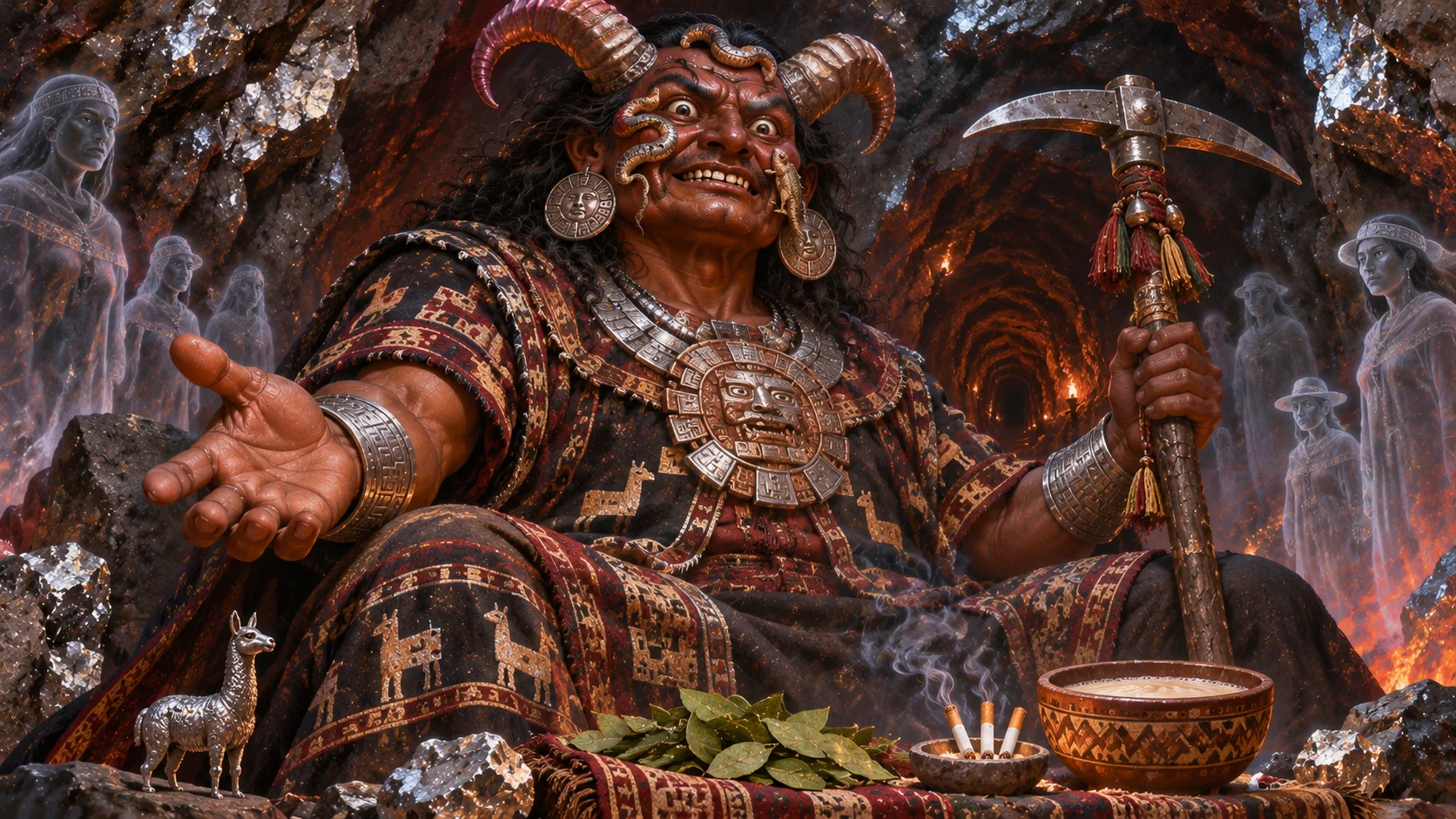
If we put aside the Christian translation, a more ambivalent picture appears in the secondary literature: supay as a class of spirits, rather than a single figure, who might harm or help, dwell in dangerous places, cause illness, and guard what is hidden. In modern highland Quechua, ethnographers report supay or supaykuna used for spirits that can seize and sicken a person, associated with ruins, caves and certain hours such as noon and midnight, and the word is also used for haunting and bewitchment. In Ecuador, among Kichwa speakers, the word is commonly used for devil figures in folklore. This may reflect a layer older than the missionaries, or it may be a result of centuries of Christian teaching; the data do not discriminate.
Aymara-speaking communities of the altiplano have their own forms and meanings of the word, and usage is not uniform. The point to carry is that the word is not stable across languages and communities.
The Tio of the mines
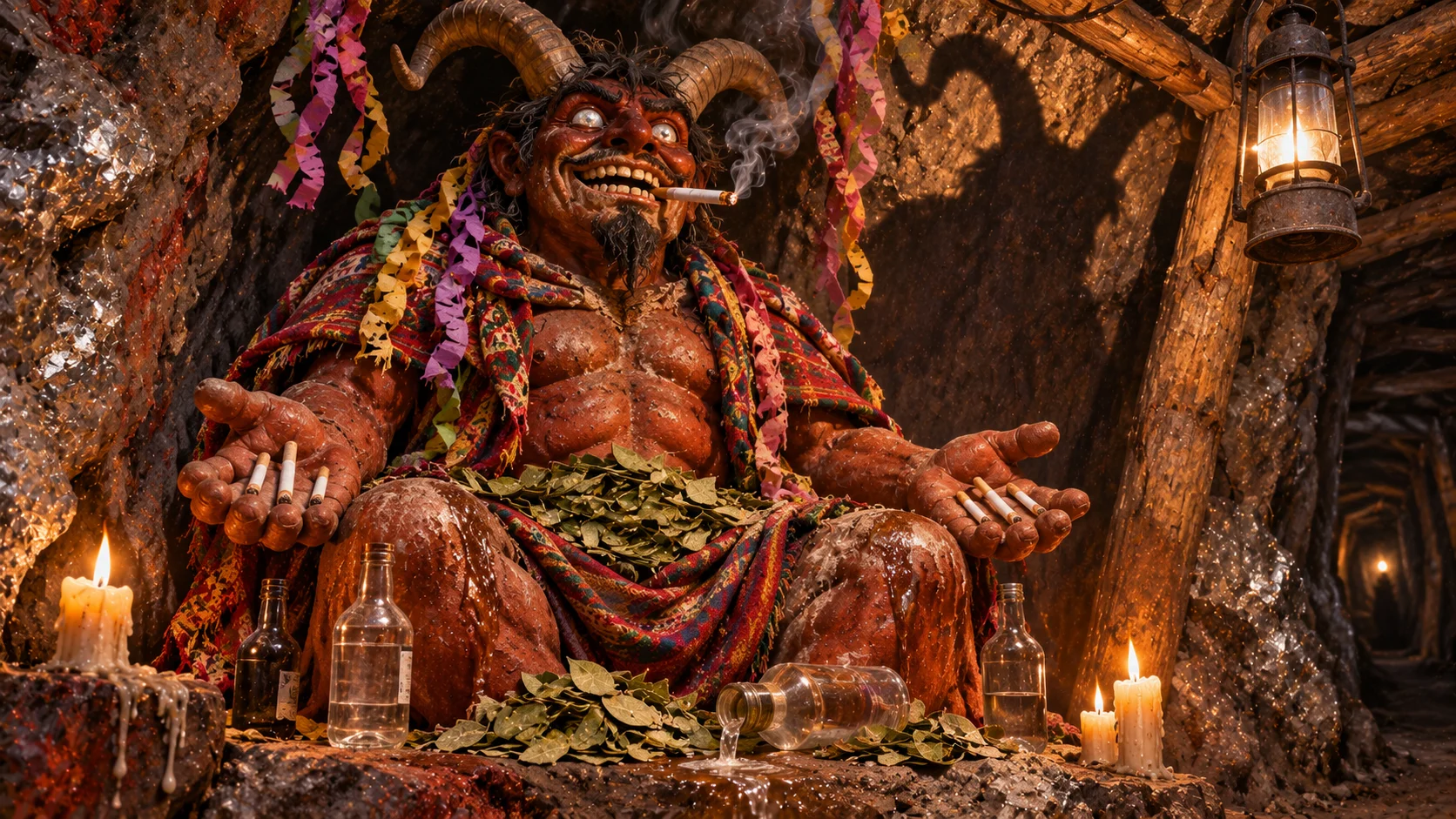
The most famous modern figure connected with the word is the Tio, Spanish for “uncle”, the owner of the mine in the silver and tin workings of Bolivia, especially Potosí, Oruro and Llallagua. At the entrance and along the galleries of the mines are clay or stone figures of the Tio, seated, often horned, with a cigarette and coca leaves in his mouth, his face painted and his dress renewed. Miners pour alcohol before him and offer coca, cigarettes and, on important days, the blood of a llama, in return for safety and for a share of the ore. In the best-known studies, by June Nash (1979), who worked in the tin mines of Oruro, Michael Taussig (1980), whose book draws on Bolivian mining accounts such as Nash’s alongside his own work in Colombia, and, for Potosí, Pascale Absi (2005), miners say that outside they are Christians and that the mine belongs to the Tio, whose domain is the interior of the earth, as opposed to Pachamama, the earth’s surface.
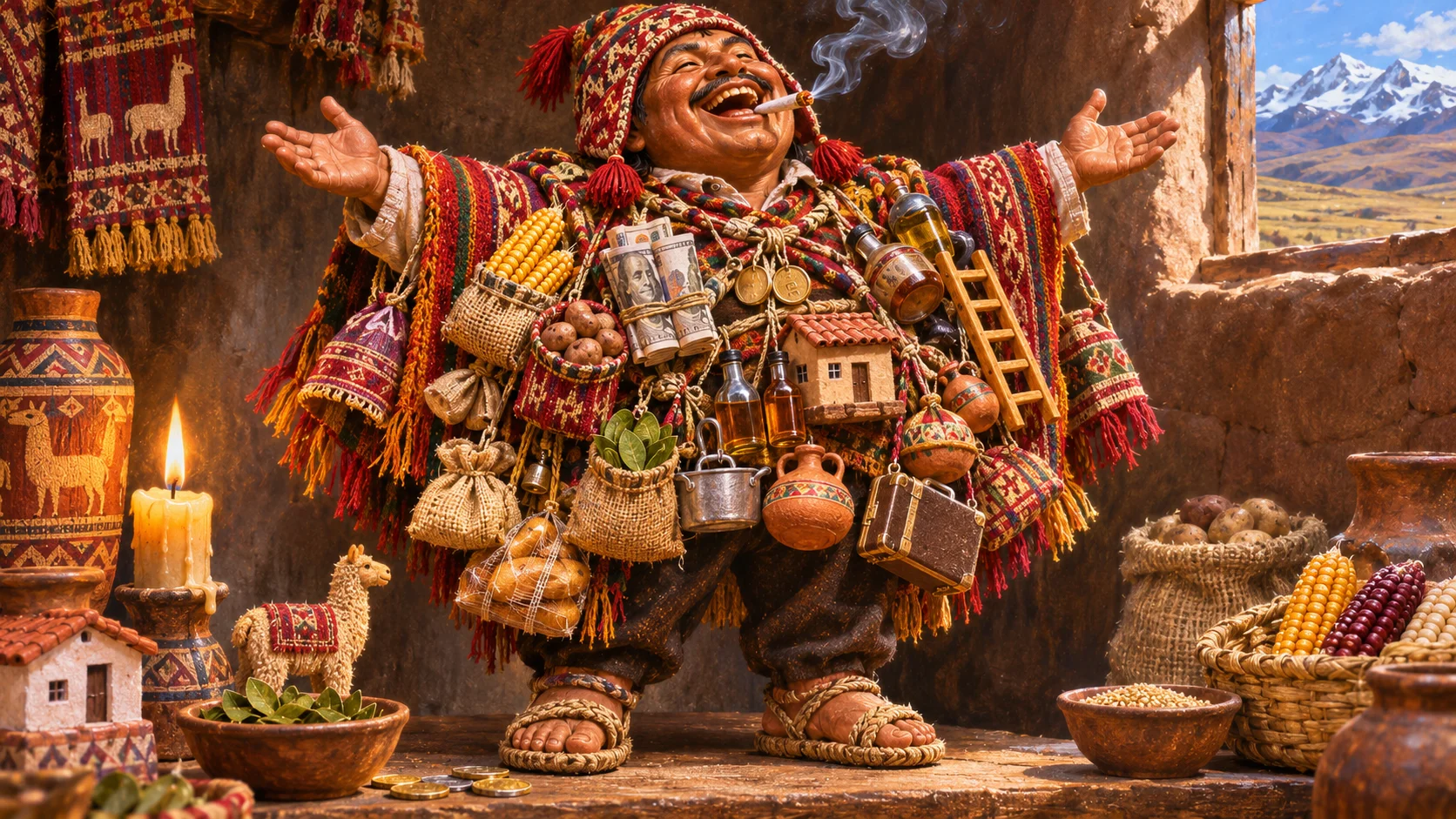
Several things are worth noting. Miners generally do not call him supay, preferring the affectionate “uncle”; the equation of the Tio with Supay and with the Devil is made as often by outsiders as by the miners. Whether the Tio is a descendant of a pre-Hispanic mine-lord or an invention of the colonial mines, which began at Potosí after 1545 and worked forced Andean labour to death, is disputed. Taussig reads him as a figure formed by the clash of an older Andean world with colonial capitalism, and a persistent folk etymology, that “Tio” is the Quechua mishearing of the Spanish Dios, “God”, because the language has no d, is only a folk etymology and is not accepted by linguists. Offerings to the guardians of mineral wealth are, of course, older than the mines, since Andean peoples worked metal long before the Spanish, but whether a particular lord of the mines was addressed in pre-colonial times is not documented.
Diablada and the carnival
At the carnival of Oruro, in Bolivia, the dance called the Diablada presents hundreds of dancers in elaborate horned masks as devils, led by a Lucifer, followed by an Archangel Michael who defeats them. The dance is tied to the cult of the Virgin of the Socavon, the “Virgin of the Mineshaft”, patron of the miners. The origins of the Diablada are debated: some trace it to rites of the Uru people of the lake, others to Spanish morality plays of the struggle between angels and devils. Some writers state that the star devil of the dance is Supay; others say that the dancers represent the Tio, Lucifer and Satan, and I could not verify that the dance names a being called Supay. The dance, for the people who perform it, is an act of devotion to the Virgin.
Regional variation and kindred powers
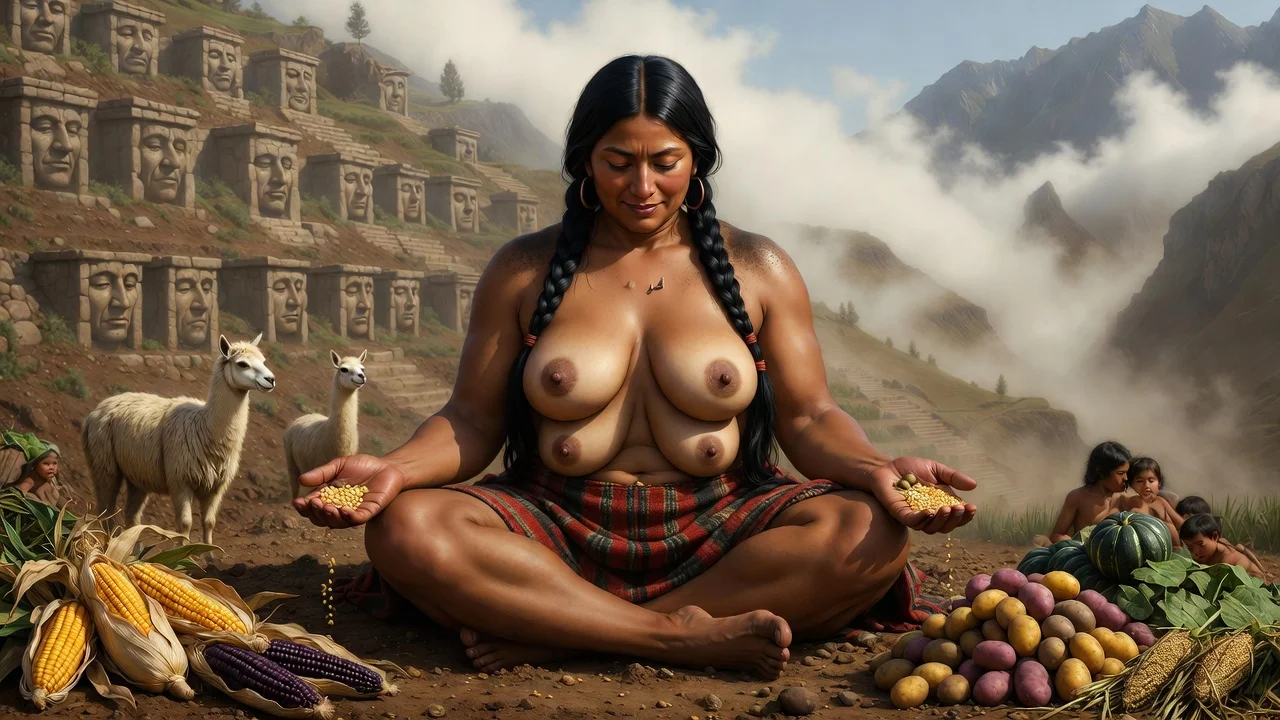
The materials are regional. On the altiplano and in the mines, the figure is the Tio. In the Cusco region, supay belongs to a vocabulary of dangerous spirits and, in Christian use, the Devil. On the coast, the Spanish equated the Pachacamac oracle with a devil, and Garcilaso records that equation and rejects it. Related powers are Pachamama, the earth; the apus, the mountain lords, who are not devils either, though Spanish priests said so; Illapa the thunder; and the ancestors, the mallkis, whose care was the real centre of Andean death-practice. In the colonial literature on the huacas more generally, powerful, jealous and sometimes dangerous sacred beings were read by Christian writers as demons, which shows the same pattern at work.
Modern practice and a note on respect
There is a danger, in an encyclopedia entry, of treating a living tradition as a set of curiosities. Miners in Bolivia work in conditions that kill, and their rites for the Tio are an intelligent, collective response to danger and a way of speaking to a power on which their lives depend. They are carried out by people who are, in the great majority, Catholics, and who see no contradiction. The Devil of the sermon and the Uncle of the mine are not the same, and neither is the same as the pre-colonial being, if there was one, whom the missionaries displaced.
A closing reflection
The word supay is a record of a conversation in which one party held the pen. A shadow, a spirit of the dead, an ambivalent power under the earth, and then, by decision of translators, the Enemy of Christianity. We can follow that change in dictionaries and catechisms with some confidence, and we can follow the afterlife of the word in the mine. What lay beneath it before 1532 is a question the sources cannot fully answer, and to answer it with confidence would be to take the missionary’s word, or the modern romantic’s, for the thing itself.
Sources & traditions
- EncyclopediaWikipedia — Supay
- TraditionIncan texts, oral tradition and village tellings (Andes)
Myths change from area to area and from time to time. This chronicle follows the most widely told versions; tellings in other villages, regions and eras may differ.