El Tío, Spanish for “the Uncle,” is the owner of the underground in the mining culture of Bolivia and the central Andes: the lord of the veins, the master of the ore and of the dangers below the earth. In the mines of Potosí and other Bolivian districts he is made of clay, set in a niche in the gallery, and fed with coca, cigarettes and alcohol. The offerings are made today by working miners, in a mountain worked for nearly five centuries, and any account of him has to be written with that in mind: he is a living figure in a living religion that sits beside Catholicism and answers to the conditions of a dangerous trade.
The Name, and the Word Supay
The Spanish word tío means uncle, and the miners use it in the familiar way: an uncle is a powerful older relative to whom one is obliged, whom one should not offend, and from whom one may ask favours. A popular explanation says that the name is a corruption of Dios, God, because Quechua and Aymara speakers who lacked a d sound heard and repeated it as tío. It is widely repeated, but it is a popular explanation that I could not find supported in the scholarly literature. The French anthropologist Pascale Absi, in the most detailed study of the Potosí miners, does not adopt it; she writes that the term probably has no single origin and combines several connotations, among them the Quechua t’iyu, sand, which tío resembles in sound, the Spanish use of tío for a relative and as a respectful form of address, and the familiar, a minor household demon of seventeenth-century Spanish belief.
The miners also call him supay, diablo, maestro, or by the diminutive Satuco, a small Satan. Absi notes that they address him as boss, foreman or labourer according to context: he supplies the ore, and in return they owe him offerings.
The word supay needs care. A scholarly note on the Huarochirí manuscript observes that the colonial clergy consistently used supay to translate “demon,” even though the word may keep an older Andean sense of the shade or light, volatile part of a living being. The earliest dictionaries show the word already in translation: the lexicon of Domingo de Santo Tomás (1560) gives supay several senses, among them, as Absi notes citing Estenssoro, that of a familiar spirit, alongside devil. Scholars still discuss how much of the devilish meaning was older and how much was imposed by Christian translation. When a writer says that El Tío is “descended from Supay,” it is wise to remember that Supay itself had already been through a Christian translation. El Tío is sometimes called Tío Supay, but he is not a simple survival of one pre-Hispanic god, and the sixteenth- and seventeenth-century chroniclers did not describe him by that name.
Potosí: The Mountain and the Mita
The Cerro Rico of Potosí stands at the centre of the story. According to the account Absi retells, Spanish captains took possession of the hill on 1 April 1545, and the town that grew beneath it became one of the largest cities of the colonial world. The man most often credited with revealing the silver is Diego Huallpa, an Indian worker from the nearby Porco mines. In his own statement of 1572, as Absi summarises it, he found a rich vein while climbing the hill on the orders of his Spanish captains, to take the offerings left at the huaca on its summit; the later version of Arzáns de Orsúa y Vela instead makes him a herder who spent the night on the hill.
The colonial writers Cieza de León, Acosta and Capoche insist, in Absi’s summary, that the mountain had been unexploited and unpopulated before the Spanish. Absi reads that insistence as a way of legitimising the Spanish takeover, and notes that archaeology shows the district was inhabited before 1545. The historian Carmen Salazar-Soler adds that the neighbouring mine of Porco was worked for the Inca and that the Cerro Rico was a huaca, a sacred place of the kind often tied to hidden treasure. A legend recorded by the Potosí historian Arzáns de Orsúa y Vela in the eighteenth century says that when the Inca Huayna Capac sent workers up the hill a voice told them not to take the silver, because it was for other owners; Capoche, in 1585, gives a parallel explanation. These are retellings written long after the event.
The institution that made the mountain deadly was the mita, a Quechua word meaning a turn or shift, which under the Inca was a labour service. The viceroy Francisco de Toledo reorganised it for the mines, and the first labourers under his scheme reached Potosí in 1573. As Absi summarises Toledo’s rules, each year the mita was to draw one seventh of the men aged eighteen to fifty from a list of villages in sixteen provinces, for a year’s service. How many men that meant differs by period and by author, and any figure should be read as approximate: a study by Carmen Salazar-Soler is summarised as giving some nine thousand mitayos in 1573, rising to more than fourteen thousand by 1578, and the standard study of the institution is Peter Bakewell’s Miners of the Red Mountain (1984).
The miners carry a different kind of number. In Absi’s fieldwork they say that about eight million mitayos died in the colonial mines, and that their blood gives the mountain its red colour and the silver its purple tones. Absi notes that this is more than the present population of Bolivia. The figure cannot be checked against any record and is not a historian’s count; it is a statement of moral weight, of how the mountain is remembered. It matters here because one story of the Tío’s origin makes him the gathered souls of those dead.
The Tío in the Mine
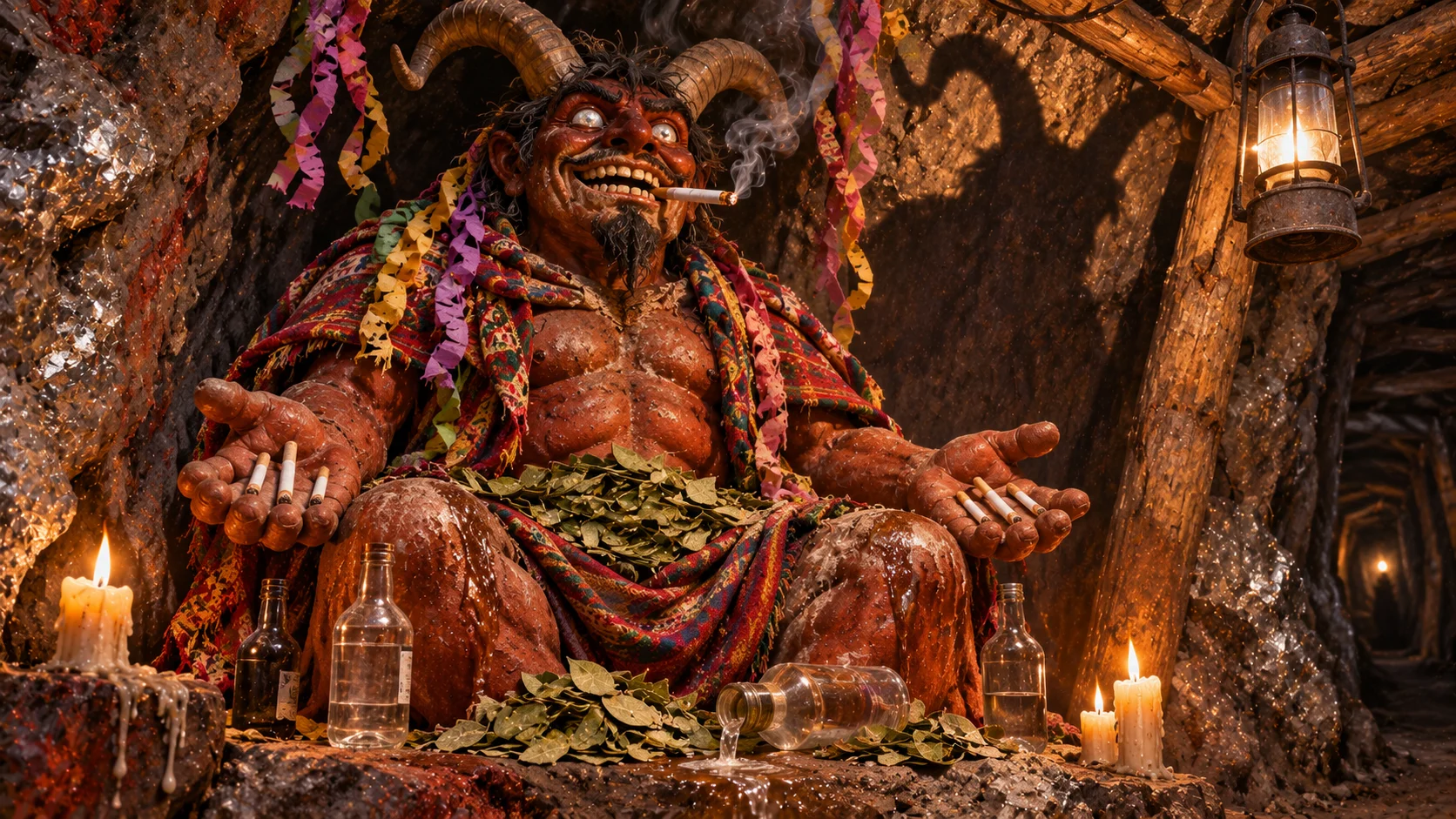
The figure in the gallery is built from the mine itself. Each work team has its own clay effigy near its workplace, and the main gallery usually has a larger one. The clay is taken from the mine, sometimes shaped around a valuable piece of ore, and the most skilled miner on the team makes it, with libations. Its features are horns, a long tail, goat legs, a face blackened by smoke, and a large erect phallus, which Absi connects to the strength and courage he gives and to the way miners speak of production as a fertile relationship between men and the mountain. A serpent, said to stand for greed, and a toad, linked to the Pachamama, may accompany him. Some figures have a female double, the Tía, though she is rarer at Cerro Rico.
The miners say that he appears in dreams to reveal rich veins, and in the mine to a worker alone, often as a tall, fair-haired man in boots and a red cape, the “gringo.” His presence is read from signs such as the footprints of a goat or a rooster, and miners who die in accidents are said to have been devoured by him.
His rules are the reverse of the Christian ones above ground. Workers must not cross themselves or say the name of God or Christ inside the mine; many fear a priest entering the galleries, and some avoid cross-shaped picks, salt and hearing Mass, which they believe can drive the Tío and the ore away. Candles offered to him are set upside down. Women have long been kept from underground work. In Absi’s account the reason miners give is the jealousy of the mountain-Pachamama, with whom the men are in a fertile relationship, together with the belief that women bring bad luck and make veins disappear; women may enter the mine on certain ch’alla days, such as the Thursday of Compadres, and she writes that both men and women today accept the separation. In Absi’s account the Pachamama and the mountain receive their rituals first, before any production starts, and the Tío appears only once the work begins.
The Offerings and the Ritual Year
The offerings are coca leaves, hand-rolled cigarettes, and above all alcohol, and on rare occasions a llama fetus. The act of pouring a libation is called the ch’alla. Absi records that it is held for the Tío weekly, usually on Fridays and sometimes on Tuesdays, “so that things go well for us,” and that some teams do it monthly, on the first Friday. Taussig quotes a miners’ leader who described chewing coca together and offering it to the Tío before going down as the miners’ own university, a place where workers voice their problems.
The annual calendar is not a single fixed festival, and sources differ in detail. Absi places the great annual ch’alla to the Tío on the Thursday before Lent, the Thursday of Compadres. In February or early March the Carnival cycle is the most collective set of rites: on the days before Carnival the men hold a ch’alla for their tools and workplaces, the women who sort ore hold theirs, and the cooperatives hold large ones at the ore-processing plants. During Carnival, Absi writes, the devils are free and tempt men, and the Tío is said to appear more often in the mine. In May and June, on three Saturdays tied to the Church calendar of Pentecost, Trinity and Corpus Christi, a llama is sacrificed, but the sacrifice is addressed to the Pachamama, not to the Tío. On the first of August an offering is made to the Pachamama and the protective mountains, and August is the month when the underworld powers are said to be hungry.
The word q’araku appears in Absi’s fieldwork for the miners’ offerings to the mountain, and llama sacrifices are made at several points of the year, most often addressed to the Pachamama and the protective mountains. Nash records llama sacrifices at Llallagua in early August before the nationalisation of the mines. Because accounts differ from mine to mine and region to region, no single calendar or addressee can be claimed.
Where He Came From
The miners tell several stories of origin, and Absi sets out five. In one the Tío is a rebel angel who opposed God and was exiled underground, where he took the riches. In another he is a pre-Hispanic guardian of the mountain, a saqra or supay, who was ignored until the Spaniards confined him underground and began to honour him in order to seize the wealth. In a third he is the dead mitayos themselves, workers who died in the mine and were transformed by long immersion in darkness. A fourth tells that Saint Bartholomew defeated the devil and sealed him in a cave near Potosí, a victory from which his cult arose, and a fifth speaks of a child named Jorge, born of a devil and a woman ore-sorter.
Each story ties the beginning of mining to a reordering of the world that came with colonial society, and each gives history a moral frame: Spanish greed brought the devil, or the mountain’s old power was driven underground, or the exploited became a power that the exploiters must pay. Absi concludes that the Tío’s mixed Spanish and Indigenous character reflects the colonial origin of the miners’ own class identity. There is also a pre-Hispanic root of practice. Cobo, writing in the seventeenth century about the Andean peoples before and after the conquest, reports that those who went to the mines revered the hills and the mines themselves and kept vigils of drinking and dancing before them, and revered the ore. He explained all of it as the devil’s work, a judgement to be set aside, but the report of offerings to the mine stands.
What the Scholars Said
June Nash’s We Eat the Mines and the Mines Eat Us, published in 1979, is a study of Bolivian tin miners built on fieldwork in the mining communities of Oruro. It reads the ritual life of the mine, including the Tío, together with the miners’ class consciousness and their dependence on, and exploitation by, the mining industry; Nash worked from a Marxist standpoint. Michael Taussig’s The Devil and Commodity Fetishism in South America, published in 1980, takes the Bolivian miners’ devil as one of two examples, the other being the Colombian cane workers who make a devil contract for higher wages. Taussig argues that these beliefs are not relics of a pre-rational past but a response to the forced entry of peasants into wage labour: a parable of the difference between a society organised around use and one organised around exchange. It is commonly noted that his Bolivian chapters draw largely on the published literature, above all on Nash, rather than on fieldwork of his own.
Absi’s Los ministros del diablo, published in 2005, is based on long fieldwork in the silver mines of Potosí. Its title plays on mineros, miners, and ministros, ministers, hinting that the miners are also in a sense the servants of the devil of the underground. Her central distinction is between the community’s Tío, whom everyone feeds, and the individual pact, a story of a man who bargains with the devil for a rich vein at the price of his soul or another life. Miners see the pact as antisocial, and they describe it in other people, not themselves.
Crisis and Change
The ritual has not stood still. After the crisis of the mid-1980s, when state mining collapsed and the work shifted from tin to silver and to cooperatives, Absi describes three changes. The ch’alla to the Tío, once reserved for the master miners, is now shared by labourers and assistants; rumours of individual pacts have multiplied, blamed on wealthy partners and linked to accidents; and from the 1980s the miners’ procession of crosses in work clothes was replaced by dance fraternities modelled on the Oruro Carnival, a change that some older miners regret. The city of Potosí was inscribed on the UNESCO World Heritage list in 1987 and was placed on its list of sites in danger in 2014. At Oruro, some accounts hold that the devil figures of the diablada represent El Tío, and the festival has a history of tension between the Church and the miners over its content.
Reading the Sources with Respect
The sources on El Tío fall into three kinds, and they should not be mixed. The Spanish chroniclers and clergy, Cieza, Acosta, Cobo, Ávila and Arriaga, wrote of Andean religion as the devil’s work and described the cult of mines and mountains through that lens. Archaeology shows that the Potosí district was inhabited before 1545, but it does not describe a deity called the Tío. The modern ethnography, by Nash, Taussig and Absi, is the only source that describes him, and it describes a figure shaped by the colonial and republican mine; how far he continues older mountain powers is exactly what the miners’ own stories of origin argue about.
He is not a joke, and not simply the Christian Satan. Miners fear and respect him; the offerings are a practical form of care, a way of speaking to the powers on which a life depends.
Sources & traditions
- EncyclopediaWikipedia — El Tío
- TraditionIncan texts, oral tradition and village tellings (Andes)
Myths change from area to area and from time to time. This chronicle follows the most widely told versions; tellings in other villages, regions and eras may differ.