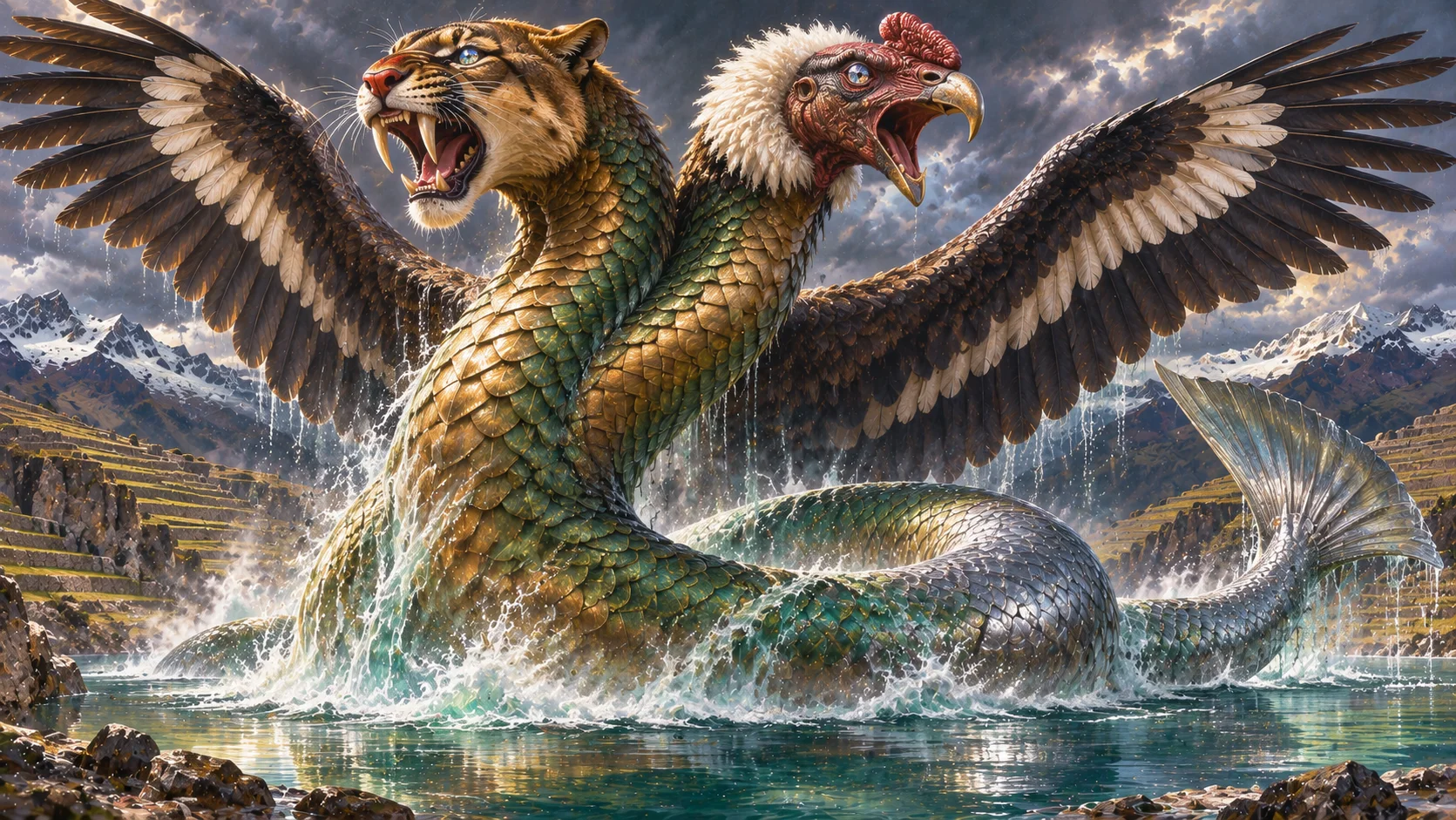
The Amaru is the great serpent of the Andes: a vast being of water, earth and storm, often drawn with two heads, the face of a llama or puma, wings, a fish’s tail and eyes that shine like crystal. It lives under lakes and rivers, rises in the hail-cloud, arches as the rainbow and runs through the night sky as a dark shape in the Milky Way. Its name is also a human name, carried by an Inca claimant executed in 1572 and by an eighteenth-century leader whose rebellion shook the Spanish viceroyalty. The picture is rich, but its sources are uneven, some of the most repeated claims about the Amaru are modern, and one famous “Amaru” site is a product of tourism. This article tries to keep those layers apart.
Name and etymology
In Quechua amaru means a large serpent, usually a boa or other great snake, and by extension the mythical serpent of the waters. The ordinary Quechua word for a snake in general is a different one, mach’aqway in the Cusco region, so the use of amaru for the mythic being is a real distinction. In Aymara the corresponding figure is called katari, a word that also appears as a personal name, most famously in Julián Apaza, the Aymara leader of 1781 who took the name Túpac Katari. Quechua mayu, meaning river, belongs to the same landscape of imagery: the Andean sky’s great river is the Milky Way, mayu, and the serpent is among the beings that move along it.
In Spanish colonial writing the word appears as amaru or amaro, and it is the root of the name Túpac Amaru, in which túpac is usually glossed as royal or shining and amaru as serpent, so “shining serpent” or “royal serpent.” Some references prefer to see the second element as the mythic serpent rather than the animal; the Quechua word covers both.
Sources and how reliable they are
The Amaru is poorly documented in the first generation of colonial chronicles, in the sense that no sixteenth-century writer gives a connected account of a serpent deity with a cult. The figure is reconstructed from three kinds of evidence: scattered colonial remarks about serpents, the rainbow and water-spirits, the iconography of earlier cultures, and the oral literature collected by folklorists and anthropologists in the twentieth century.
Reference works commonly cite the anthropologist Brian S. Bauer’s article of 1996 in American Anthropologist on the legitimisation of the state in Inca myth and ritual for a composite description: a winged serpent with crystalline eyes, a reddish snout, a llama’s head, the horns of a taruca deer and a fish’s tail, the features varying between legends while the serpent form stays constant. The same summaries link the being to storms, hail, wisdom, the rainbow and the Milky Way, and report that its image was found in the yachay wasikuna, the “houses of knowledge.” I could not read Bauer’s article itself, so these points are second-hand. Paul Steele’s Handbook of Inca Mythology (2004) offers the commonly quoted summary of a huge double-headed serpent living underground at the bottom of lakes and rivers.
Two cautions follow. First, these are modern syntheses, and a synthesis smooths over differences between valleys and centuries. Second, much of the detail comes from oral tradition recorded after four centuries of Christian preaching, in which a serpent could easily be coloured by the European devil-serpent. Where a story says that a serpent was punished or confined, as many do, we cannot always say how much of that is Andean and how much is borrowed.
Nature and attributes
The amaru is first of all a being of water. It lives at the bottom of lakes and rivers and in the underground waters, and so it is tied to the irrigation on which highland farming depends. It is also a being of the weather: hail and storm are its work, and the lightning that opposes it is the hero of the stories. In modern oral tradition its arching body is the rainbow, called k’uychi or kuychi in the Cusco region. The rainbow was honoured by the Inca. Garcilaso de la Vega, who calls it chuycu, says that the Inca kings took it as their emblem because they held that it proceeded from the Sun, and that a chamber of the Sun’s temple at Cusco was dedicated to it, with the rainbow painted in its colours on plates of gold. Some modern writers describe the royal rainbow emblem with a serpent at each end, and heraldic accounts describe Garcilaso’s own coat of arms that way; I could not trace that detail to a statement about the royal emblem in the part of the Comentarios I read, so I do not give it as established.
The amaru is ambivalent. The summaries citing Bauer say that it is usually benevolent, the source of waters and of wisdom, and yet some amarus show a violent side, bringing flood, earthquake and hail. It also stands on the boundary between worlds: the serpent that comes up from the underground into the visible world and joins earth to sky. Popular summaries make this the snake of the “lower world,” with the condor for the upper world and the puma for this one. That neat triad is widely repeated, but I could not find it set out in this form in the colonial sources, and it should be understood as a modern way of organising Andean cosmology rather than a doctrine the chroniclers described.
The story of the two amarus
The best-known narrative comes from the central highlands of Peru, in the department of Junín, and it explains the shape of the land itself. In the version summarised in reference works, the Huanca people lived in caves because beasts that haunted a great lake attacked them. They appealed to the creator Wiracocha, who sent help in the form of a first rainbow, Tulumanya, and from its breast came a dark serpent, Yana Amaru, with the head of a guanaco, the wings and claws of an eagle, the legs of a jaguar, the scaled body of a serpent and the tail of an anaconda. It was sent to kill the beasts; it did so, but then it attacked people and animals for sport and took over the lake. Wiracocha then made a white serpent, Yuraq Amaru, with silver scales, and the two fought, causing great destruction. Wiracocha sent the lightning, Illapa, and the wind, Wayra, who drained the lagoon and pursued the amarus as they tried to escape to the sky. Dying, the two grew into the mountain ranges that enclose the Mantaro Valley: the western range became fertile farmland and pasture, and the eastern remained snow-capped.
The tale is tied to a living belief. When a farmer sees a storm cloud, it is said, the amaru rises to scatter hail on the crops, and then it is vulnerable: the farmer waves a hat to alert the lightning and the wind, who split the serpent in two and confine it again in the depths of the lake. The tale is a record of folklore and not of an Inca text. Its date is unknown, and the reference works that summarise it do not say who first collected it, so it is best held as a regional tradition. It shows the roles the serpent holds in the highland imagination: the creature of the water, the maker of mountains, the hail-bringer, the opponent of lightning.
The amaru in the sky
In the night sky, as the anthropologist Gary Urton recorded among the people of Misminay near Cusco, the Milky Way is a river, and the dark patches in it are animals that come to drink. One of them is the serpent, called mach’aqway, which winds along the river. Its place in the sky links it to the flow of water through the seasons. This is a modern ethnographic observation of one community and not a statement of an Inca calendar, but it shows how the serpent fits both the water below and the river above.
Archaeology: Chavín, Tiwanaku and the Inca
Serpents are everywhere in Andean imagery long before the Inca. At Chavín de Huántar, in the northern highlands of Peru, the carved stone figures of the first millennium before the common era include fanged beings whose hair and belts end in snakes. At Tiwanaku, on the Bolivian altiplano, the carved Gateway of the Sun shows beings with serpentine features, and the serpent form recurs on the art of the Tiwanaku state, including an image described in the scholarly literature of an amaru with a bird’s head and a puma’s head emerging from a stepped-mountain motif. Later Andean drinking vessels carry serpent imagery too.
It is important to note what such evidence does and does not show. The word amaru is a Quechua word of the later period, and a figure on a Chavín stone was made by people who spoke another language and left no written explanation. To say that the Chavín or Tiwanaku serpent is “the Amaru” is an interpretation, though a reasonable one given the continuity of serpent imagery. Scholars generally speak of a long tradition of serpent symbolism of which the Inca amaru is a late form.
The “Amaru Muru” gate near Puno
Near Lake Titicaca, in the hills outside Puno, is a carved rock face with a deep rectangular recess cut into it, called in tourist literature Aramu Muru, Amaru Muru or the Gate of the Gods, and locally Hayu Marka. The rendering of that name as “City of the Gods” circulates on tourism pages without any linguistic support I could find, and I treat it as unverified. It has a striking presence. It is also, as an “Amaru” site, largely a modern story. The legend that it is a stargate, that a priest with a golden disc passed through it, or that it leads to other worlds, became popular after a local mountain guide, José Luis Delgado Mamani, publicised the place in the 1990s; some accounts give the early 1990s and others 1996. The mystical framing, including the stargate and the extraterrestrial claims, appears to come largely from outside sources, and the tourist trade in Puno and Cusco has promoted it heavily.
Archaeologists are cautious. The structure has no datable organic material associated with it, and its attribution is open: an unfinished Inca project, a Tiwanaku-period work or a place of ritual use by earlier peoples are all proposed. I found no authoritative source linking the site to the serpent Amaru; the resemblance of the name appears to be an accident of tourist spelling, which sometimes writes Aramu Muru as Amaru Muru. Visitors and some ritual specialists are reported to hold ceremonies there, which would be a living practice in its own right, but that is not evidence of antiquity for the stories sold to visitors.
The name in history: Túpac Amaru and Túpac Katari
The serpent’s name entered the history of the conquest. Túpac Amaru was the last Sapa Inca of the neo-Inca state in Vilcabamba, captured and executed by the Spanish in Cusco in 1572. Two centuries later José Gabriel Condorcanqui, a descendant of the Inca line and a regional lord, took the name Túpac Amaru II and led a great rebellion in 1780; he was captured and executed in Cusco in 1781, and the Spanish authorities afterwards moved against signs of Inca identity, including the use of the name. The same year in the Aymara country, Julián Apaza took the name Túpac Katari and besieged La Paz. In choosing the serpent’s name both men claimed the authority of a being that rises from beneath.
The name has had a long second life. Movements and individuals in the twentieth century took it, among them Uruguayan guerrillas called Tupamaros and a Peruvian armed movement of the 1980s and 1990s, and it was given to the American rapper Tupac Shakur by his mother. These uses show the symbolic weight of the serpent’s name rather than any continuity of cult.
Regional variation and false cousins
In the Amazonian lowlands of Peru, the great water-snake of Quechua-speaking communities is yakumama, the water mother, and its companion sachamama, the forest mother, is a giant serpent of the land. Many popular lists call these two the “two great Amarus.” They belong to the folklore of the Amazon basin rather than the highlands and are recorded mostly in modern times; they are cousins of the amaru, not parts of it.
Suppression and survival
The serpent suffered the usual fate of Andean sacred beings under Christianity: it was identified with the devil, and the belief in water-serpents and hail-serpents was treated as superstition. It survived as folklore, in the stories told above, in the rainbow customs of the countryside and in the placing of the serpent on textiles and pottery. Garcilaso records a related precaution from the Cusco of his youth: on seeing the rainbow, people closed the mouth and put a hand before it, because it was said that showing the teeth to it would wear and rot them, and he gives no reason beyond the custom. Rainbow prohibitions are reported from many parts of the world, but I did not find a modern Andean ethnography I could cite for a specific pointing taboo, so I leave it at the colonial record.
In contemporary Andean art, the amaru has a second life as a symbol of Indigenous identity. It appears on textiles and murals and in the iconography of Indigenous movements, most visibly in the names of Túpac Amaru and Túpac Katari.
Kindred beings
The Amaru belongs with the other powers of the sky and the waters: Illapa, the lightning that fights it; Viracocha, the creator who sets the stories moving; Mama Cocha, the waters it inhabits; and the mountain lords it was said to have become. Outside the Andes, the feathered serpent of Mesoamerica and the serpents of other water traditions share some features, but they belong to different traditions and the comparison should not be pressed.
A closing reflection
The Amaru is best seen as a way of thinking about water: the thing that is deep and unseen, that comes up as spring and river, that threatens as hail and flood, that leaps across the sky as colour, that gave the mountains their shape. Its name has been taken by those who would borrow its power. What is certain is the continuity of serpent imagery over thousands of years and the vitality of the stories in the high valleys. What is not certain, and should be said so, is how any one of its portraits stands to the lost Inca doctrine.
Sources & traditions
- EncyclopediaWikipedia — Amaru (mythology)
- TraditionIncan texts, oral tradition and village tellings (Andes)
Myths change from area to area and from time to time. This chronicle follows the most widely told versions; tellings in other villages, regions and eras may differ.