Illapa is the Quechua name for lightning, thunder and the flash of the storm, and in the religion of the Inca and their neighbours it was also the name of the power that sent them. Rain was the hinge on which highland farming and herding turned, and the one who sent or withheld it was approached with more urgency than almost any other figure in the sky. Our knowledge of him comes mostly from Spanish writers of the sixteenth and seventeenth centuries, who described a luminous warrior with a club and a sling, a river of stars from which his water was drawn, and a jar that he cracked open with a stone. Those descriptions are real and valuable, but they are also brief, uneven and written by men who thought they were recording the work of the Devil. The tradition itself did not end with them: lightning is still named, feared and honoured in the Andes, and the figure of Santiago, Saint James, carries much of the older weight.
Name and etymology
The word illapa (spelled ilyap’a or illapu in some modern orthographies, and honoured with the title apu, “lord”, in the form Apu Illapu) names the lightning flash and the thunderclap together. The Quechua lexicon compiled by Diego González Holguín in 1608 glosses it with the Spanish words for lightning, thunder and thunderbolt, which is why it is not always possible to say, in a colonial text, whether a writer means the natural event, the deity, or the weapon that is imagined to cause it. The same ambiguity runs through the Andean world: a thunderbolt is a manifestation of the power, not merely a symbol of it.
Colonial sources also give other names that appear to belong to the same family of thunder powers. Writers on the Cusco shrines record the names Chuquilla, Catuilla and Intiillapa (“Sun’s thunder”), and modern scholars disagree about whether these are separate beings, local forms, or epithets of one figure. The honest summary is that the thunder-power was named differently in different places and on different occasions, and that the Spanish recorders did not always know which name belonged to which community.
The sources, and how far to trust them
Three kinds of evidence meet in any account of Illapa, and they should be kept apart.
The first is the body of colonial chronicles. The most useful for the thunder god are Cristóbal de Molina of Cusco (writing in the 1570s on the rites and fables of the Inca), Juan Polo de Ondegardo (an administrator who investigated Inca ritual in the 1550s and 1560s), Bernabé Cobo (whose Historia del Nuevo Mundo, completed in 1653, drew on earlier material), Inca Garcilaso de la Vega (a Cusco-born writer composing in Spain in the early 1600s, who idealised the Inca past), and Juan de Santa Cruz Pachacuti Yamqui Salcamayhua (an indigenous Christian author writing about 1613, whose drawing of the Qorikancha altar includes the thunder among the great powers). Add the extirpators, above all Pablo José de Arriaga (1621), whose manual lists what native communities still did, and the Huarochirí Manuscript of about 1608, written in Quechua, which gives a view from a provincial highland valley and not from Cusco. Each wrote with Christian assumptions. Several believed that the thunder-shrine was a seat of demonic deception.
The second is archaeology, which contributes sacred places and offerings, the mountain-top shrines and the high-altitude burials of the Inca period, but which does not label any single object with the god’s name. We can say that lightning-related sacred places exist; we cannot read an image and call it Illapa without a text to match it.
The third is living practice, recorded by ethnographers across the southern Andes in the twentieth and twenty-first centuries. It is not a straight survival of the Inca religion, and it should not be treated as a window onto it. It is its own tradition, shaped by five centuries of life beside Catholicism, and it is practised by people who speak for themselves.
A figure of the sky
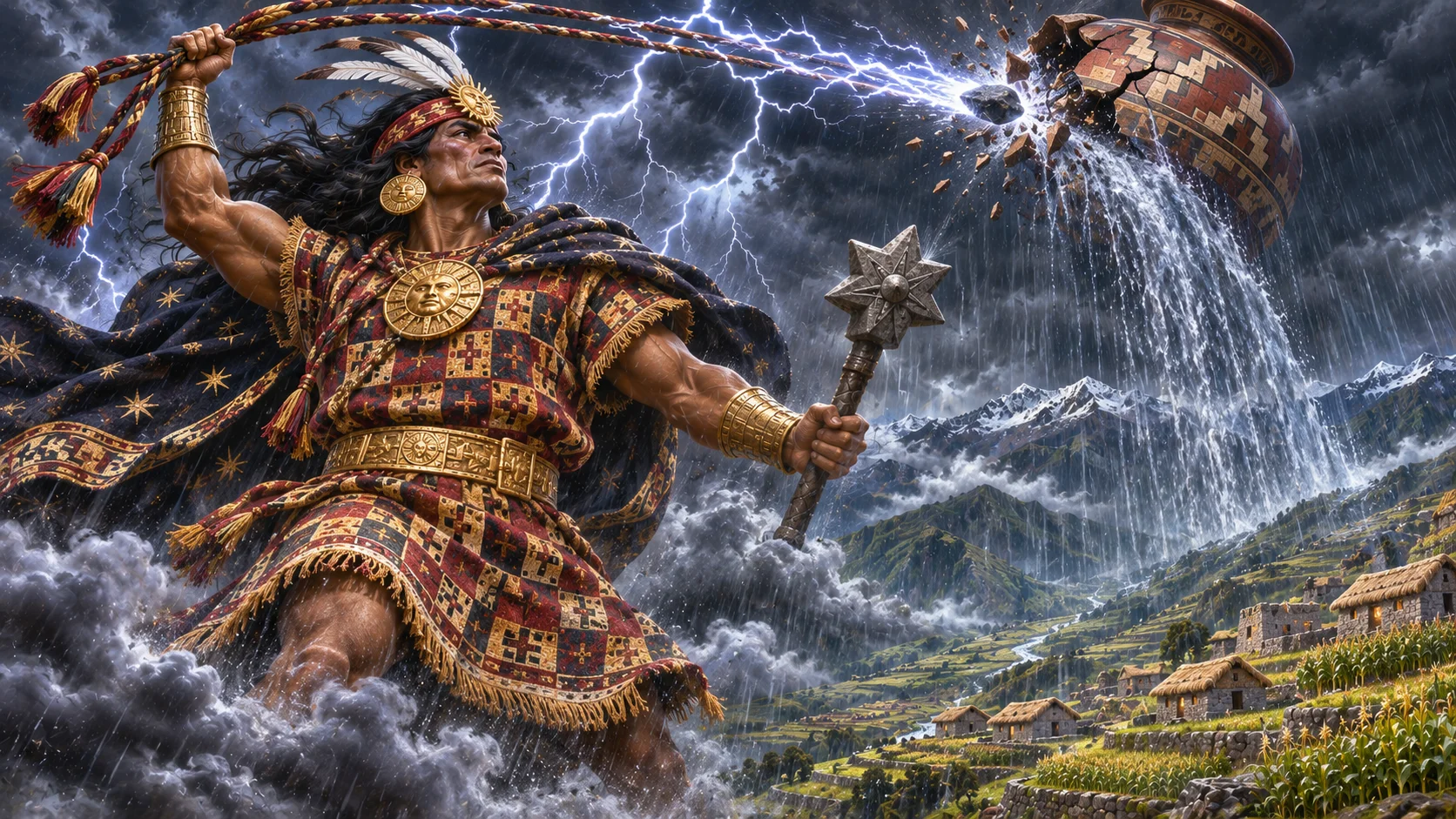
The fullest description in the early sources is a picture of a person in the heavens. Cobo is usually cited for a picture of Illapa as a warrior formed of stars, and later summaries add a luminous figure in shining garments with a club in one hand and a sling in the other. The thunder was the crack of the sling, the lightning the flash of his clothing, and the thunderbolt the stone he cast. The image fits a people whose own warriors carried clubs and slings, and the divine figure carries the weapons of the earthly one.
Several accounts add a second picture, and it is the best known. Illapa takes water from the celestial river, the Milky Way, and keeps it in a jar. A woman, often described as his sister, holds the jar; when the water is needed, he breaks it with a stone from his sling, and the spilled water falls as rain. Modern retellings name the sister as Mama Quilla, the Moon, but the earliest sources are less specific than the summaries suggest, and a tale of this kind may have been told in several versions. What is consistent is the structure: the rain is not made from nothing but is carried, kept and released.
The river in the sky and the water cycle
That structure matches what ethnographers found when they asked Andean people about the sky itself. Gary Urton, who worked in the Cusco-region community of Misminay in the late 1970s, recorded that the Milky Way is called mayu, “river”, and that it is imagined as a channel carrying water from the sea up into the sky and back to earth. Within the dark patches of the Milky Way, which Andean observers read as figures in the way Europeans read bright stars, there are animals, among them a llama known as Yacana. In the version Urton recorded, this celestial llama drinks the sea at the horizon, which prevents the world from being flooded. The chroniclers say much less about this than modern fieldwork does, and the dark-cloud llama should not be assumed to have been part of the Inca court cult of Illapa. What is solid is the larger idea: water moves in a circuit between sea, river-in-the-sky and field, and the thunder is part of the machinery of that circuit.
Illapa at Cusco
At Cusco the thunder had a place in the great temple of the Sun, the Qorikancha. Garcilaso, who described the building from childhood memory and from the recollections of relatives, tells that one room was set aside for Illapa, alongside rooms for the Moon, for Venus and the stars, and for the rainbow. He adds that the Inca regarded the thunder as a servant of the Sun and not as an equal god. Other writers rank him differently. Some colonial and many later popular accounts set Illapa third in a triad with Viracocha and Inti, a grouping that looks a little too like a Christian Trinity to be taken at face value, and that careful scholars treat with caution as a Spanish arrangement of the material.
Molina records a separate temple for the thunder, which he names Pucamarca, and later writers report a shrine for him in the area of the church of San Blas in Cusco and possibly at Sacsayhuamán above the city. These attributions are reported rather than excavated, and the colonial city has built over most of what might have been checked. Colonial writers report rites for the thunder on high places, with dances, songs, feasts and animal sacrifices. The often-repeated statement that human offerings were made to Illapa I could not trace to a specific source, and it is difficult to test. The Inca did practise a ritual of selected children, capacocha, and the burials of children on high peaks such as Llullaillaco are archaeologically real; whether a given case was directed to the thunder, to the mountain, or to the Sun, the texts do not say.
Drought rites
The rites best attested are those held when the rain failed. Summaries of Cusco practice describe black animals, llamas in some accounts and dogs in others, the dark colour being connected with rain clouds, tied in a public place and left without food or water so that their crying would stir the heavens to pity and send rain. I could not trace every detail to a first-hand colonial text, and the popular story that Illapa strikes dead anyone responsible if the animals die is a retelling that should not be repeated as fact. More firmly documented, in the colonial reports of herding communities, are offerings of coca, of llama fat and of the foetus of a llama (the sullu) at mountain shrines to secure favourable weather, and processions to sources of water in drought.
Lightning also made places and people holy. Garcilaso writes that a place struck by a thunderbolt was fenced off and honoured as a sacred spot, and that the Inca held in special regard children born as twins or in unusual circumstances. A person who survives a strike has, in many Andean communities recorded by ethnographers, been understood as chosen to become a healer or ritual specialist. This belief is well documented by ethnographers in the present; how far it reaches back is not settled by the colonial sources.
Regional variation: Catequil and the thunder oracles
Illapa of Cusco was one expression of a wider Andean concern with thunder. In the northern highlands, around Huamachuco and Cajamarca, a thunder power called Catequil was consulted as an oracle and was among the most important shrines of his region; the Inca court respected and used him, and the Spanish later set out to destroy the shrine. In the Huarochirí valley the manuscript tells of local lightning huacas, among them Libiac, and Arriaga’s manual of 1621 reports lightning cults in the central highlands. The thunder was not one deity with one cult but a family of local powers, some of which the Inca brought into their own system, and some of which they only tolerated.
Colonial reframing: Santiago
The most durable result of the encounter is the equation with Santiago. The Spanish war-cry “Santiago!” was the cry of the conquest itself, and the saint was shown as a horseman with a sword who, in the Spanish tradition of Santiago the Moor-slayer, fought on the side of the Christians. Andean people took this image and read into it what they knew of the thunder: a rider who strikes like lightning, accompanied by the noise of guns, which colonial writers say Andean speakers called illapa because of the sound. The story that lightning fell at Sacsayhuamán during the siege of Cusco in 1536 and that Santiago appeared in the storm is a well-known piece of colonial lore, reported in colonial narratives of the saint’s help, among them those of Garcilaso and Guaman Poma; it should be read as an account shaped by Christian providence and not as evidence about what Inca defenders believed.
What can be said is that by the seventeenth century Andean communities, including those in the colonial parishes, honoured Santiago in ways that preserved much of the thunder-god’s role. Scholars working on lightning in the Andes (Staller and Stross, among others) describe a “Santiago Illapa” as a standard colonial fusion. Santa Bárbara, the saint invoked against lightning in Spanish Catholicism, took on a protective role of the same kind. Whether this was a covert survival, a deliberate merger by communities that needed a saint to carry the older practice, or simply a natural recognition of a shared pattern, is a matter on which scholars differ.
Modern practice
In the present-day southern Andes the thunder is still a person to be reckoned with. Herders in Cusco and Puno make offerings to the mountain lords, the apus, and to the lightning, and the feast of Santiago on 25 July is celebrated in Quechua- and Aymara-speaking communities, often with the marking of animals and the giving of offerings to the herd, which ethnographers describe as a ritual for the fertility of the flock and as a place where the saint and the older power are addressed together. In the Corpus Christi processions of Cusco the image of Santiago is carried among the saints of the city’s parishes. People struck by lightning who survive it are still thought by many to have been called to heal. None of this is an archaeological curiosity: it is lived religion, carried out by Christians, and it is the work of people who owe nothing to the scholar’s need for tidy categories.
Kindred powers
Illapa belongs among the weather powers and the water powers. Viracocha, the creator, stands above the sky-gods of Cusco; Inti, the Sun, whom Garcilaso makes the master of the thunder; Mama Quilla, the Moon, sometimes named as the sister who holds the jar; the apus, who gather clouds on the peaks; and Mama Cocha, the sea, whose water in the Andean picture rises into the river of stars before it falls as rain. In the north there is Catequil, in the Huarochirí valley the lightning huacas, and on the coast Pacha Kamaq, who is a god of earthquakes rather than storms but belongs to the same concern with the unsettling forces of land and sky.
A closing reflection
The Spanish chroniclers wanted to know where the thunder came from so that they could say it was not God. What they preserved, almost by accident, is a picture of how an agricultural people thought about water: that it is carried, kept, and released; that it comes from the sea by way of the sky; that the force that opens the jar is also the force that can kill, and so must be spoken to with care. That picture survives in the offerings of herders and in the face of a Christian saint on a horse, and it deserves to be described with the same care that the people who hold it give to the sky.
Sources & traditions
- TraditionIncan texts, oral tradition and village tellings (Andes)
Myths change from area to area and from time to time. This chronicle follows the most widely told versions; tellings in other villages, regions and eras may differ.