Catequil (also written Apocatequil, Catequilla and, in modern Quechua spelling, Apu Katiquilla) was the great thunder and lightning huaca of the northern Peruvian highlands. His seat was the province of Huamachuco, in what is now the La Libertad region, and he was consulted as an oracle by pilgrims who came from far beyond it. The Spanish Augustinian friars who first reported on him in the mid-sixteenth century described him as the most feared and honoured idol of the whole country, and the later chroniclers of the Inca civil war remembered him as the oracle that told Atahualpa something he did not want to hear. He is one of the few Andean deities for whom archaeologists have actually excavated the sanctuary where he was addressed.
This chronicle keeps three kinds of evidence apart. The first is colonial writing: friars, soldiers and Inca-descended informants who set down what they were told in the decades after 1532, always through the lens of conversion and often to prepare the ground for destroying what they described. The second is archaeology, which can say what was built, where, and in what order, but cannot say what was spoken. The third is the living memory of the region, which survives in place names and in the way thunder is still spoken of in the northern sierra. Where these disagree, the disagreement is stated.
The Land of Huamachuco
Huamachuco lies at about 3,169 metres above sea level in the highlands behind Trujillo, on the old royal road that ran between Cusco and Quito. Before the Incas arrived it was the centre of a Culli-speaking polity that the colonial writers called the lordship of Huamachuco; the Culli language itself is poorly documented and survives mostly in place names and a few word lists. The Incas made the town their principal installation in the zone and the seat of a provincial administrative district, settled it with mitmaqkuna (colonists moved from other regions), and built storehouses on the surrounding hillsides, at least 215 of them according to the archaeological count. The Spanish town was founded in 1553 by Augustinian missionaries, on top of the Inca settlement.
The region was already ancient in religion before any of this. Not far from the modern town, on a high mesa overlooking the valleys, stands Marcahuamachuco, a great walled complex. Its curved enclosure walls stand several metres high in places, and the compounds contain galleries, circular double-walled structures and plazas. Construction is generally placed in the Middle Horizon, from about AD 400, with later phases (dating differs between authors) that include elite burials inside the walls. John and Theresa Lange Topic, who directed the long-running Huamachuco Archaeological Project, interpreted it as a ceremonial and political centre rather than a city. Researchers have proposed that it housed oracles that drew pilgrims from across the northern Andes, and it is associated in the literature with an older cult of Ataguju and a more recent one of Catequil.
One correction matters here, because it is often blurred. Marcahuamachuco is not the temple of Catequil. His sanctuary was a different place: Namanchugo, at the foot of a mountain called Cerro Icchal, a short journey from the town of Huamachuco. Marcahuamachuco is generally understood to belong to a much earlier period than the Catequil cult as the friars knew it. What the two sites share is the landscape of religion that Catequil inherited: a highland where sacred places, stones and mountains were already the language in which the community spoke to its powers.
Who Catequil Was
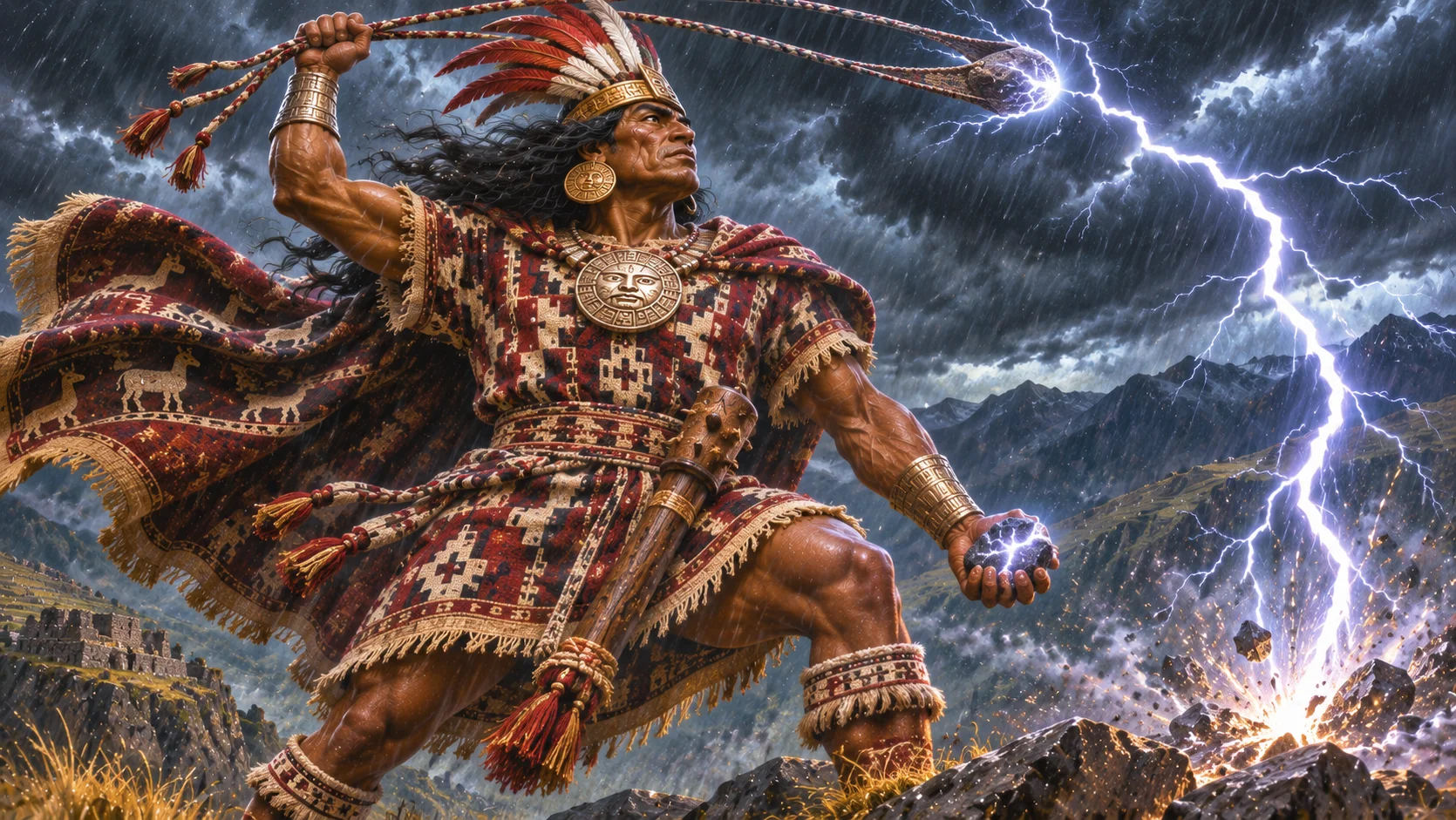
Catequil threw lightning and thunder with a sling. That makes him comparable to Illapa, the Inca thunder deity, and to Libiac, the thunder power of the central highlands. But the researchers who have studied the Huamachuco evidence stress that he appears to have been a local power rather than an Inca import, and that his myth has little in common with Inca mythology. He was the most important figure of a local pantheon, and the Incas had to deal with him as such.
The prefix apo (Quechua apu, “lord”) in the name Apocatequil is the same honorific used for mountain lords throughout the Andes. In practice Catequil was never only a sky power. He was bound to particular rock outcrops, to the cliffs above his sanctuary, and to a set of stones described as his “children”, each with distinctive features, whose worship continued after his main huaca had been destroyed and to which new stones were added both before and after the conquest. Thunder, in this tradition, comes down and takes the form of stone.
The Myth as the Friars Recorded It
The fullest account of the Huamachuco origin story comes from the Augustinian friars, whose report dates to around 1560. It is a Spanish summary of what local informants told them, so it is neither a verbatim native text nor a neutral one, and modern retellings vary in detail. The outline is as follows.
A distant creator called Ataguju sent a being called Guamansuri to Huamachuco. The first inhabitants, the guachemines, killed him by burning. Guamansuri had, however, left a woman with child: Cautaguan (the name also appears as Cauptaguan), the sister of the guachemine leaders, who had been kept confined because of her beauty. Catequil and his brother Piguerao (also written Piquerao) were born from her. In one version, which has a distinctly Andean ring, she died in childbirth and the twins hatched from eggs left on a dunghill; Catequil then restored his mother to life. Guamansuri had left slings for his son, and with these Catequil killed many of the guachemines. After the massacre he brought the people up out of the earth, at a hill called Cerro Guacat, to populate the province. The surviving guachemines were driven out, and place names such as Guachemin are said to mark the points to which they were expelled on the borders of the province.
Piguerao fares poorly in the story. In some accounts he is born weak and dies young; in others he is a presence of night and evil. Yet the Augustinians describe three crags at the sanctuary, named Apo Catequil, Mama Catequil (identified with the mother, Cautaguan) and Piguerao, so the brother was a focus of cult too, and boulders representing him stood in the shrine. A version sometimes circulated in popular collections, in which a divine grandmother gives Catequil his slings and a creator revives his mother, does not match the documents: the slings come from his father Guamansuri, and the revival is Catequil’s own act.
The story belongs to a family of Andean myths of a first race destroyed and a second brought forth from the earth, and has parallels in the coastal and Huarochirí traditions (the eggs, the annihilation of an earlier people). It also makes the thunder deity the founding hero of a political community: the Huamachuquinos were, in a literal sense, the people Catequil led out of the ground.
The Shrine at Namanchugo
The Augustinian report places the sanctuary at the foot of the three crags of Cerro Icchal, with cult buildings there. Modern excavation, led by John Topic and Theresa Lange Topic (the Catequil Archaeological Project, working at Namanchugo and nearby sites), is reported to have broadly confirmed this picture and added to it. As the excavators interpret it, the innermost building probably held a sculpture of Catequil and was small and restricted, with a small patio beside it where answers were announced. Pilgrims brought much of the area’s income. The design is that of an oracle: a restricted inner sanctum, a speaker, and a small, controlled audience hearing the answer.
This is worth pausing over. A great oracle in the Andes was not usually a god that spoke by itself. A priest or priestess served as intermediary, and the answer could be shaped by the questions asked, by sacrifice and by the political needs of the moment. The colonial writers, hostile to the practice, often called this fraud; modern scholars treat it as an institution through which a community and its visitors negotiated decisions. Catequil’s oracle was consulted well beyond Huamachuco, which is what gave it political weight.
The Incas and the Oracle
The Incas approached provincial huacas in a consistent way: they generally did not abolish them but folded them into the state’s sacred order, paid for offerings, and sometimes took a huaca’s image or a priest to Cusco. Catequil was treated this way. The friar Juan de San Pedro, in the Augustinian report, records that the oracle had a say in who would rule. The same literature describes a group of nine principal huacas of the province, and credits an Inca ruler (Huayna Capac in some readings, Topa Inca in others) with their elevation; this detail rests on secondary summaries and is given here with that caution. The Incas living in the province also worshipped Guamansuri, Catequil’s father, which may have been a way to gain legitimacy by joining themselves to the local founding story.
Atahualpa and Huascar
The Inca civil war between the half-brothers Huascar and Atahualpa was fought in the late 1520s and early 1530s and ended shortly before Pizarro seized Atahualpa at Cajamarca in November 1532. Atahualpa’s armies came south from Quito, and the road led through Huamachuco. The tradition is that he sought the oracle’s opinion on his campaign. San Pedro reports that the oracle had predicted that Huascar, not Atahualpa, would rule.
What follows depends on which source is read, and the sources do not agree.
- Sarmiento de Gamboa, like San Pedro before him, attributes the destruction of the idol and temple to Atahualpa; modern summaries sometimes add Betanzos, whose text was not checked here.
- A popular retelling, presented as a free translation of Sarmiento de Gamboa’s chapter 64, has Atahualpa send lords to consult the huaca; the answer was that he would come to a bad end. He went to the shrine in anger carrying a golden axe, met an aged priest said to be over a hundred years old, wearing a robe hung with sea shells, and struck him dead with a single blow. The original wording was not checked here, and the vivid details (the axe, the age, the shells) should be treated as the retelling’s, not as established record.
- Secondary literature reports that the Jesuit Pablo José de Arriaga, writing in 1621, placed the shrine in Conchucos and gave a different account of its destruction, and that the Augustinian chronicler Calancha later offered a correction; the details of these two passages were not verified here.
The researchers who have weighed these accounts favour the Augustinian version, with Atahualpa as destroyer, and the disagreement with Arriaga can be explained if the cult, being popular, had more than one temple, so that a destruction in Huamachuco and a flourishing shrine in Conchucos need not contradict each other. A question no source settles is why an oracle whose priests knew the political winds should have given a prophecy so costly to itself. One reading is that Catequil, tied to the Inca order of Huascar, paid the price of backing the loser; another is that the story was shaped later by those who wanted Atahualpa remembered as a usurper. Both are interpretations, not findings.
The Friars and the Destruction
The fall of the sanctuary that archaeologists can actually see belongs to the Spaniards. The literature names the Augustinian fathers Antonio Lozano and Juan Ramírez as those who pulled down its walls. The excavators report that the statue of Mama Catequil had had its genital area mutilated, that boulders representing Piguerao had been toppled, that a cross had been pecked into a boulder in the plaza, and that pieces of a sculpture of Catequil, found not in the sanctuary but in a cave in the mountains, had been broken. The Augustinians, who settled in the town over Inca ruins, also wrote the report that preserved the myth.
A note on names: the extirpator Avendaño is sometimes named in connection with Catequil’s destruction. The documented work of Fernando de Avendaño, a visitor of idolatry in the archdiocese of Lima, took place in the province of Cajatambo between 1617 and 1622, more than half a century after the Augustinians. Arriaga, who accompanied such visits, wrote the 1621 manual for extirpators. No source consulted ties Avendaño to the sanctuary at Namanchugo, and its destruction there is credited to Loçano and Ramírez. Likewise Pedro de Cieza de León, who travelled the royal road in the 1540s, is a source for the lands and peoples of the region, but no passage in which he describes Catequil could be confirmed here, and none is relied on; for the oracle the sources to cite are Sarmiento, San Pedro and the Augustinian report, with Arriaga and Calancha for the later debate.
What Survived
Catequil’s worship outlived both Atahualpa and the friars. Researchers who studied the stones and the sources conclude that it persisted despite destruction by Atahualpa and, later, by the Augustinians; the “children” stones went on being identified, and the principal huacas of the province were still venerated when the friars began their work. The name remains on the land. What remains of the sanctuary is protected archaeology; the story of the twin who led his people out of the earth, and of the oracle that told a king an unwelcome answer, is the part that the Spanish could burn but not retrieve.
Reading Catequil Carefully
Three cautions apply to anything written about him. First, the Augustinians described Huamachuco religion in terms they could condemn, and the very word “idol” belongs to the friars’ purpose. Second, most of what is told about the Atahualpa episode comes from writers who wrote after Atahualpa was dead and after the conquest had made him a villain or a victim, depending on the author. Third, the archaeology establishes a sanctuary, a form of consultation and a sequence of destruction, but not a single spoken oracle.
The twin thunder-hero of Huamachuco is, in the end, known to us from three directions that rarely meet: a friar’s report, a chronicler’s war story, and a ruin on a mountainside, cast down by people who wanted him forgotten and who have instead made him one of the best-documented gods of the pre-Hispanic north.
Sources & traditions
- TraditionIncan texts, oral tradition and village tellings (Andes)
Myths change from area to area and from time to time. This chronicle follows the most widely told versions; tellings in other villages, regions and eras may differ.