Inti, the Quechua word for the sun, was the deity at the centre of the state religion of the Inca. The ruling dynasty of Cusco claimed descent from him, his gold-sheathed temple the Qorikancha stood at the heart of the capital, and the great June festival that bore his name, Inti Raymi, was among the most important events of the Inca year. Unlike some figures of the Andean past, Inti has never quite left the stage: the festival was suppressed in the colonial period, revived as a staged pageant in the twentieth century, and is today watched by crowds above Cusco, while across the Andes many people still greet the rising sun and keep the solstice seasons in ways that predate and sometimes overlap with the Inca state.
Name and spelling
In Quechua inti means the sun, and in Aymara a very similar word is used. Some linguists, among them Rodolfo Cerrón-Palomino, have argued that inti is a loanword into Quechua from Puquina, a language of the Titicaca region that some scholars think was spoken in the Inca court and that has since disappeared. This remains a scholarly proposal, not a settled fact. In genitive constructions Quechua adds a suffix, giving Intip (“of the sun”), so Intip Churin, “son of the sun”, was the title applied to the Inca ruler, and Intip Raymin is a form of the festival’s name. Spanish writers wrote the name as Inti, Ynti or Yntip, and the god was also called Apu Inti, “Lord Sun”, in modern devotional language. The word punchao means “day” and was also the name given to the most sacred image of the sun in Cusco, discussed below.
Sources, and how to read them
As with all Inca religion, what we know of Inti comes through colonial writers. The chroniclers who matter most are Juan de Betanzos, who wrote in the 1550s with access to Inca noble families through his marriage; Pedro Cieza de León, who travelled the Andes in the 1540s and published in the 1550s; Polo de Ondegardo, a magistrate who investigated Inca religion and administration; Cristóbal de Molina, a priest in Cusco who described festivals; Pedro Sarmiento de Gamboa, who wrote for the viceroy Toledo in 1572; Garcilaso de la Vega, el Inca, whose Comentarios Reales of 1609 gave the most celebrated description of Inti Raymi; Bernabé Cobo, a Jesuit whose long Historia del Nuevo Mundo was completed in the mid-seventeenth century and drew on earlier reports; and the native authors Guaman Poma de Ayala and Pachacuti Yamqui. All of them wrote under Spanish rule, most with the aim of reporting idolatry or defending a political position. Garcilaso, for instance, left Cusco in 1560 and wrote half a century later, partly from memory and partly from letters of relatives, and he has a clear interest in presenting the Inca as proto-Christian monotheists who worshipped the sun as a visible image of an unseen creator. The chronicles agree on large matters (the sun’s place in the state, the Qorikancha, the festivals) and disagree on many details of rank, ritual and myth.
The sun in the Inca order
Inti was not the only great being of the Inca world. The creator Viracocha stood, in the chroniclers’ scheme, above him, and the thunder god Illapa, the moon Mama Quilla, the earth and the mountains were all honoured. But Inti was the god whose cult the state organised most extensively. The Inca tradition, as reported by Cobo and Polo among others, set aside lands and herds in conquered provinces for the sun, and for the Inca ruler and the people. Temples of the sun were built in provincial centres, and communities of women, known as aqllakuna (“chosen women”), served the cult and made fine cloth and maize beer. Some of them became priestesses called mamakuna. In this sense the cult of the sun worked as an instrument of empire: through it the Inca ruler could present himself as the visible, living representative of the heavenly power, and conquered peoples could be incorporated into a shared ceremonial order without being required to give up their own local gods entirely.
Sun-worship was also reflected in the architecture and the landscape. The Island of the Sun in Lake Titicaca, with its sacred rock, was developed by the Inca as a pilgrimage place, and the stories told there tied the origin of the sun to the lake. The Inca built stonework and astronomical markers at Cusco, and scholars working with the system of sight-lines called ceques have argued about how far the solstices were marked by towers on the hills around the city. The details of those alignments are debated, and the archaeological claims should be read with care.
Son of the sun: myths of origin
The Inca claimed descent from the sun, and the dynastic story is told in more than one way. In the version Garcilaso gives, the sun, taking pity on the Andean peoples who lived like animals, sent his son Manco Capac and his daughter-wife Mama Ocllo to teach them. They carried a golden rod, and where it sank into the earth, in the valley of Cusco, they were to found a city. Manco Capac taught men to farm and build and Mama Ocllo taught women to spin and weave. In the Cusco-based accounts of Betanzos and Sarmiento, by contrast, the dynasty began with a group of brothers and sisters, the Ayar siblings, who emerged from a cave at Pacaritambo and travelled to the valley of Cusco, with Manco Capac emerging as the leader after a series of incidents of rivalry and violence. In these versions the connection with the sun is thinner or arrives later. Scholars generally treat the two stories as different layers of an evolving dynastic tradition, with the more explicit solar descent possibly strengthened over time, and with Spanish-era writers shaping the final form.
What is clear is that the Inca ruler, the Sapa Inka (“unique Inca”), was called a child of the sun. At death his body was mummified and kept in his palace, served and consulted, and brought out on festivals. These royal mummies were also kept alongside the images of the sun in the processions of the capital, and a great deal of the ceremonial life of Cusco was about the relationship between living and dead kings and the sun.
The Qorikancha and the Punchao
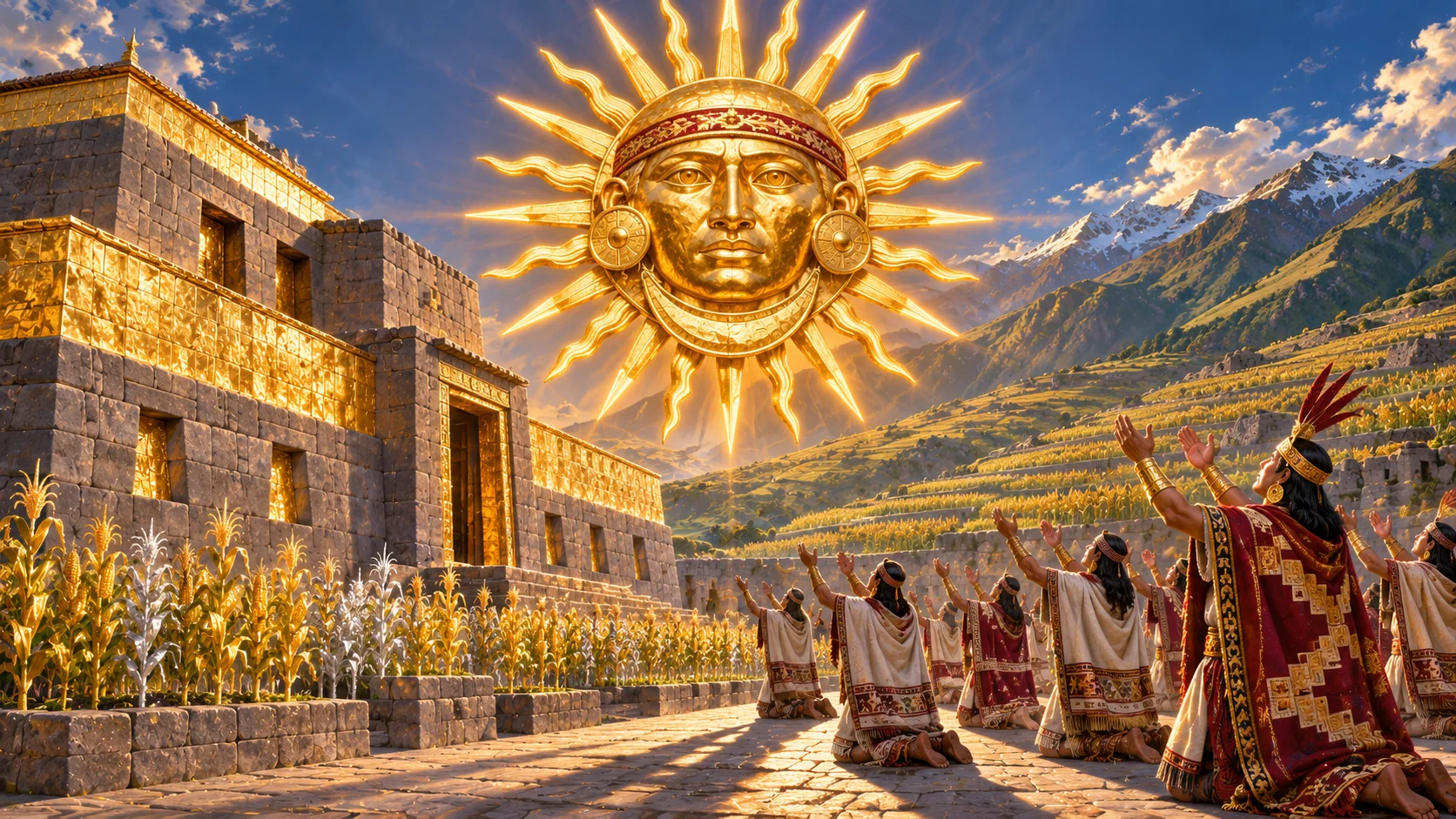
The temple at the centre of Cusco was the Qorikancha (Coricancha, usually translated “golden enclosure” or “golden courtyard”), also called Inti Wasi, “house of the sun”. Spanish writers such as Cieza, Betanzos and Garcilaso describe it as a complex of chambers around a courtyard, with walls of exceptional masonry, rooms dedicated to the sun, moon, stars, thunder and rainbow, and a garden in which plants and animals were fashioned in gold and silver. After the conquest the site was given to the Dominicans, who built the convent of Santo Domingo on the Inca foundations; the earthquakes of 1650 and 1950 damaged the colonial structures while the Inca walls largely held, a fact often noted as a testimony to Inca masonry.
The most sacred image of the sun was the Punchao, a gold figure described by the chroniclers as a small seated or standing form with a radiant face and rays, with hollow body filled with a paste or powder, said by some Spanish writers to have contained the ashes or hearts of the kings. Spanish writers describe it as being brought out in processions. When Cusco fell to the Spanish, the Punchao was hidden, and it followed the exiled Inca court to Vilcabamba. According to Spanish accounts it was taken near Vilcabamba in 1572, when the last independent Inca, Túpac Amaru, was captured, and carried to Cusco. A later report holds that Toledo took it to Spain when he returned in 1581, and a gold idol listed in an inventory after the death of Philip II in 1598 may be the Punchao, though that identification is uncertain; its subsequent fate is unknown. The Spanish reports of 1572 should be read against the background that this was the year in which the last independent Inca, Túpac Amaru, was executed at Cusco, and that the removal of sacred images was part of a deliberate campaign to eliminate the cult.
Inti Raymi in Inca Cusco
Inti Raymi, “festival of the sun”, was held around the June solstice, when the sun was at its lowest in the southern sky. In its full form it was a festival of the Cusco court with delegations from the four quarters (suyus) of Tawantinsuyu. Garcilaso, who says he saw part of it as a boy, and the other chroniclers describe a sequence that can be summarised as follows, though the sources differ on specific steps. There were days of fasting and abstinence, and no fires were kindled in the city. At dawn the Inca and the nobles gathered in the main square, Haukaypata, and waited barefoot for the rising sun, greeting it with a shout and with an offering of maize beer, the ruler raising a gold vessel to the sun and pouring the drink. A sacrifice of llamas followed, and priests read omens from the animals’ lungs. A new fire was kindled from the sun’s rays with a polished concave object, according to Garcilaso, and the sacrifice was burned with it. A feast, music and dance filled the days that followed.
It is worth noting that Garcilaso’s account has been challenged as an idealised portrait, and that Molina and Cobo give more weight to other months. In the calendar of the Inca year the great initiation and state festival of the December solstice, Qhapaq Raymi, is described by some of the chroniclers as the more important of the two. How much of what Garcilaso reports can be taken as an eyewitness report and how much as a later reconstruction is a question that scholars have not resolved.
Suppression and the long gap
Colonial authorities identified the public festivals of the sun as the most dangerous expression of the old religion, because they were tied to the legitimacy of the Inca dynasty. The royal mummies were located and removed from Cusco by the magistrate Polo de Ondegardo in 1559, and the viceroy Francisco de Toledo (1569–1581) pursued a wider campaign against the Inca dynasty and its cult. Popular and tourist accounts give 1572 as the year Toledo prohibited Inti Raymi; no decree or primary document for that date could be traced, so it should be read as a conventional attribution, not an established fact. What is better supported is that the state festival ended with the Inca state and that its public performance was suppressed under colonial rule. Reports say that parts of the festival continued for years in disguised forms, in the company of Catholic feasts that fell near the same dates, among them the feasts of Saint John and Saint Peter in late June. This pattern, in which an older season is not abolished but absorbed into Christian calendar days, is documented across the Andes.
The modern Inti Raymi
The festival as it is seen today dates from 1944. In that year, as part of the celebrations of the Week of Cusco, a staged re-creation of Inti Raymi was performed at the fortress site of Sacsayhuamán above the city, with a script prepared by the Cusco actor and writer Faustino Espinoza Navarro, who worked with Humberto Vidal Unda and others in the city’s cultural circles. The script drew heavily on the account of Garcilaso de la Vega, and was performed in Quechua. It has been repeated annually on 24 June, a date now also known as the Day of Cusco, and is organised by the municipality with large casts. The performance begins at the Qorikancha, passes through the main square, and ends at Sacsayhuamán, with an actor taking the role of the Sapa Inka and a sequence of speeches, processions and a symbolic sacrifice.
What is this? Scholars and Cusquenians do not all agree. For many, particularly the Cusco-born, it is a proud affirmation of Andean heritage in the face of a long history of denigration of Quechua culture. For others it is a theatrical reconstruction, not a religious ritual, and one that has become heavily bound up with the tourism industry; critics point out that it presents the Inca state as a single unified culture and sets the colonial era aside, and that the real religious practice of living communities is elsewhere. Both points are true. The staged festival is a modern work, based on a colonial text, performed for a modern audience, and it is also a cultural institution that Andean people have made their own.
The sun in living Andean practice
The Inti of the state cult was bound up with the Inca monarchy, and with the end of the monarchy much of that structure vanished. But the sun and the solstices remain part of lived Andean religion in different ways. In many highland communities, people greet the sun at dawn and use the position of the sun and the stars to time agricultural tasks. Near Cusco, pilgrims travelling to the glacier festival of Qoyllur Rit’i (“snow star”) in the weeks before the June solstice carry a tradition that combines Catholic devotion, mountain veneration and the astronomy of the Pleiades. Among the Kichwa of northern Ecuador, communities such as those around Otavalo and Cayambe celebrate Inti Raymi in June in a form blended with the Christian feasts of Saint John and Saint Peter, with dancing and ritual battles. In Bolivia the Aymara new year is celebrated at the June solstice, with gatherings at Tiwanaku to greet the first light, and it has been recognised as a public holiday in the country; some of these events are modern revivals that have a political and cultural meaning as well as a religious one. It would be inaccurate to describe any of these as an unbroken survival of the Inca state festival; it would be equally inaccurate to treat them as invented. They are the present expressions of a long relationship with the sun, kept by living communities.
Kindred figures
Inti’s closest companion is the moon, Mama Quilla, called in the sources his sister and wife. Above or beside him in different accounts stands Viracocha, the creator, who in many texts is his father or maker. Illapa, the thunder and weather god, is the third of the principal powers in some chroniclers’ lists, and the morning and evening star, Chasca, appears in poetic descriptions as the sun’s page. Pachamama, the earth, stands as the other great pole of Andean religious life, and in certain modern interpretations the sun and the earth are felt as a complementary pair. Beyond the Inca, Andean peoples the Inca ruled had their own sun and moon traditions, and on the north coast, according to the seventeenth-century friar Antonio de la Calancha, the moon was held in higher regard than the sun, which is a reminder that the primacy of the sun was an Inca state arrangement, not a universal Andean rule.
A closing reflection
Inti’s history is in many ways a history of how religion and power were braided together and then forcibly unbraided. The dynasty that claimed him as father is gone, the golden courtyard is a colonial convent with Inca foundations, and the image of the god itself has vanished into the records of conquest. What persists is the sun as a daily presence in the high, thin air of the Andes, welcomed by the farmer on a ridge as much as by the actor in Cusco, and the knowledge, preserved in language and ritual, that the year turns and that the turning is worth marking.
Sources & traditions
- EncyclopediaWikipedia — Inti
- TraditionIncan texts, oral tradition and village tellings (Andes)
Myths change from area to area and from time to time. This chronicle follows the most widely told versions; tellings in other villages, regions and eras may differ.