Mama Quilla — in modern Quechua spelling Mama Killa, “Mother Moon” — was the moon of the Inca world, personified as the sister and wife of the sun, Inti. Spanish chroniclers describe her chamber in the Qorikancha at Cusco as lined with silver, and modern writers often call her the keeper of the calendar and the protector of women, roles that the early sources do not spell out. She was also a figure around whom a good deal of colonial and modern writing has accumulated details that are poorly supported, so a careful account has to separate what the sixteenth- and seventeenth-century writers actually reported, what archaeology can add, and what has been repeated since without a clear source.
Name and spelling
In Quechua mama means “mother” and, as a title, a lady or a divine female being, and killa means both the moon and the month. The spelling Quilla is the older Spanish rendering of the same word; Garcilaso de la Vega, Bernabé Cobo and other chroniclers wrote quilla, and modern Quechua orthography gives killa. A variant Mama Kilya reflects the pronunciation of some regions. In Aymara the moon is phaxsi, a word entirely different from the Quechua one, which is a useful reminder that the Inca name belongs to the Quechua-speaking Cusco core and not to the whole Andes. The title Mama was used for several Andean powers connected with growth and sustenance, including Mama Cocha (the sea), Mama Sara (maize) and Pachamama (the earth).
Sources, and what they can bear
The record for Mama Quilla is thinner and more formulaic than for Inti, and that fact itself deserves notice. The earliest Spanish writers on Inca religion, including Cieza de León, Betanzos, Polo de Ondegardo and Cristóbal de Molina, mention the moon in the context of the Qorikancha and of the calendar. Garcilaso de la Vega, who wrote in 1609 as a mestizo from Cusco, describes the moon as the wife and sister of the sun, and mother of the Inca line, honoured in that role. Bernabé Cobo, writing in the seventeenth century on the basis of earlier reports and his own inquiries, also lists the moon among the powers honoured in Cusco. Almost all of these writers were men, clergy or soldiers, who observed and recorded the ceremonial life of an elite from a distance, and who were not generally interested in what women in Inca households believed or did.
It is therefore wise to be careful with modern popular accounts that credit Mama Quilla with a long list of precise functions and festivals. Many of the lines found on tourism and general-interest web pages cannot be traced to a primary source, and some come from twentieth-century occult writing. What follows relies on what the chroniclers report and on the work of historians and anthropologists who have read them critically.
Sister, wife and mother
The Inca ruler married his full sister as his principal wife, the Qoya (Coya), and in the Inca ideology of rule this pairing was understood as a reflection of the sun and moon. In the chroniclers’ accounts the moon was the sister and wife of the sun, and the mother of the Inca dynasty, so that the first Inca, Manco Capac, and his sister-wife Mama Ocllo were seen as the children of the pair in Garcilaso’s version. The historian Irene Silverblatt, in her study of gender and power in the Andes, argued that Inca ideology of parallel descent, in which women traced their descent through the female line and men through the male, was reflected in cults of the moon and the sun, and that colonial rule undermined the women’s side of that system. Her argument is influential and has been much discussed; it is an interpretation, though one grounded in the chronicles and in Spanish legal records.
Some historians of the Andes go further and suggest that the cult of the moon was bound up with queens and with female lineages and was therefore specially marked for suppression. The evidence for a distinct institution of moon-worship run by and for women is real but fragmentary: the chroniclers describe women who served in her temple, and they describe the Coya as having her own household and rituals, but they do not give a full account of them.
The silver and the temple
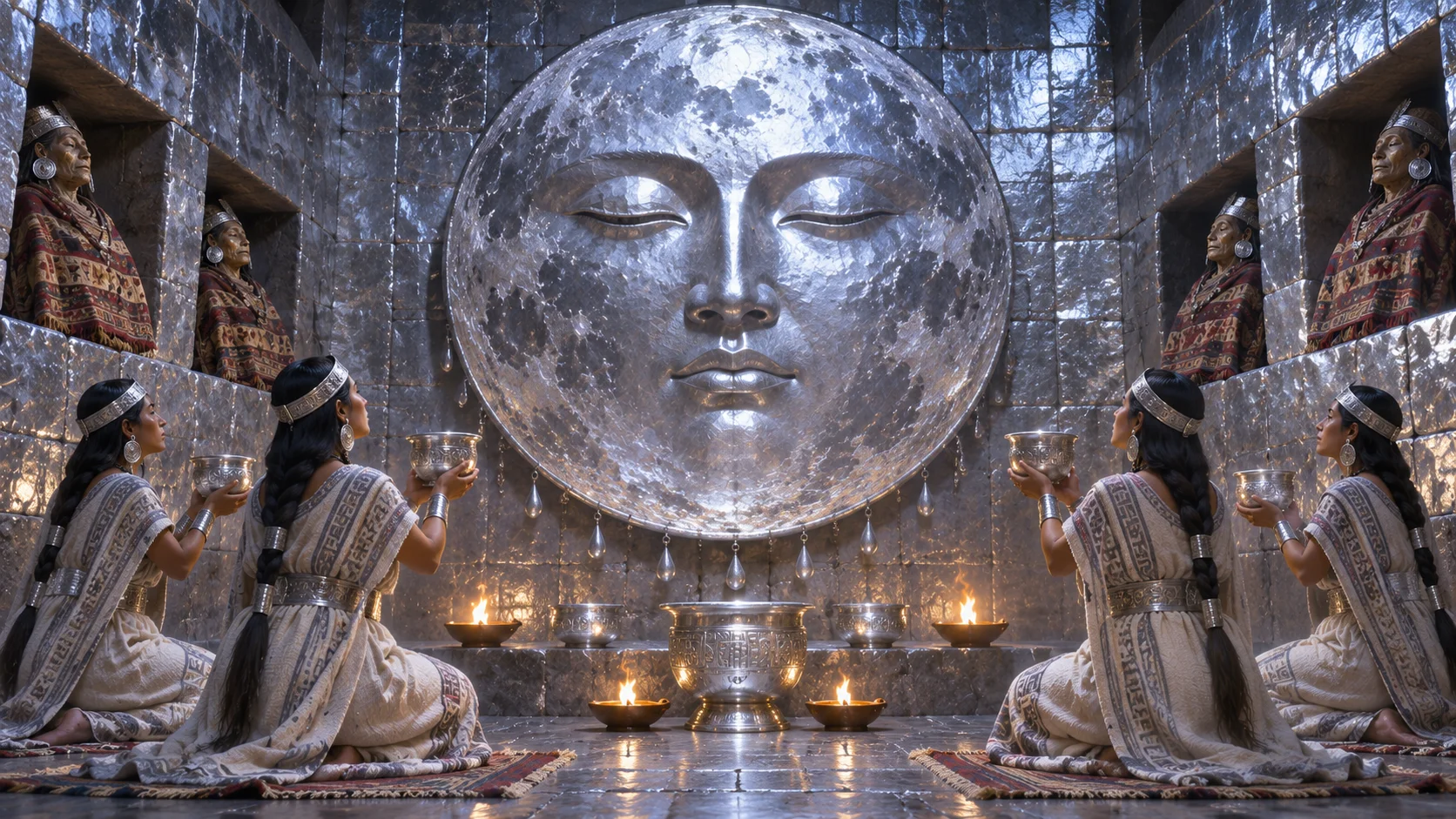
The chroniclers describe the Qorikancha in Cusco as containing a chamber for the moon beside that of the sun, with walls and doors covered with silver plates, and with a human-faced image of the moon on a silver surface. Garcilaso reports that the bodies of the Coyas, the queens, were kept in this chamber, as the bodies of rulers were kept near the sun, so that the moon-chamber was both a shrine and a place of the royal dead. Women are said to have served the moon, though the sources say little about them. Modern writing on Andean metals often says that gold was the “sweat of the sun” and silver the “tears of the moon”; the phrases are widely repeated, and the colonial source they come from is not clearly identified, so they are best treated as a modern gloss rather than documented Inca belief. What is attested is that silver was the metal the Inca associated with the moon, as gold was linked with the sun.
Archaeology gives a further landmark: on the Island of the Moon (Coati) in Lake Titicaca stands a complex of Inca buildings known as Iñak Uyu, usually called the Temple of the Virgins of the Moon or the Nunnery, which was investigated by Adolph Bandelier in the 1890s and later by other archaeologists. It is understood to have been a place where chosen women served in the Inca period, in the manner of the cult centre on the neighbouring Island of the Sun. The name “Temple of the Virgins” is of course a Spanish overlay, and what the women there actually did is known only from general descriptions of the aqllakuna of the empire.
The keeper of the calendar
The Inca calendar combined lunar months with the solar year, and Cobo, Molina and Guaman Poma list the months of the year and their festivals. The word killa is both moon and month, a fact that makes the connection plain in language: to count the months is to count moons. Scholars of Inca astronomy, among them R. Tom Zuidema and Anthony Aveni, have studied how the Cusco calendar may have been adjusted to the solar year using observations of the sun on the horizon and of the Pleiades, and the exact mechanism is disputed. Any statement that the moon governed “the Inca calendar” in a simple way needs to be tempered with this fact: the Inca reckoned in lunar months, but they also kept watch on the sun and the stars, and the reconciliation of the two was a specialist task.
The chroniclers give names to the months, and in one of them, the month assigned to the queen (Qoya Raymi), a festival of purification called Situa was held to drive sickness and evil out of Cusco, according to Molina and Cobo, who place it around September. The association of that month with the queen suggests a place for the female side of the ritual year, though the chroniclers describe the ceremony chiefly as a purification of the city and are not clear about how directly it was addressed to the moon.
Eclipses
The best-attested myth about the moon concerns eclipses. Chroniclers report that when the moon was eclipsed the people made a great noise. Garcilaso describes people making all the noise they could with trumpets, shells and drums, and tying up dogs and beating them so that their howling would call the moon back, the reason given being that she was fond of dogs for a service they had once done her. He says the moon was thought to be ill and in danger of dying and falling from the sky, which would end the world, so that the noise was meant to wake her. Later folklore and some other reports speak of an animal, a puma or a serpent, seizing the moon. A reader should not treat these as one reliable single belief; they are different reports gathered at different times and places, some of them from regions beyond Cusco.
The eclipse custom was recorded as continuing in the colonial period, and a number of ethnographers working in Andean communities in the twentieth century recorded versions in which people made noise during lunar eclipses. This is one of the better-documented continuities between the sixteenth-century reports and later practice.
The fox on the moon
A familiar story explains the marks on the moon’s face by a fox who loved the moon and climbed into the sky to take her; she embraced him and held him to her face, and he remains there as a dark shape. Garcilaso reports it among the explanations of the moon’s spots told in Cusco, and he keeps his distance from it, comparing such tales with the fables of the ancient pagans. The story is also found in folklore collected in the Andes in the twentieth century, where the fox is a regular figure, which suggests that it has been told for a long time, though what belief lay behind it for the Inca themselves cannot be known.
Regional ranking of the moon
The prominence of the moon was not the same across the Andes. The seventeenth-century Augustinian friar Antonio de la Calancha reported that on the north coast of Peru, among the Chimú and related peoples, the moon was held in higher esteem than the sun, a point often cited as a contrast with the Inca order. Archaeologists point out that the great adobe temple at Moche is called the Huaca de la Luna, but that name is modern and the building is a pre-Inca structure of the Moche culture, whose own beliefs are known only from their art. The Inca, in conquering the coast, brought with them the sun cult and placed the moon in a secondary, complementary position, as the Spanish accounts of Cusco present her.
Colonial suppression and what became of her
The queens’ mummies and the moon’s silver went the way of the rest of the Qorikancha’s treasures. Metal was melted down by the conquerors, and the royal mummies were removed from Cusco by the magistrate Polo de Ondegardo in 1559, in the years after the conquest. The moon cult as an institution of the state ended with the state. Cults of the moon in local communities were not so easy to eliminate: the extirpation campaigns of the seventeenth century, recorded in the reports of priests such as Pablo José de Arriaga, regularly mention worship of the sun, the moon and the stars among the practices to be uprooted. The moon was easily identified with the Virgin Mary or with Catholic images in colonial iconography, in which the Virgin stands on a crescent moon, and some writers suggest that this visual coincidence helped both to disguise and to transform the older devotion; that suggestion is plausible, but direct evidence of such a transfer is limited.
The moon in modern Andean life
In present-day highland communities, the moon figures chiefly in agricultural and household practice rather than as a worshipped goddess in the Inca sense. Ethnographers in Quechua- and Aymara-speaking regions report that people choose lunar phases for planting, cutting hair, castrating animals, or cutting timber, and that the waxing or waning moon is understood to affect growth. Some report beliefs connecting the moon to women’s cycles and to fertility. These are practices that vary from valley to valley, and they should be understood as part of local knowledge rather than a unified religion of the moon.
Kindred figures
Mama Quilla stands beside Inti, her brother-husband, and in the chroniclers’ scheme beneath Viracocha the creator. She is related in the family of the great mamas to Pachamama the earth, Mama Cocha the sea and Mama Sara the maize, and in the sky she is accompanied by the stars, among them Chasca (Venus) and the Pleiades, which Andean farmers have long watched. Further south, in the Aymara world, the moon appears as Phaxsi Mama.
A closing reflection
Mama Quilla is a deity about whom we know less than we would like, and that is itself a historical fact: the record was made by those who were least interested in the world of women, and the silver that decorated her house did not survive the conquest. What can be said is that the Inca imagined the cosmos as a married pair, brother and sister, light by day and light by night, and that the same pattern organised the life of the court, the calendar of the year and the way that descent was traced. The moon, in the Andes, still keeps the months, and the word for the moon is still the word for a month.
Sources & traditions
- EncyclopediaWikipedia — Mama Killa
- TraditionIncan texts, oral tradition and village tellings (Andes)
Myths change from area to area and from time to time. This chronicle follows the most widely told versions; tellings in other villages, regions and eras may differ.