Pachamama is the living earth of the Andes, honoured as a mother who feeds her people and must be fed in return. Unlike many of the deities of the vanished Inca state, she is not a figure of the past. Every August, in households and fields from southern Peru and Bolivia to northern Argentina and Chile, families and communities make offerings to her, pour a little of their drink on the ground before they drink it themselves, and ask permission before they plant, build or dig. In 2008 her name was written into the constitution of Ecuador, and in 2010 the legislature of Bolivia passed a law on the rights of Mother Earth. This is a tradition that is practised and reinterpreted by the living, and it deserves to be described as such, with the caution that what outsiders have written about it, from the sixteenth century to the present, has often reflected the writers’ own concerns.
Name and language
The name is Quechua in form: pacha is a large word meaning earth, world, ground, time, season and the whole ordered cosmos, and mama means mother. Neither word is simple to translate; pacha combines space and time, as in pachakuti, “the overturning of the world or of an age”. The form is written Pachamama, Pacha Mama and, in older Spanish sources, Mama Pacha or Mamapacha. Aymara speakers use the same name, Pachamama, and the Aymara of Bolivia also speak of the earth in more local terms and, in Spanish, of the Santa Tierra, the “holy earth”. In Kichwa of Ecuador the form is Pachamama as well. Some writers distinguish the cultivated, producing earth, often called Mama Allpa or Allpamama in Quechua, from the wider pacha; others treat them as aspects of one being. The scholarly work on the term does not give a single picture, and what the word means differs from community to community.
Sources: where she appears and where she does not
One surprising fact is that Pachamama is not a prominent figure in the great chronicles of the Inca court. Writers such as Cieza de León, Betanzos, Garcilaso de la Vega and Sarmiento de Gamboa say a great deal about the sun, the creator and the ruling dynasty, and comparatively little about the earth as a female deity. The Huarochirí Manuscript, the Quechua text compiled around 1608 and focused on the regional gods of the central highlands, is dominated by mountain deities such as Pariacaca and by Cuniraya Wiraqocha, and does not centre on an earth mother. The earth does appear in the writings of the seventeenth-century priests who documented what they called idolatry, notably Pablo José de Arriaga, and in the writings of Bernabé Cobo, where the veneration of the earth and the offerings made to it are noted.
This pattern has led to a debate among scholars. The Argentine anthropologist Ana María Mariscotti de Görlitz, in her 1978 study of Pachamama and the Santa Tierra, is generally cited for the argument that the cult in the form now known was reshaped under colonial conditions. Others point out that the earth was almost certainly worshipped long before the Inca and that the sparse sixteenth-century record reflects what the Spanish writers chose to record and where they looked, not an absence. The honest conclusion is that there was an old Andean veneration of the earth, that it was not the centrepiece of the Inca state cult as described by Spanish writers, and that the figure of a single, named, generalised Pachamama as it is now known probably crystallised, or was at least reshaped, in the colonial and later periods.
What she is
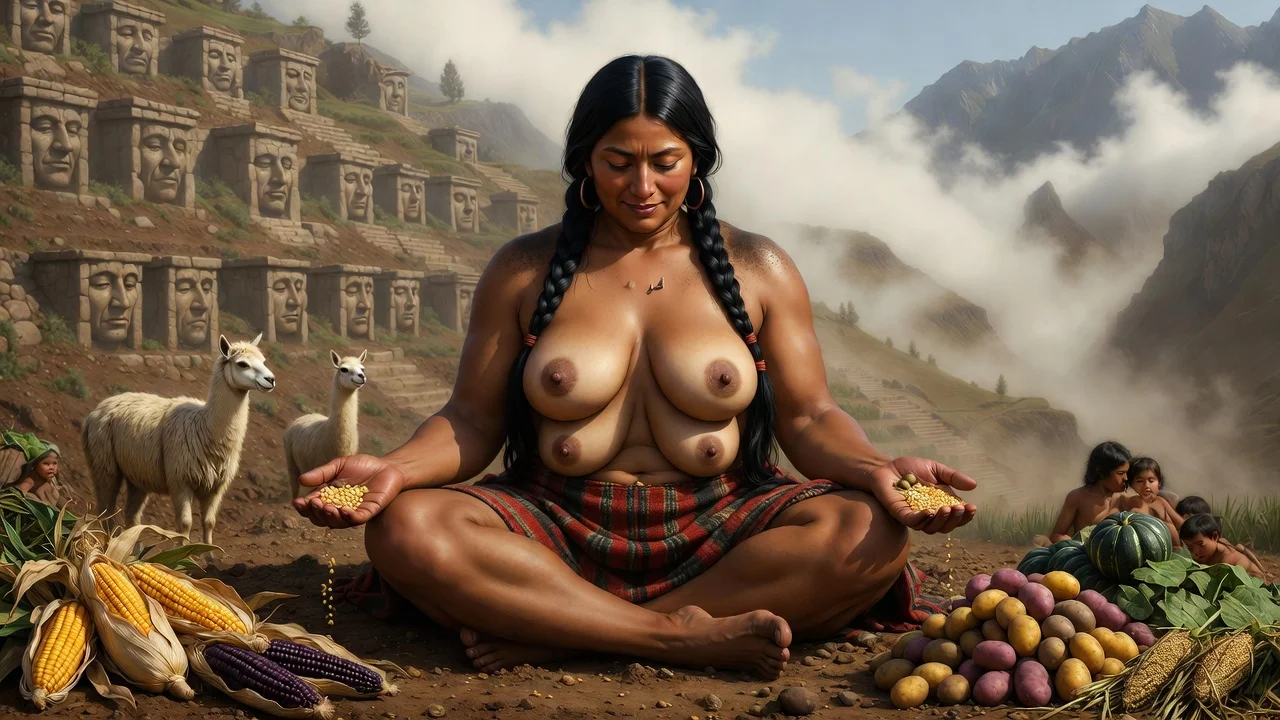
For many Andean people, Pachamama is not a goddess in the sense of a distant being residing in a heaven; she is the ground, the fields, the place, and the relationship of living beings to it. Anthropologists such as Catherine Allen, who studied a Quechua community near Cusco, have described an Andean world in which the landscape is alive and aware: the earth, the mountains and the springs are persons to whom one speaks and who must be treated with care. In Allen’s account of the community she called Sonqo, the earth is fed in the same way that people are fed, and she hungers and thirsts. The principle that organises this relationship is reciprocity, ayni in Quechua, the obligation to give back what one has received and to help those who have helped.
Pachamama is understood as a giver of life, of crops, herds and water. She is not, however, merely benevolent. If she is neglected she may withhold, and illness and misfortune can be understood as a sign that an offering has been forgotten or a debt left unpaid. The powers of the earth shake the ground, and in earthquake-prone regions the idea that the earth moves when she is angry or hungry is part of the way people speak about it. It would be a mistake to turn this into the picture of a cruel or vengeful goddess; the relationship is closer to that between family members who have obligations to each other, and an offering is a repayment and a conversation more than an appeasement.
The August rites
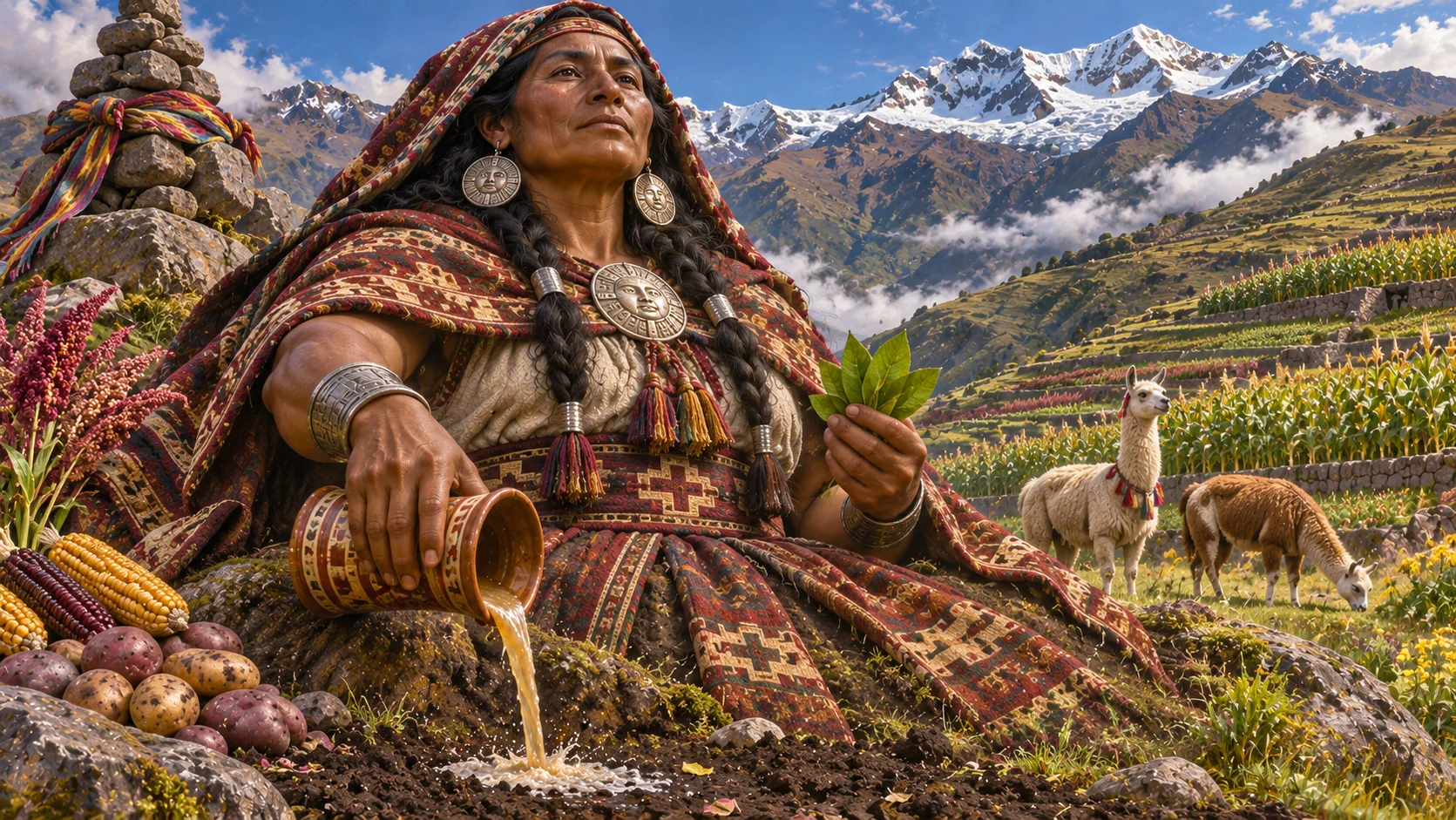
The best-known form of devotion is the August offering. August is the coldest month of the southern Andean winter, the time before sowing, and the moment when, in the view of many communities, the earth is open, hungry and thirsty. On the first of August and through the month, families and communities perform a payment (pago in Spanish, haywarikuy in some Quechua usage) to the earth. In north-western Argentina, in Jujuy and Salta, the rite is often called the corpachada, and a hole is dug in the ground into which food, coca leaves, drink and other offerings are placed and then covered, so that the earth is literally fed. Its details differ from valley to valley, and the following are typical rather than universal features:
- the pouring of a small amount of chicha (maize beer) or cane spirit on the ground before one drinks, called ch’alla in Quechua and Aymara regions;
- the offering of three selected coca leaves, k’intu, held up and blown upon with a prayer to the earth and the mountain spirits (the apus or, in Aymara, achachilas);
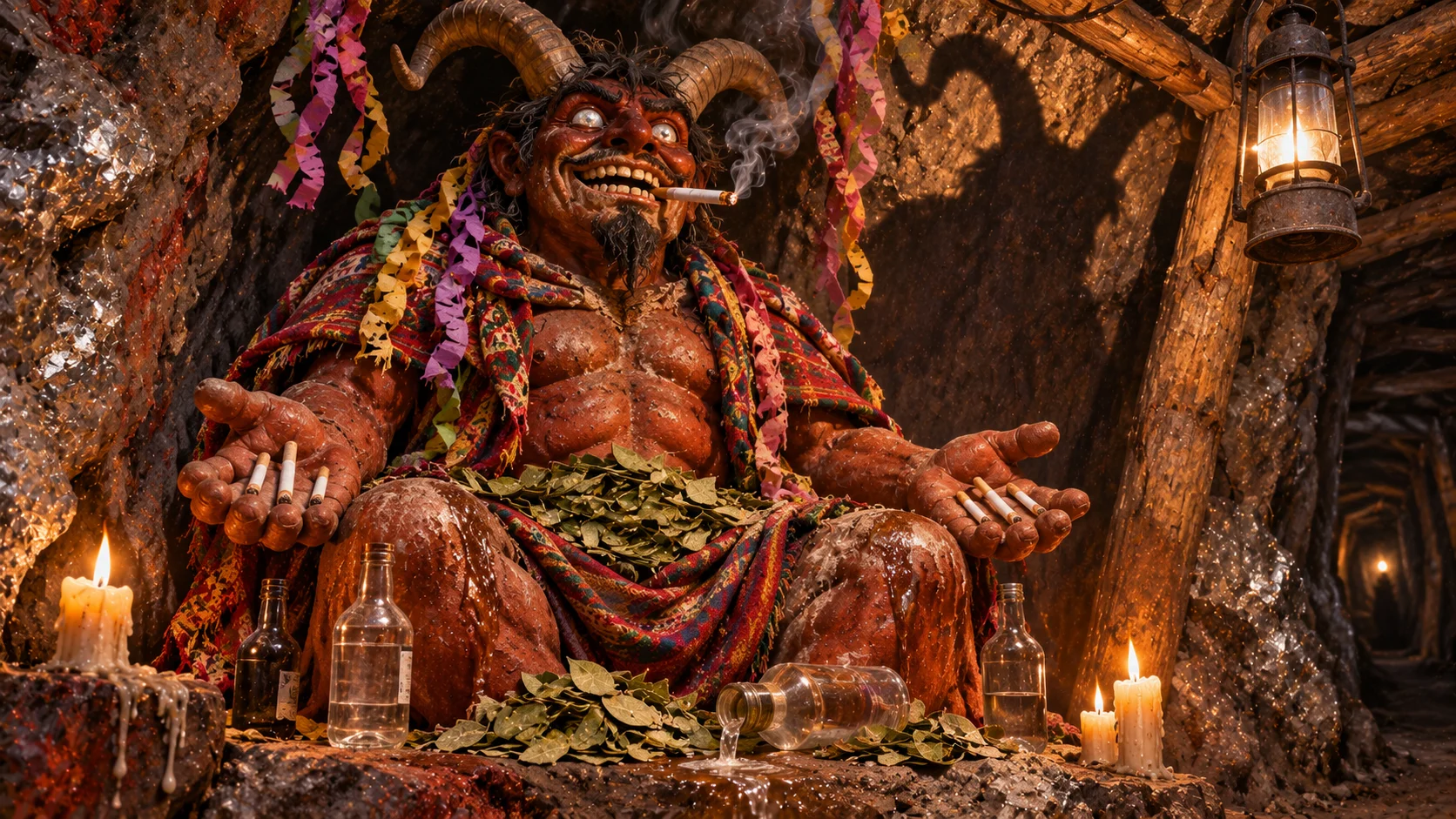
- the burning or burying of a despacho (mesa), an offering bundle assembled by a ritual specialist and containing items such as sweets, coca, seeds, wool, llama fat, and in some regions miniature objects, with the ritual specialist conducting the prayers;
- incense and smoke, with the burning of aromatic plants;
- in some regions the sacrifice of an animal, a llama or a guinea pig, whose blood or fat is given to the earth, though this has become rarer and varies a good deal by region and by community.
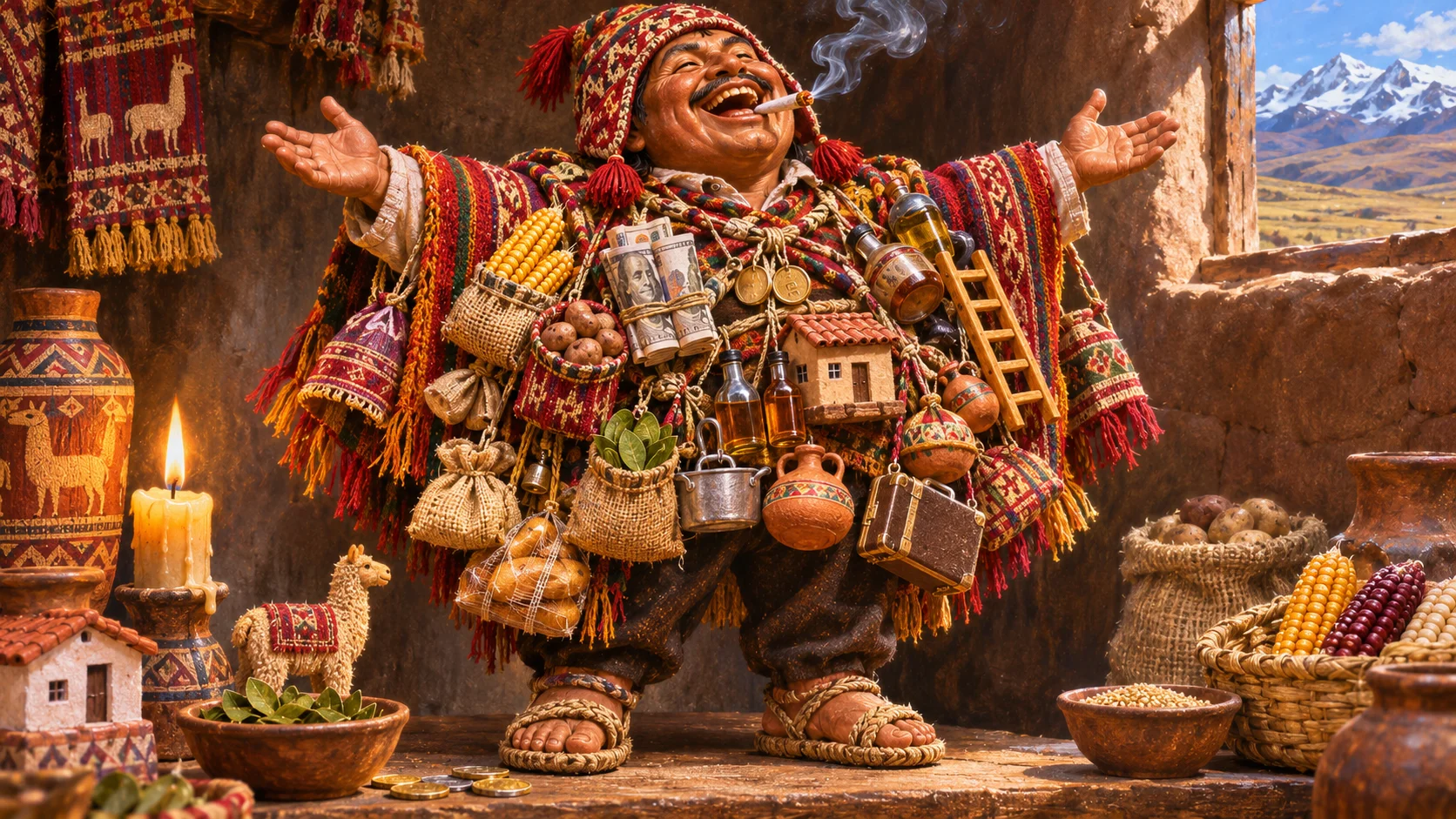
The offering is typically followed by a shared meal. In many households, a smaller form of the practice goes on all year: before drinking, a few drops go to the ground, often accompanied by words of greeting or thanks. On Shrove Tuesday, during Carnival, ch’alla is performed in some places on houses, shops and vehicles with confetti, alcohol and flowers, which shows how the gesture of giving to the earth has been adapted to modern objects.
Pachamama and the Virgin Mary
A question that has been argued for a long time is the relationship between Pachamama and the Virgin Mary. A common view, found in many popular summaries, is that the Andean people, forbidden to worship their own earth, covered her with the figure of the Virgin, so that devotion to Mary became a mask for devotion to the earth. Some ethnographers have noted an association between Pachamama and particular images of the Virgin, such as the Virgin of the Candelaria in the Titicaca region, and the Jesuit anthropologist Manuel Marzal, who studied Andean Catholicism in Peru, described a religious world in which saints, mountains and the earth are addressed in overlapping ways.
Other scholars warn against reading this as a simple equation. The comparison of the earth with a mother is easy to make from outside; whether Andean participants themselves regard the two as one being, or as two beings that they honour in different contexts, varies. In many communities people say plainly that Pachamama is not the Virgin, that the earth is addressed with her own offerings and that the Virgin belongs to the church. In others the lines are blurred, and a person may pray in church and make an offering to the earth in the same week without any sense of contradiction. Modern Andean Catholicism, in which saints, mountains and the earth are often addressed in the same ritual vocabulary, does not fit neatly into the categories of pure survival or pure conversion. The word syncretism is widely used for this, though some scholars now prefer to speak of coexistence or of a local Christianity with Andean forms.
The Catholic hierarchy’s response has varied over time: from the extirpation campaigns of the seventeenth century, through periods of tolerance, to more recent statements. In October 2019, during the Vatican synod on the Amazon, carved wooden figures of a pregnant woman were displayed at a ceremony in the Vatican Gardens and in a nearby church, Santa Maria in Traspontina, and were widely labelled “Pachamama” in the press. On 21 October some of the figures were taken from the church and thrown into the Tiber. Speaking on 25 October as Bishop of Rome, Pope Francis asked forgiveness of those who had been offended by that gesture, and the figures were recovered. The identity and meaning of those figures was disputed: Vatican spokesmen described them as symbols of life and fertility, critics called them idols, and observers pointed out that Pachamama is a figure of the Andes and not of the Amazon basin. It is an episode that shows how the name still carries weight beyond the Andes.
Rights of the earth: Ecuador and Bolivia
In the early twenty-first century, Pachamama became a reference point in constitutional and legal texts. The Ecuadorian Constitution of 2008, approved in a referendum in September 2008 by a large majority, mentions “Pacha Mama” in its preamble and, in the chapter on the rights of nature, states in Article 71 that nature, or Pacha Mama, where life is reproduced and occurs, has the right to integral respect for its existence and for the maintenance and regeneration of its life cycles. It was the first national constitution to give nature legal rights, and it also gave citizens the standing to defend those rights. The text is bound up with the Kichwa concept sumak kawsay, usually translated as good living or buen vivir.
In Bolivia, the Plurinational State’s constitution of 2009 refers to Pachamama in its preamble, and in December 2010 the legislature passed the Law of the Rights of Mother Earth (Law 71), which lists rights including the right to life, to the diversity of life, to water, to clean air, to equilibrium, to restoration and to freedom from contamination. A broader framework law followed in 2012. Bolivia also promoted the United Nations resolution, adopted in 2009, that designates 22 April as International Mother Earth Day.
These texts have been welcomed by many and criticised by others. Commentators have noted that the actual meaning of the rights of nature is still contested, with different groups in Ecuador reading the provisions in different ways. Critics, including some indigenous organisations and environmentalists, have pointed to the gap between the language of the constitutions and policies of resource extraction in both countries. In Ecuador, a proposal to leave oil in the ground in the Yasuní region was abandoned by the government in 2013; in Bolivia, the conflict over a planned highway through the TIPNIS indigenous territory in 2011 became a symbol of the tension. Pachamama is above all a highland Andean figure, and some observers have asked how well her name fits a whole plurinational state that includes lowland peoples with their own ideas of land and forest. The question of whether a legal personification can honour an Andean relationship, or only borrow its name, is one that Andean writers themselves debate.
Modern practice, tourism and new forms
Alongside community practice, there are newer forms. Political leaders have invoked the name; for example, a ceremony was held for the Peruvian president Alejandro Toledo at Machu Picchu in July 2001, the day after his swearing-in, in which Andean ritual specialists called on the sacred powers of the place. Among urban mestizo and white people in the Andean countries, and among visitors from elsewhere, a New Age practice has grown up around her, and travel agencies offer participation in offerings at Inca sites. Some Andean specialists and community members welcome the interest; others are critical of the commercialisation of rituals, and of the idea that a ceremony conducted for a paying visitor stands in the same relation to the earth as one conducted by a family on its own land. These debates are part of the living tradition, and should not be treated as a corruption of an original pure form: the practice has been changing for as long as it has existed.
Kindred figures
Pachamama belongs to a set of Andean beings who take the title mama. Her kin include Mama Cocha, the mother of the sea and lakes, Mama Sara, the mother of maize, and Mama Quilla, the moon. Alongside her stand the apus, the lords of the mountains, and the wak’as, the sacred places and objects that the Inca identified across the landscape. The Inca state had its sun and creator; the people of the villages kept their earth and their mountains, and what is called Pachamama today draws on those many local relationships. In some modern narratives she is paired with the sun, Inti, as a complementary couple, though this arrangement belongs more to modern interpretation than to the sixteenth-century chronicles.
A closing reflection
To describe Pachamama as a goddess is accurate and incomplete. She is, for those who honour her, a relationship: the ground one walks on, the field one works, the source of food, the place to which one is returned. The sources show a figure that was perhaps less prominent in the Inca court than later writing implies, and that was transformed by colonial rule and the long history of the Andean peasantry. What can be said without hedging is that every August the ground is still fed, in small ways and large, by people who understand themselves as owing it something, and that this practice has outlasted the empire, the extirpators and the legal reforms that borrowed her name.
Sources & traditions
- EncyclopediaWikipedia — Pachamama
- TraditionIncan texts, oral tradition and village tellings (Andes)
Myths change from area to area and from time to time. This chronicle follows the most widely told versions; tellings in other villages, regions and eras may differ.