Mama Sara, the “Maize Mother,” is the name the Andes gave to the living spirit of maize: the power that makes a field of corn rise, ripen and renew itself from one year to the next. She appears in the colonial record not as a throned goddess of the Inca state but as something humbler and more intimate, a bundle of ears dressed in women’s clothing, a granary tended through a night-long vigil, an oddly doubled cob kept in a household. The sources are few, written by outsiders and often hostile, and a careful account has to say so. What they do show, from several directions at once, is that maize was understood in the Andes as a being with a mother, and that the mother had to be fed, clothed and kept well.
Name and etymology
The name joins two ordinary Quechua words. Sara is maize, and mama is mother, a word used for women of standing and, in religious language, for powerful female beings: Mama Quilla, the moon, Mama Cocha, the sea or lakes, Pachamama, the earth. In the Spanish of the sixteenth and seventeenth centuries the maize word was spelled with a z, which is why older books write zara, Zaramama or Zara-mama, and why modern writers use Mama Sara, Mama Zara and Saramama more or less interchangeably. They are one name in different spellings, not different goddesses.
It matters that the “mama” element is not unique to maize. The same source tradition names a quinoa-mother, a coca-mother and a potato-mother, so the Maize Mother belongs to a general Andean idea: that each cultivated plant has an animating mother-being, rather than to a single goddess of agriculture standing over all of them.
What the sources say, and how far they can be trusted
There is no Inca-written account of Mama Sara. The Inca had no alphabetic writing, and everything we have about her was set down by Spaniards, or by Andean authors working inside a Spanish world, decades after the conquest. Two kinds of writing carry the evidence.
The first is the natural-history and ethnographic tradition. The Jesuit José de Acosta, writing in his Historia natural y moral de las Indias (1590), describes a rite of the pirua (in book five, chapter 28, of the edition Frazer used). The fullest English summary most readers meet is the one in James Frazer’s The Golden Bough, which paraphrases Acosta and then adds a short list of Peruvian “mothers” of useful plants. Frazer was a comparativist of the late nineteenth and early twentieth century, interested in showing that harvest customs across the world shared one logic of a spirit that is killed and renewed. That framework is his, not the Andes’. His summary is useful as a pointer to the older Spanish text; it should not be taken as Andean theology.
The second kind is the literature of the campaigns of “extirpation of idolatry” in the early seventeenth century. Pablo José de Arriaga, a Jesuit, published his Extirpación de la idolatría del Perú in 1621 as a manual for priests hunting what they regarded as surviving idolatry. Such a text records the objects the visitors confiscated and the practices they punished. It is invaluable and it is a prosecutor’s file: it describes belief from the point of view of those who intended to destroy it, and what people said under inspection was shaped by what they knew the inspectors wanted.
A third caution concerns the later retellings. Popular compilations of Inca “gods” often present Mama Sara as one of a trinity of mother-goddesses with the earth and the sea, or give her a youthful, serene appearance, or compare her to Demeter and Ceres. None of that appears in the colonial sources I could trace. It is the work of modern mythographers arranging a pantheon, and it should be treated as such.
The dressed maize and the pirua
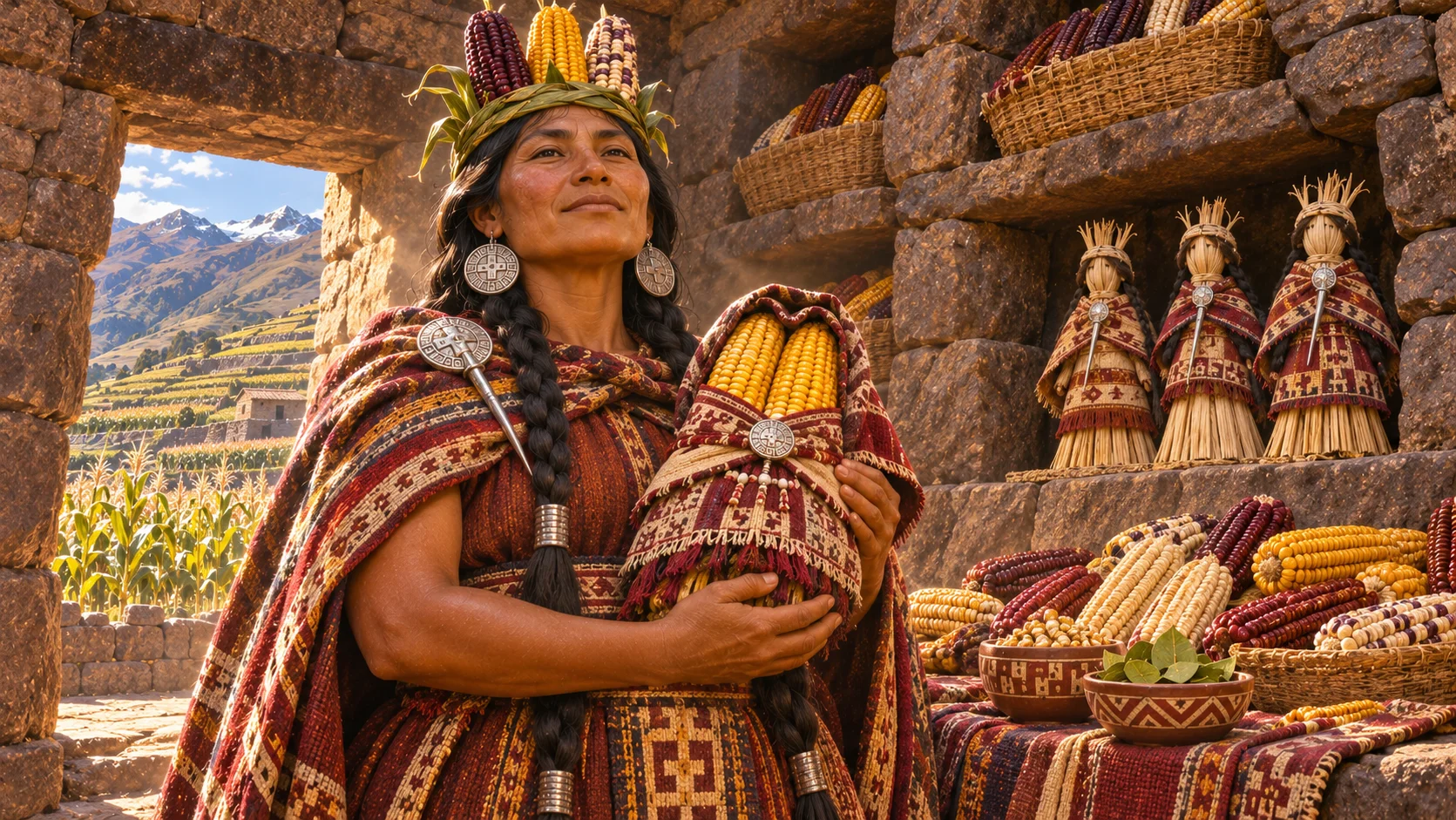
The most concrete description is Acosta’s account of the pirua, as Frazer relays it. At the harvest, people took a portion of the most fruitful maize from their fields and placed it in a granary called a pirua, with certain ceremonies and a watch of three nights. The stored maize was dressed in the richest garments the household had and, in Acosta’s word, worshipped as the mother of the maize; the English translation also calls those who questioned it “witches,” the hostile label of an outsider for ritual specialists. Acosta says the custom was widespread and continued in his own day: in the English paraphrase, it was very common among the Indians to have these piruas.
The cycle that followed is the part that explains the whole. In the sixth month, which Frazer’s English text glosses in square brackets as May (the gloss is Frazer’s own, so the month is best taken as approximate), the keepers asked the pirua whether it had strength enough to last until the next year. If the answer was that it did not, the maize was burned on the farm and a new pirua was made with the same ceremonies. If it was strong, it stayed until the following year. The logic is plain even through the hostile retelling: the seed-mother has to be sound, because the next crop descends from her. A weak mother is retired and replaced so that the seed of maize may not perish.
Frazer suggested that Acosta had confused the granary with the thing worshipped, and that the object of worship was the dressed bunch of maize and not the building. That reading is plausible and it is also an inference by a reader three centuries later, so it is worth holding loosely. What can be said safely is that the sources describe a portion of the harvest, singled out and clothed, kept through the year and consulted about its own vigour.
Frazer then turns to a second line of evidence. The Peruvians, he writes, believed all useful plants to be animated by a divine being, and he names the Maize-mother (Zara-mama), the Quinoa-mother (Quinoa-mama), the Coca-mother (Coca-mama) and the Potato-mother (Axo-mama). Figures of these mothers, he says, were made of ears of maize and leaves of the quinoa and coca plants, dressed in women’s clothes and worshipped, and the maize figure was a puppet of stalks in full female attire which people believed, as a mother, had the power of giving birth to much maize. His footnote shows how long the chain is. The list reaches him through the German folklorist Wilhelm Mannhardt, whose authority is a pastoral letter of Archbishop Pedro de Villagómez printed in Lima in 1649, itself partly based on Arriaga’s Extirpación of 1621. Frazer also consulted Arriaga’s book himself in the British Museum and prints its page 16 in Spanish. So Arriaga, not Acosta, is the real primary source for the plant-mothers, and the page Frazer prints names maize-mothers, coca-mothers and potato-mothers; the quinoa-mother comes through the later letter.
Strange cobs and the logic of the unusual
The strand about found rather than made figures is documented in Arriaga himself. On page 16 of the Extirpación, as Frazer prints it, Arriaga says that zaramamas are of three kinds and are among the things found in the villages. The first is a doll made of maize canes, dressed like a woman with her anaco (wrap-around dress), her lliclla (shoulder cloth) and silver pins, and people understand that, as a mother, she has the power to engender and bear much maize; coca-mothers are made the same way to increase the coca. The second kind are stones worked into the shape of cobs, with the kernels in relief, which people kept in numbers in place of household conopas. The third kind are fertile maize canes that bore many large ears, or two ears that come out joined together, and these, he says, are the principal zaramamas, revered as mothers of the maize. He gives such ears the names huantayzara or ayrihuayzara.
Arriaga adds details that show how the prosecutor understood the matter. People did not give this third kind the adoration owed to a huaca or a conopa, he says, but kept it “superstitiously” as a sacred thing. They hung such canes with many ears from willow branches, danced with them the dance called ayrihua, then burned them and made an offering to a being he calls Libiac, asking for a good harvest. He mentions too the strangely painted ears and the ears whose kernels climb in a spiral instead of straight rows (micsazara, piruazara), which people placed in the heaps of maize and in the piruas to guard them, and potatoes found growing together, called axomamas and kept for a good potato crop. So the doubled cob is not a modern embellishment: it is the colonial record’s most explicit form of the maize mother. Frazer adds a report from Bolivia by the explorer Erland Nordenskiold (1903): at Tarija a cross was set up at harvest in the maize fields and twin-eared spikes were hung on it, called Pachamamas and thought to bring good harvests.
The wider principle in which such a belief sits is easy to state. Colonial writers explained the Quechua word huaca as applying to anything out of the ordinary: a striking rock, a spring, a mountain, an unusual birth, a thing that did not follow the common run of its kind. An ear of corn that departs from the pattern would, in that vocabulary, be exactly the sort of object that marks a place where the sacred has shown itself. Arriaga’s page shows the principle at work on the cob itself.
Maize in the Andean world
To see why the Maize Mother mattered, it helps to remember what maize was. It was domesticated in Mexico and reached the Andes long before the Inca, and in the high valleys around Cusco and the warmer valleys below them it was grown on irrigated terraces whose remains are still visible. Under the Inca state it became a crop of political weight. It was stored in the state storehouses, the qollqa, which survive as rows of stone buildings on hillsides above Cusco and above provincial centres, and it was brewed into aqha, the maize beer, which the state served in enormous quantities to labourers, soldiers and guests and which was poured out in offering to the sacred beings of the landscape.
Maize was therefore at once a food, a drink, a tribute good and an offering. A mother-figure for the plant sits naturally inside that economy. The household pirua and the state storehouse were two scales of the same concern, which was to hold back a portion of the harvest, protect it and keep faith with the source of next year’s seed.
The ritual calendar
The harvest of maize fell, in the Cusco region, around April and May. The Andean chronicler Felipe Guaman Poma de Ayala, in his illustrated letter to the king, listed the months of the Inca year with their agricultural tasks, and his May is aymuray quilla, the harvest month, which his text glosses as the time of reaping and heaping up the maize (it also gives the month a second name, hatun cusqui). Chroniclers do not agree on which month fell where, so the match is approximate, but Acosta’s sixth-month question to the pirua falls, on Frazer’s gloss, in the same season, and it is reasonable to read the two as describing the same moment: the harvest is in, the seed-mother is chosen and dressed, and the household takes stock of its strength for the coming year. Planting followed in the months from about August, when fields were opened and offerings made to the earth and the mountains. The Maize Mother thus stood at the hinge between the end of one agricultural year and the start of the next.
Suppression and survival
The campaigns that produced Arriaga’s book were not subtle. Inspectors entered villages, demanded that people name their huacas, seized household effigies, burned or displayed them in public, and punished those who were found to be keeping them. A dressed bundle of maize in a granary is exactly the kind of object that would have been taken and burned, and a custom that depended on households keeping a clothed bundle was easy to suppress where the inspectors were present and easy to continue where they were not.
What survived did so by changing form and by moving into the ordinary. Maize beer is still poured to the earth and to the mountains before it is drunk, and the first fruits and the best ears are still treated with a care that is more than practical. Frazer’s Tarija cross, hung with twin ears, shows a Christian symbol carrying the older idea, and in some regions the mother of the crops is spoken of as Pachamama, the earth, rather than by the name of one plant. I did not find, in the sources available to me, a detailed modern ethnography of rites specifically addressed to Mama Sara as a named being, and I will not invent one. What can be said is that the idea she names, that the crop is a family with a mother to be thanked, is alive in how maize is planted, shared and poured out.
Regional variation
The colonial lists are drawn from the central and southern highlands, where Quechua was spoken, and the pattern need not hold everywhere. Aymara-speaking communities of the Titicaca region had their own vocabulary and, at that altitude, grew less maize and more potato and quinoa, so the plant-mother most important to them differed. The coastal valleys, where maize was grown under irrigation long before the Inca, had other shrines and other names, and they were recorded unevenly. The Maize Mother of the books is the one Spanish writers happened to ask about in the highlands, and the rest is a silence rather than an absence.
Kindred beings
Mama Sara is best understood among a family of mother-beings. Pachamama is the earth that carries every crop. Mama Allpa appears in some modern lists as a related earth-mother, though I did not find her in the colonial sources I could read. Mama Cocha is the water of sea and lakes, and Mama Quilla is the moon, the regulator of the months. The sources also name the quinoa-mother, the coca-mother and the potato-mother. They are not a hierarchy so much as a household: each plant is somebody’s child, and each field is a place where the mothers of different crops are tended in turn. Related figures in the encyclopedia, such as Pachamama and Mama Cocha, are worth reading beside this one.
A closing reflection
The record of Mama Sara is small, and the smallness is part of what it teaches. She is not a deity of great temples and long hymns; she is attached to a granary and to a bundle of ears, to a vigil of three nights and a question put in May. Behind the colonial prose is a practice that is easy to understand: take the best of what the earth gave, dress it as one dresses a person one honours, keep it through the year, and ask whether it still has the strength to carry the seed. That the Spanish who described it saw only idolatry, and that the modern comparativist saw only a European harvest custom in other clothes, should not hide what the plain description shows, which is a people treating the plant that fed them as kin.
Sources & traditions
- TraditionIncan texts, oral tradition and village tellings (Andes)
Myths change from area to area and from time to time. This chronicle follows the most widely told versions; tellings in other villages, regions and eras may differ.