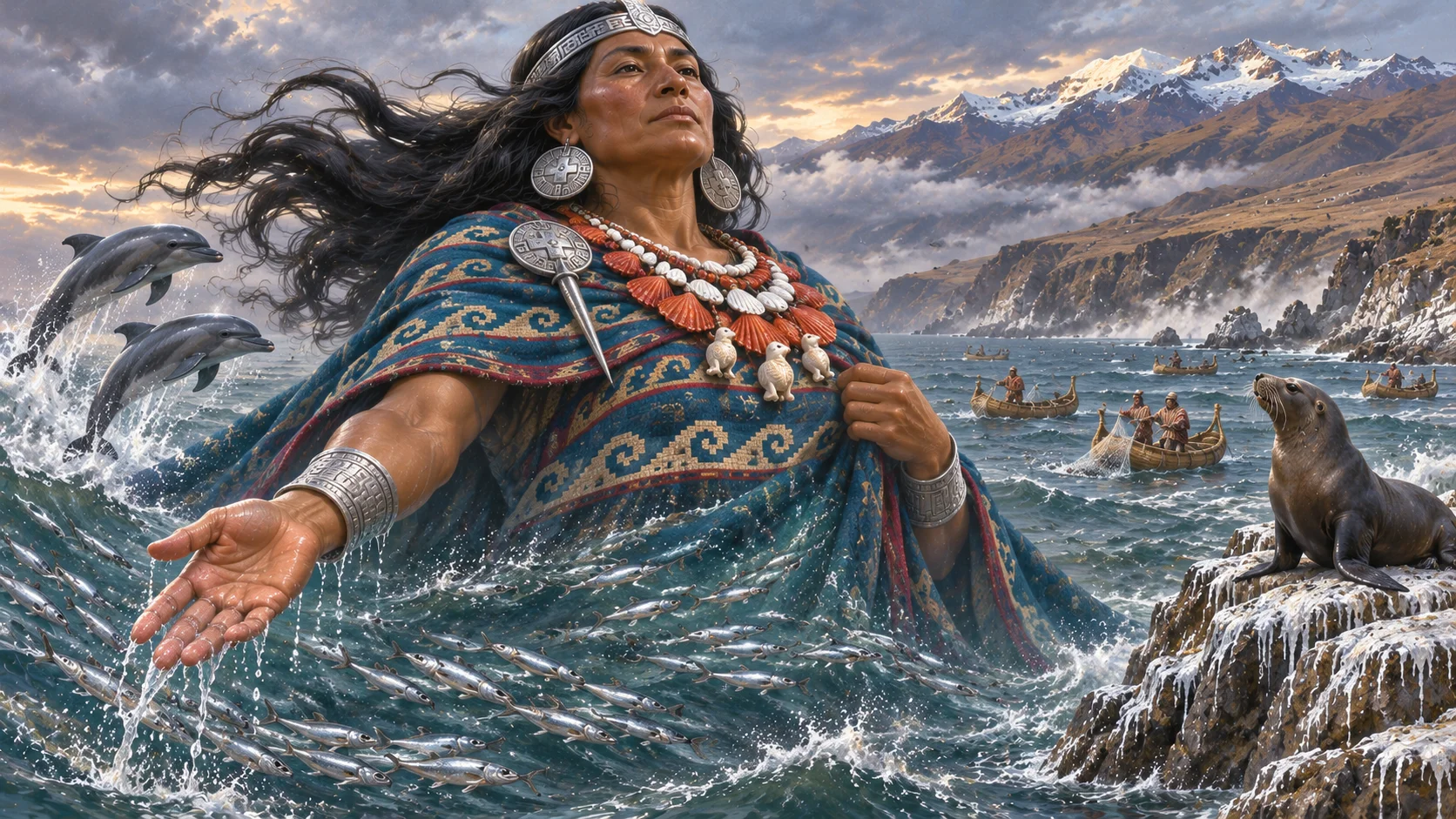
Mama Cocha, in the spelling of modern Quechua Mama Qucha, means “Mother Sea” or “Mother Lake”. The name is real, and early Spanish writers recorded that the peoples of Peru honoured the sea under it. Beyond that, the written record is very thin. The tidy portrait found in many modern handbooks, in which Mama Cocha is the wife of the creator Viracocha and the mother of the Sun and the Moon, cannot be traced to any early source that I could verify, and it should be treated as a late systematisation and not as a recorded Inca myth. This article therefore does something slightly different from most: it says plainly what the sources do and do not give, and it builds the rest from the documented world in which the name makes sense, the cold coastal sea, the lakes of the high Andes, the circuit of water through the sky, and the offerings that people made to water.
Name and etymology
The two elements are simple. Mama is “mother”, and in Quechua it is applied to many powerful beings and substances, as in Pachamama, Mama Quilla (the Moon), and the maize-mother called Sara Mama. Qucha, written cocha in the older Spanish spelling, means lake, pond or sea; the Quechua language did not need to separate them, and context decides which is meant. The name therefore does not by itself say whether a speaker is thinking of the Pacific or of a mountain lake. Spanish writers wrote “Mamacocha” as one word, and some later authors use “Cochamama”, with the elements reversed, a form that appears in encyclopedias and not, as far as I could find, in the early texts.
There is a further, quieter hint in the language. The name of the creator, Wiraqucha or Viracocha, contains the same word qucha. Its first element, wira, is usually glossed as “fat”, and the compound has been interpreted as something like “sea foam” or “lake fat”, though the meaning has been debated and no reading is certain. In the accounts of Cieza de León and Juan de Betanzos, Viracocha rises from Lake Titicaca to make the world. A link between the creator and the water therefore runs deep in the tradition, and it may be one of the reasons that modern writers have paired a sea-mother with him. But a verbal echo is not a myth, and the early sources do not give the marriage.
What the sources actually say
The key passages are short. The Jesuit José de Acosta, in his Historia natural y moral de las Indias (1590), notes among the objects of native worship in Peru the sea, which, he says, the Indians called Mamacocha, “mother sea”, comparing it to the Thetis or Neptune of the ancients. I could not confirm that he gives a reason for its honour, though the sea plainly fed the coast. Bernabé Cobo, whose Historia del Nuevo Mundo was completed in 1653 and drew on earlier writers, is usually cited for the idea that animals and birds, and in some summaries the creatures of the sea, had celestial counterparts that guaranteed their increase. That idea, that species on earth have their heavenly prototypes, is well attested in the Cusco sources, and it is far more informative than any biography of a goddess.
Other writers add scraps. The Augustinian Antonio de la Calancha (1638) writes about the northern coast, where the Chimú and their neighbours spoke the Mochica language, and records that the sea and the Moon received worship there, giving a Mochica-language name for the sea, Ni. I treat these names as reported by one colonial author and not as confirmed. The Inca Garcilaso de la Vega, writing in Spain in the early 1600s, mentions the sea and the offerings of the coast but is mostly concerned with the Sun. The extirpators, Pablo José de Arriaga and his colleagues, list lakes and springs among the places where native people still gave offerings in the early seventeenth century.
It is important to say what is missing. There is no extended narrative of Mama Cocha in the chronicles. There is no description of her image, no named priesthood, no Cusco festival devoted to her, and no confirmed place for her in the Qorikancha. The Huarochirí Manuscript, the Quechua text of about 1608, contains the richest sea-related story that I know of, which I discuss below, but it does not use her name in the way the handbooks suggest. Anyone who gives a detailed life story for Mama Cocha is working from sources I cannot see.
Why the sea mattered: the cold current and the coast
The significance of the sea on the Peruvian coast is not a matter of speculation. The Humboldt, or Peru, Current brings cold, nutrient-rich water north along the coast, and the result is one of the most productive marine environments on earth. For several thousand years before the Inca, coastal communities lived on anchovy, sardine, shellfish, sea lions and the birds that fed on them, and farmed the narrow river valleys that cut across the desert. A mid-sixteenth-century inquiry into the Chincha valley, south of Lima, recorded the lord of Chincha’s subjects as divided into farmers, fishermen and merchants; the figures usually quoted are about 12,000 farmers, 10,000 fishermen and 6,000 merchants (some summaries give 10,000 farmers), a Spanish record of native estimates that I would not rely on as a census, but the three-way division is itself informative. The fishermen of Chincha had, according to a colonial record, a patron of their own, discussed below.
The state also had a stake in the sea. Garcilaso reports that the Inca protected the seabirds of the guano islands, forbidding anyone to land on them during the breeding season on pain of death, and that the guano was carried to the fields as fertiliser. The detail comes from a writer who often idealised the Inca, so it should be treated as an indication of the importance of the guano rather than as a legal citation, but archaeology and later agricultural history confirm that seabird manure was a prized resource of the coast. The sea, in short, fed both the fishermen and the farmers, and a reverent mother-name for it needs no more explanation than that.
A sea mother in the Huarochirí story
The nearest thing to a sea-goddess story in the Quechua sources is in the Huarochirí Manuscript, and it concerns a woman who is not called Mama Cocha. In the second chapter, the trickster-creator Cuniraya Viracocha pursues Cavillaca, a woman who bore his child, and the two end at the coast, where she and the child enter the sea and become rock islands. Cuniraya then comes to the house of Urpay Huachac, whom the text names as the wife of Pachacamac, who raised fish in a small pond. In the versions of the story summarised by modern commentators, at that time there were no fish in the sea. Cuniraya, in anger, upends the pond and pours the fish into the ocean, and from them come all the fish that live there. The name Urpay Huachac is commonly read as something like “she who gives birth to doves”, though the reading is a scholar’s gloss.
A colonial record from Chincha mentions a sacred object called Urpai Guachac, apparently a place or an island, as the guaca of the fishermen. I could not read the original document, so the link between the Huarochirí figure and the Chincha guaca is reported by secondary writers and should be regarded as plausible rather than proven. If it holds, it gives something precious: a local sea-mother figure, tied to fish and fishermen, with her own story, whose name is not Mama Cocha. That is a reminder of how the pan-Andean “Mama Cocha” of the handbooks may be a Spanish and Cusco-centred umbrella over a variety of local powers.
Water in the sky
If the sea has a place in the high Andean cosmos, it is in the circuit of water. The ethnographer Gary Urton recorded in the Cusco-region community of Misminay in the 1970s that the Milky Way is a river, mayu, and that it is understood as carrying water from the sea to the sky and back down. A llama-shaped figure within the dark clouds of the Milky Way, called Yacana, is said to drink the ocean at the horizon so that the world is not flooded. This is modern fieldwork and not an Inca source, but it fits the Cusco chroniclers’ picture of Illapa the thunder breaking a jar of the sky’s water, and it gives a reason why a mountain people, living far from the coast, could consider the sea the mother of their rain. The sea is not distant; it is the origin of the rain that waters their fields.
That idea appears to be what some modern writers mean when they say that Mama Cocha is identified with rainwater, or that the Inca understood the water cycle. The statement is probably true in outline, as an account of how Andean people describe the cycle today, but it should not be read back into Cusco state theology as a documented doctrine.
Lakes, springs and offerings
The word qucha also names the lakes of the highlands, and these have a better record than the sea. Lake Titicaca was the origin place of the Inca in several accounts and one of the greatest shrines of the empire, centred on the Island of the Sun. Underwater archaeology around the island, including work on the Khoa Reef, has recovered Inca-period offerings, among them small figures of gold and of the red-orange Spondylus shell, deposited in stone containers on the lake bed; this is the best material evidence we have for formal offerings to a body of water in the Inca period. It does not name Mama Cocha, but it shows how seriously water was approached.
The Spondylus shell, called mullu, is the other thread. It comes from the warm waters off Ecuador, and was carried through the Andes by traders from the coast for more than a thousand years before the Inca. Ground to a powder or offered whole, it was the preferred gift for water, for springs and for rain, and Inca ritual burials on high mountains frequently include small figures of it. Modern studies cite Polo de Ondegardo and other early writers for the offering of shell, whole or ground, to springs, rivers and the sea; I could not check the passage in Polo himself. Encyclopedic summaries say that streams and springs were thought of as daughters of the sea and honoured with shells; I could not trace that formulation to an early text, but the practice of offering mullu to water is well documented.
Colonial reframing
The Spanish had little interest in a goddess of the sea. Their concern in the coastal towns was the destruction of the great shrines of the oracle at Pachacamac and the suppression of the cults of the huacas, the sacred places that included rocks, springs and islands. The sea itself could not be removed, and fishing continued; the coastal peoples were reduced by epidemic disease and tribute, and their old rituals were absorbed in part into the cult of the saints. Christian patrons of fishermen, such as San Pedro, whose feast of 29 June is celebrated with boats and processions in Peruvian fishing communities, now carry the protective role. Whether these processions preserve any old practice is a question that has to be answered community by community, and I could not verify a continuous line.
There was also a second, quiet change. By treating “Mama Cocha” as a goddess in the Greek or Roman sense, with a husband, children and a seat on the council of the gods, Spanish and later European writers made a figure that fits a Mediterranean pantheon. The Andean pattern, in which the sea is a powerful mother to be addressed and fed but which has no biography, was easier to describe once it was dressed in a family tree.
Modern practice
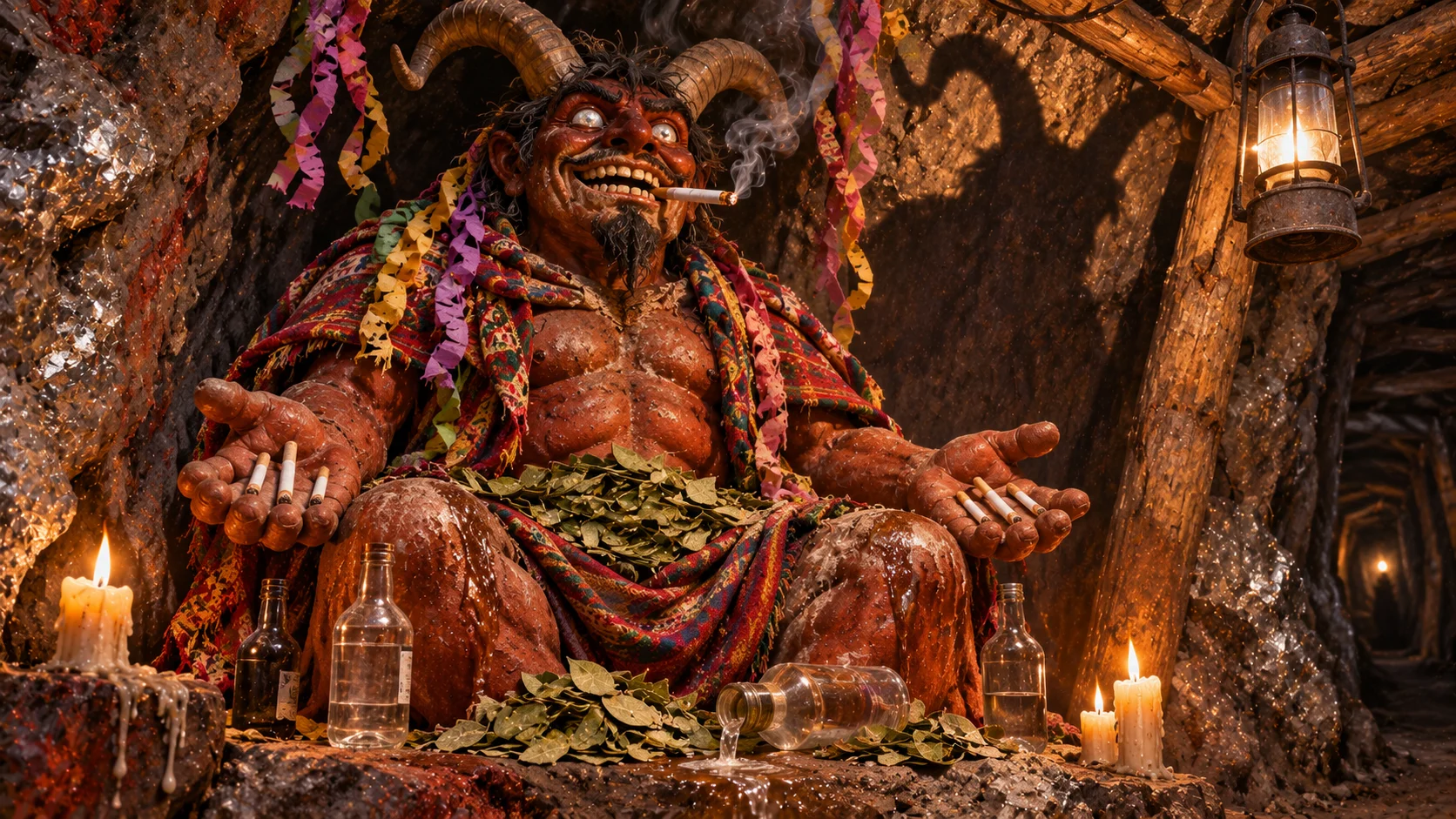
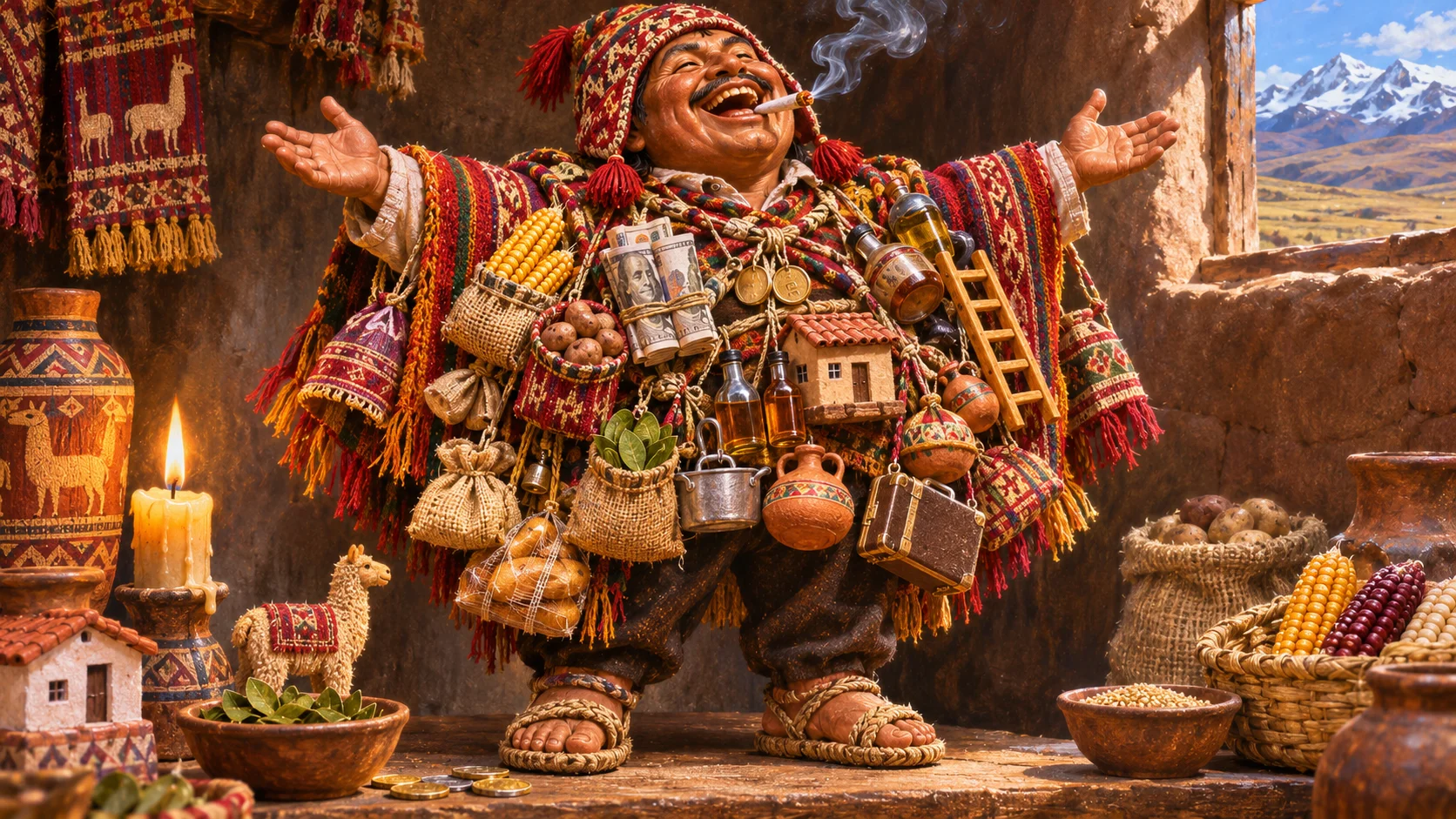
Water is still addressed in the Andes. Communities across the highlands make payments, pagos or despachos, to springs, lakes and mountains, usually at the opening of the agricultural year, with coca, alcohol, sweets, llama fat and other offerings, and many lakes carry the name Mamacocha or Mama Qucha on modern maps. Ethnographers have recorded offerings to lakes in communities of the southern highlands, often in the dry season before the rains. For the sea itself I could not verify a detailed modern ethnography; I would not claim that an organised cult of the Pacific as Mama Cocha exists among present-day coastal fishermen. What does appear, in fishing towns, is a tradition of blessing boats and nets within the Catholic calendar. A reader who wants to say more should look for local studies from communities on the coast, and not assume that practice in the highlands is a model for it.
Kindred powers
Mama Cocha belongs with the other “mothers” of Andean thought: Pachamama, the earth; Mama Quilla, the Moon, whom Cusco writers describe as a patroness of women; Mama Sara, the maize; and Mama Allpa, who is also linked to the ground and its fertility. Among the male powers, she stands alongside Viracocha, whose name contains her element, and Illapa, who pours the water from the sky. On the coast her place was filled by local huacas of fish, islands and the shoreline, and by Pacha Kamaq, who in Huarochirí is the husband of the fish-keeper Urpay Huachac.
A closing reflection
The sea mother of the Andes is a case where the fullest honesty is also the most useful. There is a name, a few lines from Spanish observers, a set of well-documented practices around water, and a cosmos in which the sea, the sky and the field are one circuit. There is not a family history. The Andean sea is addressed as a giver and feared as a danger, and the people who lived beside it appear to have needed no more than that. To restore a goddess with a consort and children would be to give back less than the evidence supports, and to add what it does not.
Sources & traditions
- EncyclopediaWikipedia — Mama Qucha
- TraditionIncan texts, oral tradition and village tellings (Andes)
Myths change from area to area and from time to time. This chronicle follows the most widely told versions; tellings in other villages, regions and eras may differ.