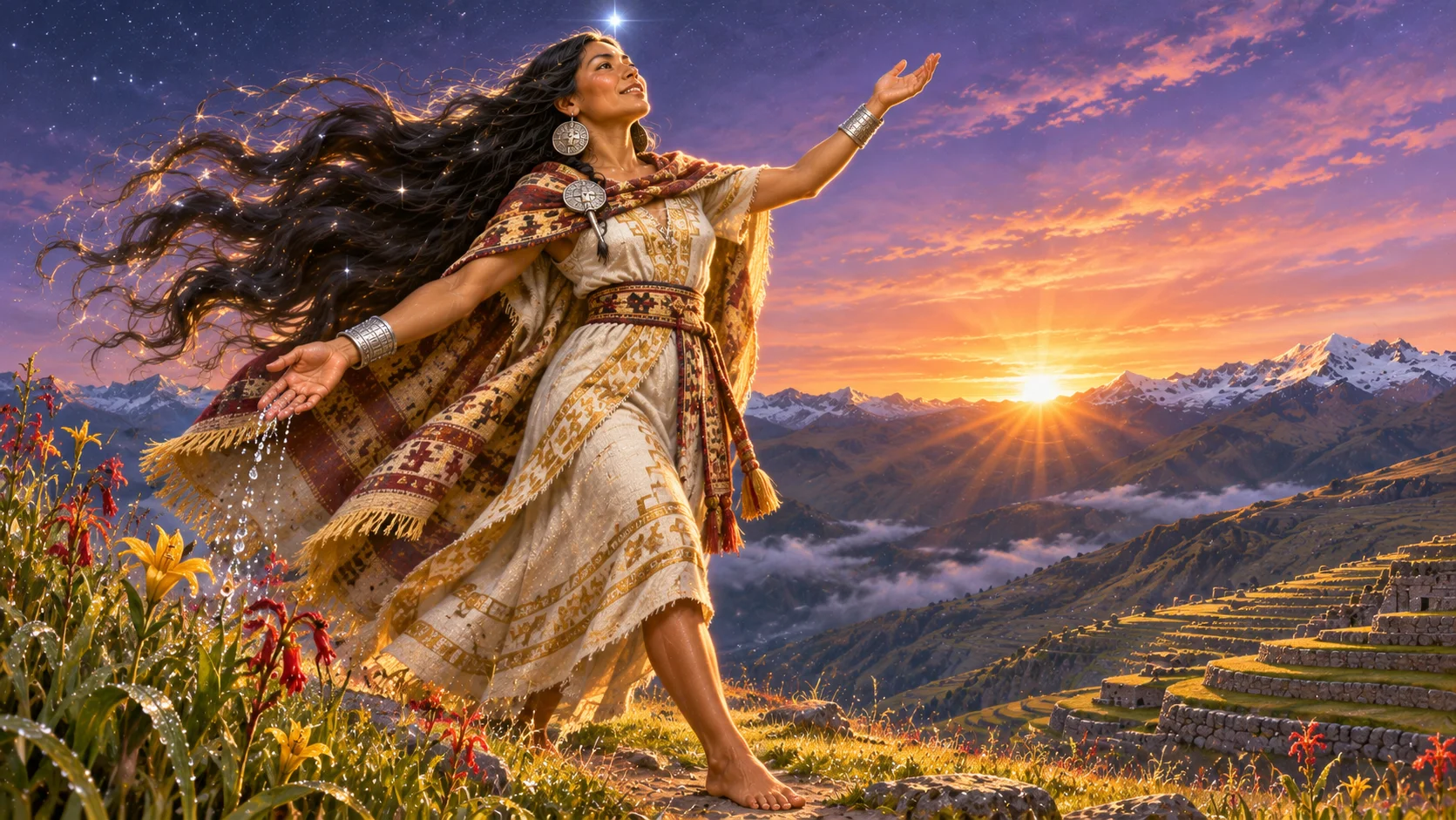
Chasca, in modern Quechua spelling Ch’aska, is the Quechua name for the planet Venus, the brightest point of light in the Andean sky after the sun and moon, seen low in the east before sunrise and low in the west after sunset. The name carries a second meaning, tousled or long, curling hair, and Garcilaso, the one colonial writer I could read who explains it, says that the Inca honoured the planet as the page of the sun, because it travels closer to him than any other star. That, with one or two details, is nearly all that the early sources say with confidence. Around it modern books have built a goddess of dawn, dew, flowers and young women. This article separates the two: what the chroniclers actually report, what the sky itself offers, and what later writers have added.
Name and etymology
In Quechua ch’aska (older Spanish spellings include chasca and chaska) is both a word for a star in the sense of a bright, shining body and the proper name of Venus. It also names dishevelled, long or curly hair. Garcilaso glosses the name as “of long and curly hair” (see below), which agrees with the modern word. He does not say why the planet should be so called; the idea that Venus’s rays resemble loosened hair is a natural reading offered by modern writers, and I did not find it in the colonial text. Diego González Holguín’s Quechua dictionary of 1608 is the early lexical source one would consult for the word, but I could not read its entry for ch’aska, so I do not rely on it here.
An ordinary Quechua word for a star in general is qoyllur (also spelled quyllur). Today Chaska is also a woman’s given name in Quechua-speaking regions, a quiet testimony that the word has stayed in use as a name for something loved and bright.
The sources and how far they can be trusted
The best-known statement comes from Garcilaso de la Vega, called the Inca, born in Cusco in 1539 to a Spanish captain and an Inca noblewoman and author of the Comentarios Reales de los Incas (1609). I have read the passage in a Spanish edition. In his description of the Temple of the Sun at Cusco, Garcilaso says that one chamber was dedicated to the lucero Venus, to the Seven Little Goats (the Pleiades) and to the other stars in common, and that Venus was called Chasca, which he glosses as “of long and curly hair.” They honoured it, he writes, because they said it was the paje del Sol, the page of the Sun, who goes nearest to him, sometimes ahead and sometimes behind.
Several features of this statement matter. First, the figure is a page. The Spanish noun paje is masculine, though Garcilaso refers to the star with the feminine (“la estrella Venus,” “honrábanla”); he does not make Venus a goddess or a youth, and the gender in later summaries is the summarisers’ choice. Second, the source is a single colonial writer, famous but also writing in Spain long after the conquest, with a literary style and with an interest in presenting the Inca as an enlightened people. Third, the explanation of the name is that of a speaker of Quechua explaining his language to Spanish readers, so it deserves more weight than most.
The other chroniclers of Inca religion are less helpful on this figure. Juan de Betanzos, Cristóbal de Molina, Pedro Sarmiento de Gamboa, Juan Polo de Ondegardo and Bernabé Cobo (whose Historia del Nuevo Mundo, completed in 1653, is the largest single source on the religion of the Inca) write at length about the sun, the moon, the creator, thunder and the sacred places of Cusco. I found no passage in the secondary accounts available to me that gives Venus a named priesthood or a myth of its own. Garcilaso gives Venus a place, shared with the Pleiades and the other stars, in one chamber of the Sun’s temple, so a shrine “of its own” would overstate it. The sentence sometimes put in encyclopedias, that there was no temple or priesthood dedicated to Chasca, is unsourced in the places I saw it, and it is safest to say only that no separate cult is documented.
What the sky shows
The reason a Quechua-speaking watcher would single out Venus needs little explaining. It is the brightest planet and, at its best, bright enough to be seen in the daytime by a practised eye. Because its orbit lies inside the earth’s, it never strays far from the sun, so it appears either shortly before dawn or shortly after dusk. It cycles through morning and evening appearances, with a full return to the same configuration after about 584 days. It is lost in the sun’s glare twice in each cycle: for about a week when it passes between the earth and the sun, and for roughly two months when it passes behind the sun.
That behaviour fits the one thing the sources do say. A star that goes ahead of the sun at one season, and after it at another, and is never far from it, is naturally described as an attendant or page, and as a bright thing with rays like loosened hair. The idea of an attendant to the sun is not a mystical addition; it is a description of what the planet does.
Where Venus sits in the larger sky
Venus was one element in an Andean sky that was watched with great care, and the sky’s best-attested features were not the planets. The Milky Way, called mayu, the river, was the greatest feature of the night. Within and beside it, Andean observers recognised dark constellations made from the lanes of dust rather than from bright stars: a llama and her young, a toad, a fox, a tinamou bird and a serpent among them. These are known above all from the work of the anthropologist Gary Urton, who recorded them among the Quechua-speaking people of Misminay near Cusco in the 1970s, and who argued that their relationship to the seasons and to the water cycle gave them their meaning. His book At the Crossroads of the Earth and the Sky (1981) remains the starting point.
The other star group that mattered was the Pleiades, qollqa in Quechua (also spelled collca or qullqa), the storehouse. Garcilaso, in the same passage on the Sun’s temple, says the Inca respected the Seven Little Goats for the strangeness of their arrangement and the evenness of their size. The group disappears from the night sky for several weeks in the austral autumn and returns to the pre-dawn sky around June, and Andean farmers have long read its appearance at that moment as an omen for the coming rains and the planting. The best-known scientific study, by Benjamin Orlove, John Chiang and Mark Cane in Nature in 2000, found that poor visibility of the Pleiades in June, caused by thin high cloud associated with El Niño years, tends to precede reduced rainfall in the growing season, and that farmers who read the stars adjust the planting dates of their potatoes accordingly; the authors suggested that the traditional method rests on a real indicator of El Niño conditions. That is a modern measurement of an old observation, and it suggests that the Pleiades, more than Venus, did the practical work in the agricultural calendar.
It is useful, then, to keep three things apart. Chasca is a name for Venus, the planet, with a specific and well-evidenced place in the Quechua vocabulary. The Pleiades are a separate star group with a distinct role as a calendar and weather signal. The dark constellations of the Milky Way are a third system again. Much of the writing that treats all these as a single celestial pantheon blends sources recorded in different centuries and different valleys.
The page of the sun and the household of the moon
Many modern summaries say that Chasca attended both the sun and the moon. Garcilaso’s text is more precise. Venus is the page of the Sun. The Moon, whom the Inca called mother of the Incas and the sister and wife of the Sun, had a chamber of her own in the Sun’s temple, lined with silver, in which stood the bodies of dead queens. The next chamber, nearest the Moon’s, was dedicated to Venus, the Pleiades and the other stars in common, and the stars were held to be the Moon’s servants, because they are seen with her by night and not with the Sun by day. That chamber was hung with silver and its ceiling was set with stars great and small, like the night sky. Beyond it were chambers for lightning and thunder (Illapa) and for the rainbow, and a fifth for the priests.
Garcilaso was writing to explain the Inca to European readers, with a stake in showing them as reasonable, and he is the only source I could read for this arrangement. It should be treated as his account of a building he knew in ruins and in memory, not as a surveyed floor plan.
What the modern books add
Many popular lists of “Inca gods” credit Chasca with presiding over flowers and the dew, with protecting maidens and virgins, and with being a goddess of the gentle rains. These attributes do not appear in the chroniclers I could trace. They seem to come from a tradition of modern mythology handbooks that reasoned from the hair-like rays and the dawn hour, and from a European habit of making the planet Venus a patroness of beauty and love. The association of the Andean planet with flowers and with girls is therefore best treated as a modern elaboration, not as Inca doctrine.
The same caution applies to claims of ceremonies for Chasca at dawn or twilight. Dawn rites were certainly important to the Inca: they greeted the sun with offerings and with the gesture Garcilaso describes as kissing the air, a homage he compares to kissing a prince’s hand in Spain. That the morning star was part of those rites is plausible, and I did not find it attested.
Regional and archaeological variation
The Quechua name belongs to the Inca heartland and its language. The Aymara-speaking peoples of the Titicaca basin have their own names for stars and planets, and the older cultures of the coast and highlands, such as Moche, Nasca and Tiwanaku, left images of stars, celestial beings and sky serpents that were not recorded in Quechua. Whether any particular image represents Venus is debated, and I found no secure identification that I could cite. Interpretations of Inca buildings as aligned to Venus rising at particular places have been proposed by various authors, but astronomical alignment claims for Inca sites are contested, and I will not present any single one as established.
Suppression and survival
The astronomical observation of the Inca was not a quiet pastime but a part of the religion that the Spanish set out to eliminate. The mountaintop and stone markers from which the sun and stars were watched were among the shrines the visitors sought, and the ritual specialists who kept the calendar were among those the campaigns pursued. But the practical observation of the sky, because it was woven into planting and herding, was easy to continue under another name. Calendar knowledge, the star names and the dark constellations all survived in Quechua communities, and Urton recorded them in the twentieth century.
What does not seem to have survived in the same detail is a separate rite for Venus. The living star practice that scholars report is concentrated on the Pleiades and on the Milky Way. Ethnographers report that in some communities of the Cusco region a specialist observes the Pleiades before the planting of tubers and makes offerings to the mountain lords and the earth to decide when to plant; for such a community the star group is part of the same conversation as the mountains and the earth, and Venus is background.
Kindred figures
Chasca belongs with Inti, the sun, whose page she was; with Mama Quilla, the moon; and with the other celestial beings of the Cusco religion. Outside the Andes, the planet Venus plays very different roles: a warrior in Mesoamerican reckoning, a goddess of love in the Mediterranean, a morning star in Mesopotamian tradition. The Andean treatment is distinct in making the planet an attendant, a companion to the great light, and in naming it for its hair.
A closing reflection
Chasca is a reminder of how much of a religion can rest on a single sentence and a single name. The evidence says that a Quechua-speaking people looked at the brightest planet and called it the long-haired one, saw it travel with the sun, and spoke of it as the sun’s page. That is a precise and attractive piece of observation, and it needs no embroidery. The goddess of dew and virgins is a later portrait; the planet and its name, and the habit of watching it rise before the sun, belong to the Andes.
Sources & traditions
- TraditionIncan texts, oral tradition and village tellings (Andes)
Myths change from area to area and from time to time. This chronicle follows the most widely told versions; tellings in other villages, regions and eras may differ.