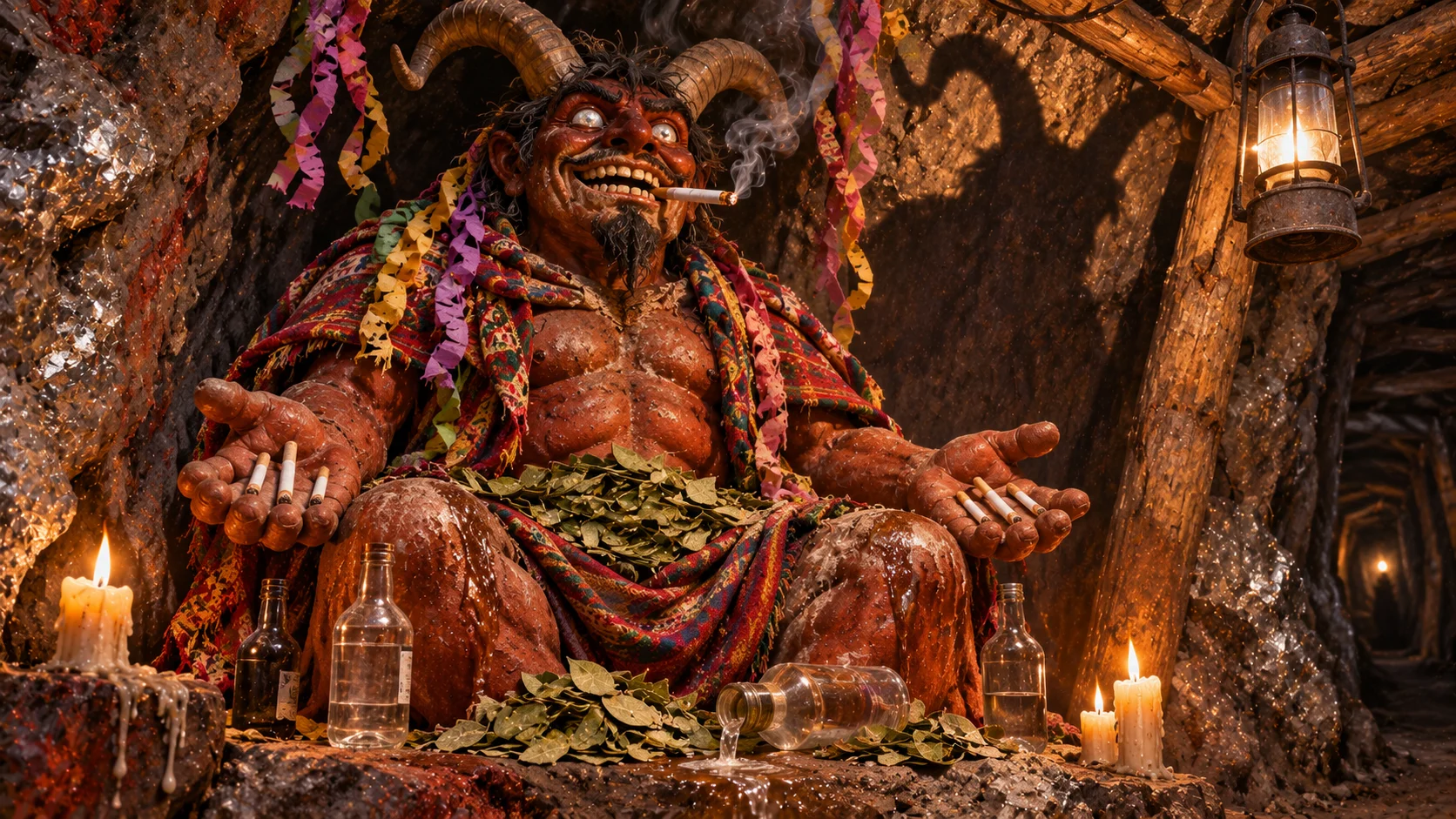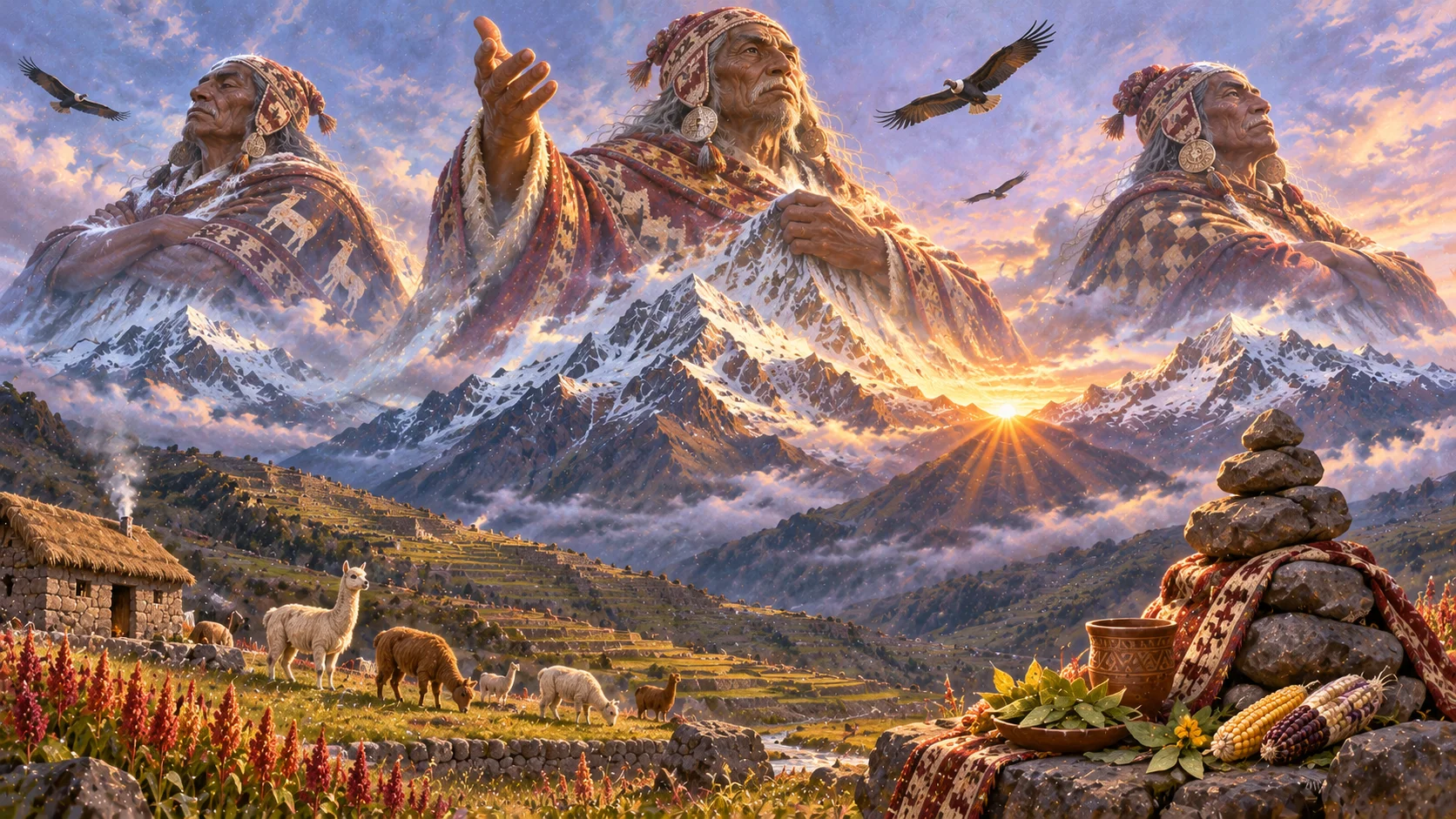
The Apu are the mountain lords of the Andes: the powerful living presences of peaks, ridges and sometimes single great rocks, who are thought to watch over the people and animals on their slopes, to control water and the fertility of fields and herds, and to repay or punish according to how they are treated. Unlike many figures in an encyclopedia of old religions, they are not a memory. People in the Andes still address them with offerings of coca leaves, alcohol and the fat of llamas, still name them before a journey or a planting, and still travel in their tens of thousands to the foot of the glaciers in their honour. A responsible account has to hold two things together: a long record, including archaeological evidence of the gravest kind, and a present that belongs to the people who live it.
Name and etymology
Apu is a Quechua word meaning lord, and in the language of the Cusco region it names a mountain spirit as well as a person of rank. In other regions the same being goes by other names: wamani (notably in Ayacucho), awki or awkillu in some regions, and in Bolivia achachila, mallku or machula, terms associated with grandfathers, lords and ancestors. Scholars disagree whether these names are simply regional labels for one Pan-Andean kind of being, or sometimes mark different ranks in a hierarchy. Some communities also speak more broadly of tirakuna, earth-beings, a term the anthropologist Marisol de la Cadena drew attention to in her work on the Ausangate region, which includes mountains, lakes and rocks among those who act in the world.
A question that is sometimes raised is whether the lordly sense of apu was a colonial coinage. The evidence I found does not support that. Apu as a title of rank for people is old Quechua; Spanish writers record it for Inca officials, and as far as I understand it appears in the early Quechua dictionaries, including González Holguín’s of 1608, as a word for a lord or chief (I could not check the entries myself). What is harder to date is the application of the word specifically to a mountain’s spirit. The sixteenth- and seventeenth-century Spanish writers more often speak of huacas, sacred places and beings, than of apus, and the detailed picture of apus as lords of named peaks comes mostly from modern ethnography. I did not trace a colonial text that applies the word apu to a mountain spirit, but I could not search the sources exhaustively either, so the date at which the word was first used that way is an open question rather than evidence that it was a colonial coinage. The honest statement is that the idea of powerful mountains is ancient, while the particular vocabulary of the apu is best documented in recent centuries.
Sources and how reliable they are
The oldest direct evidence is archaeological, and it is read through colonial writing that is hostile. The Spanish administrators and priests who described Inca religion, among them Juan Polo de Ondegardo, Cristóbal de Molina, Bernabé Cobo and, for the struggle against it, Pablo José de Arriaga, wrote either to catalogue or to condemn. Cobo’s long account, completed in 1653, is the nearest to a systematic inventory, and it records the Cusco shrines arranged along lines called ceques; Brian Bauer’s study of the Cusco ceque system counts some 328 huacas along about forty-one ceques. Mountains were among the most powerful of such places.
The Huarochirí Manuscript, compiled in Quechua around 1608 in the circle of the extirpator Francisco de Ávila (its author is unnamed), is a unique source because it records the beliefs of a highland community in their own language: it speaks of the mountain Pariacaca as a being with a history and a following. Its compiler was working inside the extirpation, and it should be read with that in mind, but it is the closest thing we have to an Andean voice on the sacred landscape. The modern accounts, from folklorists and anthropologists of the twentieth century onward, supply what the colonial documents leave out, and they are also the evidence on which the following sections largely rest.
Nature and attributes
Apus are the spirits of certain mountains, volcanoes and, in some places, single rocks. Anthropologists differ on whether the mountain is the dwelling place of the spirit, as some scholars put it, or is itself the apu, as others argue from what their informants say. They may be male or female, benevolent or dangerous, may have spouses and families, are often linked to condors, and are frequently regarded as ancestors. They are one kind of wak’a, a material manifestation of the sacred. In many accounts they form a hierarchy: a taller peak may issue orders to shorter ones, so that the authority over water and pasture runs from the great summits to the smaller hills.
Their roles are concrete. They protect those who live beneath them and can be called on by those farther away. They control the water that comes down from snow, the fertility of crops and animals, and the distribution of natural resources. If offended, they may send illness, accident or disaster. The relationship rests on ayni, the Quechua and Aymara principle of reciprocity: apu and people each owe the other, and the exchange of gifts is continuous. A community that neglects its mountain places itself out of balance.
Named lords
Hundreds of apus are named, and the lists are long. Ausangate, the great glaciated peak above the Cusco region of more than 6,000 metres, is regarded as one of the most important and is the one invoked first by many pilgrims; people ask it for good harvests, healthy livestock and guidance to good pasture, and its weather is read as a sign of whether it is pleased. Salkantay, another peak above 6,000 metres in the same region, is a major apu. Others named in the literature include Wanakawri and Pachatusan near Cusco, Machu Picchu and Huayna Picchu and Putucusi near the citadel, Coropuna, Ampato, Chachani and Solimana in Arequipa, Huascarán in the Cordillera Blanca, and in Bolivia Illimani, Illampu and Tunupa. Several of these names are contested or vary by speaker, and an apu can have a different name for people on its different sides.
The record of the Inca and earlier peoples
Veneration of mountains is very old in the Andes, and the Inca were heirs to it rather than its inventors; archaeologists have found evidence of earlier ritual attention to mountains and high places, though which peoples addressed which peaks, and under what names, is often uncertain. The Inca built shrines, buildings and terraces at such sites, which helped them claim the power of the land and control access to sacred space.
The gravest form of offering was the capacocha, in which children and young people, chosen for their perfection, were taken from the provinces to Cusco and then sent to mountain summits to be given to the sacred beings. The finds on high Andean peaks are among the best-documented evidence of Inca religion. In 1995 a young girl, called Juanita, was found on Ampato in southern Peru by Johan Reinhard and Miguel Zárate; in 1999 three children were found on Llullaillaco, on the Argentine-Chilean border, at about 6,700 metres, by Reinhard and Constanza Ceruti, at one of the highest archaeological sites in the world. The bodies were preserved by the cold and were accompanied by small gold, silver and shell figurines and fine textiles. Scholars discuss why such sacrifices were made, whether to request water for irrigation, to seal political bonds or to claim legitimacy for the state, and the record does not decide the matter. These were children, and in modern Andean communities there is also a reasonable debate about whether their remains should be exhibited.
Rites and offerings
The practice that is most widely described today is the pago or despacho, a payment or dispatch to the mountain. A ritual specialist, called a paqo in Cusco or an altomisayoq in the more elaborate ranks of the tradition, arranges a bundle of offerings that may include coca leaves, llama fat, sweets, flowers, sugar, alcohol and sometimes cigarettes, wraps them in paper, and then burns or buries them while naming the mountains. Blowing across fanned coca leaves, called a k’intu when three leaves are held together, carries a prayer to the apu. Travellers at passes add a stone to a cairn, an apacheta, and sometimes a little coca or a mouthful of maize beer. A portable altar, a mesa, holds stones and shells that carry the force of mountains and lakes.
In the Cusco region, ethnographers report that specialists watch the Pleiades before the planting of tubers and make offerings to the mountains and the earth to decide when to plant (the article on Chasca describes the scientific study of this practice).
Qoyllur Rit’i and the pilgrimage to the snow
The great public expression of this devotion is the pilgrimage of Qoyllur Rit’i, “bright white snow,” to the valley of Sinakara, below the glaciers in the Cusco region, at very high altitude at the foot of the Sinakara mountain. It is held at the end of May or in June, in the days before the Catholic feast of Corpus Christi, and it coincides with the return of the Pleiades to the dawn sky. Attendance is large: estimates vary widely, from about ten thousand in some descriptions to many tens of thousands in others, and the UNESCO file is reported to speak of some ninety thousand. Pilgrims travel in groups organised as “nations” by area of origin, eight in UNESCO’s count as reported, among which those of Paucartambo and Quispicanchi are the best known, and each has its own dance groups.
The Catholic centre of the pilgrimage is a boulder painted with an image of Christ, the Lord of Qoyllur Rit’i, linked by a foundation story to a herder boy, a mestizo child and a late eighteenth-century miracle. The indigenous centre is the apu of the glaciers, and, for many, Ausangate. The figures called ukukus, dressed in dark woollen masks and coats, act as tricksters and keepers of order, and in the early morning of the final day climb to the glacier to cut blocks of ice believed to have healing power. Because of glacier retreat, descent with the ice has been reported to have ended or been curtailed, a change that pilgrims themselves read as a sign of the apus’ distress.
UNESCO inscribed the pilgrimage on the Representative List of the Intangible Cultural Heritage of Humanity in 2011, at the sixth session of its committee, in Bali. Peru had recognised it nationally in 2004. The inscription describes a blend of Catholic elements with the veneration of pre-Hispanic nature deities.
Colonial suppression and survival
Mountain worship was an obvious target. The campaigns of the seventeenth century, and the earlier movement of the 1560s called Taki Onqoy, in which people possessed by huacas preached a return to the old powers, show that the sacred mountains were fully in play during the first generations. Church authorities are reported to have set crosses on summits and saints at the old shrines, and some Catholics came to see the apu in terms of the saints. In modern practice, some mountains are linked to saints, and the cross is used alongside them.
The result is not a clean contrast of old and new. For many people the apu and the Christian God are both real, in a layered scheme.
Modern practice, mining and climate
The mountains are now also contested ground. Mining concessions on peaks and in the highlands have come into conflict with people for whom the mountain is a being that can be hurt. Anthropologists have written about the clash between mining concessions and the mountain as a being, and Marisol de la Cadena’s book Earth Beings (2015) follows Mariano Turpo and his son Nazario, ritual specialists and community leaders from the Ausangate region, through decades of dealings with the hacienda, the state and, later, mining interests, arguing that for them the mountains are beings that take part in politics rather than symbols of it.
Climate change is understood by some as the apu’s pain and anger at the disrespect of the world. Melting glaciers have changed the pilgrimage at Sinakara, and some highland communities report difficulty in reading the Pleiades and communicating with the apus. Many say the answer is to repair and maintain the relationships with ceremony. In recent decades ritual specialists have also offered ceremonies to invoke apus for healing to visitors for payment, a practice about which Andean communities hold varied views.
Apu and Inkarrí
A further, related tradition is that of Inkarrí, the Inca-king, recorded among Quechua speakers of the central and southern highlands in the twentieth century by folklorists such as José María Arguedas and Efraín Morote Best. In its widely repeated form the Inca’s head was cut off by the Spanish and buried, and the body is growing again underground, and when it is whole the Inca will return. The name is Inca plus the Spanish rey, king. The spelling Inkarrí is the one in the scholarly literature, and I found no scholarly source for a distinct figure called “Apu Inkari,” so I do not treat one as established. Versions vary by community, and the first were published in the mid-1950s.
Kindred beings
The apus are closely linked with Pachamama, the earth, whose body they rise from; with Illapa, whose lightning breaks on their peaks; and with Pariacaca, the mountain-god of Huarochirí who stands as one of the most developed of the lords in the written sources. They share a landscape with Mama Cocha, the waters, and with Inti, the sun that rises behind them. Cousins elsewhere exist in the mountain deities of the Himalaya and the sacred peaks of many peoples, but the Andean apu is distinguished by being still addressed and by the close reciprocity of the relationship.
A closing reflection
The Andean landscape is not a backdrop. In the world of the apus, the mountain listens and remembers, and what a person takes from it must be paid back. That conviction has outlasted the Inca state, the colonial campaigns against it and the pressure of the market. Whatever a visitor believes, it is worth recognising that the people who give coca to the wind on a pass are not performing a quaint survival: they are maintaining a living account with the powers on which their water, their animals and their lives depend.
Sources & traditions
- EncyclopediaWikipedia — Apu (god)
- TraditionIncan texts, oral tradition and village tellings (Andes)
Myths change from area to area and from time to time. This chronicle follows the most widely told versions; tellings in other villages, regions and eras may differ.