Tu is the short name of Tumatauenga, the Maori atua of war and of humankind, and "Tu Maori" — "the Maori god Tu" — is the same figure named for an English-speaking readership rather than a separate being in his own right. He is a son of Ranginui the sky father and Papatuanuku the earth mother, one of the great atua born in the crowded dark between them before the world had light or breathing room. What follows gathers what is reliably said of him under either name, read as one continuous tradition rather than two.
One God, War-God Tu
Tu is the name spoken in the marae, in the war-party's karakia, and in the proverbs that have carried his character down through generations of telling. Where "Tumatauenga" is the fuller, more formal rendering — the name that carries his whole genealogy and his whole weight — "Tu" is the working name, the one used when the moment calls for urgency rather than ceremony. A name shortened in daily use is not a diminishment; if anything it is a sign of how close to the surface of ordinary life this atua sits. War, contest, effort, the raw work of surviving — these are not distant, occasional things in human experience, and neither is the god who presides over them kept at a formal distance. He is invoked quickly, plainly, because he is needed quickly and plainly.
Last updated .
The Short Name and the Full Name
It is worth pausing on why a single atua carries two forms of address, because the pattern says something about how Maori tradition holds its most serious figures. A long, descriptive name like Tumatauenga is a kind of biography compressed into a word — it says something about fierce-eyed standing, about a presence that does not flinch. The short name, Tu, strips that away and leaves only the root: to stand. Both forms point at the same being, and neither is more "real" than the other. A reader encountering "Tu" in a proverb and "Tumatauenga" in a genealogical chant is not meeting two gods but one god addressed two ways, exactly as a person might be known formally in one setting and by a shortened name in another.
Son of Sky and Earth
Before there was a Tu who fought, farmed, or fished — the roles later tradition gives him dominion over — there was simply a son among sons, born to Ranginui and Papatuanuku in the primal embrace that held sky and earth pressed together over their children. That embrace was not gentle for the children caught inside it: there was no room to stand upright, no light, no wind, nothing but the crush of two parents who would not let go of each other. Whatever a child atua of that generation became afterward, it became it having first been formed in that darkness, among brothers who argued fiercely about what to do next.
The Fierce Brother
When the brothers debated the fate of their parents — whether to separate them and let light into the world, or to leave the embrace intact and endure the darkness rather than commit an act against their own mother and father — Tu is remembered as the one who counselled the harder path. Where others hesitated, he pressed for the parents to be killed outright rather than merely parted, a position stark enough that it set him apart from his brothers even before the separation itself was carried out. That counsel did not carry the day in the form he gave it, but it marked him from the outset as the brother willing to speak the hardest thing aloud rather than let it go unsaid.
Standing Alone Against the Storm
After the sky and earth were forced apart, one brother turned his fury on the others: Tawhirimatea, the atua of wind and storm, unwilling to accept what had been done to his parents, lashed out with everything the sky could throw down. The other brothers fled or bent before it — into forests, into the sea, into cultivated ground, each finding a place to weather the onslaught by yielding to it in some way. Tu did neither. He stood. Alone among his brothers he held his ground against the full weight of the storm, refusing shelter, refusing retreat, meeting violence with unmoving resistance rather than escape. It is this image — the single figure still standing after everyone else has given ground — that the short name "Tu" is often felt to carry within it: to stand, undiminished, when standing is the hardest and least comfortable option available.
The Conquest of the Brothers
Having endured what the storm brought, Tu turned afterward on the brothers who had fled rather than fought beside him, and tradition remembers him as overcoming them in turn — the very brothers who now preside over forest, sea, and cultivated food are, in this telling, brothers Tu once bested for their retreat. It is a hard, unsentimental piece of the story, and it is offered here exactly as the draft tradition frames it: not as petty grievance, but as the origin of humankind's later claim to draw on forest, sea, and field for survival. Because Tu prevailed over those domains' guardians, his descendants — the human beings who trace themselves to him — hold the standing to hunt, to fish, to plant and harvest, asking as of right what would otherwise have to be asked as a favour.
A Name Spoken Before Battle
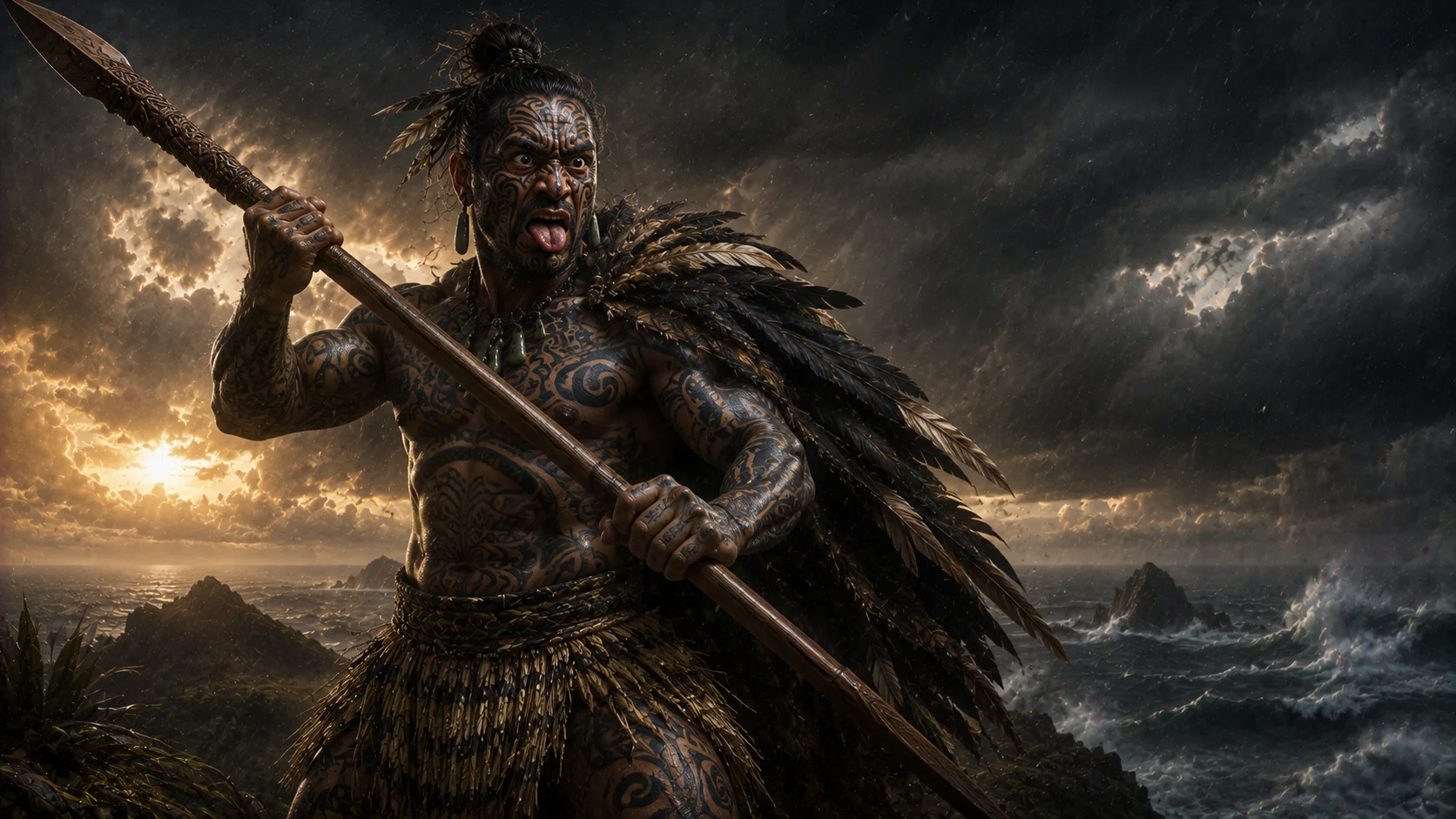
It follows naturally that Tu's name belongs at the front of any undertaking that resembles his own trial in the storm: war above all, but by extension any contest where a person must hold ground against force. War parties invoked him before setting out, not as a distant petition to an uninvolved power but as an appeal to a figure who had himself once stood alone and not broken. To call on Tu before battle was to ask for that same quality — the refusal to flee that had once left him the last brother standing — rather than to ask for victory as a gift handed down from outside. His name is a summons to a specific kind of courage, not a general blessing.
God of War and Humankind
Tu's second domain, standing alongside war, is humankind itself, and the pairing is not accidental. Human beings are, in this tradition, his particular people in a way that echoes his own solitary stand: they are the descendants who must contend daily with a world that does not yield easily, gathering food from domains that once had to be won rather than simply granted. To call him the god "of war and humankind" together is to say that the human condition, as this tradition frames it, is itself a kind of continuous, unglamorous contest — with weather, with scarcity, with rival claims — and Tu is the atua whose character models how that contest is to be met.
Mana Over the Natural World
Because Tu's brothers preside over forest, sea, and cultivated land, and because he is remembered as having prevailed over them, human beings acting under his mana are understood to hold real standing when they take from those domains — the fish drawn from the sea, the birds taken from the forest, the crops raised from cultivated ground. This is not framed as a taking without cost or without relationship; it is framed as an assertion of mana, of rightful standing, won rather than simply assumed. The same logic that lets a war party invoke Tu before a fight lets a hunting or fishing party invoke him before drawing on his brothers' domains: the appeal is to the same quality of earned, contested standing in both cases.
Tu in Proverb and Ritual
It is in the proverb and the karakia, more than in any single narrated episode, that Tu's name has been kept alive across generations. A short name travels easily through spoken forms that are meant to be remembered exactly and repeated often — in the words said over a war party departing, in sayings that invoke his stand against the storm as a model for human endurance, in the ritual language that surrounds contest and conquest more broadly. The brevity of "Tu" against the fuller "Tumatauenga" suits this kind of use precisely: ritual speech favours the name that can be spoken quickly, under pressure, without breaking the rhythm of the words around it.
A Name, Not a Second God
It should be said plainly, in the interest of treating this tradition accurately rather than multiplying figures who do not exist: "Tu Maori" is not attested as a distinct atua standing apart from Tumatauenga in the general published record of Maori cosmogony. "Maori" itself, as a word applied to people and things, is a comparatively late usage meaning something closer to "ordinary" or "of this land," used to distinguish humankind from atua and spirits — an unlikely element to have formed part of a pre-contact deity's own name. The far more probable explanation is straightforward: "Tu Maori" is a descriptive English-language label, "the Maori god Tu," attached at some point to the same Tumatauenga described throughout this account, rather than a separately named figure from a specific iwi tradition. Readers and researchers should treat any content under this label as referring to Tumatauenga himself.
Handling the Tradition with Care
Tu, or Tumatauenga in full, belongs to a living body of Maori knowledge, still spoken, still carried by iwi whose whakapapa reach back through him to the separation of sky and earth. Because the name "Tu" also appears as a root shared by other ancestral figures in particular tribal genealogies — a Tunuiarangi here, a Tukaitaua there, each distinct within their own iwi's lines — care is needed not to let this widely known primal atua absorb figures who, in their proper context, are someone else entirely. Where a specific iwi source names a genuinely separate Tu figure with its own history, that history deserves to be told in its own right, on its own authority, rather than folded into Tumatauenga's story for convenience. Absent such a source, what can be responsibly said is what is set out here: one atua, two names, a single continuous account of standing firm when the storm came and everyone else had already given ground.