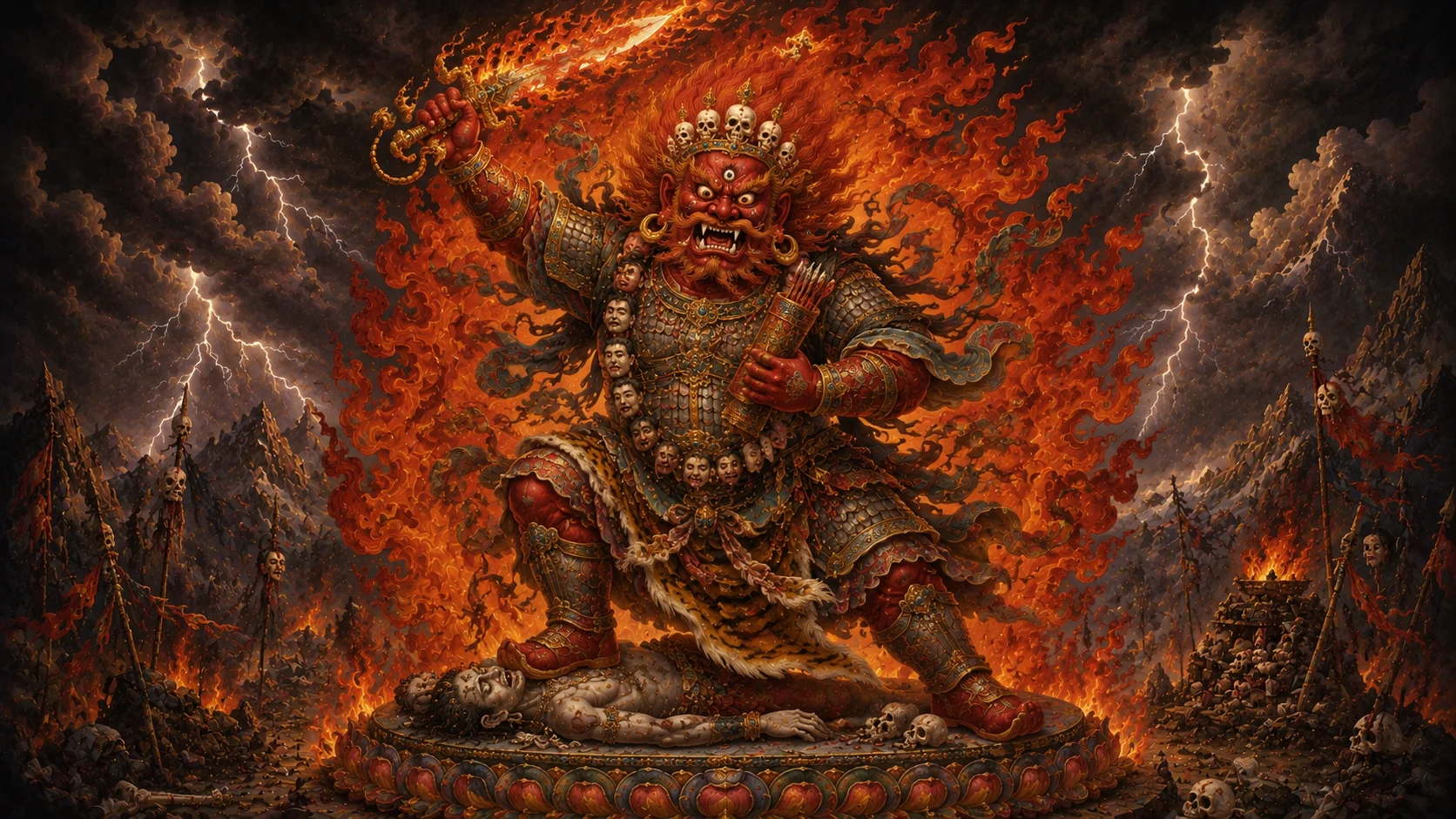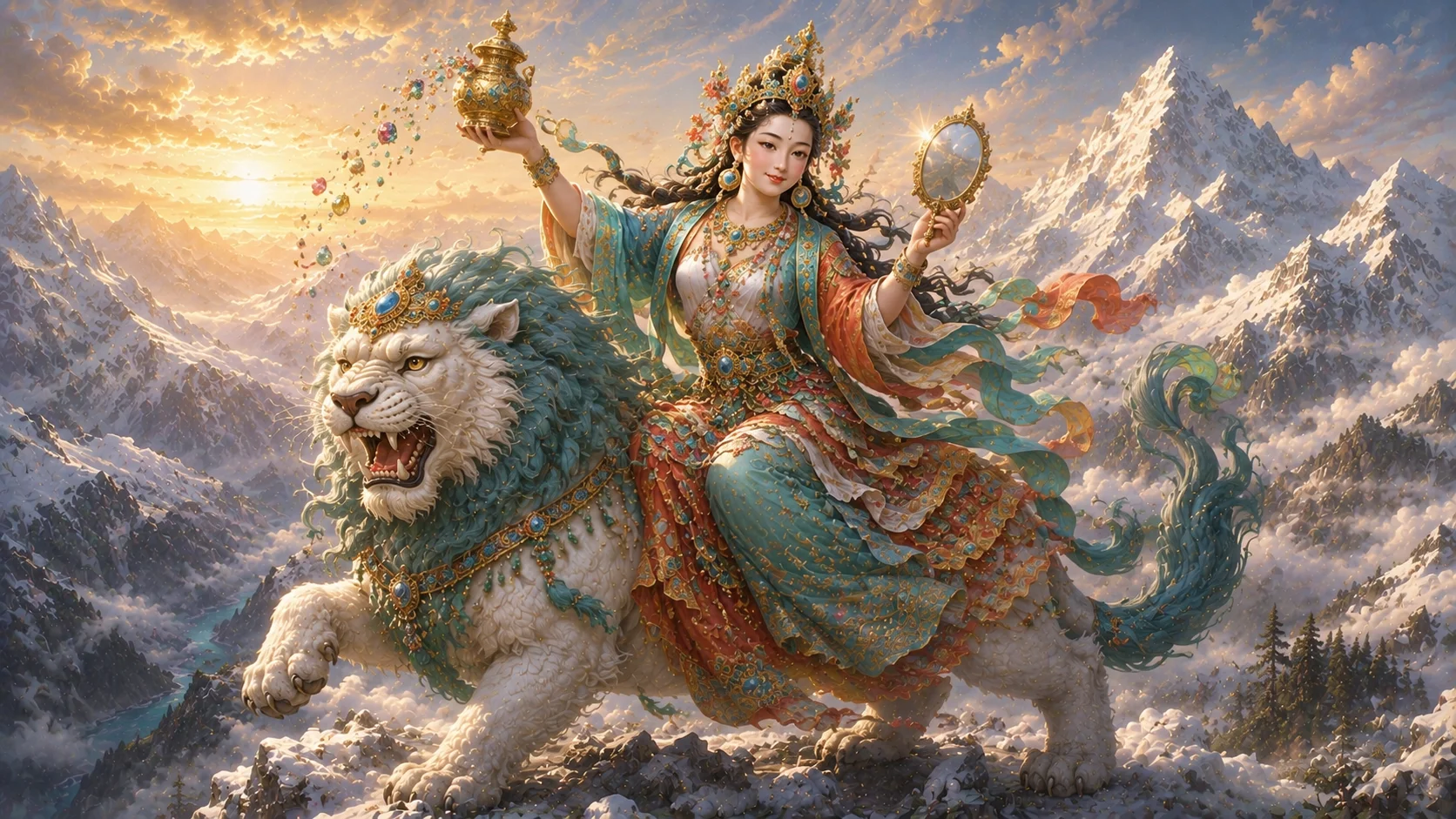
Tseringma — “the Goddess of Long Life” — is a beautiful Tibetan mountain-goddess, the chief of the Tseringma Chenga, the “Five Sisters of Long Life”: five goddesses dwelling upon the high Himalayan peaks who were subdued and bound to the dharma by Padmasambhava and who became protectors of the teaching and bestowers of long life and prosperity. She is associated with the great mountain of Everest and its neighbours.
The Goddess of Long Life
Tseringma (Tashi Tseringma, “the Auspicious Lady of Long Life”) is the foremost of the Five Sisters of Long Life (Tseringma Chenga), a group of five mountain-goddesses of the Himalayas. She is depicted as a beautiful, serene goddess, usually white, riding a snow-lion, holding a vajra and a vase of the nectar of immortality — for she is a bestower of long life, health, and prosperity. The Five Sisters are each associated with one of the great peaks of the Everest region, and Tseringma herself is connected with the mountain of long life in that range.
The Sisters Bound to the Dharma
By tradition, the Five Sisters of Long Life were originally fierce and dangerous local mountain-goddesses — the wild deities of the high peaks — who were subdued and bound to the dharma by Padmasambhava, converted from dangerous powers into protectors of the Buddhist teaching, in the same pattern by which Guru Rinpoche tamed the demons of Tibet. The sisters are especially associated with the great yogi Milarepa, who is said to have taught them and bound them as protectors and disciples; they became his guardians and devotees, and the goddesses of the snowy peaks where he meditated.
The Mountain Protectresses
Tseringma and her sisters are honoured as protectors of the dharma and of the Himalayan land, as bestowers of long life, health, fertility, and prosperity, and as goddesses of the great mountains. They embody the Tibetan reverence for the high peaks as the abodes of powerful goddesses, and the integration of these local mountain-deities into the Buddhist framework as protectresses and benefactors. In Tseringma, Tibetan Buddhism gave form to the goddess of long life and the sacred mountains — the beautiful chief of the Five Sisters who dwell upon the Himalayan peaks, subdued by Padmasambhava and taught by Milarepa, the bestower of long life and prosperity and the protectress of the snowy land.
Lords of the Ground
To understand why a mountain should have a name, a temper and a history, it helps to know what the older Tibetan religious world thought a mountain was. Beneath and before the Buddhist framework lies an order in which every peak, pass and gorge of consequence had an owner: a yul lha, a “god of the place,” or a gzhi bdag, a “lord of the ground.” Such a being was not a universal god of compassion but a landlord — local, proprietary, easily offended, closer in temperament to a weather system than to a Lord Buddha. Travellers greeted it at the pass, herders fed it, and nobody dug, built or hunted on its ground without leave. Read from the other side, the taming stories Buddhism tells about the Himalaya are the record of a negotiation with powers that had never asked anyone’s permission to be sacred. The Five Sisters belong to that older stratum of landlords, and the crucial thing about their conversion is what it left untouched.
The Contest in the Snow
In Tseringma’s case the subjugation is not left as a bare claim: it survives as a scene. The cycle of songs attributed to Milarepa and gathered into the collection known as the Hundred Thousand Songs — assembled in the late fifteenth century by the yogin remembered as the Madman of Tsang — gives her several chapters of her own, set in the border country of Lapchi and Chubar where the ageing hermit is said to have passed his last years. The sisters do not yield quietly. They come at him as any territorial power comes at a trespasser: first in terrifying apparitions, with an army of illusions raised to break his nerve, and afterwards in beautiful ones meant to break his resolve instead. Milarepa answers with neither force nor counter-ritual but with verse, singing back at them until the assault has been turned into a lesson on impermanence. Defeated and then genuinely persuaded, the sisters offer up their life-essence — the standard gesture of surrender in these narratives, the handing over of the one thing that makes a spirit dangerous — and ask for teaching in exchange. He binds them by oath to guard the doctrine and its practitioners in mountains that remain, in every other respect, entirely theirs.
It is worth noticing what changes and what does not. Tseringma keeps her peak, her power and her name; only her allegiance is new. And where Padmasambhava’s taming of the Tibetan landscape, some three centuries earlier, is remembered as a general accomplishment, hers is remembered as a conversation — which is why she is the sister whose story can still be told as a story.
Five Peaks, Five Sisters
The Five Sisters are not an undifferentiated chorus. Tradition gives each her own mountain, her own colour, her own mount and her own emblem, so that the group reads as a small pantheon of specialists rather than five copies of one goddess. Tashi Tseringma is identified with the sharp twin-summited massif that Nepal knows by the Hindu name Gauri Shankar and that Tibetan and Sherpa communities of the Rolwaling have long called Tseringma — one mountain, named twice, by two religious worlds facing each other across a ridge. Her sister Miyo Langsangma, whose name opens with mi g.yo, “unshakeable,” holds the highest seat of all: she is the goddess said to reside on Everest, and she is shown riding a tiger and carrying a bowl of food. The emblems that recur across the set — the vase of deathless nectar, the divining mirror, the bowl — all point back to a single underlying identity. These are goddesses of sustenance and continuity, not of war or judgement, which is why their painted forms read as gentle even though what they were before was anything but.
The Puja at the Foot of the Icefall
None of this is confined to old paintings. At the start of every climbing season, Sherpa teams at Everest Base Camp build a stone altar, call a lama, burn juniper so that the smoke rises, string prayer flags out from the cairn, and ask the mountain’s resident goddess for permission — before a single fixed rope goes into the Khumbu Icefall above. The ceremony is neither decorative nor optional: Sherpa staff will not set foot on the route until it has been performed. In Sherpa accounts the deity addressed is Miyo Langsangma herself. Everest’s Tibetan name, Chomolungma, opens with jo mo, “lady” — and whatever the disputed history of the rest of it, the name sits easily beside the conviction that the summit has an owner, that the owner is female, and that she is asked, every spring, for leave.
Why the Mountain Needed a Face
The logic of Tseringma is the logic of every society that has had to live off a landscape capable of killing without warning. A crevasse cannot be addressed; a goddess can be greeted, fed and thanked. Giving the massif a person — a name, a temperament, a preferred mount, and a known history of having once been argued with and won over by a human being — converts an indifferent hazard into a relationship, and a relationship has rules. Rules can be kept. Avalanches cannot be. That the goddess of the world’s highest mountain should also be, specifically, a goddess of long life is the sharpest irony in the whole arrangement: she is asked for it, season after season, by precisely the people whose work takes them into the one place on earth least inclined to grant it.
Sources & traditions
- TraditionTibetan Buddhist texts, oral tradition and village tellings
Myths change from area to area and from time to time. This chronicle follows the most widely told versions; tellings in other villages, regions and eras may differ.