Taweret — a name that itself means “the Great One” or "the Great Female" — was the hippopotamus-goddess of ancient Egypt, the fierce and ever-watchful protectress of childbirth, pregnancy and the household. She was one of a small cluster of closely related hippo-goddess figures known to Egyptian religion, sometimes named Ipet or Reret, and scholars still debate exactly how distinct these figures were from one another or whether they represented shifting local names for the same guardian power. What is certain is that in whichever name she was invoked, she was the presence Egyptian women turned to in the most dangerous hour of their lives: the hour of birth.
Body Borrowed From Four Beasts
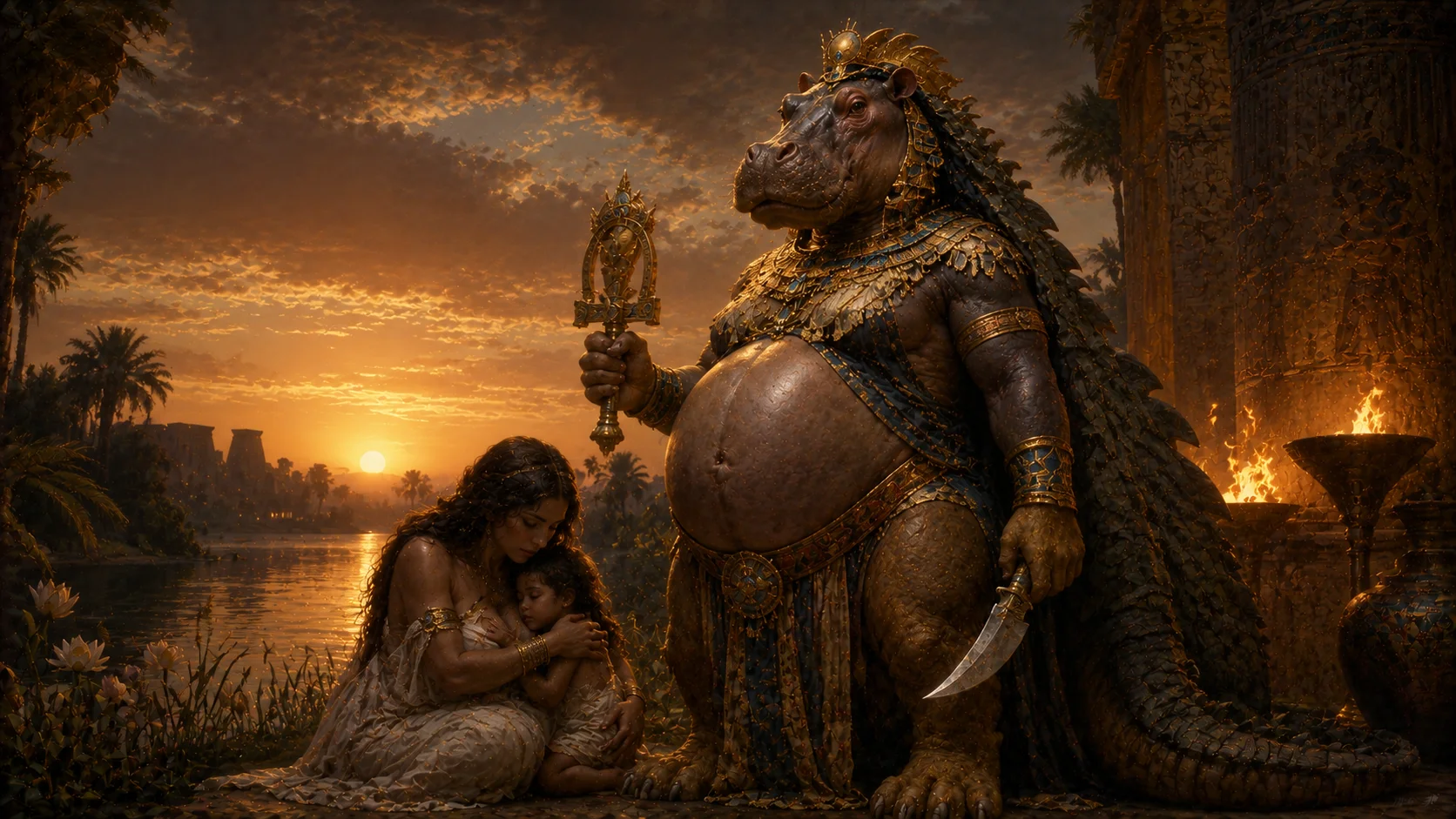
Taweret had one of the most arresting forms of any Egyptian deity. She was shown standing upright on the hind legs of a pregnant hippopotamus, her heavy body swollen as if far along in pregnancy herself. Onto that hippopotamus frame were grafted the paws and forelimbs of a lion, the ridged back and long tail of a crocodile, and — startlingly human among all this — pendulous human breasts. It was a body built from four of the most feared creatures an Egyptian could encounter: the hippopotamus that could capsize a boat and crush a man in the reeds, the lion that stalked the desert margins, and the crocodile that waited beneath the river's surface. Each was folded into a single guardian figure, and the effect was not meant to be pretty. It was meant to be formidable enough to stand between a vulnerable mother and whatever might come for her in the dark.
A Shape Turned Inside Out
The hippopotamus in Egyptian thought was not an innocent animal. Male hippos in particular carried strong associations with Set, the god of chaos, storm and violence, and the same beast that could be a symbol of destruction in his hands became, in female form, a symbol of fierce maternal defense. The connection was less a fixed myth than an inversion the Egyptians clearly felt: the same raw power that made the hippopotamus dangerous in the wild made a mother hippopotamus — famously protective of her calf — one of the most devoted guardians in nature. Taweret's iconography draws on that same instinct without needing a single settled parentage myth to explain her; she has no fixed genealogy tying her to the great family trees of Osiris, Isis or Horus. She belongs instead to a different register of Egyptian religion altogether — one built less on grand cosmic narrative and more on the daily, urgent needs of ordinary households.
Watching Over the Birthing Bed
It was in the intimate space of the birthing room, not the halls of state temples, that Taweret was most present. Egyptian mothers faced childbirth with good reason for fear, and Taweret was the deity most often invoked to stand between a labouring woman and the evil spirits believed to threaten her and her child in that vulnerable window. Amulets bearing her image were worn by pregnant women and kept near the bed. "Wands" — magic knives carved with rows of protective creatures, Taweret prominent among them — were placed beside the sleeping infant or drawn in a protective arc around the birthing space, a physical boundary meant to keep harm out. In some images she carries the sa sign, the hieroglyph for protection itself, or an ankh, the sign of life, making explicit in her hands what her whole fearsome body was already declaring.
A Goddess of the Home, Not the State Cult
Unlike Osiris, Isis or Amun, Taweret rarely appears at the centre of an elaborate mythic cycle recorded on temple walls. Her presence is instead scattered across the texture of everyday religious life — amulets worn on the body, ostraca scratched with quick prayers, small household shrines tucked into the corners of homes. This was, in its way, a different kind of importance rather than a lesser one: she was not a goddess encountered occasionally in grand festival processions but one carried daily, close to the skin, by women who needed her nearer than any state temple could be. Her worship flourished most visibly at Deir el-Medina, the village of the workmen who built the royal tombs, where private household religion left an unusually rich trace in the archaeological record, and where a figure like Taweret — practical, personal, and fierce on your behalf — mattered more than the distant gods of royal ideology.
A Small Chapel at Karnak
Taweret was not confined entirely to the household sphere. She received her own small chapel at Karnak, built under Egypt's Ptolemaic rulers — modest beside the towering precincts of Amun nearby, but a mark that her protective power was recognised even within the greatest temple complex in Egypt. That a goddess so associated with private, domestic fear found a place, however small, inside the walls of state religion's most prestigious address says something about how deeply her protection was valued across every level of Egyptian society, from the household shrine to the temple precinct.
Kinship With Hathor and Bastet
Taweret's protective and maternal character brought her naturally into association with other goddesses who shared her concerns. She was sometimes linked with Hathor, the great goddess of motherhood, love and joy, and with Bastet, the protective cat-goddess whose gentler ferocity guarded home and hearth in her own right. These were not always formal mergers of identity so much as overlapping spheres of protection — different goddesses whose domains of care for women, mothers and households ran close enough together that their images and epithets could blend and reinforce one another in popular devotion, each lending her particular strength to the shared work of keeping mothers and children safe.
Mistress of Pure Water, Lady of the Horizon
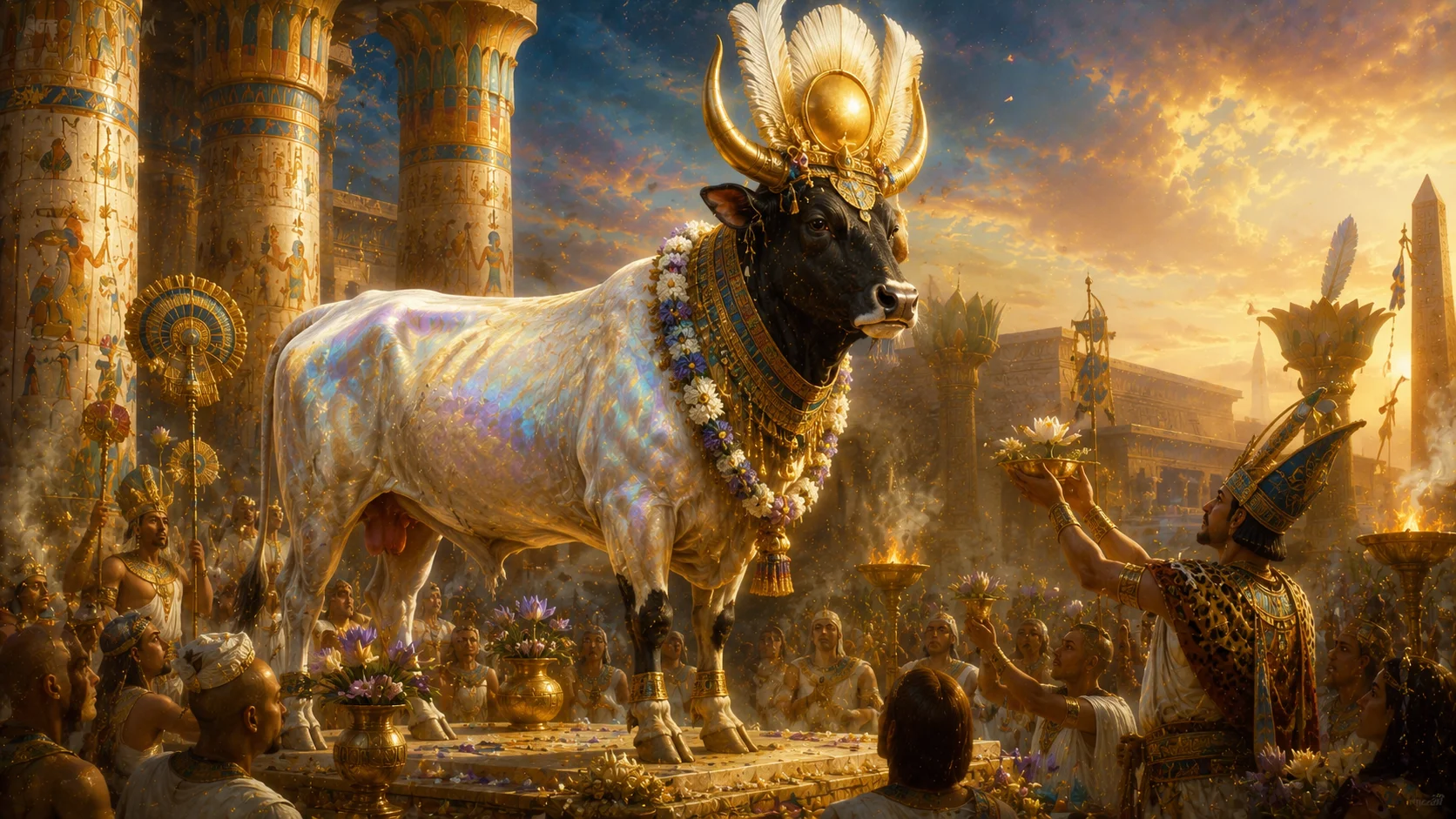
Taweret carried epithets that reached beyond the birthing room into the wider cosmos. She was called Lady of the Horizon, and in funerary contexts she appears as Mistress of Pure Water, a title that ties her protective power to purification and to the passage between one state of being and another — themes as relevant to the dangerous threshold of birth as to the equally dangerous threshold of death and rebirth in the Egyptian afterlife. In vignettes from the Book of the Dead she appears near the celestial cow and in other protective roles connected with the sky, standing guard not only over the newborn in this world but over the safe passage of souls in the next.
A Cosmic Hippopotamus in the Northern Sky
Taweret's protective reach extended even to the heavens. She was associated with the star grouping identified with the region of Draco and the northern sky, where Egyptian astronomers saw in the circling, never-setting stars of the north a great cosmic hippopotamus — sometimes folded into the imagery later called the Great Bear — whose role was to restrain the forces of chaos at the very axis of the heavens. In this celestial guise, the same fierce vigilance that guarded a single birthing bed in Deir el-Medina was imagined writ large across the sky itself, holding back disorder from the turning pivot of the cosmos the way she held back evil spirits from a single vulnerable household. It is a striking continuity in Egyptian religious imagination: the goddess who protected the smallest, most private threshold of a single family was also trusted to hold the largest threshold of all, the order of the night sky.
A Company of Guardians at the Threshold
Taweret rarely stood entirely alone in the popular imagination of protection; she belonged to a loose company of apotropaic household deities whose images clustered together on amulets, wands and domestic shrines, deities whose entire purpose was to guard the thresholds of daily life — birth, sleep, the vulnerable hours of infancy — against unseen harm. Her fearsome composite body worked exactly as such protective images were meant to work: a monstrous face turned outward against monsters, a guardian too frightening for evil to approach, holding that ferocity always in service of the gentlest, most vulnerable moment a family could face.
Recognised Anew as Thoueris
Egypt's long religious history did not end at its borders, and neither did Taweret's recognition. In the Ptolemaic period, as Greek rule brought Greek observers into close contact with Egyptian religious life, Taweret was identified by them with a goddess they called Thoueris — a Hellenized rendering of her Egyptian name that shows her cult was distinctive and important enough to be noticed, named and folded into the wider Greco-Egyptian religious landscape of the time, rather than dismissed as a purely local household superstition. It is a small but telling sign of how far her protective reputation had travelled beyond the birthing rooms where her worship began.
Ferocity as the Shape of Love
What makes Taweret distinctive among Egypt's protective deities is how directly her terrifying form and her tender purpose were fused into one image, with no contradiction felt between them. She was not a beautiful goddess who happened to also protect; her protection was her monstrousness, deliberately assembled from the parts of the Nile's most dangerous animals so that nothing else would dare approach. The mother hippopotamus, ready to defend her calf, was the model the Egyptians chose precisely because they understood that kind of love — fierce, unglamorous, absolute — as the truest form protection could take. Taweret's enduring image is this exact paradox held without strain: a goddess frightening enough to stand at the door of the birthing room, and gentle enough to be trusted with the newborn child just past it.
Sources & traditions
- EncyclopediaWikipedia — Taweret
- TraditionEgyptian texts, inscriptions and later retellings
Myths change from area to area and from time to time. This chronicle follows the most widely told versions; tellings in other villages, regions and eras may differ.