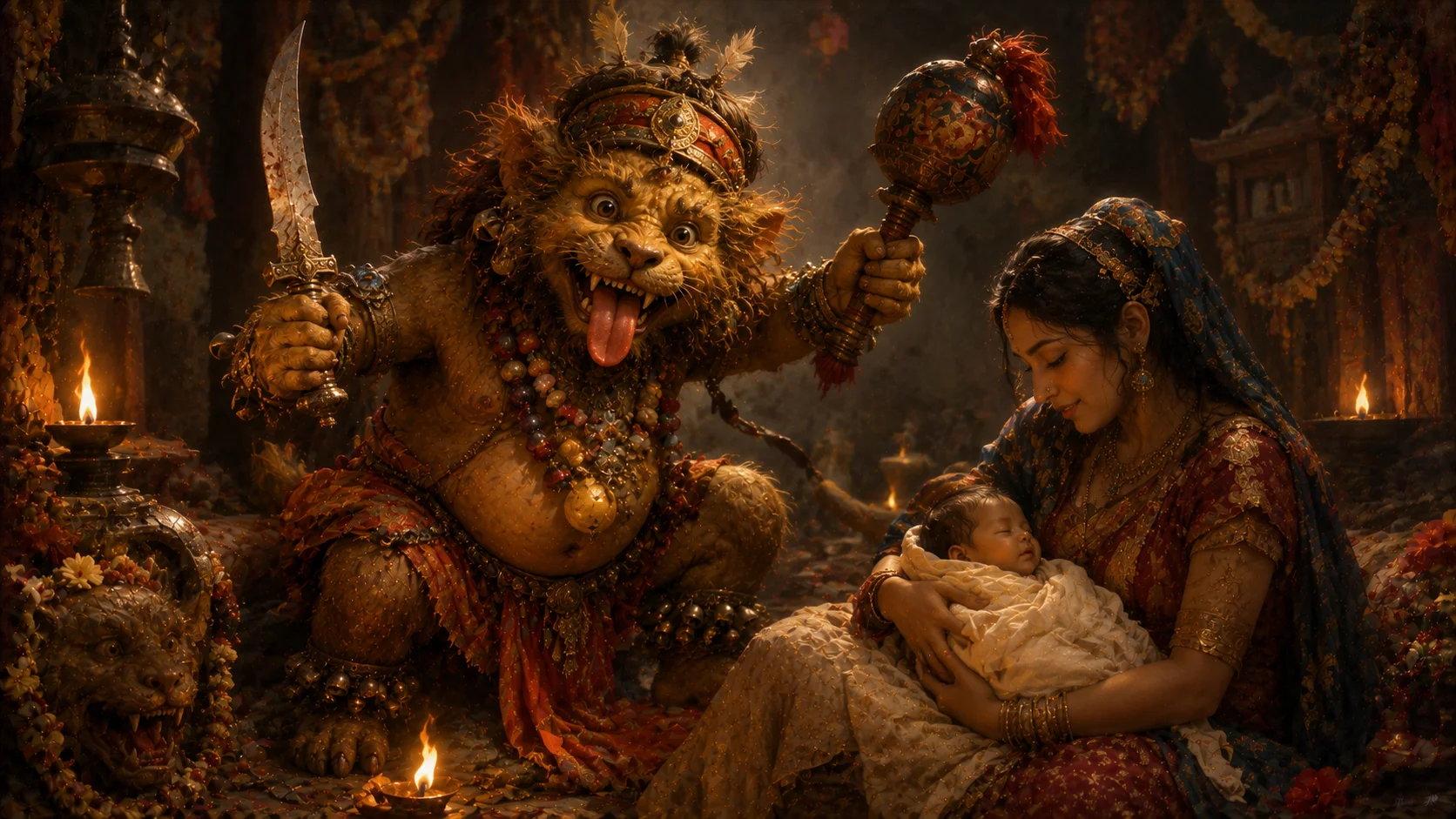
Bes was the grotesque, lion-faced dwarf-god of ancient Egypt, protector of households, mothers, infants and the perilous hour of childbirth. Egyptologists sometimes hesitate to call him a "god" at all in the fullest sense, classing him instead among the genii or demon-protectors — guardian spirits whose business was not the cosmos but the threshold, the birthing stool, the sleeping child. He held no great state temple, commanded no priesthood of national weight, and yet his stub-legged, tongue-lolling face was carved, painted and amuletted into more Egyptian households, across more centuries, than almost any figure in the pantheon.
A Face Turned Toward the Viewer
Egyptian art followed a convention so consistent it reads as a rule of grammar: gods and men alike were shown in profile, head turned to the side, the body arranged in the flattened, legible silhouette that governed nearly three thousand years of relief and painting. Bes breaks that rule outright. He is shown frontally, facing the viewer directly — one of the only figures in the entire Egyptian repertoire granted that treatment. The effect was deliberate and unmistakable: a face that stares back at you does something a profile cannot. It confronts. Combined with his leonine features, a wide grimacing mouth, a tongue often shown protruding, and legs bowed in the stance of a dwarf, the frontal pose turned an image into something closer to a mask — an apparition meant to be met eye to eye rather than observed from the side.
Made Ugly on Purpose
Nothing about Bes's appearance was accidental or unrefined. He was often crowned with a feathered headdress, sometimes draped in a lion's mane or trailing a lion's tail, his squat dwarf's body rendered with the same care Egyptian artists gave to the serene, idealised faces of Osiris or Hathor. The grotesqueness was itself a craft. His function was apotropaic — evil-averting — and apotropaic images work by confrontation rather than by beauty. A hostile spirit, a venomous snake, a fever-demon creeping toward a sleeping child was to be met with a face more frightening than itself, a roar louder than its hiss, a grimace uglier than its malice. Bes did not ask evil to respect him. He meant to startle it into flight.
Guardian at the Birthing Stool
Bes's central duty, the one repeated across the material record more than any other, was watching over women in childbirth and the infants they delivered. Birth in ancient Egypt was understood as genuinely dangerous ground, a threshold where mother and child were exposed to hostile forces at their most vulnerable, and it was here that Bes's fierce ugliness was put directly to work. He appears on birth-related amulets, on the small objects a household kept close through pregnancy and delivery, standing as a declared line of defence between the newborn and whatever might come for it. This was not distant, formal religion conducted by priests on a family's behalf; it was protection kept within arm's reach, worn on the body or set beside the bed.
A Blade Against the Unseen
In some images Bes is shown brandishing knives, his stance aggressive rather than merely watchful, or surrounded by the snake and animal imagery that marks Egypt's broader tradition of protective magic against dangerous creatures. This connects him thematically to the magical tradition surrounding the Cippi of Horus — stelae showing Horus as a child mastering serpents and scorpions, carved and consulted precisely for their power to ward off bites and stings. Bes belongs to that same current of belief: divine protection imagined not as passive blessing but as active combat, a guardian who fights, on the family's behalf, dangers that could not be fought by ordinary means.
Music as a Weapon Against Silence
Bes was as strongly associated with music, dance and merriment as with combat, and the two sides of his character were not separate. He is shown playing the tambourine and the harp, dancing with the same wide-legged energy that marks his combative poses. Noise, in this tradition, was itself protective: festive, deliberate clamour was thought to help drive away malevolent forces, much as his grimacing face did. A god who shook a tambourine at a sickbed and a god who brandished a knife at a serpent were performing variations of the same task — filling a vulnerable space with enough sound and spectacle that harm found no quiet opening to enter.
Furniture, Mirrors and the Architecture of the Ordinary
Unlike deities whose primary presence was the temple relief or the cult statue behind a shrine door, Bes belonged chiefly to the world of household objects. His image turns up on beds, headrests, mirrors and cosmetic containers — the small, handled, daily things a family actually touched. This was not a lesser form of worship so much as a different register of it: protection woven into the furniture of ordinary life rather than reserved for formal ritual. A headrest carved with his face stood guard over sleep itself; a mirror bearing his image carried protection into the most personal moments of a woman's day. Few Egyptian deities are so thoroughly documented through the objects of everyday use rather than through monumental architecture.
Beside the Hippopotamus Guardian
Bes is frequently paired with Taweret, the hippopotamus-goddess who shared his role as protector of childbirth. The two appear together repeatedly on birth-related amulets and household furnishings, an odd-looking pair — the grimacing dwarf and the pregnant hippopotamus standing upright — united by a single shared purpose. Neither figure conformed to Egypt's usual visual language of divine beauty, and that shared strangeness may have been part of the point: two guardians whose very unlikeness to the serene, idealised gods marked them out as belonging to a different, more immediate kind of protection, one aimed squarely at the dangers of the birthing room rather than the order of the cosmos.
A Face Without a Family Tree
Bes sits outside the great genealogical structure of Egyptian myth. He has no fixed place in the Ennead, no settled parentage, no canonical spouse or children binding him into the interlocking family sagas of Osiris, Isis and Horus. In later apotropaic and magical contexts a female counterpart known as Beset appears alongside him, but she belongs to the same loose, functional tradition rather than to a fixed marriage or lineage. This absence of pedigree is itself informative: Bes was defined by what he did — guarding, frightening, drumming evil away — rather than by his place in a divine family. He needed no genealogy to do his work.
A Question Egyptologists Still Argue
Where Bes came from is genuinely unsettled. His visual traits — the dwarf's build, the exotic feathered headdress, the leonine grotesquerie so unlike Egypt's usual divine iconography — have led some Egyptologists to propose roots in Nubian or wider sub-Saharan African tradition, reading his "foreign" appearance as a trace of that origin. This remains a scholarly hypothesis rather than an established fact, and the debate has not been resolved. What is firmer is his chronology: Bes is attested from at least the Middle Kingdom onward, and his presence in household religion only grew from there, becoming markedly more common through the New Kingdom and reaching its widest diffusion in the Late Period, by which point he ranks among the most frequently depicted figures in all of Egyptian everyday material culture.
Rooms Built for a Grimacing Face
By the Late Period and into the Ptolemaic era, Bes's image had climbed from household object to formal architecture. He appears on temple birth-houses, known as mammisi, standing alongside other deities concerned with childbirth in structures attached to major temple complexes. Archaeologists have also identified so-called "Bes chambers" — rooms, such as those found at Saqqara, decorated extensively with his image — though what these chambers were actually used for remains a matter of open debate rather than settled interpretation. Whatever their exact function, their existence marks a genuine shift: a figure who began in the intimate scale of a headrest or a mirror had, by the twilight of pharaonic religion, earned dedicated architectural space of his own.
A Face That Travelled Without a Country
Few Egyptian images crossed as many borders as Bes's did. His protective, apotropaic image was exported widely across the ancient Mediterranean world — into the Levant, onto Cyprus, and eventually into Greek and Roman visual culture — carried, it seems, less as a piece of Egyptian state religion than as a recognisable protective amulet motif, useful and legible to people who owed no particular allegiance to the Egyptian gods at large. In that diffusion Bes became, arguably, one of the most internationally travelled of all Egyptian divine images, a grimacing face at home in far more places than the household shrines where his story began.
Facing the viewer where every other god turns aside, drumming and grimacing at once, the dwarf-guardian stood between a sleeping child and whatever moved in the dark — not a god of temples and genealogies, but of the headrest, the mirror, and the birthing stool.
Sources & traditions
- EncyclopediaWikipedia — Bes
- TraditionEgyptian texts, inscriptions and later retellings
Myths change from area to area and from time to time. This chronicle follows the most widely told versions; tellings in other villages, regions and eras may differ.