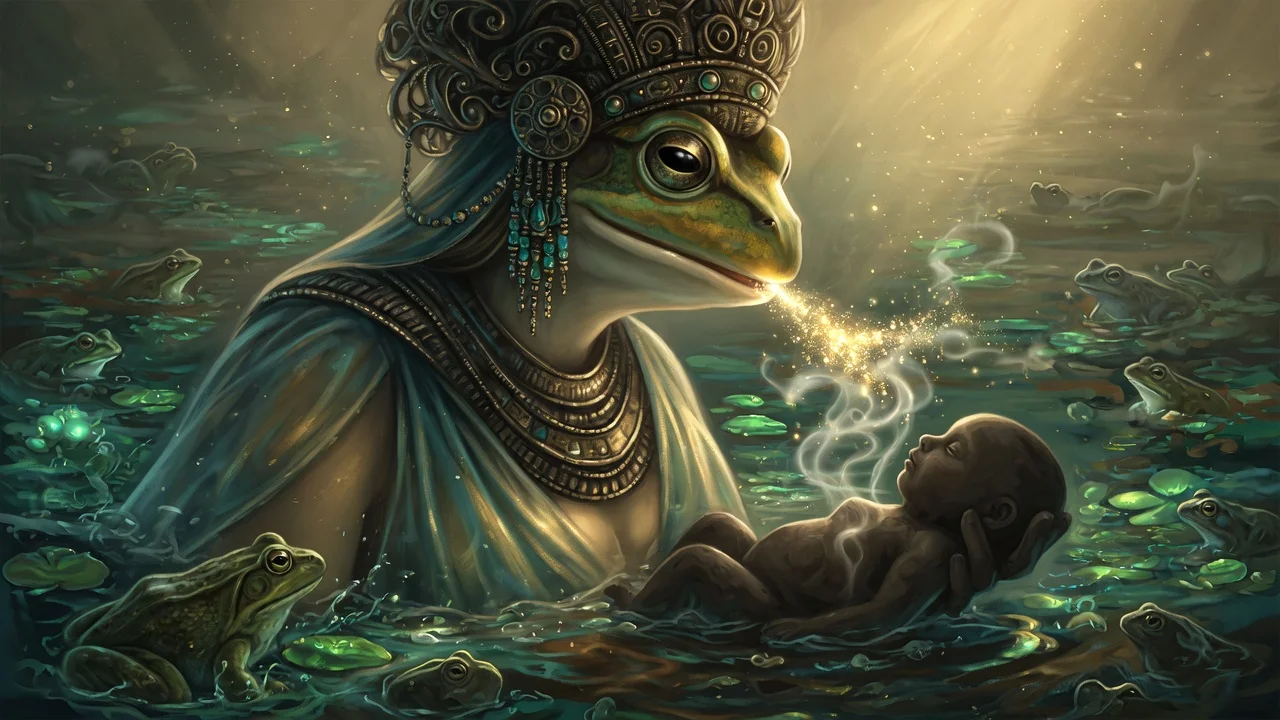
Heqet was the frog-headed Egyptian goddess of fertility, childbirth and the quickening of life — the goddess who breathed life into the newly-formed bodies of children and presided over the final stage of birth, and a deity of resurrection. Associated with the teeming fertility of the frogs that swarmed after the Nile flood, she is the goddess of the spark of life and the safe delivery of children.
The Frog-Goddess
Heqet (also written Heket) was depicted as a frog, or as a woman with a frog's head — an unusual and striking form rooted in close observation of nature. After the annual flooding of the Nile receded, vast numbers of frogs appeared in the fertile mud and shallow waters, teeming with new life. The Egyptians associated this sudden, abundant emergence of frogs with fertility, abundance and the swarming multiplication of new life. The frog became a symbol of generative power, and Heqet the frog-goddess embodied that life-bringing force in her very body.
The Mud of the Retreating Flood
Her form was not decorative but explanatory: the frogs of Egypt appeared to be born directly from the wet black mud left behind as the Nile inundation withdrew, seeming to spring into being from the earth itself with no visible origin. To Egyptian eyes this looked like spontaneous generation — life arising unbidden from the flood's aftermath — and Heqet's identity as a frog-goddess tied her directly to the inundation as the source of Egypt's fertility, its harvests, and the renewal of life along the riverbanks each year.
Servants at the Birthing Stool
Heqet was, above all, a goddess of childbirth and the bringing-forth of life. She presided over the final stages of labour and delivery, protecting women in childbirth and easing the child's passage into the world. In some contexts midwives were described as acting “as servants of Heqet,” a title that placed the ordinary work of assisting a birth under her direct patronage. She was invoked by women in the dangerous hour of labour, believed to hasten a difficult delivery and to stand between the mother and the many perils that childbirth carried in the ancient world.
She Who Opens the Way
Among her functions Heqet carried an epithet describing her as the one who opens the womb, or who assists precisely at the moment the child is born — a title that marks out her domain with unusual precision. Where other goddesses touched motherhood more broadly, Heqet's province was narrower and more urgent: the specific, physical instant of delivery itself, the passage from womb to world that she was called upon to ease and to guard.
Amulets Against the Hour of Danger
Women carried her protection with them in tangible form. Small amulets shaped as frogs, associated with Heqet, were worn or kept by Egyptian women through pregnancy and into the hour of childbirth, and such charms have been recovered from burials and settlements across multiple periods of Egyptian history. They were not abstract devotions but working protections, meant to be near the body at the moment her power was needed most.
The Tale of the Three Kings
Heqet's clearest appearance in narrative comes from the Middle Kingdom story preserved in the Westcar Papyrus, in which the wife of a priest, Ruddjedet, is due to give birth to triplets destined to become kings of the Fifth Dynasty. Heqet is among the deities sent to attend the birth, and she acts to hasten the delivery of the three children, working alongside other birth-related powers so that each child is brought safely and swiftly into the world. It is one of the few surviving Egyptian narratives in which her role as a birth-goddess is shown directly in action rather than invoked in ritual formula.
Meskhenet, Khnum, and the Company of Birth
In that same tale Heqet does not act alone. She appears together with Meskhenet, the goddess who determined a child's destiny at birth, and with the god Khnum, placing her within a recognized company of deities whose combined presence oversaw a birth from its physical delivery to the shaping of the newborn's fate. Her place in this grouping shows that Heqet's power was understood as one part of a larger, cooperative structure of divine attention brought to bear on the birth of a child, rather than a role she held in isolation.
Consort to the Potter of Bodies
Heqet was linked mythologically to Khnum, the ram-headed creator-god who fashioned the bodies and kas of human beings upon his potter's wheel. In some theological formulations she was regarded as his consort, and it was said that where Khnum shaped the clay form of a child, Heqet was the one who breathed life into it — the animating force that turned a molded shape into a living being. The exact nature of this pairing shifts across different sources and periods, but the underlying image is consistent: Khnum the sculptor, Heqet the breath that quickens what he has made.
The Breath That Quickens Clay
This was Heqet's most profound role: not merely attending birth but standing at the threshold between the unliving and the living. The moment a molded form, or a child forming in the womb, received its vital spark was her province — the instant of quickening, when clay or flesh became something that breathed and lived. She animated what Khnum had shaped, the giver of the breath itself, and in this she touched the deepest mystery the Egyptians attached to the origin of a human life.
Frog of the Tomb as Well as the Womb
Because the frog seemed to generate itself out of the Nile mud with no visible parent, its image carried meaning beyond the birth chamber. In funerary contexts the same imagery spoke of resurrection and renewal: if a frog could apparently spring into being unbidden from the mud, then a person, too, might be born again out of death, quickened by the same breath Heqet gave to the newly formed living. Her power over the first breath of life extended naturally to the hope of a second one beyond the grave.
Shrines of Qus and Herwer
Heqet's cult was centered at particular sites in Middle and Upper Egypt, notably Qus (also rendered Qis) and Herwer, among other places where the veneration of a frog-goddess is attested. Unlike the great state goddesses whose temples and priesthoods spanned the length of Egypt, Heqet's worship was concentrated and localized, rooted in specific communities where her protection over childbirth was sought close to home.
A Goddess Known Mostly by Her Work
Heqet's textual footprint is comparatively modest next to goddesses such as Mut or Isis. She surfaces chiefly in birth-related ritual and magical texts, in the amulets women carried, and in the small number of narrative sources such as the Westcar Papyrus that show her in action. Her fame was never built on grand hymns or state cult so much as on a role that touched ordinary Egyptian households at one of life's most dangerous and hoped-for moments — which may be exactly why the frog amulet endured in daily use even where formal temple worship did not.
An Echo Scholars Note With Caution
Modern scholarship has, cautiously, noted a resemblance between Heqet's frog imagery and the plague of frogs described in the biblical Exodus narrative, given Egypt's broader association with frogs arising from the Nile's flood. This connection is interpretive rather than a documented link between Egyptian religious texts and the biblical account, and it is raised as an observation about shared imagery rather than a claimed line of influence.
The Quickener of Life
Heqet endures as the frog-goddess of fertility, childbirth and the quickening of life — the giver of the breath of life, the protectress of women in labour, the goddess of the teeming fertility that followed the Nile flood. She embodies the Egyptian wonder at the abundant, sudden emergence of new life and the sacred mystery of birth and quickening; and she stands as the gentle goddess of the spark of life and the safe delivery of children — the frog of the fertile flood-mud who breathes life into the newly-made and brings each child safely into the world.
The frog-goddess of the fertile flood who breathes the breath of life into each newly-formed child — the quickener of life and the protectress of women in the hour of birth.
Sources & traditions
- EncyclopediaWikipedia — Heqet
- TraditionEgyptian texts, inscriptions and later retellings
Myths change from area to area and from time to time. This chronicle follows the most widely told versions; tellings in other villages, regions and eras may differ.