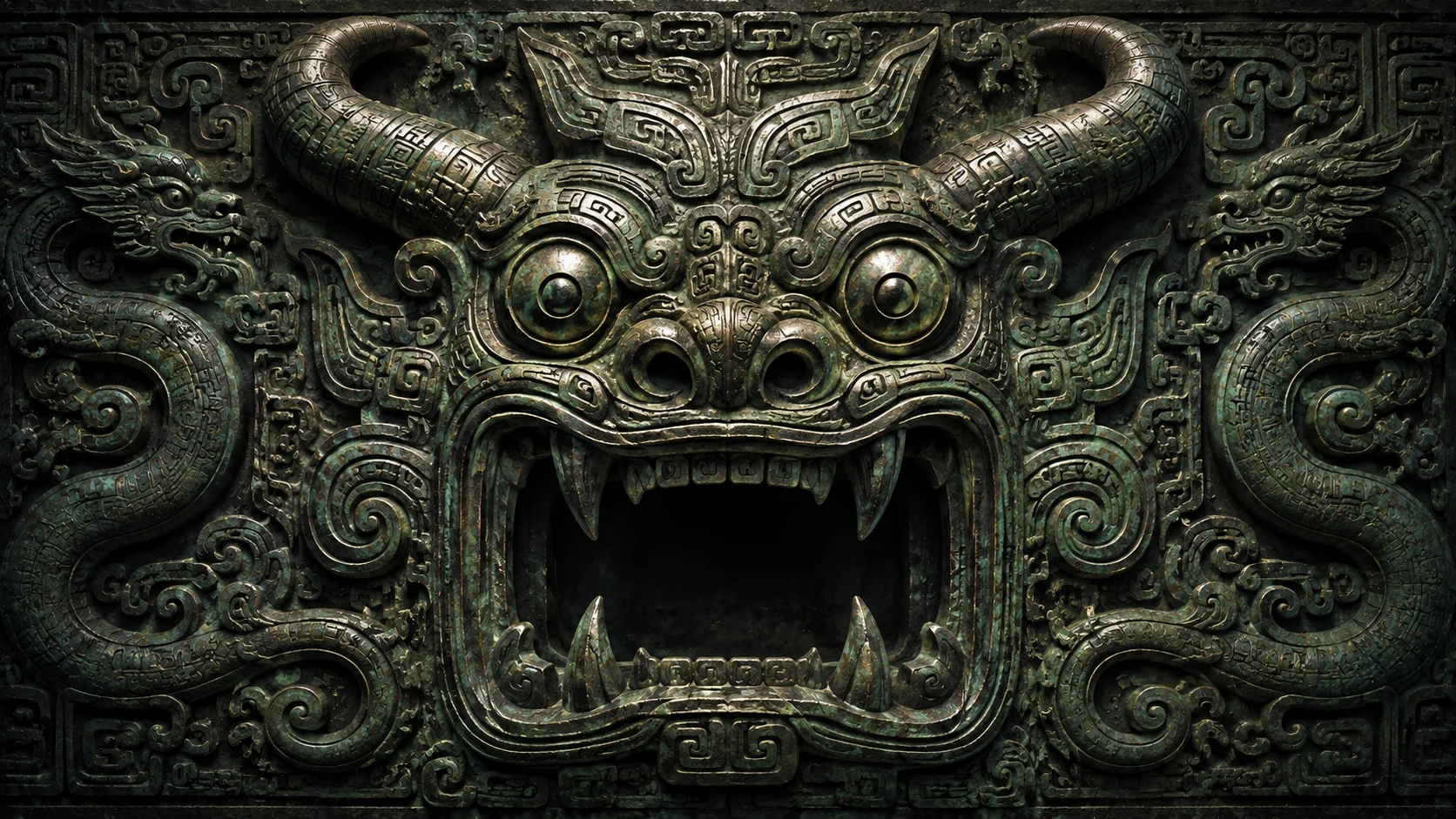
The Taotie (饕餮) is among the oldest surviving images in Chinese civilization — a staring, symmetrical mask-face cast into bronze more than three thousand years ago, long before anyone wrote down what it was supposed to mean. It is not, at its root, a story. It is a face, repeated for centuries on the ritual vessels of the Shang and Zhou dynasties, and only much later given the biography of a monster: a creature so consumed by hunger that it ate its own body, leaving nothing behind but the head that could not stop chewing.
A Face Older Than Its Name
Long before any surviving text describes the taotie as a being with appetites and a fate, the image already existed — stamped, incised, and cast into the bronze ritual vessels of the Shang dynasty and carried forward into the Zhou, spanning roughly 1600 to 256 BCE. This makes the taotie one of the very few figures in Chinese myth where the picture is demonstrably older than the story. Archaeologists can hold the face in their hands centuries before any writer explains what it is.
The motif itself is unmistakable once seen: a frontal, bilaterally symmetrical animal mask, wide-set bulging eyes, curling horns, and a mouth spread open as if mid-roar or mid-swallow. On many vessels the design splits down a central axis, as though the creature had been peeled outward and laid flat across the bronze surface — two profiles merging into one confrontational face. What species that face belongs to was never settled, not even by the people who first cast it. It has no fixed anatomy beyond eyes, horns, and a gaping mouth. Everything else — whether it had a body, whether it was a real animal, a composite, or no animal at all — was left an open question from the very beginning.
The Voracious One of the Zuo Zhuan
The taotie's reputation as a monster of appetite is not a Shang-dynasty idea. It comes centuries later, from texts like the Lüshi Chunqiu (the Spring and Autumn Annals compiled under Lü Buwei in the third century BCE) and the historical chronicle known as the Zuo Zhuan. These sources gave the ancient bronze face a personality it had never explicitly carried in the metal itself: a being of such consuming greed that it devoured everything within reach, and when nothing else remained, turned on its own flesh.
It is a strange kind of death sentence — hunger with no off switch, no capacity to recognize the boundary between the world and the self. The taotie in this telling does not starve. It simply keeps eating until there is nothing left to eat except itself, and even then, it does not stop until only the head remains, jaws still open, appetite apparently undiminished by the total absence of a body to feed it.
Four Perils, One Warning
The Zuo Zhuan places the taotie in distinguished, terrible company: the Si Xiong, the Four Perils (or Four Fiends) of ancient Chinese legend, alongside Hundun, Qiongqi, and Taowu. These four were not simply monsters roaming the wilds — in the moral framework of the text, they were bound up with the figures of unfilial, banished, or corrupted sons of the mythical sage-kings, each one standing in for a particular vice that a ruler's household, and by extension a state, could not afford to harbor.
Where Hundun represented formless ignorance and Taowu stood for stubborn, unteachable wickedness, the taotie's vice was named plainly: gluttony, and the greed that gluttony makes visible. Grouped together, the Four Perils functioned less as a bestiary and more as a warning chart — a way of naming the failures of character that could unmake a ruling house from within, dressed in the safer language of ancient monsters rather than pointed at any living person.
The Body It Devoured Away
One detail ties the literary taotie directly back to the bronze image that predates it: the reason, according to the later moralizing texts, that taotie is so often shown as a face and nothing more. Having eaten its own body in its hunger, there was nothing left to depict but the head — and so the bronze artisans, in this retroactive explanation, rendered exactly that: a mask with no torso, no limbs, no tail, just eyes, horns, and a mouth suspended against the vessel's surface.
It is a tidy explanation, and a popular one, but it is worth holding lightly. The bronze face-without-a-body predates the literary explanation for why it has no body by many centuries. The story may well have been built to explain an image whose real origins were already lost to memory by the time anyone thought to ask.
Bronze Vessels for the Ancestors
The taotie mask is not scattered evenly across all bronze objects — it belongs, overwhelmingly, to the ritual vessels used in ancestor worship: the great three-legged ding tripods used for cooking and presenting sacrificial meat, the gui food vessels, the jue wine cups used in offering rites to the dead. These were not household items. They were instruments of a family's or a state's connection to its ancestors, used in ceremonies where the living fed the dead in hope of blessing, legitimacy, and continued favor.
That the most voracious face in the tradition presides over vessels built for ritual feasting has not gone unnoticed by anyone who has studied it. Whether that placement is meant as accusation, protection, or simple decoration is exactly where the certainty of the historical record runs out.
A Name Given by Later Scholars
Here is the detail that unsettles the tidy myth most: the Shang dynasty artisans who cast these faces did not necessarily call them "taotie" at all. The name is a much later attribution. It was Song dynasty antiquarians — scholars who, more than a thousand years after the Shang, began systematically collecting, cataloguing, and naming ancient bronzes as objects of study — who looked at this recurring mask motif and reached for the taotie of the old moral texts to name it.
In other words, the link between the gluttonous monster of the Zuo Zhuan and the mask-face of Shang bronzes is a scholarly identification made centuries after both the image and the story already existed separately. It may be exactly correct. It may be a plausible guess that stuck so thoroughly it became fact. Modern archaeology and art history still use "taotie" as the standard term for this entire category of Bronze Age zoomorphic decoration — but that usage itself is a convention inherited from the Song dynasty, not a demonstrated survival of whatever the Shang people actually called their own artisans' work.
Variant Faces in the Classic of Mountains and Seas
Adding to the tangle, the name taotie does not settle on a single fixed creature even within the classical sources that describe it as a being rather than a motif. The Shan Hai Jing, the Classic of Mountains and Seas, offers its own taotie — and it looks nothing like the bronze mask. In one passage it is described as sheep-bodied, with a human face, tiger's teeth, and — strangest of all — eyes set beneath its arms rather than in its head.
This is not a contradiction to be resolved so much as a reminder of how classical Chinese mythography actually worked: the same name could be applied to more than one described creature across different texts, compiled at different times, by different hands, with no central authority reconciling them into one official form. The taotie of the bronzes, the taotie of the Zuo Zhuan's gluttony, and the taotie of the Shan Hai Jing's strange anatomy may share a name and a shadow of a theme, but they were never fused into a single consistent creature by the tradition itself.
Whose Son Was the Glutton?
Some accounts push the taotie's origin further into genealogy, identifying it as one of several monstrous or exiled sons of a legendary ruler — the corrupted offspring whose vices were too great for their father's household to contain. The details vary across tellings and are not fixed into a single canonical lineage; some threads connect it to the broader mythic circle around the Jiuli chief Chiyou, others to an unspecified corrupt clan whose name did not survive as clearly as its reputation.
What stays constant across these variations is the function of the story, not its cast: a monstrous son given a name and a fate as a way of making an abstract vice — insatiable greed, unchecked appetite, avarice in a position of power — into something that could be told as a cautionary tale rather than argued as a political accusation. A greedy official is dangerous to name directly. A greedy monster from the deep past is safe to point at, and the point still lands.
No Temple, No Offering, No Cult
Unlike many figures that populate Chinese mythic tradition, the taotie was never the object of worship. There is no temple built to it, no festival held in its honor, no ritual of propitiation meant to keep its hunger turned away from human affairs. It occupies a different kind of space entirely — not a god to be appeased, but a symbol to be read.
Its entire cultural role runs through two channels that never required belief in the creature as a living threat: as a moral emblem of greed personified, deployed in texts and speech to make a point about character, and as a decorative and art-historical element, appearing on bronze after bronze as a design convention whose exact meaning even its own makers may not have agreed upon. It asked nothing of anyone. It was never fed, never thanked, never blamed for famine or drought. It simply watched, from the surface of a vessel, while the actual rituals happened around it.
From Monster to Metaphor
By the time of the Han dynasty, the taotie's transformation from bronze motif to moral shorthand was essentially complete. "Taotie" had become a fixed literary way of naming a greedy, gluttonous person — particularly an official whose appetite for wealth or power exceeded any reasonable bound. The creature's mythic details mattered less than the accusation the word now carried: to be called a taotie was to be told, in the language of ancient monsters, that your hunger had become a danger to everyone around you.
That shorthand never really faded. It survived the fall of every dynasty that came after the Han, carried less as belief in a literal creature and more as a durable piece of moral vocabulary — proof that a myth does not need worshippers to remain useful. It only needs a vice worth naming.
The Feast the Face Watches Over
Scholars who study the placement of the taotie mask on ritual bronzes have never reached a single settled answer for why it belongs there, and this genuine disagreement is worth stating plainly rather than smoothing over. One reading treats the face as a warning cast directly into the vessels used for ancestral feasting — a visible reminder, present at every ritual meal, not to let appetite curdle into the very greed the taotie represents.
A second reading takes the opposite view: that the mask functions as a guardian, an apotropaic face meant to ward off harm from the vessel and the rite it serves, its ferocity aimed outward rather than inward as caution. A third possibility treats it as a totemic emblem tied to ancestry itself, a clan or lineage symbol whose ferocious features carried authority rather than warning. None of these three readings has displaced the others. The taotie's meaning on the bronze remains an open scholarly question, not a settled fact dressed up as one.
A Debate Without a Verdict
It would be convenient to say that modern scholarship has finally solved the taotie — identified its species, fixed its meaning, closed the case that the Song antiquarians opened when they first reached for that ancient name to label a mysterious bronze pattern. It has not. The debate over whether the taotie depicts a real animal, a purely invented composite, or a wholly decorative pattern with no zoological referent at all has continued since those Song dynasty scholars first began systematically studying and naming the bronzes in their collections.
This is not a failure of research. It is a fair reflection of how thin the evidence actually is: a striking, recurring image with no surviving Shang-era explanation attached to it, inherited by a tradition many centuries later that did its honest best to make sense of what it had found. The uncertainty is part of the true history here, not a gap waiting to be filled by a more confident storyteller.
The Word That Still Bites
Walk through a modern Chinese city and the taotie has not gone anywhere — it has simply changed shape again. In contemporary Mandarin, "taotie" (饕餮) survives as a colloquial term closely related to chihuo (吃货), used to describe a gourmand, an enthusiastic eater, someone whose love of food runs a little larger than most. It shows up in restaurant names and food branding across the country, a three-thousand-year-old bronze monster now advertising someone's dinner special.
This is not a trivialization so much as a genuinely continuous thread: a motif cast in bronze during the Shang dynasty, moralized into a symbol of greed by the Warring States and Han periods, and still doing linguistic work today, just softened from accusation into affectionate exaggeration. Few mythic figures anywhere manage a lineage of unbroken relevance quite that long.
A Warning Carried Into the Present
The taotie's harsher meaning has not disappeared alongside its gentler culinary one — it persists in contemporary Chinese cultural and political rhetoric, where the figure is still invoked as a cautionary symbol against corruption and unchecked greed, particularly among those entrusted with power. Education and public discourse both continue to draw on the same moral logic the Zuo Zhuan established over two thousand years ago: that appetite left unexamined does not stop at satisfaction, and a ruler or official who consumes without limit risks becoming, in the end, a creature that has eaten everything except the mouth that keeps demanding more.
What makes the taotie unusual among ancient warnings is how little it has needed reinterpretation to keep functioning. The bronze face never explained itself, the classical texts gave it a story rather than a fixed form, and the centuries since have simply kept finding new places to hang that same old warning — on a ritual vessel, in a chronicle's moral catalogue, in a modern editorial about corruption, or, most disarmingly, on the signboard of a restaurant proud to call its portions generous. The face still stares out the same way it always has: wide-eyed, open-mouthed, and never quite finished.
Sources & traditions
- EncyclopediaWikipedia — Taotie
- TraditionChinese texts, oral tradition and village tellings (China)
Myths change from area to area and from time to time. This chronicle follows the most widely told versions; tellings in other villages, regions and eras may differ.