The Nian is the monstrous New Year beast that emerged once a year to devour livestock and children until people discovered its weaknesses — a discovery that gave the world red lanterns, firecrackers, and the family reunion dinner that still anchors Chinese New Year today. The very name of the holiday remembers the fight: Chinese New Year is called Guo Nian (過年), "passing of the Nian" — surviving the beast, one more time.
A Name Older Than the Monster — and a Name for Getting Past It
Long before it named a beast, the character 年 (nián) marked something far gentler: the cycle of grain, the turning of a harvest. In the oracle bone script of ancient China, nián recorded the rhythm by which a community measured its survival — planting, growth, reaping, rest. Only later did the word for "year" become entangled with a monster's name, in the way folk memory often works backward, building a fearsome origin story around a term that had already settled into everyday language. The Nian's name, in other words, may be younger than the beast it supposedly describes — a legend growing up around a word, rather than a word growing out of a legend.
That backward-built connection is exactly why the festival itself is named for the beast. The Chinese term for the Spring Festival is Guo Nian, 過年 — literally "passing" or "getting through" the Nian. Whatever the character's older grain-cycle roots, the holiday's own name preserves the monster story directly: this is the day people got past the Nian, and lived to celebrate it.
The Shape of the Beast
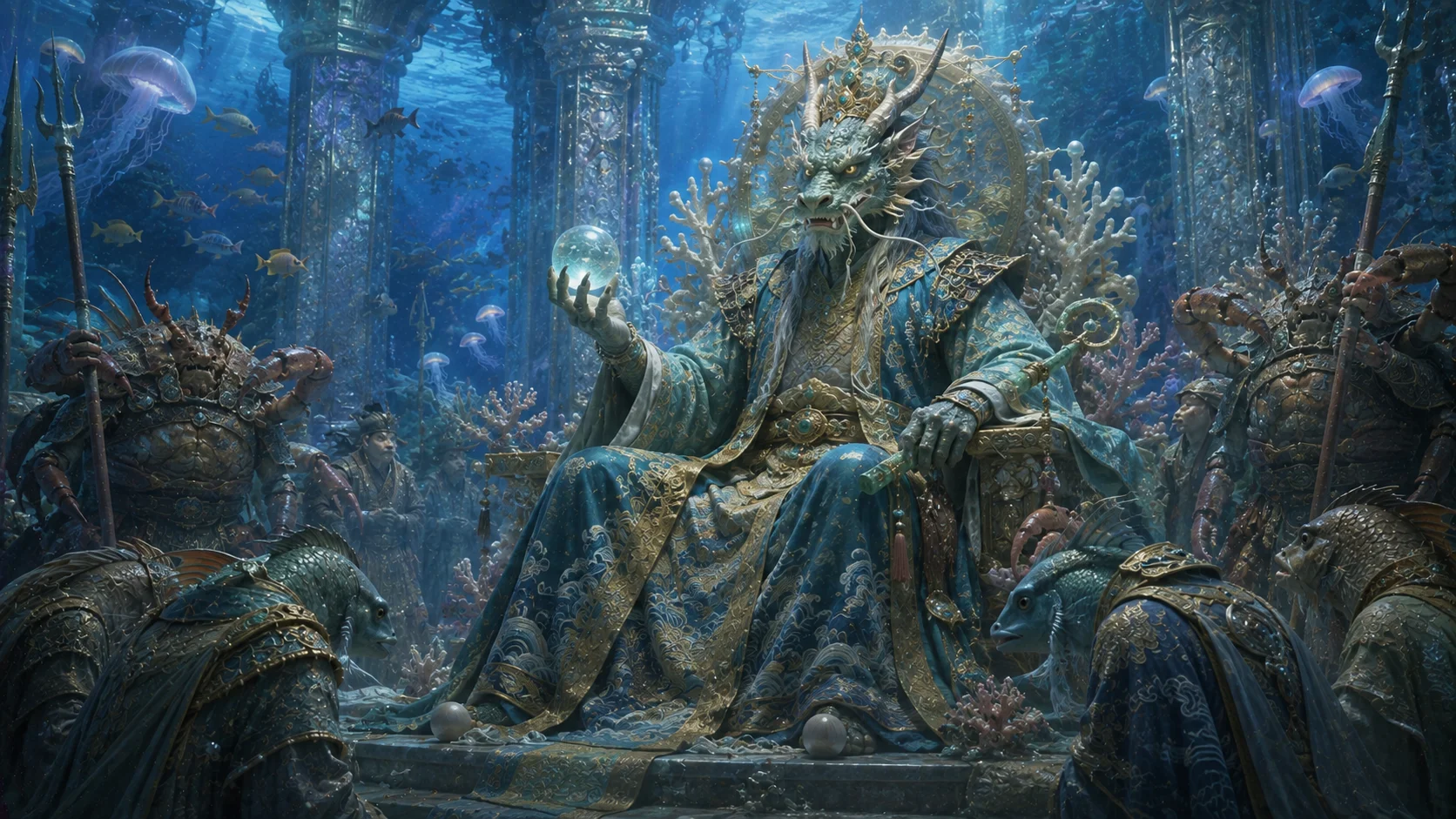
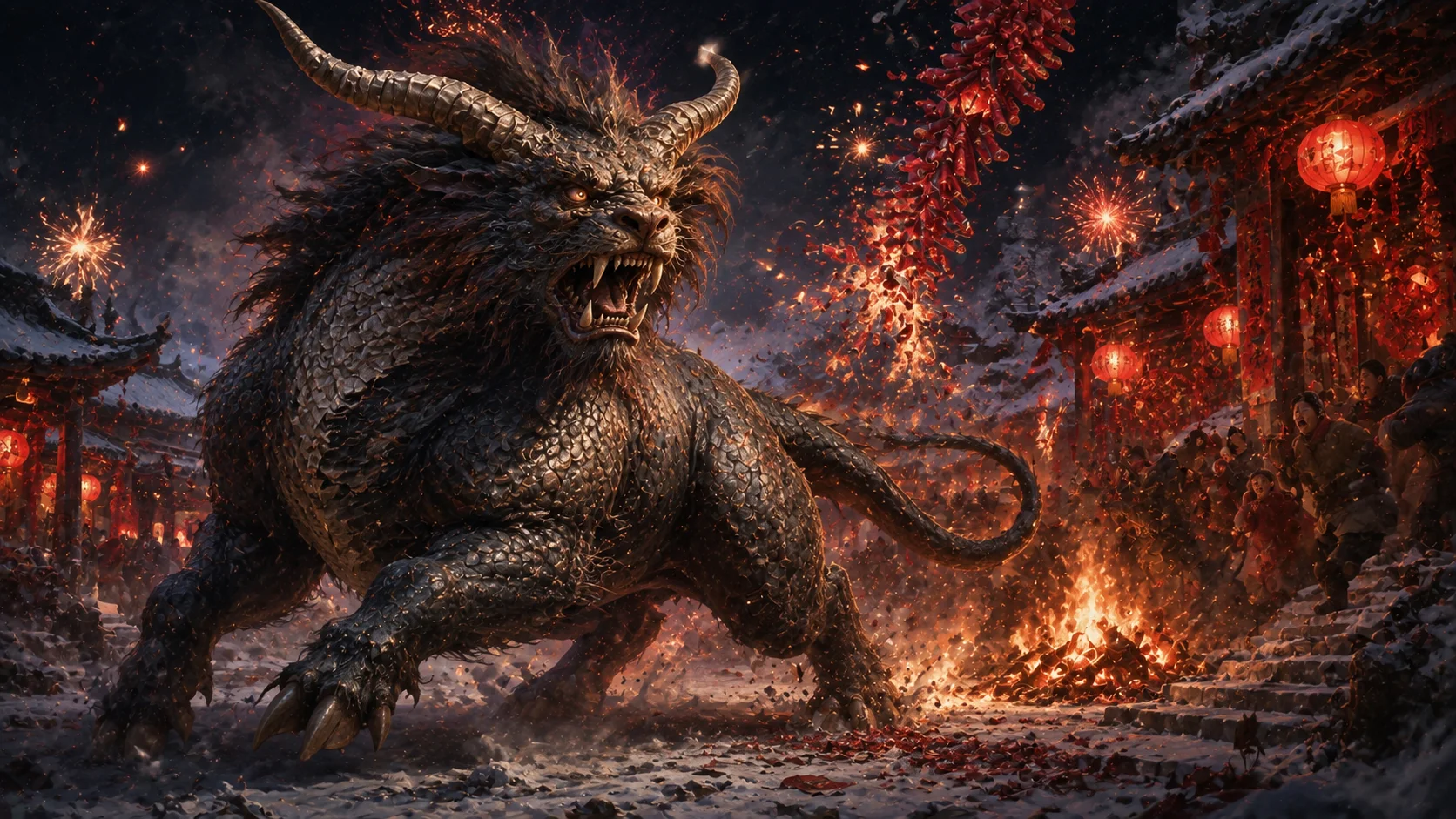
Where the Nian came from, storytellers never fully agreed — some placed its lair in the crushing dark of the deep sea, haidi, where no fisherman's net had ever returned intact; others set its den in a remote mountain cave, sealed off from human paths by cliffs and forest. What the tellings do agree on is its shape: a creature stronger than nearly any other beast in the folklore of its region, built like a fusion of things a farming village would fear most. It carried the head of an ox, blunt and heavy, crowned with sharp horns capable of goring through a wooden gate. Its body moved like a lion's or a dragon's, coiled with muscle, low and fast. Its snout was long, built for tearing, and its teeth were the kind that left no doubt about what had happened to the animals found missing at dawn.
The Night It Was Named For
Once each year, on the last night of the old cycle, the Nian rose from wherever it slept and came down toward the villages of the lowlands. New Year's Eve was not, in this telling, a night of celebration first — it was a night of dread. Livestock vanished from their pens. Fields of grain, painstakingly grown across the very cycle the beast's name would come to represent, were trampled and stripped. And when the beast's hunger ran deeper than crops and cattle could satisfy, it turned toward the villagers themselves, with children said to be its favored prey — the smallest, the least able to run, the easiest to carry off into the dark before anyone could stop it.
Peach Blossom Village
In some regional tellings, the terror had a specific address: a farming community called Peach Blossom Village, struck at the same turning point of the lunar calendar every year without fail. Naming the place mattered to the people who told the story — it rooted an enormous, almost cosmic threat inside something as small and specific as a single agrarian settlement, the kind of place where everyone knew whose barn had been emptied and whose child had not come in from the fields. The Nian was not an abstract force of chaos; it was a neighbor's tragedy, repeated on a fixed schedule that the whole village had learned to dread.
The Stranger Who Would Not Flee
Every other household in the threatened village did the only sensible thing when the beast's night approached: they fled to the hills, taking food, children, and whatever livestock could still walk. But in the year the story turns on, an old man arrived as everyone else was leaving. Tellings differ on who he was. In some versions he is simply a beggar, unremarkable and easily overlooked. In others he is a Taoist immortal, or, in the oldest tellings, the god Hongjun Laozu, walking the earth in a humble guise. The tradition doesn't settle on a single sheltering household or name who took him in — only that he found villagers to instruct. For the sake of one continuous telling, this version has him reach the villagers still gathered at the edge of town before the last of them scatter, and he tells them what to do.
What the Old Man Knew
He told them not to run. He told them, instead, to trust him with their doors. As night fell and the beast's approach could be felt before it could be seen, the old man had the remaining villagers set to work with what seem, on the surface, like small and almost domestic tools against so vast a monster: strips of red cloth and red paper pasted across doorways, red lanterns lit and hung where the beast would have to pass, and stores of bamboo set ready by the hearth to be thrown into the flames. When the Nian finally reached the village that night, expecting the usual silence of an abandoned settlement, it found instead houses blazing with light, wrapped in red, and about to make a sound the beast had never had reason to associate with people before.
Fire, Color, and Sound
The bamboo went into the fire and split apart with a crack loud enough to rattle the beast's nerve — the origin of baozhu, the "exploding bamboo" that would eventually give way to gunpowder firecrackers and, much later, the fireworks that fill the sky over Chinese New Year celebrations to this day. The red cloth and red paper seemed to burn at the beast's eyes in a way nothing else in its long, undisturbed hunting life ever had. And the light itself — the sheer refusal of the houses to go dark — unsettled a creature that had always associated New Year's Eve with villages huddled in silence, waiting to be found. Between the noise, the color, and the light, the Nian's nerve broke entirely, and for the first time anyone could remember, it turned and fled without taking anything at all.
The Village Returns
When the frightened villagers came back from the hills the next morning, braced for the ruin they always found, they discovered the settlement untouched — houses standing, animals safe, doorways still wrapped in red paper and dusted with spent bamboo ash. The old man who had told them what to do was gone. The lesson the villagers took from it was not treated as luck. It was treated as a method, and methods can be repeated.
A Different Ending: The Red-Robed Deity
Not every telling of the story ends the same way, and it's worth keeping the versions separate rather than folding them into one plot. In a related variant, the beast isn't merely frightened off by an anonymous old man's instructions — it is confronted and permanently subdued by a red-robed old man who, at the story's close, is revealed to be a deity. Only after the Nian is driven off for good in this version do the villagers realize that red cloth and fire are the lasting solution, and the ritual is repeated every year afterward. It's a distinct telling with a distinct emphasis: where the first version is about villagers learning a defense, this one is about a god intervening directly — and tellers frame it explicitly as a separate variant, not a continuation of the same night.
A Ritual Becomes a Tradition
From that year forward, the defense against the Nian stopped being an improvised act of desperation and became an annual preparation. Red paper went up on doors before the beast could ever be expected. Red lanterns were lit as a matter of course, not emergency. Bamboo, and later gunpowder firecrackers, were kept ready and set off deliberately at midnight rather than thrown into the fire in a panic. The custom of shousui — "staying up to see the year out," keeping every light in the house burning through the night — grew directly from the discovery that the beast could not bear a house that refused to go dark. What had once been a single village's narrow escape became, across generations, the shared defensive posture of an entire festival — Guo Nian, repeated every year since.
Barred Doors and Gathered Families
Because stepping outside on that one night carried a real risk of encountering the beast, families stopped venturing out at all once the sun set on New Year's Eve. Instead, they gathered everyone under one roof, barred the doors, and shared a meal together while they waited out the hours until the danger had passed. That meal — nianyefan, the New Year's Eve reunion dinner — endures today as one of the most important fixed points on the entire Chinese calendar, long after the fear that first drew families indoors has faded into folklore. It is worth sitting with the shape of that inheritance: an act of survival, repeated so faithfully and for so long that it became, instead, an act of love.
The Beast Beside Other Beasts
The Nian did not haunt the New Year season alone in every telling. Storytellers sometimes spoke of a similar creature called Xi, described in comparable terms, and in some regional traditions the Nian's story blurs together with that of Sui, a separate and different kind of threat — not a beast that raided villages for food, but a spirit said to slip into houses at night and frighten sleeping children until they fell ill or lost their nerve entirely. It was to guard against Sui, specifically, that the custom of ya sui qian arose: money given to children, meant to press down and ward off the spirit's touch as they slept. That practice survives today in the red envelopes — lai see, hongbao — passed from elders to the young at every Lunar New Year, a second thread of protective color woven in beside the Nian's own.
What the Story Still Teaches
Strip away the ox-headed monster and the deep-sea lair, and what remains is a tale doing a very specific kind of work: explaining, to each new generation, why the color red covers every doorway during Chinese New Year, why firecracker strings crack open the night at every parade, why dragon and lion dances move loud and bright through the streets, and why families the world over treat the reunion dinner as non-negotiable no matter how far they have scattered. Retold today in children's books, animated shorts, and public New Year education campaigns, the Nian remains the standard answer given to a child who asks why the fireworks are so loud and the paper on the door is so red. The beast is gone, if it was ever more than a story — but the answer it left behind has outlived every retelling of the question, and the festival's own name, Guo Nian, still says so.
Sources & traditions
- EncyclopediaWikipedia — Nian
- TraditionChinese texts, oral tradition and village tellings (China)
Myths change from area to area and from time to time. This chronicle follows the most widely told versions; tellings in other villages, regions and eras may differ.