Hundun — 混沌, "Chaos" or "Muddled Confusion" — is the primordial figure and concept that stands, in Chinese mythology and philosophy, at the place where nothing has yet been separated from anything else: no light from dark, no self from other, no face from the smooth mass that will one day wear one. Hundun is not a single, stable character the way a dragon or a fox-spirit is. It is a name that different ancient texts reach for when they need to speak about the condition before distinction existed — and, in one troubling strand of the tradition, a name for a monstrous son who never learned to distinguish anything at all. Both figures share the same faceless quality. Neither shares the other's meaning.
Before the World Had Edges
To understand Hundun is to sit for a moment in the state Chinese cosmology imagines before there was a world to describe. Not darkness, exactly — darkness already implies the possibility of light. Not emptiness, since emptiness implies a space that could be filled. Hundun names something more total: a condition in which the categories that would let you say "this, not that" have not yet come into being. Sky and earth are not yet apart. Up and down have not yet been decided. Self and world have not yet drawn a line between them.
This is why later poets and cosmological commentators use "hundun" as a general byword, reaching for the word whenever they need to gesture at a state of primal unity or inchoate mixture — a usage that spread far beyond the specific mythic figure and became, in effect, philosophical shorthand. To call something "hundun" is to say: not yet cut apart.
The Emperor Who Wore No Face
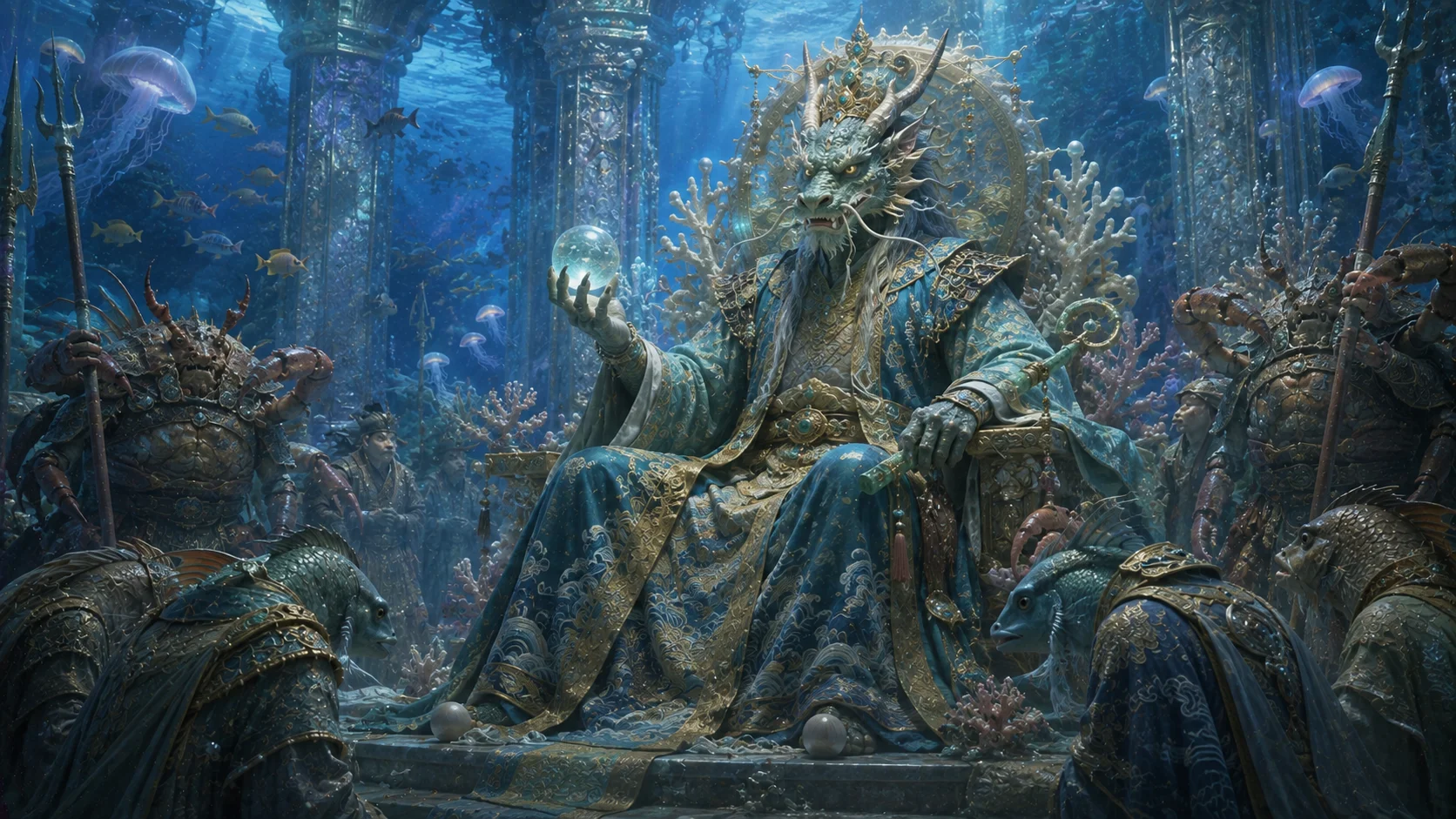
The most famous vessel for this idea is a short, deceptively simple parable in the Zhuangzi, composed during the Warring States period some two and a half thousand years ago. In it, Hundun is imagined not as an abstraction but as a person of sorts — the Emperor of the Center, ruling the middle realm the way the Emperor of the South Sea, called Shu, and the Emperor of the North Sea, called Hu, rule their own domains.
Shu and Hu would meet, from time to time, in the territory Hundun governed, and each time Hundun received them with warmth and hospitality — a good host, generous and untroubled, asking nothing of his guests. The text gives him no features to soften or sharpen with expression, no eyes to widen in welcome, no mouth to smile with. He is simply, completely faceless, and this does not appear to trouble him. It is not written as a wound. It is written as a fact of his nature.
A Gift Repaid in Openings
Eventually Shu and Hu resolved to repay their host's kindness. They discussed the matter between themselves, as the parable tells it, and noticed something that seemed to them an oversight, even a deprivation: every person has seven openings in the head — two eyes, two ears, two nostrils, a mouth — through which to see, hear, breathe, and eat. Hundun alone had none of these. Out of what they believed was generosity, the two emperors decided to give their host this gift that every other being already possessed.
They set to work carefully, almost tenderly by the story's own account, boring a single opening each day so as not to overwhelm their friend — one day an eye, the next day an ear, and so on, patiently, across seven days. It is worth pausing on the pacing the parable insists on. This is not violence done in anger or conquest. It is order imposed with the very best of intentions, one careful incision at a time, by guests who believed they were completing something unfinished in their host.
The Seventh Day
On the seventh day, when the last opening was bored, Hundun died.
The parable offers no further elaboration, no lingering death scene, no cry of pain — it simply ends there, the sentence closing as abruptly as the openings closed off Hundun's undifferentiated wholeness. The abruptness is the point. Everything that made Hundun what he was depended on his remaining whole and unmarked. The seven openings that let other beings see, hear, smell, and speak were exactly the things that, cut into a being whose nature was to have none of them, extinguished him. What completed a human being killed the Emperor of the Center.
What the Death of Chaos Teaches
Read as philosophy rather than narrative, the parable is one of the most cited passages in the entire Daoist canon, deployed constantly in the teaching of Chinese philosophy and in comparative philosophy more broadly as a compact, almost violent illustration of wu wei — non-action, or action that does not force itself against the grain of a thing's own nature.
Shu and Hu do not act out of malice. That is what makes the story unsettling rather than merely tragic. They act out of a generosity built entirely on their own frame of reference: they assume that what serves them — sight, hearing, speech — must also be a lack in anyone who lacks it. They cannot imagine that Hundun's facelessness might not be an absence waiting to be filled but a completeness in its own right, one that categorization itself would destroy. The parable's warning is precisely against this kind of well-intentioned imposition: that differentiation, order, and the categories by which the ordinary world organizes itself are not neutral gifts that can be handed to anything without cost. Imposed onto something whose nature is prior to and outside of those categories, they do not perfect it. They end it.
A Different Creature Entirely: The Sack on Heaven's Mountain
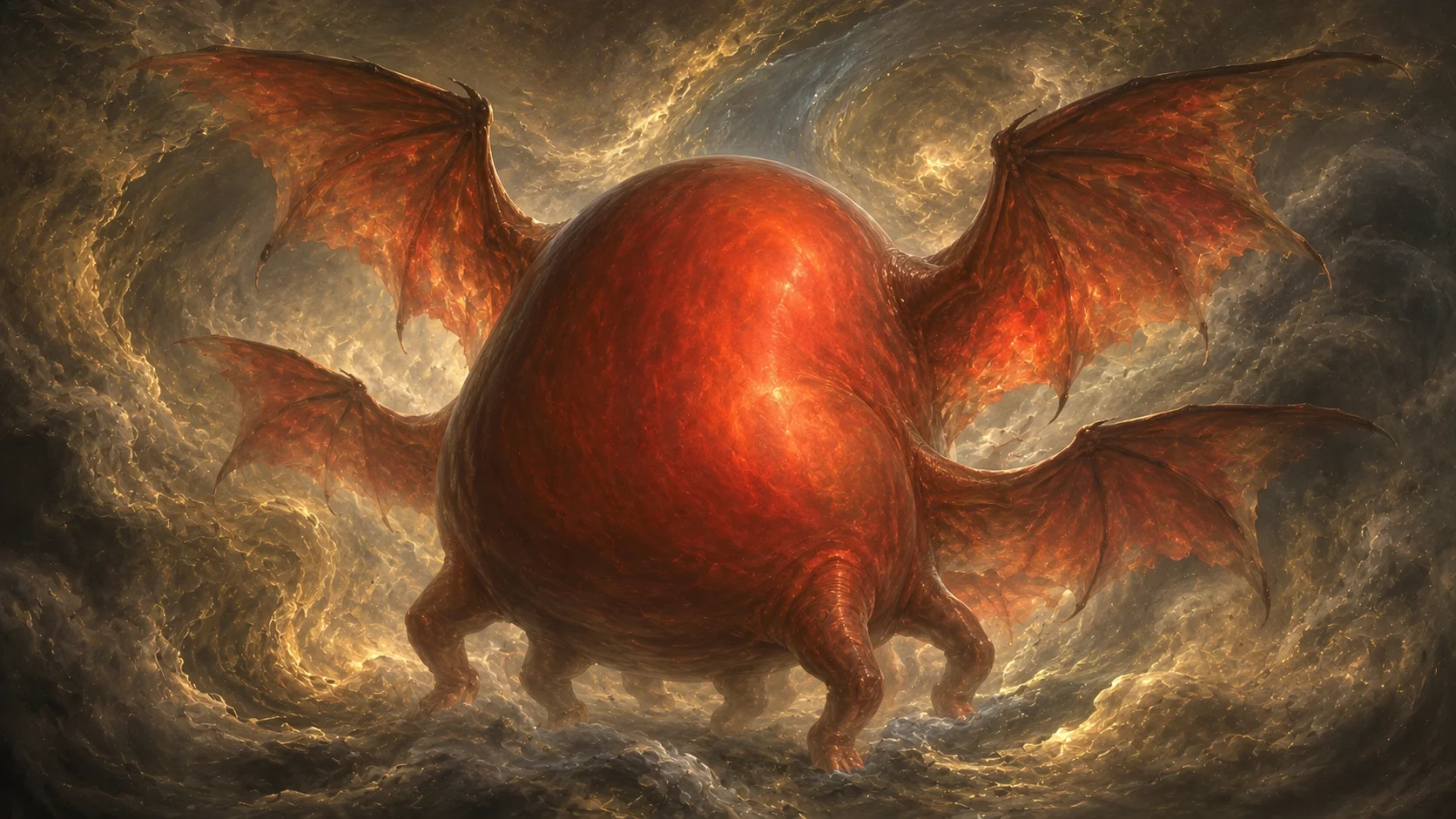
Set the Zhuangzi's philosophical emperor aside for a moment, because the tradition also preserves a wholly different Hundun, one who belongs not to allegory but to the catalogue of strange beings compiled in the Shan Hai Jing, the Classic of Mountains and Seas. There, on a peak called Tianshan, Heaven's Mountain, dwells a creature resembling nothing so much as a yellow sack — red as fire, six-legged, four-winged, and, in the one detail it shares with its philosophical namesake, entirely without a face: no eyes, no ears, no nose, no mouth.
Yet this sack-like being is not inert or passive the way its facelessness might suggest. The text credits it with the ability to sing and to dance, and — strikingly, given its lack of eyes — with knowing how to travel and how to recognize good from evil. It is a being of paradox: featureless yet expressive, sightless yet discerning, closed yet somehow alive to the moral shape of the world around it. Scholars generally treat this Shan Hai Jing creature and the Zhuangzi's Emperor of the Center as separate strands of tradition that happen to share a name and a formless, faceless motif, rather than as one consistent character moving through two stories. The overlap in imagery is real; the overlap in meaning is not.
The Fourth Peril
A third and darker strand runs alongside the first two. In the Zuo Zhuan and later in the Shiji, Hundun appears again — this time named among the Si Xiong, the Four Perils or Four Fiends, standing alongside the ravenous Taotie, the winged tiger-like Qiongqi, and the intractable Taowu. In this genealogy, Hundun is no serene host and no strange singing sack, but an unfilial, wicked son of a legendary ruler, in some tellings connected to Diku or to a clan that itself bore the Hundun name. He is exiled for a chaos that is explicitly moral rather than cosmological: a wrongdoing so thorough that it blurs truth and falsehood together, leaving no way to tell one from the other.
This is the most difficult strand to reconcile with the sympathetic emperor of the Zhuangzi. Where the parable mourns Hundun as chaos wronged by order, the Si Xiong tradition condemns a Hundun who is himself the wrong — chaos not as a lost primal wholeness but as a corrosion of the very distinctions, between right and wrong, true and false, that let a society function. Rather than force these accounts into a single coherent biography, the honest reading holds them apart: three uses of one name, unified by a shared fascination with formlessness and by nothing else that can be safely assumed to connect them.
Chaos Before the Egg
Hundun's cosmological sense — chaos as the condition preceding order — inevitably invites comparison with Pangu, the giant whose story is more properly one of a cosmic egg: an undifferentiated mass out of which the first being emerges to separate sky from earth with an axe. In later retellings, Chinese cosmogonic writers sometimes borrow the imagery of the hundun-state to describe the egg's contents before Pangu splits it open, letting the two traditions bleed into each other at the level of picture-making. But it is worth holding the line the texts themselves hold: Pangu and Hundun descend from different textual strata and were never, in their origins, the same story. One is chaos as a name and a fate; the other is chaos as an egg waiting to be cracked. Later syncretism linked their imagery. It did not merge their histories.
Sealed Like a Dumpling
The name outlived the myth in an unexpectedly domestic form. Huntun, 餛飩 — the dumpling now known abroad as wonton — shares its name with the primordial figure, and Chinese food culture has long delighted in the wordplay this invites: a dumpling with no distinct features, its filling folded and wrapped shut inside a skin that gives away nothing of what lies within, much as Hundun himself was closed and featureless before Shu and Hu opened him. It is a charming connection, frequently repeated in writing about Chinese food, and it captures something true about how the culture plays with the idea of undifferentiated wholeness wrapped inside a single unbroken surface. Whether it reflects genuine etymology or a folk pun layered on afterward remains debated among linguists, and the honest telling keeps that uncertainty rather than resolving it for the sake of a tidier story.
A Myth With No Altar
Unlike so many figures in the wider landscape of Chinese religious life, Hundun has never had a temple, a festival, or a devotional practice built around it. No incense has ever been lit in its name, no procession has ever carried its image through a village street. Its entire significance is literary and philosophical, with a secondary life as a single strange entry in the ancient bestiary of the Shan Hai Jing. This is itself telling: Hundun was never asked to intervene in a harvest or protect a household. It was asked, instead, to sit at the edge of thought and mark the place where categories give out — a role a shrine cannot really hold, but a parable can.
Chaos Refigured for Modern Eyes
In recent popular retellings, the Shan Hai Jing's faceless, sack-like description has occasionally been redrawn to resemble the amorphous blob-monsters familiar from modern fiction — a visual shorthand that makes intuitive sense given the source description, but one that belongs to modern illustration rather than to the classical tradition itself. It is a reminder that a creature defined chiefly by its lack of features is unusually easy to remake in whatever image an era finds compelling, and unusually hard to pin to a single faithful portrait across the centuries.
An Echo Across Distant Traditions
Some scholars working in comparative mythology have proposed a typological kinship between Hundun and other primordial chaos figures found across unrelated cultures — most notably Mesopotamia's Tiamat, the churning sea-mother of an entirely separate cosmogony. The comparison is suggestive: both figures stand for a formless condition that must be dealt with, violently or otherwise, before an ordered world can take shape. But this is a hypothesis born of comparative scholarship, not a claim rooted in the Chinese textual tradition itself, and it should be weighed as such — an interesting resonance across cultures rather than a genealogy connecting them.
What Remains When the Openings Close
What makes Hundun endure, across a philosophical parable, a monster catalogue, a genealogy of moral perils, and a bowl of dumplings, is not a fixed shape but a fixed question: what is lost when wholeness is cut into parts, however kindly the cutting is meant? The Zhuangzi answers with a death delivered by generosity. The Shan Hai Jing answers with a creature that sings and dances and somehow still discerns good from evil without a single feature to do it with. The Zuo Zhuan answers with exile and condemnation. None of these answers agrees with the others, and the tradition has never asked them to. Hundun survives precisely because it was never one thing — because chaos, by its own definition, refuses to be reduced to a single, tidy face.
Sources & traditions
- EncyclopediaWikipedia — Hundun
- TraditionChinese texts, oral tradition and village tellings (China)
Myths change from area to area and from time to time. This chronicle follows the most widely told versions; tellings in other villages, regions and eras may differ.