Sigyn was the faithful wife of Loki — the Norse goddess of devotion and loyalty, who stayed at her treacherous husband's side even in his terrible punishment, holding a bowl above his face to catch the venom that drips upon him until the end of the world. In a pantheon full of grand and violent deeds, her quiet, endless act of love is among the most moving images in all of Norse myth.
The Faithful Wife
Sigyn (Old Norse Sigyn, perhaps “victory-girlfriend”) was an Aesir goddess and the wife of the trickster Loki, by whom she bore sons, including Narfi and Nari (or Vali). Through all of Loki's mischief, scheming and growing wickedness, Sigyn remained loyal to him — a figure of steadfast devotion married to the most faithless being in the cosmos. She is the very personification of fidelity and constancy, her loyalty all the more striking for the unworthiness of its object.
The Binding of Loki
Sigyn's great moment came in the grimmest of the Norse myths. After Loki had engineered the death of Baldr and heaped mockery on the gods, the Aesir hunted him down and took their terrible revenge. They seized Loki's two sons; they transformed one into a wolf, who tore the other apart; and with the entrails of the slain son they bound Loki fast to three sharp rocks in a deep cave. Then the goddess Skadi fixed a venomous serpent above him, so that its poison would drip down forever onto Loki's face, searing him in endless agony — a torment to last until Ragnarök.
The Bowl of Venom
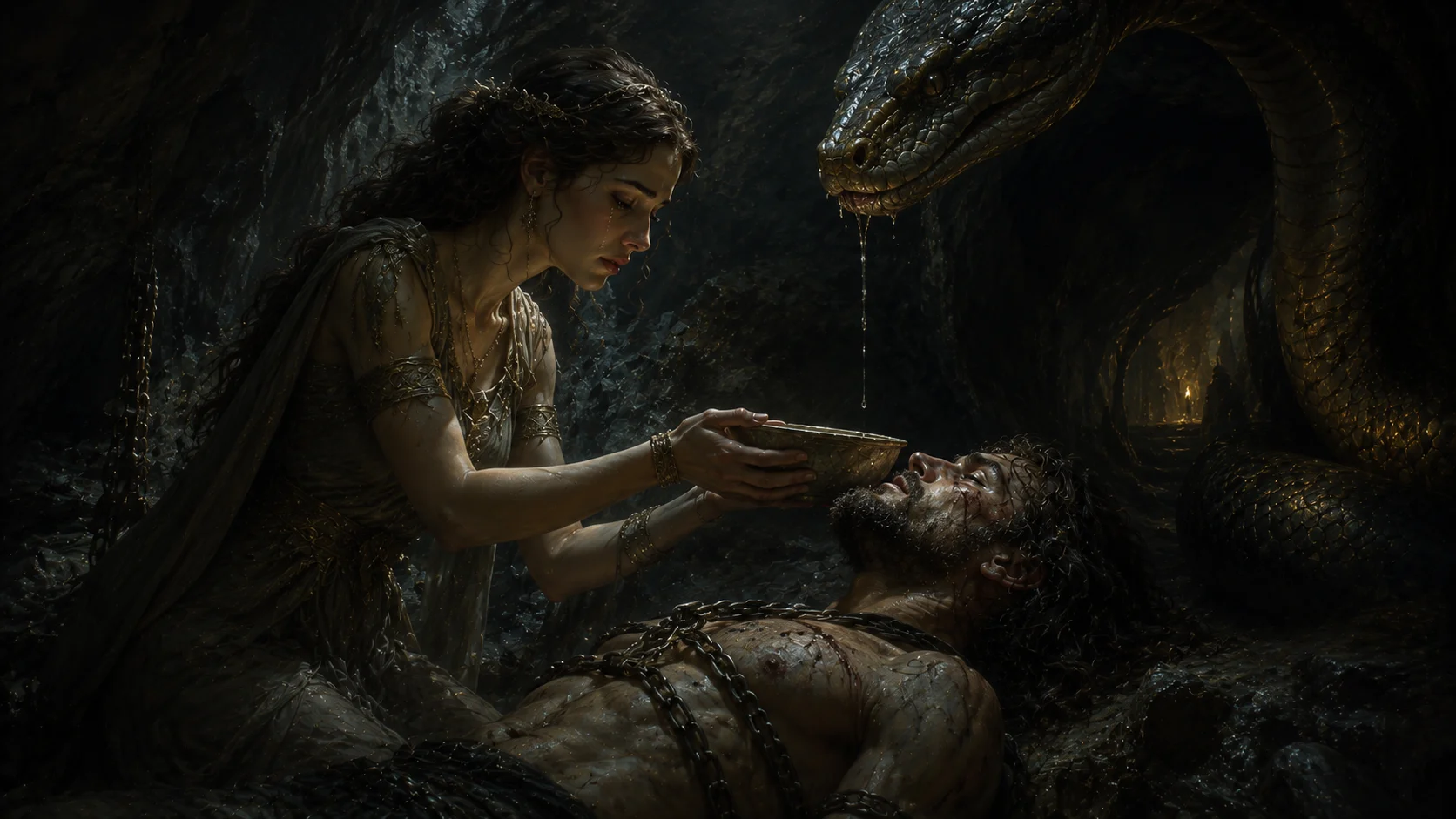
And here Sigyn performed the act for which she is forever remembered. Rather than abandon her bound and tormented husband, she took her place beside him in the cave and held up a bowl over his face, catching the serpent's dripping venom before it could fall upon him. So long as she holds the bowl, Loki is spared the burning poison. But the bowl fills, and when it is full she must turn away to empty it — and in those moments the venom falls upon Loki's face, and he writhes in such agony that the whole earth shakes, and men below call it an earthquake. Then Sigyn returns and raises the bowl again, and the brief mercy resumes. This is her eternal vigil: catching the poison, emptying the bowl, returning, again and again, through all the ages until the world ends.
The Image of Devotion
Sigyn endures as one of the most poignant figures in Norse myth — the faithful wife who would not leave her doomed and guilty husband, who chose to share his punishment and ease his suffering when she might have walked away. She embodies an ideal of loyalty and self-sacrificing love taken to its absolute limit: devotion that persists not because its object deserves it, but simply because it is given. In the dark cave, holding her bowl against the dripping venom for all eternity, she is love that does not abandon, even at the end of the world.
The most faithless being in the cosmos has the most faithful of wives — who stands in the dark holding a bowl above his tormented face, and will go on holding it until the world itself ends.
What the Oldest Sources Actually Say
Sigyn survives in a handful of lines — and that scarcity is itself part of her story. The Eddic witness is Völuspá, the great prophecy-poem of the Poetic Edda, where the seeress sweeps past the bound god in a few cold words on her way to the end of the world. In stanza 35 she sees a captive lying beneath Hveralundr, a shape treacherously like Loki, and then: Þar sitr Sigyn þeygi um sínum ver vel glýjuð — “there sits Sigyn, in no way gladdened over her husband.” That is all. One sentence, built on litotes, the grim Norse habit of understating a horror until it becomes unbearable. She is not glad. The poem moves on to Ragnarök without another glance at her.
The prose coda appended to Lokasenna adds the mechanics: after the flyting, after Loki has insulted every god in the hall and fled, he is caught and bound, and his wife sits beside him holding a vessel beneath the venom. Snorri Sturluson gives the fullest account — Gylfaginning introduces her in chapter 31 as Loki's wife and mother of his son, then returns in chapter 50 for the sons, the wolf, the entrails turned to iron, Skadi's serpent, the basin and the earthquakes. In Skáldskaparmál she is simply counted among the Ásynjur, the goddesses, without a single deed of her own to justify the ranking.
That is very nearly the whole dossier. No poem is addressed to her, no myth belongs to her, no adventure is hers. Everything we know about Sigyn happens in a cave, and nearly all of it is a description of her posture.
The Burden of Sigyn's Arms
The earliest surviving mention of her name is not a story at all but a riddle-phrase in a court poem. The skald Þjóðólfr of Hvinir, composing Haustlöng in the ninth century — generations before any Edda was written down — calls Loki farmr arma Sigvinjar, the cargo of Sigyn's arms: the freight she carries. Three centuries later, Snorri's own list of ways to name Loki still includes the marriage among them, ver Sigynjar, husband of Sigyn.
Two things follow from that small phrase, and both matter. First, Sigyn is old. A skald could not build a kenning on a name his audience did not already know, so by the ninth century she was common property in Norway — not a late literary invention of Christian Icelandic antiquarians, a suspicion that has attached itself to several of the quieter goddesses. Second, and more hauntingly: the very first time we meet Sigyn in the written record, she is already defined by what she is holding. The oldest fact about her is that her arms are full.
The skaldic line also preserves an older shape of the name. The metre requires Sigvinjar rather than the later Sigynjar, and that older form shows the parts plainly: sigr, “victory,” and vina, “female friend” — victory-friend, the friend who brings victory. It is the same victory-element that names valkyries, Sigrún and Sigrdrífa among them. It was given to a goddess whose entire recorded career consists of losing.
A Goddess Who Never Speaks
In Lokasenna, every god in the hall gets a voice. Odin speaks, Frigg speaks, Freyja speaks, Skadi speaks, Sif speaks, even the servant Beyla speaks. Loki tears through all of them and they answer him. Sigyn belongs to the room's aftermath — she appears only in the prose that closes the poem — and she says nothing.
She says nothing anywhere. Across the whole surviving corpus of Norse myth, Sigyn is never given a line of dialogue. She never pleads for her husband, never curses the gods who killed her children, never explains herself. We are not told that she wept, or forgave, or hated. We are told only that she sat, and that she was not glad.
Nothing survives to suggest she was worshipped in the heathen period either: no temple, no recorded festival, no securely attested place-name, no charm or invocation. She is one of those figures who exist in Norse religion purely as an image — and the image proved strong enough to outlive the religion that produced it.
Narfi, Nari and the Confusion of the Sons
The killing of Sigyn's children is the hinge of the whole episode, and the sources cannot keep their names straight. Gylfaginning gives Loki and Sigyn two sons, Nari (or Narfi) and Váli; the gods transform Váli into a wolf, and he tears his brother apart. The prose after Lokasenna tells it with the names distributed differently, and no Váli in it at all. Manuscripts disagree; editors emend; the muddle is genuine and old.
The confusion deepens because both names collide with other figures. A Nörfi or Narfi appears elsewhere as the giant father of Nótt, the night. And Váli is also the name of Odin's son, begotten specifically to avenge Baldr — one night old, the poems say, when he took that vengeance, having neither washed his hands nor combed his hair. That two Vális stand on either side of the same catastrophe, one avenging Baldr and one used as the instrument of vengeance against Baldr's killer, is the kind of dark symmetry the Norse material throws up constantly and never bothers to explain.
One distinction is essential and often lost. Sigyn is not the mother of Loki's monsters. Fenrir the wolf, Jörmungandr the world-serpent and Hel who rules the dead were born to the giantess Angrboða. Loki has two families, and their fates are exact opposites: Angrboða's children survive to destroy the gods at Ragnarök; Sigyn's children are destroyed by the gods before it. The monstrous brood endures. The ordinary sons die first, and their bodies become the rope.
The Basin
The word used for Sigyn's vessel is mundlaug — the manuscripts also give munnlaug — and it means, literally, a “hand-bath.” It is not a ritual chalice or a divine artefact with a name and a history, the way Norse myth usually equips its objects. A mundlaug is the wash-basin a household passes round before a meal. It is the most ordinary thing in a Viking-age hall.
That is the detail worth sitting with. The gods bring their whole apparatus of divine punishment to bear — a transformed son, iron-hard entrails, three standing stones, a serpent hung by a goddess of the mountains — and what stands against it, for all eternity, is a woman with the kitchen bowl. Norse myth is full of magnificent countermeasures: hammers, spears, chains forged from impossible ingredients. Sigyn's answer to the venom is domestic, unmagical and completely inadequate, and she uses it anyway.
Hveralundr, and the Ground That Shakes
Völuspá gives the place a name: Hveralundr, which means something like “kettle-grove” or “grove of hot springs.” Hverr is the word Icelandic still uses for a boiling spring. The bound god does not lie in some abstract underworld; he lies in steam and sulphur and hot mud, in a landscape any Icelander could walk to.
Read that alongside the earthquakes and the myth turns into something quite specific. Snorri wrote in Iceland, on ground that shudders and steams and periodically tears itself open, and his story hands his countrymen an explanation they could feel through the soles of their feet: the tremor is the interval, the few seconds in which the bowl is elsewhere. It is one of the rare Norse myths tied to a physical event people actually experienced — and it makes every earthquake a message about a marriage.
Nobody Bound Sigyn
Here is the detail the story never comments on, and which changes everything once noticed: the gods did not sentence her. There is no line in any source in which the Aesir condemn Sigyn, chain her, or forbid her to leave. They bound Loki. Nobody bound Sigyn.
She is, as far as the sources go, the only figure in Norse myth serving an eternal punishment voluntarily. Fenrir strains against Gleipnir; Loki writhes against the stones; both would be free in an instant if they could. Sigyn could stand up and walk out at any moment between now and the end of the world, and the myth's whole weight rests on the fact that she does not. Her chain is the one she is holding.
Set her beside Frigg and the contrast sharpens. Frigg tried to save her son by extracting an oath from every thing in creation, and one overlooked plant undid her — the tragedy of the mother who did everything and lost anyway. Sigyn does not attempt rescue at all. She never tries to loosen the bonds, never petitions the Aesir, never seeks a loophole. She has looked at a situation with no solution and chosen the only thing left: not fixing, but easing. The distinction is the difference between heroism and care, and Norse myth, which usually has no time for the second, gives it one of its most enduring images.
How to Recognise Her
Sigyn is one of the few Norse goddesses with an unmistakable visual signature. She is a standing or kneeling woman with both arms raised, holding a bowl or basin above her head or shoulder; beneath her a man lies bound and contorted; above them a serpent coils. No other scene in the northern repertoire looks like it.
The oldest probable image is carved on the Gosforth Cross in Cumbria, an Anglo-Scandinavian stone usually dated to the tenth century and still standing in an English churchyard, its red sandstone shaft mixing Christian imagery with scenes from Norse myth. Low on the west face is a bound, manacled figure with a knotted serpent above him and a long-haired woman kneeling with a vessel held out over him, and the panel is widely read as Loki and Sigyn. If the identification is right — and it is the standard one — then Sigyn's vigil was being cut into stone by Norse settlers in England on the same monument that carries the Crucifixion: two images of a suffering body and the women who would not leave it, on one cross.
When Scandinavian painters of the Romantic era went looking for subjects in the old religion, they found her again: the cave, the raised bowl, the upturned face. It is a composition that needs no caption. Anyone who sees it understands immediately what is happening and how long it has been going on.
Sigyn Today
Sigyn is honoured in contemporary Heathenry and Ásatrú, where practitioners who keep her commonly associate her with endurance, compassion, and the unglamorous work of caring for someone who cannot be cured. Some describe their devotion in exactly the terms her myth suggests, as a commitment made without expectation of resolution. This is living practice rather than antiquarian reconstruction, and it is one of the clearest examples of a modern community finding weight in a figure the medieval sources barely bothered to describe.
Outside religious practice she has fared less well. Loki has become one of the most recognisable figures in global popular culture, endlessly reinvented in comics, television and games; Sigyn has largely been left in the cave. She appears in Marvel's Thor comics as Loki's wife, but screen adaptations have generally passed her by. The trickster travels. The woman holding the bowl does not, because her story cannot be adapted into anything — there is no arc in it, no reversal, no escape. It is one gesture, repeated forever.
Why the Story Will Not Let Go
Most myths are about doing. Sigyn's is about staying, and that is why it has outlasted gods with far more spectacular careers.
Everyone eventually meets a version of her cave. Someone we love is in pain that will not end, and nothing we can do will end it — the parent with dementia, the spouse whose illness has no cure, the addict who will not stop, the friend whose grief has no bottom. What is left is not rescue but relief: the bowl held up for as long as the arms last, knowing there will be a moment when it must be emptied and the poison will fall, and knowing you will come back and raise it again. It is a story about the specific exhaustion of the carer, and it is more than a thousand years old.
The Norse were not sentimental people, and they did not give Sigyn a happy ending. There is no version in which the bonds break early, no rescue party, no reward. When Ragnarök comes and Loki finally tears loose to lead the dead against the gods, the sources do not tell us what becomes of her. Her vigil ends only because the world does.
And yet the image survives because it says something the heroic poems cannot. The Aesir measured worth in deeds; Sigyn has none. She kills nothing, wins nothing, discovers nothing. She simply refuses to leave, and a culture built on glory kept her anyway — because somewhere in the telling, the people telling it recognised that the hardest thing a person can do is not the deed at all. It is the returning. Again, and again, and again, until the world ends.
Sources & traditions
- EncyclopediaWikipedia — Sigyn
- TraditionNorse texts, inscriptions and later retellings (Scandinavia)
Myths change from area to area and from time to time. This chronicle follows the most widely told versions; tellings in other villages, regions and eras may differ.