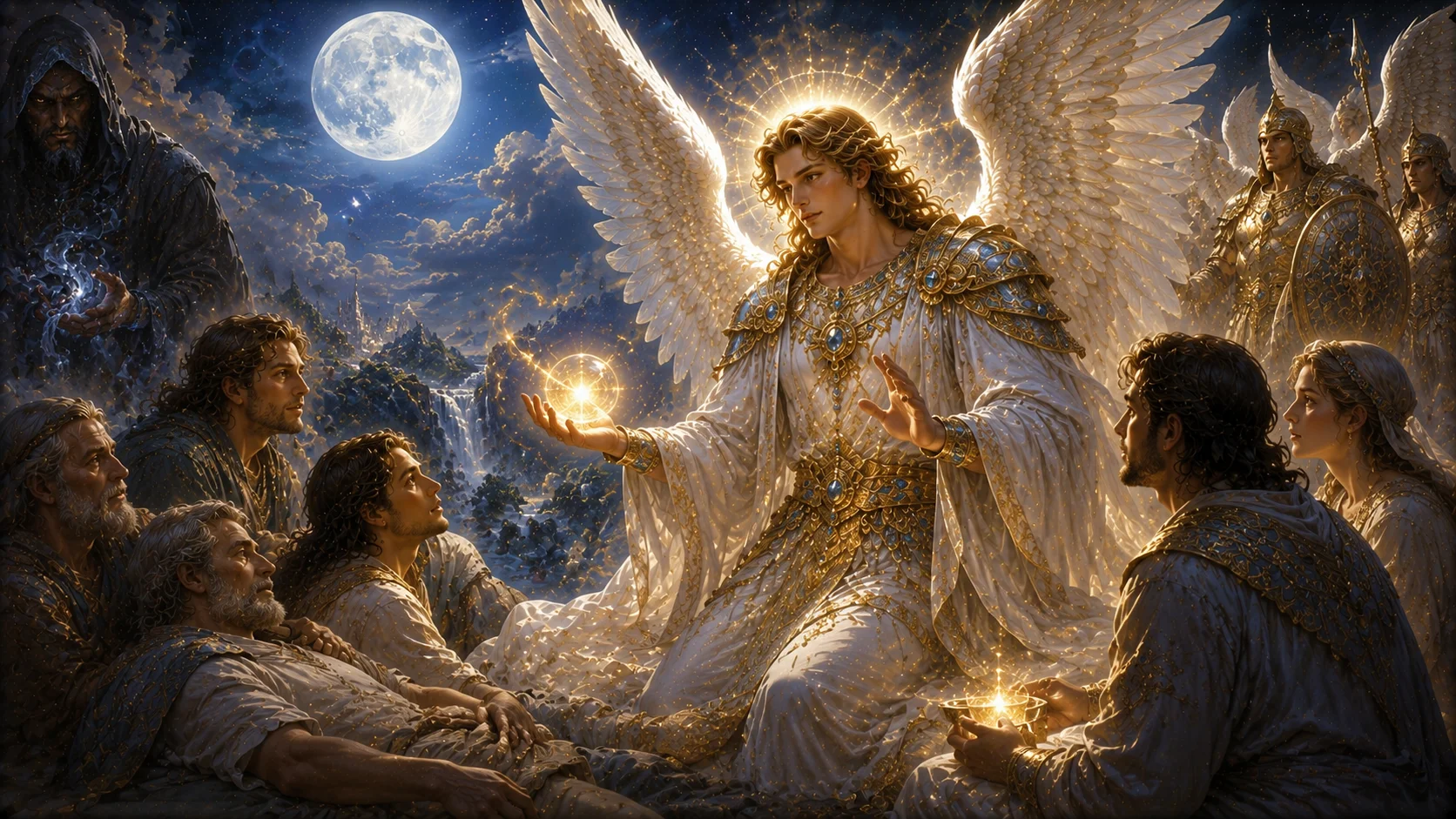
Sariel — “the Command of God” — is an archangel of Jewish tradition associated with healing, the moon, knowledge, and the fate of souls: one of the holy angels named in the Book of Enoch, a teacher of divine secrets and a guardian against evil, sometimes counted among the seven archangels and the leaders of the heavenly host. He is the command and the knowledge of God.
The Command of God
Sariel (Suriel, Saraqael, “the command of God” or “God is my ruler”) is named in the Book of Enoch among the holy archangels — in one list, the angel “set over the spirits who sin against the spirit,” that is, over the fate and judgment of certain souls. He is an angel of knowledge and divine command, a teacher who reveals the secrets of heaven (in some traditions, the courses of the moon, or the knowledge of certain mysteries), and a guardian and healer.
The Healer and the Teacher
Sariel is associated with healing — in some traditions he is an angel of healing, invoked against sickness and evil — and with knowledge and the imparting of divine secrets and teaching. He is connected with the moon and its courses, and with the fate of souls and the judgment of spirits. In the Dead Sea Scrolls, Sariel is named as one of the four (or seven) chief angels, one of the great princes of the heavenly host who lead the angels of light. He is a guardian against evil and a revealer of hidden knowledge.
The Guardian and the Knowledge of Heaven
Sariel is invoked for healing, knowledge, protection against evil, and guidance, the angel of the command and knowledge of God. As one of the holy archangels of the Book of Enoch and a chief of the heavenly host in the Scrolls, he holds an important place among the great angels, though he is more enigmatic and less widely known than Michael or Gabriel. In Sariel, Jewish tradition gave form to divine command, knowledge, and healing — the archangel of the command of God who teaches the secrets of heaven, heals and guards against evil, watches over the fate of souls and the courses of the moon, one of the holy princes of the heavenly host.
The Angel Who Appears in Both Ledgers
Read the Book of Enoch straight through and something goes wrong with Sariel. In chapter twenty he stands among the seven holy angels who watch, each given a portion of creation to oversee. Fourteen chapters earlier he is standing on the summit of Mount Hermon with two hundred rebels, binding himself to them by mutual curse before a crime against heaven.
This is not a scribal slip that later copyists tidied away. The roll of the chiefs who descend in 1 Enoch 6 ends, in the standard translations, with Sariel — the last name on the list of the fallen — while the list of holy angels in 1 Enoch 20 includes Saraqael, widely identified as the same name in another dress, the angel set over the spirits who sin in the spirit. One Sariel is among those who carry forbidden knowledge down the mountain; the other is appointed to judge the spirits who do exactly that. The text hands you both without a word of explanation.
He is not quite alone in this. Remiel appears in the same doubled position — a Ramiel among the descending chiefs, a Remiel among the holy seven — which is the surest sign that we are not looking at one copyist’s mistake but at a fault line in the tradition itself. The Enochic literature was assembled over centuries out of older Aramaic material, and angel-names travelled between traditions the way tools travel between workshops: picked up, repurposed, occasionally used against their former owner. Sariel is the case where the doubling matters most, because of what he is accused of teaching.
The Crime Was the Moon
The eighth chapter of 1 Enoch runs through the curriculum of the Watchers like a charge sheet. One taught the cutting of roots, one the breaking of spells, one astrology, one the constellations, one the reading of clouds, one the signs of the earth, one the signs of the sun. And Sariel — Sariel taught men the course of the moon.
To a modern reader that sounds harmless, even beautiful. It was not meant to. The Astronomical Book embedded in Enoch sets out at length a schematic 364-day year, a year that divides cleanly into fifty-two weeks so that every festival falls on the same weekday for ever — and the book returns, near its end, to warn that in the days of the sinners the reckoning itself will go wrong, that the moon will alter its order and men will err concerning it. The same quarrel runs through the Book of Jubilees and through the sectarian writings from the Dead Sea, which set their festivals by that fixed calendar and not by the lunar reckoning of the Jerusalem establishment.
Read against that quarrel, Sariel’s crime stops being astronomy and becomes something sharper. He gave humanity the wrong clock. It is one of the most quietly devastating ideas in the apocalyptic corpus: that a piece of knowledge can be perfectly accurate and still be a catastrophe, because of what it displaces. The moon is not false. The moon is simply not what the calendar of heaven runs on.
Four Names on Four Shields
Among the scrolls recovered from the caves above the Dead Sea is a battle plan for the end of the world. The War Scroll sets out, with the flat precision of a quartermaster’s inventory, how the Sons of Light will be armed, formed and marched against the Sons of Darkness — and it specifies what is to be written on the shields of the four towers of the formation. Four names, one to a tower: Michael, Gabriel, Sariel, Raphael.
Sariel is no marginal figure here. He is one of four cardinal angels belonging to a community that expected to fight beside them, his name assigned to equipment men expected to carry into a real battle. And his presence in that quartet points at something the later tradition quietly buried.
Compare that shield list with the one most readers know. In 1 Enoch 9, four angels look down from heaven and hear the blood of the earth crying out, and the received text names them Michael, Uriel, Raphael and Gabriel — though some versions carry Suriel in the group as well. The fourth seat is the same seat. Who sits in it depends on which book you have open.
And the drift runs consistently in one direction. Where the older material has Sariel, the later material tends to have Uriel: in the Sibylline Oracles, Uriel stands in the group of four; in rabbinic texts such as Numbers Rabbah and Pesiqta Rabbati, and in the Apocalypse of Moses, the same substitution recurs. Uriel — light of God, a name easier to love, and one that survived into the mainstream — took the post, and Sariel was left drifting between the archangel lists and the Watcher lists, belonging fully to neither.
A Name That Will Not Hold Still
Sariel, Seriel, Suriel, Suriyel, Sauriel, Souriel, Sarakiel, Saraqael: the spellings multiply because the Hebrew consonants behind them can be pointed more than one way, and because scribes working in Aramaic, Greek, Ge’ez, Syriac and Latin each heard the name through their own phonology.
The meaning shifts with the reading. Take the first element as śar, prince or commander, and you arrive at the familiar gloss — the command of God, God as ruler — and at the title the Talmud gives him, not merely an angel but a sar, an officer of the court. Take it instead from the root meaning to strive or to contend, and something else surfaces: the same root that gives Israel its name, the name Jacob receives at the ford of the Jabbok after a night of wrestling with a being he cannot identify and will not release. Whether the ancient writers heard that second echo is not something the texts settle. But it is there in the consonants, and Sariel’s reputation as an angel who deals in hard, contested, dangerous knowledge sits comfortably beside it.
Suriel, Prince of the Presence
The Babylonian Talmud gives Sariel his most human appearance, and it is not what a reader of Enoch would expect. In tractate Berakhot, Rabbi Ishmael reports that Suriel, the Prince of the Presence, told him three things — and the three things are domestic almost to the point of comedy. Do not take your shirt in the morning from the hand of the attendant and put it on. Do not let your hands be washed by someone who has not washed his own. Do not hand the cup back to anyone but the person who gave it to you.
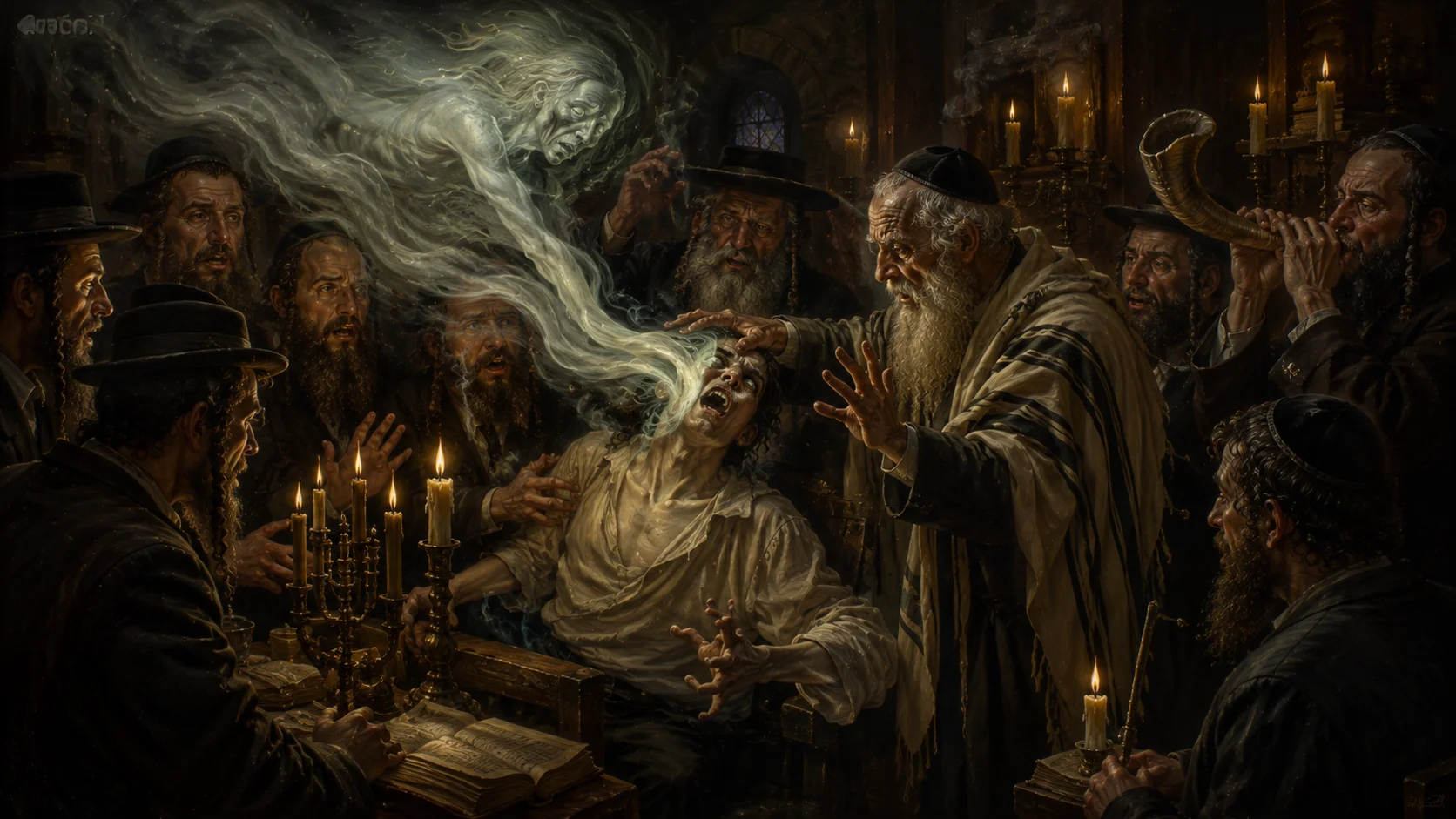
The reasoning is that harmful spirits wait in exactly these small unguarded transactions: the moment of half-dress, the borrowed water, the passed cup. This is the ancient world’s religion of the household, and one of the great angels of the apocalyptic war has been recruited to superintend it. The archangel painted on a battle-shield is here explaining table manners, because the front line between order and chaos runs through a bedroom at dawn as surely as it runs through the last battle.
The title matters as much as the advice. A Prince of the Presence stands inside the throne room, in the immediate radiance, close enough to be addressed. The Hekhalot writings — the visionary literature of the heavenly palaces — are largely about how a human being might survive that proximity and, more daringly, what he might ask for on arrival. A recurring goal there is knowledge itself: the adjuration of a Prince of Torah to fix the whole of it in a man’s memory without years of study. An angel of the Presence who is also an angel of taught secrets is precisely the figure that literature needs.
The Name on the Amulet
Sariel’s reputation as a healer is real, but it does not come from scripture. It comes from the objects.
Across late-antique Palestine and Sasanian Babylonia, ordinary households protected themselves with written names: metal lamellae rolled into pendants, and earthenware bowls inscribed in spirals of Aramaic and buried mouth-down beneath the threshold or the corner of a room, to catch and hold whatever came for the family inside. The texts on them are not theology. They are practical — a sick child, a failing pregnancy, a neighbour’s curse, a demon named and bound — and their power was held to lie in marshalling the right angelic names in the right order.
Suriel belongs to that world of invoked names, and the Talmud all but confirms it by putting anti-demonic household instructions in his mouth. This is worth stating plainly rather than smoothing over: the archangel of healing and protection that later devotional writing describes owes a great deal to the archangel of the amulet, promoted. It makes him no less genuine a figure of Jewish tradition. It makes him a figure who reached the tradition from below, through the hands of frightened people, rather than down from a canonical page.
Where He Is Still Named
Western Christianity narrowed sharply. The Church came to recognise three archangels by name — Michael, Gabriel, Raphael — and councils and synods from the fourth century onward discouraged the invocation of angels under names not found in scripture. Sariel, whose entire dossier lay in books the West had stopped copying, simply fell out of the language.
He did not fall out everywhere.
The Ethiopian Orthodox Tewahedo Church holds the Book of Enoch — Mets’hafe Henok — as canonical scripture, and the Ge’ez text preserved in Ethiopia is the only complete version of Enoch that survives anywhere in the world. Every European translation of the book, and by descent every modern retelling of the Watchers and their fall, goes back to manuscripts kept in use by that church. For Ethiopian Christians, Saraqael is not an obscure name from an apocryphon; he is scriptural, part of a text read and honoured as the Word.
In the Coptic Orthodox Church, seven archangels are venerated together — Michael, Gabriel, Raphael, Suriel, Sedakiel, Sarathiel and Ananiel — and Suriel has a feast of his own, kept on the twenty-seventh of Tobi. His office there is a startling one for an angel the West forgot: he is the trumpeter, the one whose sounding gathers the elect from the four winds and raises the righteous from the dead. The Beta Israel of Ethiopia knew him under the same title. The angel accused of teaching men the wrong clock ended up holding the horn that stops time altogether.
And there is a quieter survival in Jewish practice. The bedtime Shema sets four angels around the sleeper — Michael at the right, Gabriel at the left, Uriel in front, Raphael behind, and above the head the Presence of God. It is almost exactly the quartet the War Scroll assigned to its four towers, shrunk from an eschatological battlefield to the space around a bed. Almost. Sariel’s post is still there. Uriel is standing in it.
Why the Fourth Angel Keeps Coming Back
Sariel is the patron of a specific and permanent human unease: the suspicion that knowledge arrives from somewhere, that it is handed to us, and that the hand may not be clean.
Every tradition that thinks seriously about revelation runs into this. The Greeks put it in Prometheus, punished for a gift that was genuinely useful. The astronomy that lets you predict an eclipse is the astronomy that lets you claim the sky is a machine; the medicine that saves the child is the root-craft the priests forbade. What makes the Watchers myth unusually unforgiving is that it refuses the easy exit — it never says the teaching was false. It says it was taken and handed down early, out of order, and that knowledge acquired that way deforms the people who receive it. Sariel, who taught the moon and was also appointed to judge those who sin in the spirit, is the figure in whom that argument is left unresolved.
That unresolved quality is exactly why he keeps resurfacing. Michael has a job and a sword. Gabriel has a message. Raphael has a patient. Sariel has a name, a place in a formation, a demoted seat, and a crime he may or may not have committed — which is to say he has the shape of a character rather than the shape of a function. Novelists, game designers and screenwriters have noticed. The name reads as authentically ancient, because it is; the personality is open, because the sources never closed it.
The tradition itself never sorted him out. It kept both entries, the holy and the fallen, standing side by side in one book, and left the reader to sit with the possibility that the angel who governs the fate of sinning spirits knows the work from the inside.
Sources & traditions
- EncyclopediaWikipedia — Sariel
- TraditionJewish/Kabbalistic texts, grimoires and later commentary
Myths change from area to area and from time to time. This chronicle follows the most widely told versions; tellings in other villages, regions and eras may differ.