Raziel — “the Secret of God” — is the archangel of mysteries and divine secrets in Jewish mysticism: the keeper of the hidden wisdom of the cosmos, who stands close to the Throne and hears the secrets spoken there, and who is the supposed author of the Sefer Raziel, the legendary “Book of the Angel Raziel” containing all the secret knowledge of heaven and earth. He is the angel of esoteric wisdom.
The Secret of God
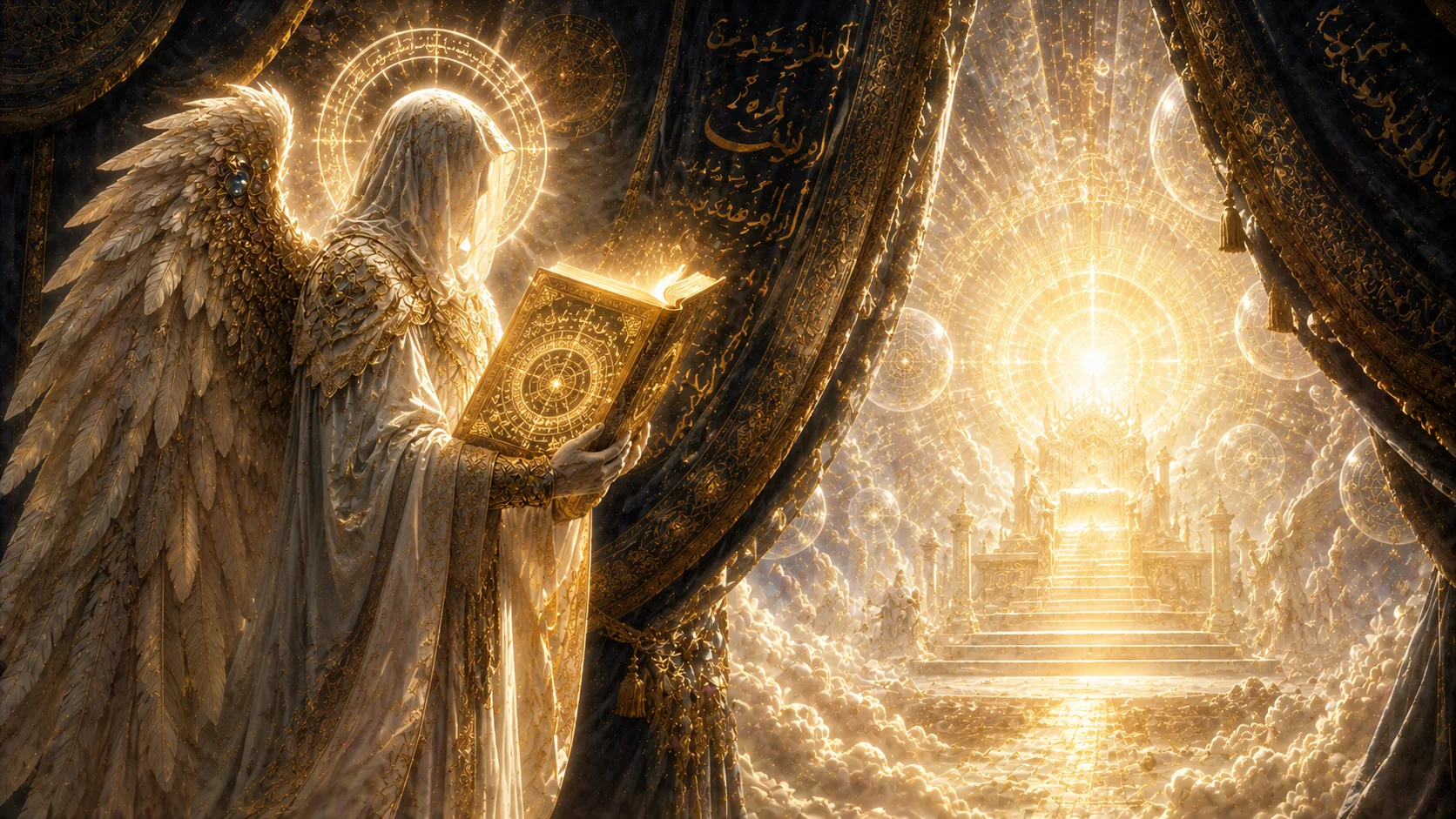
Raziel’s name means “the secret of God” or “God is my secret,” and his nature is bound to the divine mysteries. He is the angel who stands closest to the curtain (the pargod) before the Throne of Glory, and who hears the secrets of the universe spoken by God and the celestial council — the hidden wisdom of creation, the mysteries of the cosmos, the secret workings of all things. He is the keeper and the revealer of esoteric knowledge, the angel of the deepest secrets of heaven.
The Book of Raziel
Raziel’s great legend concerns the book that bears his name. According to tradition, after Adam and Eve were expelled from Eden, the angel Raziel took pity on Adam and gave him a book — the Sefer Raziel ha-Malakh, the “Book of the Angel Raziel” — containing all the secret wisdom of the cosmos: the knowledge of the heavens, the stars, the angels, the mysteries of creation, and the secret names and magic by which the world is governed. This book of all wisdom was passed down (in the legend) through the generations — to Enoch, to Noah (who used it to build the Ark), to Solomon — the supreme grimoire of divine secrets. The actual Sefer Raziel, a medieval Kabbalistic and magical text, claims this celestial origin.
The Keeper of Wisdom
Raziel is honoured as the patron of secret wisdom, esoteric knowledge, and the deep mysteries of the Kabbalah — the angel to whom the hidden truths of the cosmos are known, the keeper of the book of all wisdom. In some traditions he is associated with the sefirah of Chokhmah (Wisdom) on the Tree of Life. A figure of profound mystical importance, Raziel embodies the longing for the hidden knowledge of heaven. In Raziel, Jewish mysticism gave form to divine secrets and esoteric wisdom — the archangel who stands by the curtain of the Throne and hears the mysteries of creation, the keeper of the Book of all wisdom given to Adam, the angel of the deepest secrets of heaven and earth.
Before the Book
No verse of the Hebrew Bible names Raziel, and the Talmud never mentions him either. The archangel of secrets belongs to a later, stranger stratum of Jewish writing — the mystical and magical literature that grew up on the margins of rabbinic study, recording what the sages preferred to leave unsaid. Centuries before the Sefer Raziel ha-Malakh existed in the form now printed and sold in Judaica shops, Jewish magical literature already had books with the same ambition: to map the hidden architecture of the heavens, name the angels who administer each level of it, and hand a mortal reader the keys. One such text — the Sefer ha-Razim, or “Book of Mysteries,” a work of late antiquity describing seven heavens stacked with named angelic officials, to be invoked for healing, protection, and practical magic — survived only in scattered fragments for centuries until modern scholarship pieced it back together from manuscripts, including material recovered from the Cairo Genizah. Raziel’s book did not spring from nowhere. It inherited a genre, and a hunger for total knowledge, that Jewish mystics had been feeding long before his name was ever attached to it.
The Angels Who Grew Jealous
Tradition does not let the gift to Adam pass quietly. In the fuller telling, Raziel’s decision to hand a book of heaven’s secrets to a man freshly expelled from Eden for reaching after forbidden knowledge scandalised the rest of the angelic host. Secrets of that order, they argued, were not meant to descend to a being made of dust. The story says the envious angels stole the book and flung it into the sea, hoping to drown its wisdom before Adam could open a single page. It did not stay drowned. Rahab, the prince of the deep — the same sea-power the Hebrew Bible remembers being subdued at creation — was sent down after it, and brought the book back up to Adam. It is a strange episode to attach to an angel otherwise defined by calm, custodial patience, and it says something pointed about the legend’s view of secrecy: even in heaven, the story insists, hidden knowledge is something other beings would rather see destroyed than shared.
A Guardian at the Cradle
Long after the legend of the book settled into its familiar shape, it kept working — not as scripture to be studied but as an object carried into the most dangerous room in the house. In Ashkenazi communities across Europe, and among some observant families today, a copy of Sefer Raziel is placed in the room of a woman in labour, or set beside a newborn’s cradle, as a ward against Lilith and the spirits believed to threaten mothers and infants in the vulnerable days around birth. The book did not need to be read to do this work, only to be present: its association with the archangel who guards heaven’s secrets was thought to extend a kind of protection over the room itself. A related folk belief held that a household that owned a copy would never burn down. It is a fitting afterlife for a text whose founding legend turns on knowledge handed to a family newly exposed to a world outside Eden — centuries later, that same book was still being carried into rooms where a family felt most exposed.
An Angel Without a Face
Jewish tradition’s discomfort with picturing the divine extends to its angels, and Raziel has almost no settled visual iconography — no attribute, no face, nothing you could point to in a painting and say that is Raziel, the way a sword names an archangel of judgement or a lily names one of annunciation. What stands in for a portrait is the book itself. Manuscript and early printed editions of Sefer Raziel are dense with the visual vocabulary of hidden power: circular diagrams charting the heavens and the planetary spheres, protective seals meant to be copied by hand onto amulets, and columns of angelic names rendered in specialised alphabets built to be unreadable to anyone the working was not intended for. To recognise Raziel in the surviving tradition, in other words, is to recognise a page covered in seals rather than a figure at all — an angel more legible as a code than as a face.
From a King’s Library to a Video Game
The book crossed out of Jewish tradition and into the wider current of European learned magic remarkably early. In the mid-thirteenth century, the court of King Alfonso X of Castile — a monarch who sponsored the translation of Arabic and Hebrew astronomical and magical texts into Latin and Castilian on an almost industrial scale — produced a Latin Liber Razielis Archangeli among its output, folding Raziel’s book into the same current of astral magic that carried the far better known Picatrix into Christian Europe. From there the name kept travelling in looser and looser company. Cassandra Clare’s Shadowhunter novels cast Raziel as the angel who creates the Nephilim and grants the founding relics of her invented order, borrowing directly from his old identity as the being who hands mortals knowledge and power they would not otherwise be permitted. The name has reached video games too, most famously as the protagonist of Crystal Dynamics’ Legacy of Kain: Soul Reaver, a fallen lieutenant turned loose on his own former brethren — a plot with no real debt to the Kabbalistic legend beyond the borrowed name, but a telling borrowing all the same: stripped of its theology, “Raziel” still reads as a name for someone who knows something he was not supposed to survive knowing.
Why We Still Want the Book
Strip away the angelology and the myth’s engine is a very old, very human transaction. Paradise is lost because two people reached for forbidden knowledge, and the story’s answer is not to close the subject but to reopen it: an angel appears at the gate of Eden and hands the exiles a book containing everything, as though the punishment for wanting to know had always been in proportion to how much there still was left to learn. That is a stranger and more generous response than the expulsion itself, and it may be why the legend kept being copied, translated, smuggled into a king’s library, tucked beside a mother’s pillow, and borrowed by novelists and game designers who never opened a page of Kabbalah in their lives. A book that claims to hold every secret is, among other things, a kind of permission: it says the hunger Adam and Eve were punished for was never a flaw to be corrected, only an appetite that heaven itself eventually chose to feed.
Sources & traditions
- EncyclopediaWikipedia — Raziel
- TraditionJewish/Kabbalistic texts, grimoires and later commentary
Myths change from area to area and from time to time. This chronicle follows the most widely told versions; tellings in other villages, regions and eras may differ.