Azrael, a name popularly glossed as "help of God," is the figure widely known today as the angel of death — the celestial office charged with separating the soul from the body at the hour God has appointed. But the name itself deserves an honest caution before anything else: Azrael does not appear in the Hebrew Bible, and it is not the name the Talmud or early midrash uses for this office. The classical rabbinic sources speak of the Malakh ha-Mavet (מלאך המוות), the Angel of Death, without attaching a personal name to him at all. The name "Azrael" enters Jewish tradition only later, through popular folklore, and its firmest roots lie in Islamic literature, where he is known as Malak al-Mawt. In regions of long Jewish-Muslim cultural contact — Judeo-Arabic and Judeo-Persian communities especially — that Islamic figure and his name were absorbed into Jewish folk sources. What follows should be read with that layering in mind: a rabbinic core concerning the Angel of Death, and a later, syncretic name laid over it.
A Name Borrowed Across a Border
Scholars remain genuinely divided on whether "Azrael" has any independent pedigree in Jewish sources prior to Islam, and the honest answer is that most classical rabbinic texts simply never use it. The Talmud and the early midrashic collections speak only of the Malakh ha-Mavet, an office and a function rather than a proper name. The identification of that office with the name Azrael belongs to a later stratum: post-biblical folklore, popular storytelling, and Kabbalistic-adjacent literature that had already been in conversation with Islamic angelology for centuries. This is not a flaw to be smoothed over. It is the honest shape of the tradition, and it is worth stating plainly rather than letting a popularized single figure stand in for what the older sources actually preserve.
The Talmud's Angel, Full of Eyes
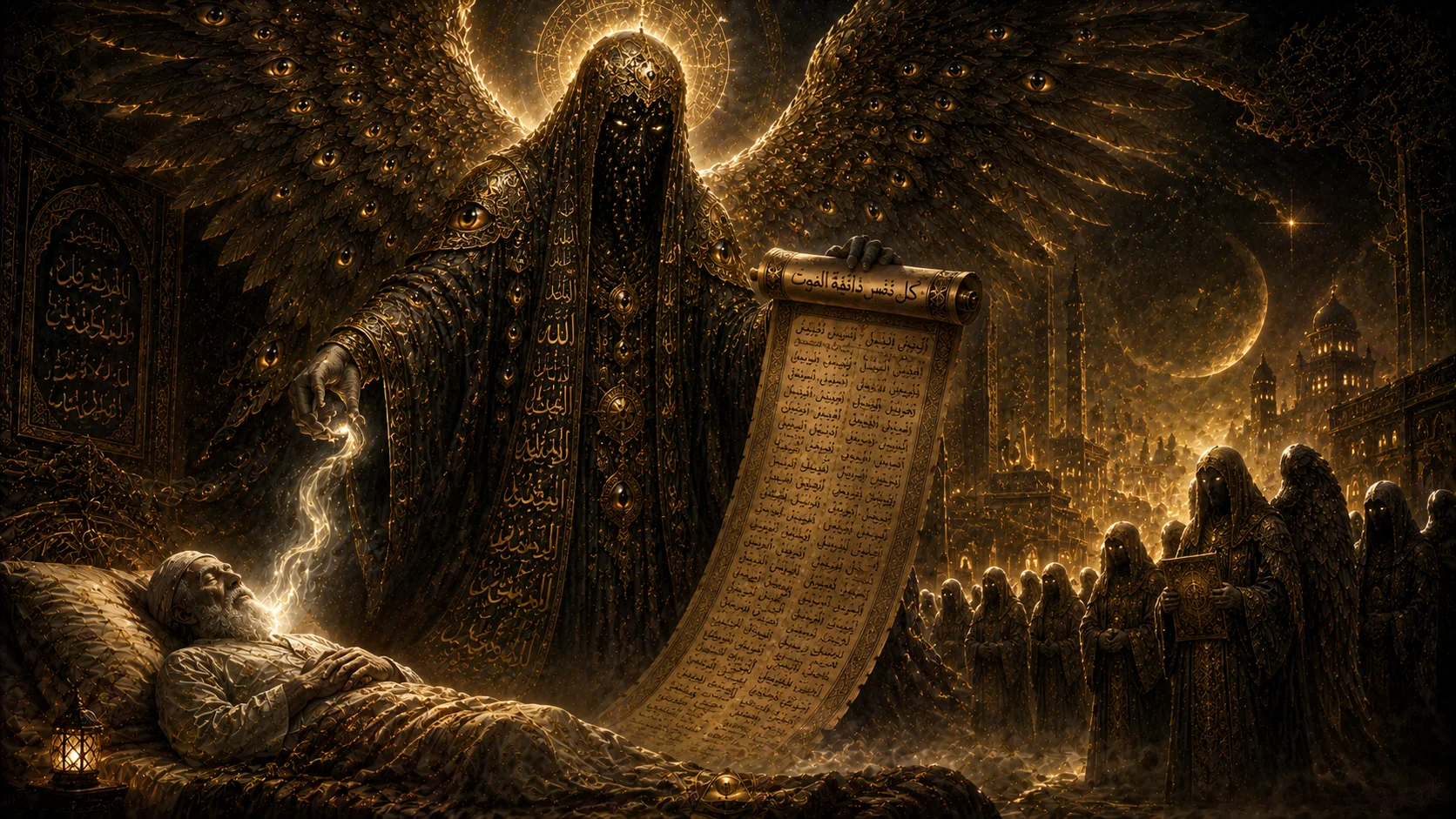
The oldest and most vivid rabbinic description of the Angel of Death comes from Tractate Avodah Zarah 20b, and it is unsettling in exactly the way a confrontation with mortality should be. He is described as full of eyes, standing at the head of the dying person, a drawn sword in his hand with a single drop of poison, or gall, balanced at its tip. At the moment of death he casts that drop into the mouth of the one who is dying, and from it comes death itself. It is a stark, physical image — not an abstraction of mortality but an encounter, a visitation with a face, or many faces, turned toward the one whose hour has come.
One Adversary Wearing Three Masks
A widely cited strand of rabbinic aggadah, most notably in Bava Batra 16a, draws a startling equivalence: Satan, the Evil Inclination — the Yetzer ha-Ra — and the Angel of Death are declared to be one and the same. Berakhot 4b and related passages carry the same association forward. This identification is not treated as uniform doctrine across every source; the rabbis were comfortable holding multiple, not fully reconciled pictures of the same figure. But where it appears, it recasts the Angel of Death from a neutral functionary into something closer to an adversarial presence, the same force that tempts a person toward sin now returning at the end to collect what sin has earned. It is one of the tradition's most serious meditations on how death, temptation, and accusation might be facets of a single spiritual reality rather than three separate problems.
The Argument at Nebo
The richest narrative portrait of the Angel of Death in all of rabbinic literature belongs to Moses, our Teacher, and it is preserved in the Petirat Moshe cycle within Deuteronomy Rabbah 9:1 — the "Death of Moses" midrash. God sends the Angel of Death to take Moses' soul, and Moses does not go quietly. He argues. He delays. In the sweep of the aggadah he negotiates and, in a manner unlike almost any other figure in the tradition, holds the Angel of Death at bay through sheer force of merit and protest before the decree is finally carried out. It is an extraordinary text — not because it questions that death must come, but because it insists that even death can be met with dignity, argument, and something approaching negotiation, at least for the one man the Torah calls the humblest of all men upon the earth.
A Second Name Sometimes Laid Over the First
Some midrashic sources go further and identify the Angel of Death with Sammael, described elsewhere as chief among the accusing and demonic angels. This identification is not consistent; other texts keep the two figures distinct, treating Sammael as a separate power of accusation and the Malakh ha-Mavet as his own office. Where the two are merged, the effect is much the same as the Satan–Yetzer ha-Ra–Angel of Death equation above: it draws the figure of death closer to the accuser, the prosecutor in the heavenly court, rather than a mere executor of a purely mechanical decree.
The Working of Strict Judgment
The Zohar, in the section at I:245b and in other passages, situates the Angel of Death within the architecture of the sitra achra, the "other side," and ties his function to the outworking of Din, divine judgment and severity, as against Chesed, the divine attribute of mercy. In this Kabbalistic reading death is not simply an event that happens to a body; it is the visible edge of a much larger cosmic balance, the place where strict judgment presses through into the world of the living. Later Kabbalistic and Lurianic sources extend the image further, linking the Angel of Death's sword and its drop of poison to the entry of death into the world through the primordial sin — tying his office directly to theodicy, to the old and unresolved question of how a good and merciful God permits death to reign at all.
Gentleness for the Righteous, Severity for the Rest
The tradition does not describe one uniform encounter with death. Some sources distinguish between a gentler angel sent for the souls of the righteous and a harsher one sent for the wicked — a plurality that the later, popularized single figure of "Azrael" tends to flatten into one persona. For the righteous, tradition speaks of a death like drawing a single hair from milk, so gentle it is barely felt. For others the encounter is far more severe. This diversity matters: it reflects a rabbinic worldview in which the manner of death is itself a moral commentary, not merely a biological inevitability administered identically to all.
Names Written and Fading
Popular retellings, carrying forward motifs absorbed from the wider folklore, describe the Angel of Death keeping a great scroll or book in which every living name is inscribed, and say that when a name begins to fade from that book, the hour of that soul's death draws near. Whatever its precise origin, the image endures because it captures something the rabbinic material insists upon in its own terms: death by decree, not by accident — an appointed hour rather than a random one, however arbitrary it may feel to the living left behind.
Amulets Against the Threshold
The Angel of Death was never treated, in folk practice, as a purely abstract personification to be reasoned about from a safe distance. Cairo Genizah materials and later Ashkenazi and Sephardi folk-custom compilations preserve protective formulas invoked specifically against him, especially around the vulnerable thresholds of childbirth and serious illness. These amulets and incantations treat him as an active, appealable agent — a power that could, perhaps, be turned aside, delayed, or propitiated, in the same spirit that animates the Moses narrative on a far grander scale. It is a very human response to an inhuman office: if the decree cannot be refused outright, perhaps it can still be met, addressed, argued with.
Fallen Angels and Cosmic Reckonings
Pirkei De-Rabbi Eliezer, in chapters 13 and 34, folds the Angel of Death into a wider cosmology that includes traditions of angels who fell or were punished, situating his office within a larger drama of heavenly rebellion, hierarchy, and consequence. This is not a story of the Angel of Death's own fall — the sources keep his office intact and sanctioned — but it places him among the same cast of powerful, morally freighted beings whose standing before God is never entirely settled or simple.
The Promise That He Will Be Undone
For all the weight given to his office, the tradition does not grant the Angel of Death permanence. Rooted in Isaiah 25:8 — "He will swallow up death forever" — Pirkei De-Rabbi Eliezer and the broader rabbinic eschatological hope look toward a messianic age in which the Angel of Death himself will finally be destroyed. Severity and judgment, in this reading, are not the last word; they are a stage within a larger story whose ending has already been promised, even if its timing has not. Death, however full of eyes, however sharp its sword, is understood to be temporary, answerable in the end to the same mercy it presently seems to override.
The Servant, Not the Master, of the Decree
Read across these strands — Talmud, midrash, Zohar, folk custom, and eschatological hope — the figure conventionally called Azrael emerges less as a single fixed character than as a name later stitched onto an older and more varied rabbinic office. He is full of eyes and armed with a poisoned sword in Avodah Zarah; identified with Satan and the Evil Inclination in Bava Batra; argued with and delayed by Moses in Deuteronomy Rabbah; bound to strict judgment in the Zohar; sometimes merged with Sammael and sometimes kept distinct from him; gentle to the righteous and severe to the wicked; invoked against in amulets meant to hold him off at the threshold of birth and illness; and, in the end, promised destruction in the age to come. The name "Azrael" belongs most properly to Islamic tradition and reached Jewish folklore through genuine cultural contact rather than native rabbinic invention — a fact the sources themselves make clear once the later popular label is set aside and the older office beneath it is allowed to speak for itself.
Sources & traditions
- EncyclopediaWikipedia — Azrael
- TraditionJewish/Kabbalistic texts, grimoires and later commentary
Myths change from area to area and from time to time. This chronicle follows the most widely told versions; tellings in other villages, regions and eras may differ.