Sammael, the Poison of God, is among the most consequential and unresolved figures in Jewish angelology and demonology: an accusing archangel, an angel of death, the traditional instigator behind the serpent in Eden, and, in later Kabbalistic thought, the ruling prince of the Sitra Achra, the demonic Other Side, and consort of Lilith. Across more than a thousand years of literature — pseudepigrapha, Talmud, midrash, and Zohar — his portrait was built up in layers rather than composed at once, and the tradition itself preserves that seam rather than smoothing it over.
The Meaning Folded Into the Name
Sammael's name (סַמָּאֵל) is generally parsed by scholars as a compound of sam, "poison" or "venom," and El, "God" — commonly rendered "poison of God" or "venom of God." It is worth stating plainly that no ancient source glosses the name this way explicitly; the etymology rests on later philological analysis rather than on any text that pauses to explain itself. Still, the reading has been repeated widely enough, and fits so closely with the destructive offices later attached to him, that it functions as the standard gateway into who Sammael is understood to be: a being whose very name carries lethality, folded permanently and audibly into the syllables people speak when they name him.
A Hostile Power Before the Demonization
Sammael's presence in Jewish literature is older than his systematic villainy. He is attested from the pseudepigrapha onward, appearing in works such as the Ascension of Isaiah and in later apocalyptic and hekhalot literature as a chief hostile angelic figure — powerful, adversarial, and troubling to the heavenly order, but not yet fixed into the single composite "prince of demons" that rabbinic and Kabbalistic writers would later assemble. This matters for how the figure should be understood: Sammael did not arrive in Jewish tradition already fully demonic. He arrived first as a formidable and dangerous angel, and the darker identifications accumulated around him across centuries of retelling.
Satan, the Angel of Death, and the Evil Inclination
In Talmudic and midrashic literature — including material found in tractates such as Bava Batra and in associated midrashim, and elaborated further in Pirkei de-Rabbi Eliezer — Sammael is repeatedly identified with Satan and with the Angel of Death. Some rabbinic sources go further still, folding in the yetzer hara, the evil inclination that stirs within a person, as effectively one and the same force wearing different names for different occasions. It is important to be precise about what this identification actually is: a rabbinic synthesis built up across multiple sources, not a single unambiguous verse that names Sammael, Satan, and the Angel of Death in one breath and declares them identical. The equation was assembled by tradition, generation after generation, reading these figures together until the boundaries between them wore thin.
Rider of the Serpent
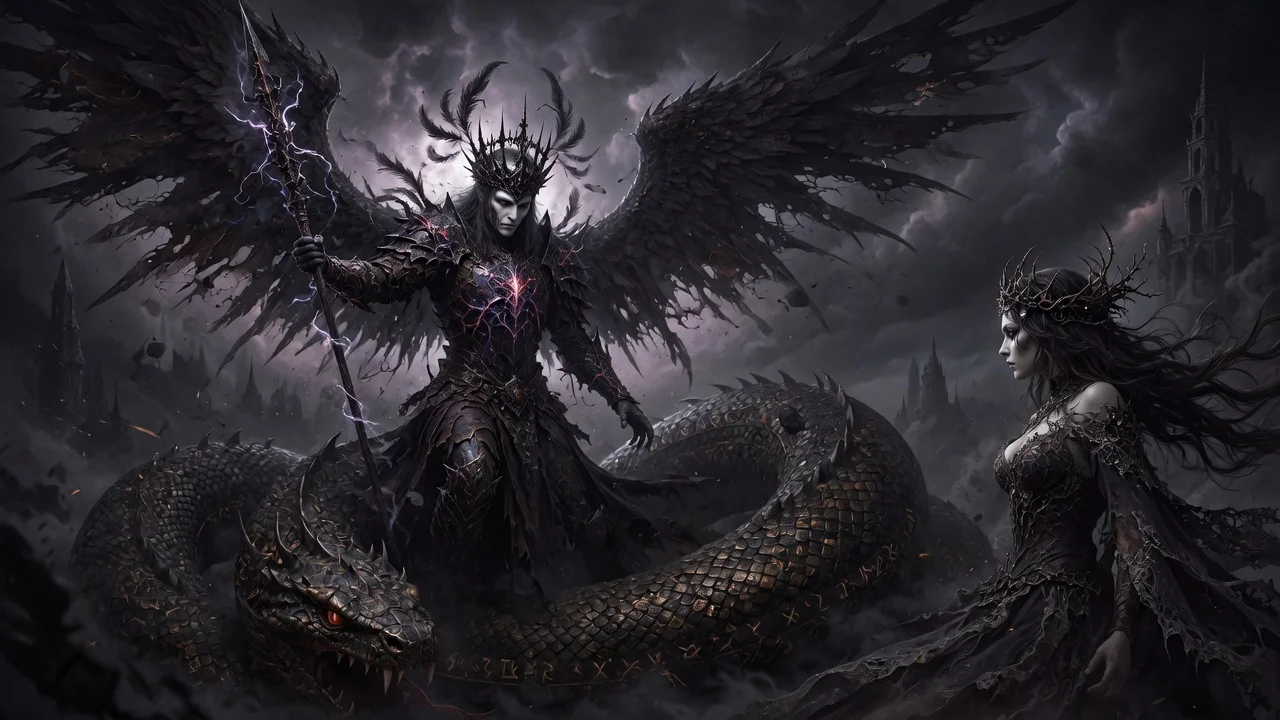
The most vivid and specific elaboration of Sammael's role in the Fall comes from Pirkei de-Rabbi Eliezer, chapter 13, where he is cast as the great prince of the angels who, mounted upon the serpent as upon a beast, is the true instigator behind the seduction of Eve. The serpent, in this telling, is his mount and his instrument — a vehicle for his will — rather than being identical with him. This is a deliberate and important distinction that the midrash itself preserves: the plain text of Genesis names no such figure at all, and it is this later midrashic elaboration, not the Torah's own account, that supplies Sammael as the hidden hand steering the serpent through the garden.
Accuser Before the Throne, Adversary of Michael
Rabbinic legend, developed across a range of midrashim, casts Sammael as the celestial adversary and accuser of Israel — a heavenly prosecutor bringing charges against the people before the divine court. He is frequently set opposite the archangel Michael, Israel's heavenly defender, in a recurring aggadic pairing of prosecutor and defender that plays out repeatedly across the literature. This structure is significant: it places Sammael's opposition within a courtroom, not a battlefield. He accuses; Michael answers the accusation. The drama is forensic rather than martial, and it recurs precisely because the tradition found it a durable and useful way to dramatize the tension between divine judgment and divine mercy.
The Angel Who Came for Moses
Among the legends attached to Sammael's office as Angel of Death is his role in the death cycles surrounding Moses, found in midrashic material such as the Petirat Moshe traditions. In these accounts, Sammael is portrayed as the angel dispatched to take Moses's soul — and, in a detail that speaks to how the tradition regarded Moses's stature, he is rebuffed or overcome in the attempt. The scene is less about Sammael's failure than about Moses's singularity: even the Angel of Death, who comes for every soul without exception, meets resistance and reversal when he comes for this one. It is one of the clearest illustrations in the literature of Sammael functioning strictly as an office-holder carrying out an assigned task, rather than as a freely malicious agent choosing his targets.
Consort of Lilith, Prince of the Other Side
It is in the Zohar and the broader current of Kabbalistic literature that Sammael's profile changes register entirely. Here he is identified as the consort, the husband, of Lilith in her demonic aspect, and he functions as a central figure of the Sitra Achra, the "Other Side" — an emanated realm of impurity that parallels and opposes the sefirotic tree, the structure through which the divine is understood to flow into creation. The pairing of Sammael and Lilith is presented as a dark counterpart to the holy union between the divine masculine and the Shekhinah, the indwelling divine feminine presence. Where the sefirot channel holiness downward into the world, the Sitra Achra channels its inverted mirror, and Sammael stands at its head.
Rulership Among the Qliphoth
Kabbalistic cosmology, elaborated especially in Zoharic and later Lurianic-adjacent literature, associates Sammael with the Qliphah known as Golachab, or more broadly with rulership over the qliphotic strata as a whole — the "shells" or "husks" that constitute the demonic counter-structure to the sefirot. It should be said clearly that the exact assignment of demons to qliphoth is not fixed across the tradition; it varies somewhat between different Kabbalistic schematics and later systematizers, including those working in Zohar-derived and even Christian Cabalist reworkings of the material. Treating any single qliphah correspondence as the definitive one misrepresents a tradition that developed multiple, sometimes competing, internal maps of the same territory.
Titles Accumulated Across Centuries
The epithets attached to Sammael across the literature read almost as a résumé assembled by many different hands: Angel of Death, Chief of Satans, the Evil One, and, in some strata, the instigator riding the serpent at the Fall. None of these titles was coined all at once, and none was necessarily coined with the others in mind. They reflect an accretion of roles across centuries of retelling rather than a single original job description handed down complete. Reading Sammael today means reading a composite built from many contributing texts, each adding a title without necessarily reconciling it against what earlier texts had already said.
An Accuser Operating With Permission
For all his fearsome titles, Sammael's theological function in Jewish tradition is primarily that of an accuser and tester operating with divine permission — a role that parallels the Satan, the ha-satan, of the Book of Job, who likewise moves only within bounds the divine court has set. Mainstream rabbinic Judaism holds firmly to strict monotheism, and Sammael is not, in that framework, an autonomous evil power capable of rivaling God on anything like equal terms. His opposition is bounded and instrumental — a point emphasized in scholarly treatments of Kabbalistic demonology, notably Gershom Scholem's studies of the subject. He is formidable, but he is not sovereign.
The Left Emanation, Mirroring Severity
Later Kabbalistic and folk elaboration — including material in the Zoharic-influenced and grimoire-adjacent literature that grew up around it — expands Sammael into a full "left-emanation" counterpart to the sefirah of Gevurah, or Din, the divine attribute of severity and judgment. This reflects a broader and genuinely important principle within Zohar-derived Qliphothic thought, as analyzed by Scholem and by later scholars such as Joseph Dan: the demonic Sitra Achra does not stand apart from the divine sefirotic emanations as something unrelated. It structurally mirrors them, in distorted form, strata for strata. Sammael, in this reading, is not the opposite of holiness so much as its shadow — severity untethered from the mercy that, in the sefirotic order, is meant to balance it.
A Name That May Also Be an Office
Some strands of the tradition distinguish Sammael as a title or an office — an "accusing angel" role that could, in principle, be filled by different occupants — from Sammael as a proper individual name attached to one specific being. This ambiguity closely parallels the way "Satan" itself functions ambiguously between title and name across Second Temple and rabbinic literature. It is a recognized point of scholarly discussion rather than a question the sources themselves resolve uniformly, and it is worth carrying as a genuine open question rather than flattening it into a false certainty in either direction.
A Composite Never Meant to Be Read as One Portrait
Because Sammael's profile is built up across Second Temple pseudepigrapha, the Talmud, multiple midrashim, the Zohar, and later Kabbalistic and folk syntheses spanning roughly a millennium, scholars caution against treating him as a single stable character with one coherent biography. His attributes — accuser, Angel of Death, instigator behind Eve's seduction via the serpent, Lilith's consort, ruler of a Qliphah — accumulated in different literary strata over different centuries, and they are not all mutually consistent with one another. This composite nature is itself a well-attested scholarly observation, made by Scholem and Dan among others, and it is the most honest way to hold Sammael in mind: not as a single figure with a fixed story, but as a name under which many generations of tradition placed their reflections on judgment, death, temptation, and the shadow the sacred casts when severity is left unbalanced by mercy.
Sources & traditions
- EncyclopediaWikipedia — Samael
- TraditionJewish/Kabbalistic texts, grimoires and later commentary
Myths change from area to area and from time to time. This chronicle follows the most widely told versions; tellings in other villages, regions and eras may differ.