Azazel is a great fallen angel and demon of Jewish lore: the leader (with Semyaza) of the fallen Watchers who descended to corrupt humankind, the teacher of forbidden arts, and above all the dread figure of the wilderness to whom the “scapegoat” was sent on the Day of Atonement — the demon of the desert who bears away the sins of Israel. He is one of the most ancient and resonant of the dark beings.
The Scapegoat of Atonement
Azazel’s most ancient appearance is in the ritual of the Day of Atonement (Yom Kippur) in the Book of Leviticus. On that day, two goats were chosen: one was sacrificed to the Lord, and the other — the “scapegoat” — had the sins of all Israel confessed over it and was then sent away into the wilderness “for Azazel,” bearing away the people’s sins into the desert. Azazel, in this rite, is the dread power of the wilderness — a desert-demon or fallen being to whom the sin-laden goat is dispatched, the embodiment of the wild, impure realm to which sin is banished. (The English word “scapegoat” derives from this ritual.)
The Fallen Watcher
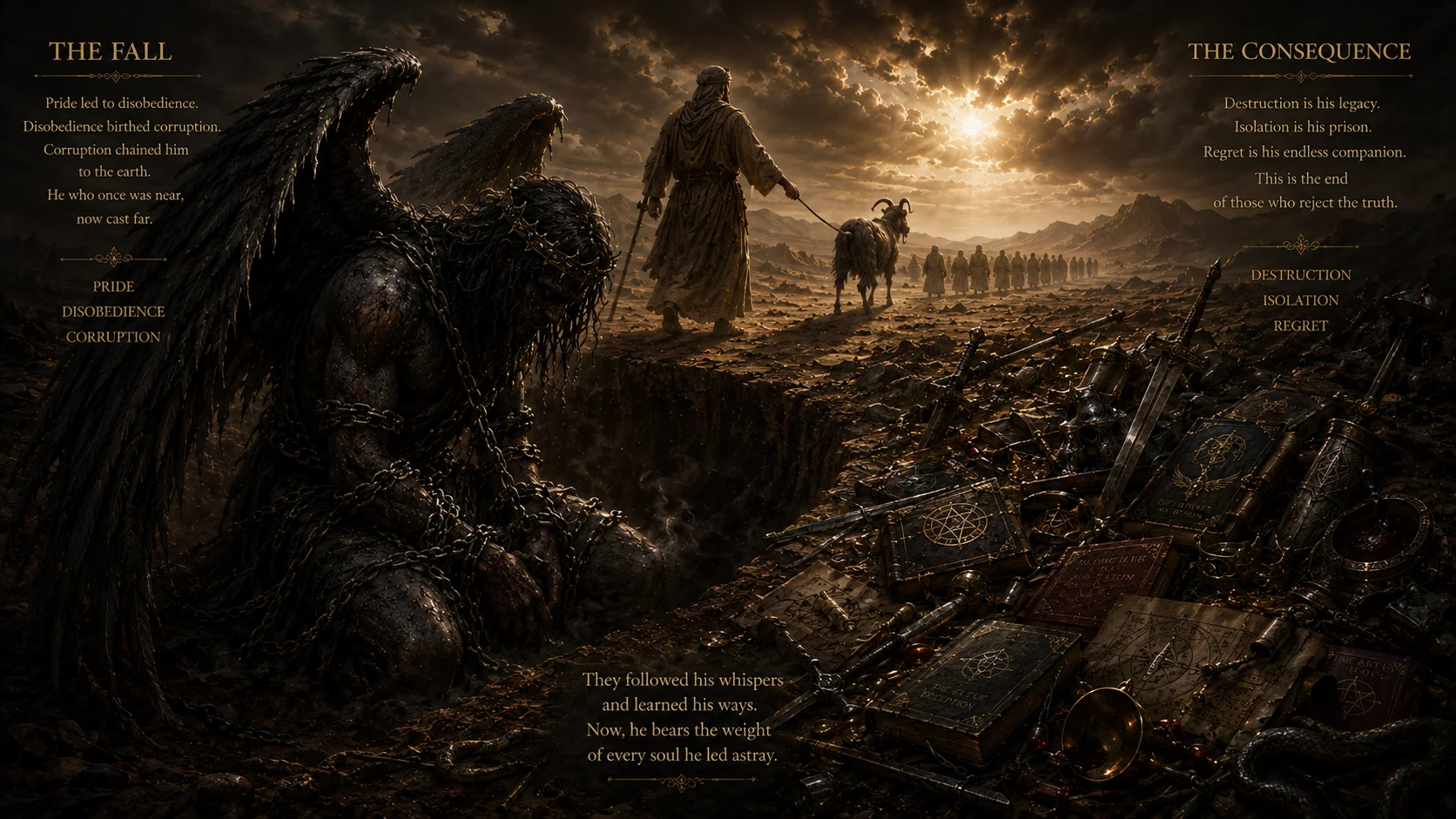
In the Book of Enoch, Azazel is one of the chief of the fallen Watchers (the Grigori — Hebrew realm) who, with Semyaza, descended to take mortal wives and corrupt the earth. Azazel’s particular sin was teaching humankind forbidden knowledge: the making of swords, knives, and weapons of war; the working of metals; and the arts of cosmetics, jewelry, and seduction — so that violence, vanity, and corruption spread among humankind. For loosing these evils upon the world, Azazel was singled out for a special doom: the archangel Raphael was sent to bind him hand and foot and cast him into a pit of darkness in the desert, there to remain until the final judgment, when he will be cast into the fire. Upon Azazel, the Book of Enoch says, “ascribe all sin.”
The Demon of the Wilderness
Azazel thus unites two great roles: the desert-demon of the scapegoat ritual, who bears away the sins of the people; and the chief fallen angel who taught humankind the arts of war and corruption and was bound in the desert pit for his crimes. In later demonology he became a prince of demons and a figure of the infernal hierarchy. A being of ancient and profound resonance, Azazel embodies sin, the wilderness, and the fallen angel. In Azazel, Jewish lore gave form to the demon of the wilderness and the fallen Watcher — the dread power to whom the scapegoat bears the sins of Israel, the chief fallen angel who taught humankind the arts of war and was bound in the desert pit, the great demon upon whom all sin is laid.
What the Name Actually Means
Long before anyone tried to work out who Azazel was, translators were arguing over what the word even said. The Hebrew of Leviticus reads simply la-azazel — “to/for Azazel” — with no explanation, as though the audience already knew. One reading breaks it on the Semitic root azaz (to be strong, fierce) joined to el (god), giving something like “fierce god” or “the god is strong” — an unsettling title to leave sitting inside a purity law, and one with manuscript support: the older form Azaz-el appears in the Samaritan Pentateuch and in the Temple Scroll from Qumran, where the Masoretic spelling has been smoothed over. A second, ancient interpretive tradition split the word instead as ez (goat) and azel (departs), reading it as “the goat that goes away.” It was this second reading that reached English readers directly. When William Tyndale translated the Pentateuch into English in 1530, the living goat had no name in his Hebrew text, so he built one: scape, a shortening of escape, plus goat. The word has stood in English Bibles, and in the language itself, ever since. Every time someone is called a scapegoat today, they are, without knowing it, being compared to Azazel.
A Desert Power Named Beside God
The structure of the Yom Kippur rite is stranger than its summary suggests. The two goats were not simply chosen; lots were cast over them, and the text records what the lots said — one “for YHWH,” the other “for Azazel.” That is the detail that has troubled readers for two millennia. Azazel is not described, not placed, not explained; he is named in the same breath as the God of Israel, as though he were an address the sin-laden goat could be sent to. A ritual built on that symmetry reads less like an act of exorcism aimed at empty desert and more like the survival, inside the priestly law itself, of an older conviction that the wilderness had its own resident power. The text never explains Azazel because whoever first set the rite down had no need to: the desert was already understood to belong to something.
The Bird That Tried to Stop Abraham
The Book of Enoch is not the only early Jewish text to give Azazel a face. In the Apocalypse of Abraham, a Jewish work surviving only in Old Church Slavonic translation, he arrives at the patriarch’s sacrifice as an unclean bird that swoops onto the carcasses — and then speaks, asking Abraham what he thinks he is doing on the holy heights, where no one eats or drinks, and telling him to go down. Abraham drives the bird off; the angel accompanying him names it and delivers the rebuke, declaring that Abraham’s portion is in heaven and Azazel’s is on earth, and that he was never appointed to tempt the righteous. The same text folds Azazel into Eden as well: the figure standing behind the tree, who beguiles the first couple into eating, is a serpent with human hands and feet and six pairs of wings, and he is identified as Azazel. Two very different scenes — the fall of the Watchers on a mountain, and a lone bird interrupting a sacrifice generations later — are treated here as the same being at different moments, evidence that by the turn of the era Jewish writers had already begun stitching Azazel’s scattered appearances into a single continuous biography of evil.
The Angel Who Became Iblis
The figure travels into Islamic tradition under his own name. Early Islamic exegetical literature preserves an account in which the being who refuses God’s command to bow before the newly created Adam — and is cursed and renamed Iblis for that refusal — had, before his fall, been called Azazil. The commentators disagreed about what he was: one line of interpretation holds that he was a jinn who rose to the rank of the angels through sheer devotion, another that he stood among the angels outright, a worshipper of immense standing who had spent ages in praise before pride undid him. The shape of the story is the same one told of the Watchers — a being of high rank, trusted with heaven’s own household, brought down by a single act of defiance, and given a new and permanently diminished name to mark the fall. The name itself appears to have travelled from Jewish literature into Islamic commentary, which is the first tradition to treat it as Satan’s original name; wherever it came from, Azazel and Azazil sit at the same hinge in both accounts of how evil entered the world — through pride, and before humanity had done anything at all.
Standard-Bearer of the Fallen
Medieval and early modern writers kept promoting him. In later Jewish mystical literature Azazel is ranked among the great princes of the demonic realm, associated with Samael and with the wilderness-powers of impurity — still tied, centuries after Leviticus, to the desert that was always his. Christian demonological catalogues absorbed him into the standard roll-call of named devils, keeping the memory of his exile and his teaching. The clearest literary monument to this promotion is John Milton’s Paradise Lost, first published in 1667, which gives Azazel a specific post in Hell’s new order. He is “a Cherub tall” who claims as his right the raising of the rebel standard, unfurling the imperial ensign from its glittering staff so that it shines like a meteor over the mustering legions. It is a small but telling honour: the angel once blamed for teaching men to forge swords is handed the flag of Hell’s entire army.
From Scripture to Screen
Azazel’s name has proved unusually durable as shorthand for a demon of real weight rather than a generic devil-name invented for effect. Television has used it directly: the recurring antagonist of the American supernatural drama Supernatural, the demon with yellow eyes whose designs run across generations of one family, is named Azazel. Film has done the same — the 2011 X-Men: First Class gives the name to a teleporting mutant with red skin and a forked tail, a design that draws openly on centuries of demonic iconography built on exactly the tradition described above. Neither production needed to explain the choice, which is the point: a name coined to account for a goat driven into the Judean wilderness still reads, without a word of gloss, as unmistakably sinister.
Why the Goat Still Walks
Strip away the demonology and something plainer is left standing. Azazel is the name Israelite religion gave to the place where guilt goes when a community needs it gone. The rite does not destroy the sin-laden goat — it exiles it, sends it toward a being whose only defined function is to receive what the people can no longer carry. Early Christian writers noticed the shape of that mechanism and could not leave it alone: the Epistle of Barnabas, Justin Martyr and Tertullian all read the two Yom Kippur goats as a paired figure of Christ, the goat that dies and the goat that bears sin into the wilderness taken together as two aspects of a single atonement — though they could not agree which goat stood for which. That a single obscure verse about a goat and a wilderness demon could be read, centuries apart and in three religions, as a template for atonement itself is the real measure of Azazel’s staying power. He persists not because anyone still fears a literal demon chained in a desert pit, but because every human community keeps needing somewhere to send what it cannot forgive itself for keeping.
Sources & traditions
- EncyclopediaWikipedia — Azazel
- TraditionJewish/Kabbalistic texts, grimoires and later commentary
Myths change from area to area and from time to time. This chronicle follows the most widely told versions; tellings in other villages, regions and eras may differ.