Asmodeus — Ashmedai — is the king of demons in Jewish lore: a powerful and cunning demon-king of lust, wrath, and trickery, famous from the Book of Tobit (where he slays seven bridegrooms) and from the rich legends of his dealings with King Solomon, whom he both served and outwitted. He is one of the mightiest and most vivid of the demons of the Jewish and wider tradition.
The King of Demons
Asmodeus (Ashmedai, from a root connected to wrath or destruction, perhaps from the Persian Aeshma) is a great demon-king — in the tradition the king or chief of the demons (the shedim), a being of immense power, cunning, and knowledge. He is associated above all with lust and with wrath, the demon of carnal desire and destructive anger, but also with cunning, wisdom, and trickery. He is a figure of tremendous power and intelligence, more a mighty and crafty prince than a mere tormentor.
The Slayer of Bridegrooms
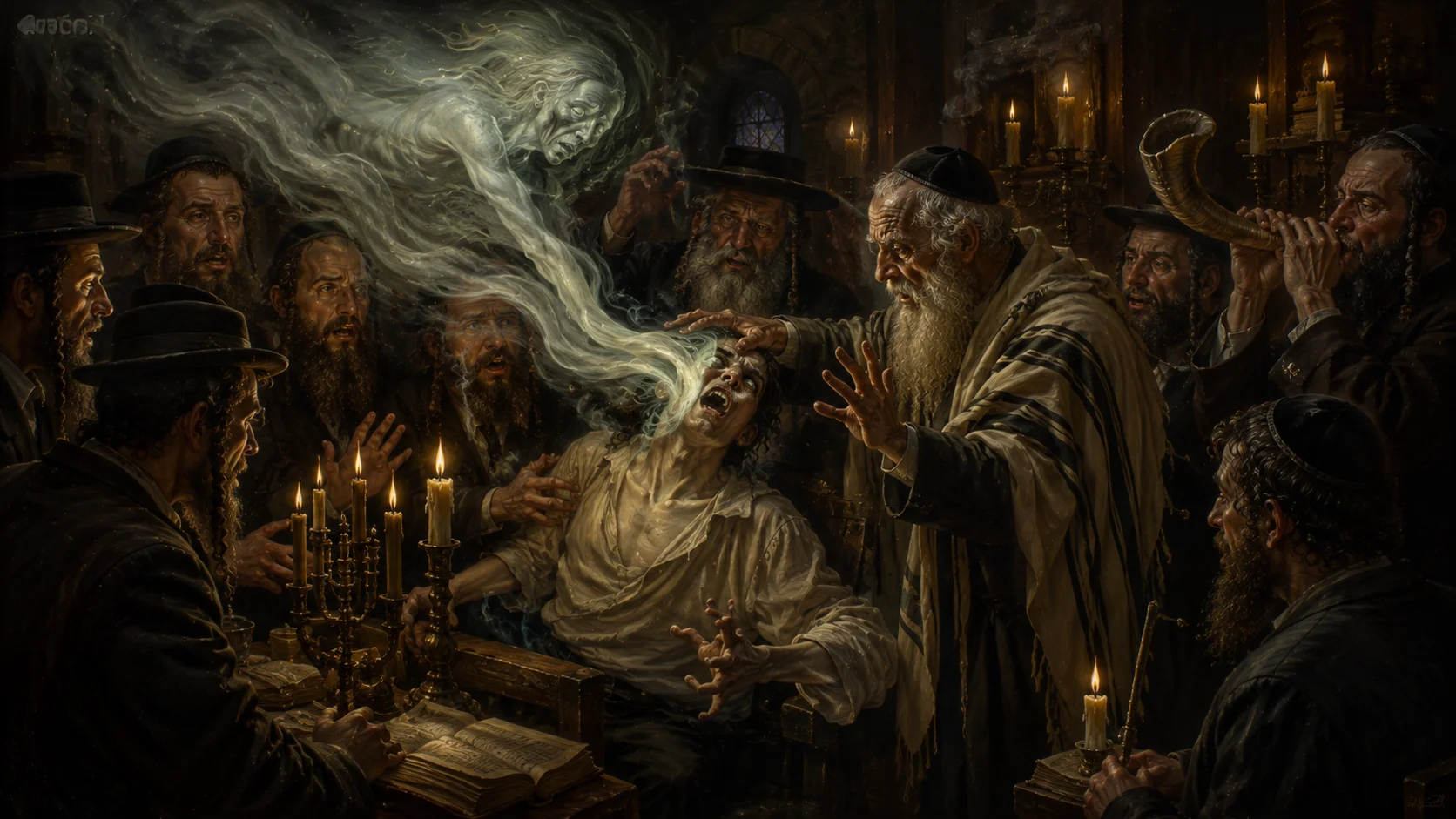
Asmodeus enters scripture in the Book of Tobit, where he is the demon who, out of lust for the maiden Sarah, slays each of her seven bridegrooms on their wedding night, one after another, before the marriage can be consummated — until the angel Raphael teaches the hero Tobias to drive Asmodeus away with the smoke of a fish’s heart and liver, and the demon flees to Egypt, where Raphael binds him. This tale established Asmodeus as the demon of lust and the destroyer of marriages.
Asmodeus and Solomon
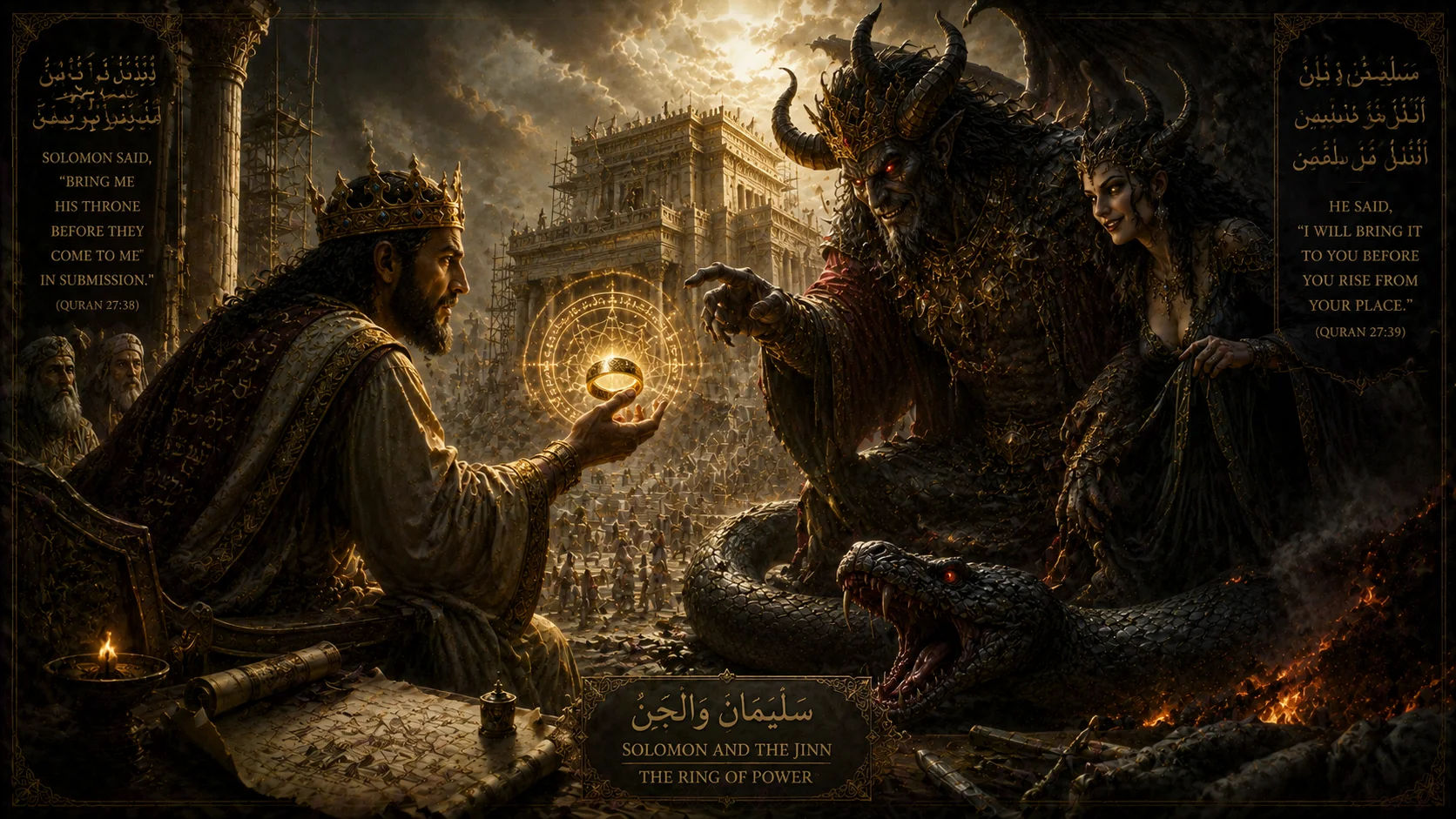
Asmodeus’s richest legends concern King Solomon. In the tradition, Solomon, building the Temple, needed the shamir (a worm or substance that could cut stone without iron), and captured Asmodeus by trickery (with a magic ring bearing the divine name, and by intoxicating him) to compel his aid — the demon-king forced to labour on the Temple and to reveal his secrets. But in a famous turn, Asmodeus tricked Solomon: gaining the king’s magic ring, he flung it away and cast Solomon from his throne, taking the king’s own form and reigning in his place for a time, while Solomon wandered as a beggar — until the deception was discovered and Solomon restored. These tales made Asmodeus the archetype of the powerful, cunning demon bound to and contending with the wise king. In Asmodeus, Jewish lore gave form to the king of demons — the mighty, lustful, wrathful, and cunning demon-prince of the Book of Tobit and the Solomon legends, the slayer of bridegrooms and the trickster of the wise king, one of the greatest of all the demons of the tradition.
Before Tobit: The Wrath That Came from the East
The oldest thing about Asmodeus is his temper. Centuries before he appears in any Jewish book, Persian scripture already knows a demon called Aeshma — in the Avesta the daeva of fury, the standing adversary of Sraosha, the spirit of obedience and disciplined attention. Aeshma is not a seducer and not a liar. He is the sudden loss of control: the raised hand, the bloodied club, the rage that wrecks a household in an afternoon. The resemblance between that name and Ashmedai is close enough that the Jewish demon-king has often been read as a Zoroastrian import, carried westward during the long centuries in which Jewish communities lived, prayed and argued under Persian rule.
It is not the only possibility, and the question has never been settled. The compound that would have to stand behind Ashmedai — wrath joined to demon — is a scholarly reconstruction rather than a quotation; the surviving Avesta gives us Aeshma alone. Hebrew has its own candidate in the root sh-m-d, “to destroy, to exterminate” — which would make Ashmedai simply the Destroyer, a native coinage that only happens to sound Persian. Both readings suit him disturbingly well, and the honest position is that we do not know which came first. What we can say is that the demon who arrives in the Book of Tobit is already fully formed: named, motivated, and lethal. Nobody had to invent him on the page.
Tobit itself is a Hellenistic-era book, and for a long time it was known only in Greek and Latin. That changed at Qumran, where fragments of Tobit turned up in Aramaic and in Hebrew — proof that the story circulated in Semitic languages in the last centuries before the common era, and that Ashmedai was a Jewish demon long before he was a Christian one. The book is deuterocanonical: it stands in the Catholic and Orthodox Bibles, outside the Jewish and Protestant canons. Asmodeus therefore occupies an unusual position — a demon whose scriptural home is a book many of the traditions that fear him do not read as scripture.
The Smoke of the Fish: A Real Ritual, Not a Fairy-Tale Trick
The detail readers usually remember from Tobit is the strangest one: a fish’s heart and liver laid on burning incense, and a demon fleeing the smell. It sounds like whimsy. It is not. Fumigation — driving out a hostile spirit by burning a substance whose smoke it cannot endure — is one of the most widely attested exorcistic techniques of the ancient Near East and the Mediterranean, used with sulphur, bitumen, resins, and animal parts. Tobit is not inventing a magic trick; it is describing, in narrative form, the sort of thing an anxious family might actually have done.
What the book adds to the technique is a theological correction. The smoke drives Asmodeus out of the room; it is the angel who pursues him to Egypt and binds him there. And before Tobias touches his bride, the two of them pray — a prayer that reframes the wedding night as something other than an appetite. The book is quietly making an argument about what protects a marriage. The fumigation clears the chamber. The prayer, and the angel, do the rest.
It is worth pausing on Sarah, too, because she is the reason the demon exists in the plot at all. Seven husbands dead, and a household maid who taunts her with the suggestion that she killed them herself. Sarah goes upstairs intending to hang herself and stops only because of what it would do to her father’s reputation. Asmodeus is the supernatural cause of her suffering, but the book is at least as interested in the human machinery around it: the gossip, the shame, the assumption that a woman at the centre of repeated catastrophe must somehow be the catastrophe.
Ashmedai in the Talmud: The Demon Who Attends Two Academies
The fullest and by far the most extraordinary account of Ashmedai is not in Tobit at all. It is in the Babylonian Talmud, tractate Gittin, and it is one of the great sustained narratives of rabbinic literature.
Solomon needs the shamir to shape the Temple stone without iron. A captured pair of demons do not know where it is, but they know who does: Ashmedai, king of the shedim. He lives on a mountain, where he has dug a pit, filled it with water, covered it with a rock and set his own seal upon it — a demon so careful about being poisoned that he checks his own seal every time he comes home. Every day he ascends to the heavenly academy and studies there, then descends to the earthly academy and studies there too. This is the detail that makes the Talmud’s Ashmedai unlike any other demon in world literature. The king of the demons is a scholar. He sits in the same lecture halls the rabbis sit in.
Benaiah son of Jehoiada is sent to take him, carrying a chain and a ring engraved with the divine Name, and skins of wine. He bores a hole beneath the pit and drains the water, plugs it with fleece, bores a hole above and pours in the wine, covers everything over, and waits in a tree. Ashmedai returns, inspects the seal, finds it untouched, drinks, and sleeps. The chain goes round him. When he wakes and thrashes, Benaiah says only that the Name of his Master is upon him — and that is enough.
What He Saw on the Road
The journey to Jerusalem is the heart of the story. Ashmedai walks in chains through the ordinary world and behaves inexplicably. He uproots a palm tree. He begins to knock a house down, and when a widow pleads with him he bends away so violently that he breaks one of his own bones, remarking that this is what the proverb means about a soft tongue breaking bone. He sees a blind man wandering off the road and puts him right. He sees a drunk wandering off the road and puts him right too. He passes a wedding and weeps. He hears a man order shoes built to last seven years and laughs out loud. He watches a diviner at work and says the man is sitting on a royal treasure and cannot see it.
Solomon, when he finally asks, gets answers that turn the whole journey inside out. The blind man was perfectly righteous, so helping him earned merit. The drunk was thoroughly wicked, so the kindness was payment in this world for a man with nothing owed him in the next. The wedding drew tears because the bridegroom had thirty days to live and the bride would then be bound to wait years for a child-brother to grow up. The shoes were funny because the customer would not survive the week. The diviner could see everything except the ground beneath him.
This is not a horror story. It is a story about knowledge and its limits — and the demon is the one who has it. Ashmedai’s laughter is the laughter of someone who can see the ends of things, standing among people who cannot. Even his crimes have the flavour of a superior intelligence bored by human blindness.
The King Who Could Not Prove He Was the King
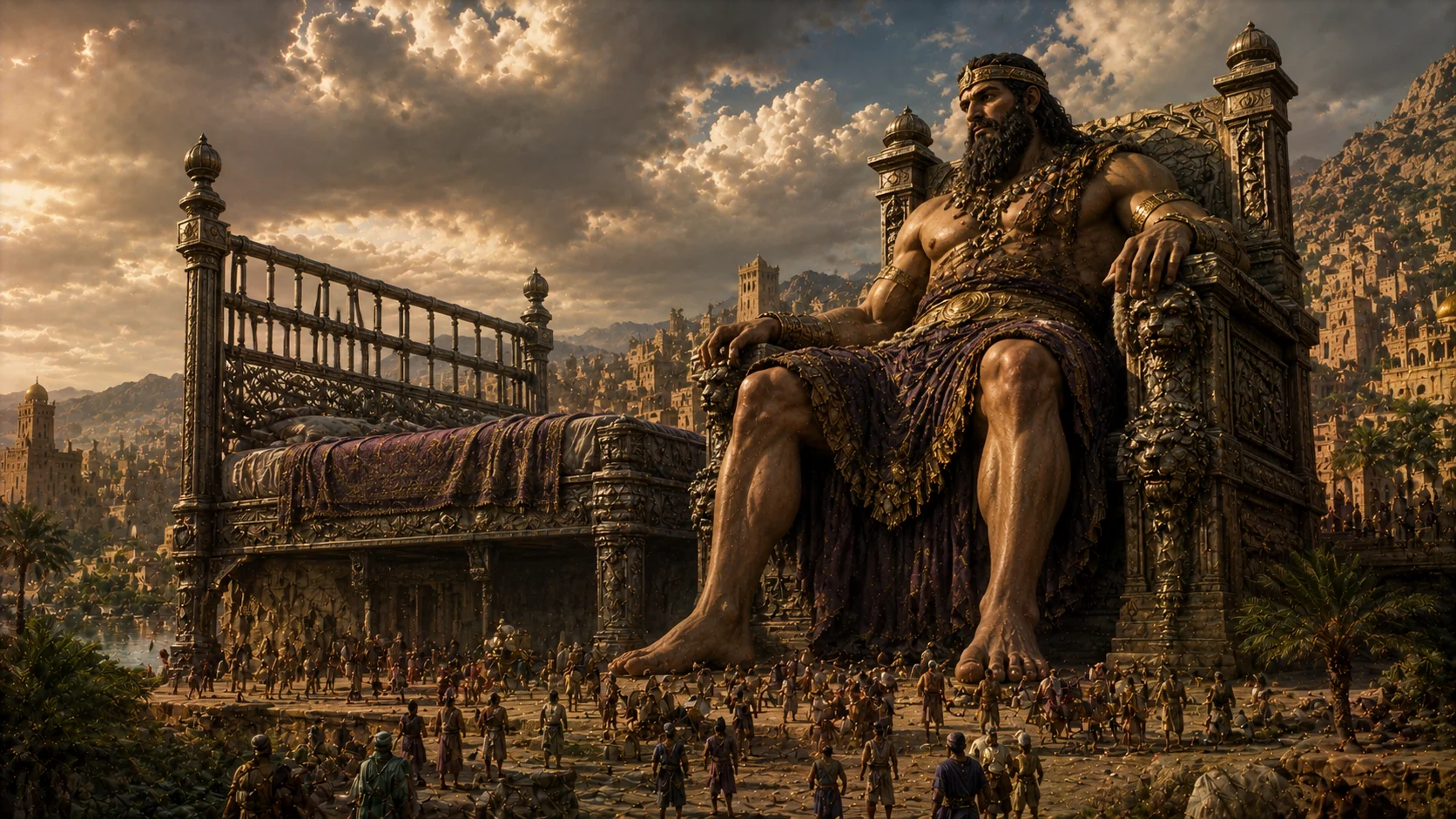
The famous reversal, when it comes, is almost gentle. Solomon asks what makes demons superior to men. Ashmedai says: unchain me, give me your ring, and I will show you. Solomon does. Ashmedai sets one wing on the earth and one in the heavens, hurls the king four hundred parasangs away, and takes his place.
What follows is the part that lingers. Solomon wanders from town to town saying the same sentence over and over: I, Koheleth, was king over Israel in Jerusalem. It is the opening line of Ecclesiastes, and the Talmud has weaponised its tense. Not am. Was. The wisest man alive, reduced to a beggar repeating a true claim that nobody has any reason to believe, becomes the author of the most disillusioned book in the Hebrew Bible. The rabbis even disagree over how much he had left — his staff, or his cloak.
He is restored not by a miracle but by a bureaucratic suspicion. The impostor on the throne behaves wrongly in ways the household eventually notices — and one thing he never does is show his feet. Demons, in this tradition, have feet that give them away. When Solomon reappears with the ring and the chain bearing the Name, Ashmedai simply flies.
What a Shed Actually Is
To understand why Ashmedai can sit in a study hall, it helps to know what the Talmud thinks demons are. The shedim are not fallen angels and not the damned. They occupy a middle rank: in three respects they resemble the ministering angels — they have wings, they cross the world in an instant, and they know what is coming — and in three respects they resemble human beings, for they eat and drink, they reproduce, and they die. They are a third species, sharing the world with us, subject like us to law and to mortality.
That is why Ashmedai can be bound by an oath, tricked by wine, hurt by a broken bone, and required to answer questions honestly. He is not evil in the later Christian sense of a being whose whole nature is rebellion. He is a powerful non-human person with appetites, a temper, a legal standing, and a scholarly habit.
Buried Bowls and Written Divorces
Ashmedai was not only a literary figure. In Sasanian Mesopotamia, from roughly the fifth to the seventh century, householders buried inscribed earthenware bowls upside down beneath their thresholds, in the corners of rooms, under the floors of their houses. The texts spiral inward toward the centre in Jewish Aramaic, Syriac and Mandaic, naming the client and their mother, and naming the powers to be kept out. Many of the bowls are aimed at Lilith; a number invoke or bind Ashmedai, king of the demons.
The most striking thing about them is their legal form. Some are written as a get — a writ of divorce — served on the demon, formally dissolving its claim upon the house and the marriage bed and ordering it to depart. This is what belief looked like at floor level, in the hands of people who were not writing scripture: not philosophy about evil, but a document, correctly worded, addressed to a named entity, and buried where it would do the most good. The demon of the wedding chamber was answered with paperwork.
Parentage, Consorts, and the Court of the Left
Asmodeus acquires a family late, and the sources disagree. The Greek Testament of Solomon, a magical pseudepigraphon that grew over several centuries, has him claim descent from a human mother and an angel — placing him among the hybrid offspring that older Jewish tradition blamed for the corruption of the world before the Flood. In that text he is interrogated by Solomon like the others, admits that his business is with newlyweds, names the angel who thwarts him and the river fish whose liver and gall undo him, and is set to work on the Temple in chains, kneading clay. He also cannot resist telling the king that his kingdom will one day be divided. Even in captivity, Asmodeus gets the last word.
Medieval Kabbalah gave him a court. In the demonological writings that emerge from thirteenth-century Castile, the shadow-side of the divine world is organised like the real one, with kings, consorts and rivalries; Ashmedai appears there as a king ranked beneath Samael, and paired with a younger Lilith. A strand of the Zohar literature goes further back and names Naamah, mother of demons, as the mother of Ashmedai himself. None of this is a single settled system — medieval demonology is a set of competing genealogies rather than one family tree — but the direction of travel is clear. The demon who began as a solitary intruder in a bedroom ends as a married monarch with a lineage and a rank.
The Christian Demon of Lust
Christian Europe inherited Asmodeus through Tobit, and it inherited him narrowed. The Talmud’s scholar-king, the Persian fury, the trickster who out-argues Solomon — almost all of it fell away, leaving one function: sex. Medieval and early-modern witch-hunting literature treats him as the demon of carnal desire, and when demonologists began to sort the hierarchy of hell against the seven deadly sins, Asmodeus was the obvious appointment for lust. That scheme, popularised in the late sixteenth century, is why he still turns up in modern lists of the seven princes of hell.
He also appears in the most notorious possession case of the seventeenth century. At Loudun, where an entire Ursuline convent was declared possessed and the priest Urbain Grandier was burned in 1634, Asmodeus was named among the spirits inhabiting the nuns. The infernal pact produced at the trial — written backwards, signed in blood, and countersigned by a small parliament of devils — was explained by the sisters as stolen from Lucifer’s own cabinet of contracts and handed to the exorcists by Asmodeus. The exorcisms then produced a stranger document still: a written undertaking in Asmodeus’s name, set down in the prioress’s own hand, specifying the terms on which he would vacate her — down to the pin-length slit he would leave below her heart on the way out, and the blood it would put on her linen. It is worth noticing what that means. By the seventeenth century Asmodeus was concrete enough to enter into an agreement and be held to its wording. A demon who could be produced in evidence in a French courtroom had travelled a very long way from an abstraction called Wrath.
How to Recognise Him
Asmodeus has no fixed face in ancient art, but grimoire tradition gave him one so specific it has never been forgotten. In the seventeenth-century Solomonic magical literature he appears as a great king with three heads — a bull, a man, and a ram — the tail of a serpent, fire coming from his mouth, and feet webbed like a goose’s. He rides an infernal dragon and carries a lance and a banner. He teaches arithmetic, astronomy, geometry and every handicraft, gives true answers, reveals where treasure lies and guards it, and can make a man invincible. The magician is told to work in the open air, to stay on his feet throughout, and to keep his head bare — leave the cap on, the text warns, and Amaymon will deceive him.
Almost every element of that portrait has a pedigree. The treasure-guarding answers the Talmudic diviner sitting on gold he cannot see. The teaching of the exact sciences answers a demon who attends the heavenly academy. Even the bird’s feet have a precedent, since rabbinic tradition gives demons the feet of a cock — which is why the impostor on Solomon’s throne would never show his. The grimoire compresses a thousand years of story into a single figure a magician could hold in his head.
He acquired one more famous image by accident. In the church at Rennes-le-Château in southern France, restored in the 1890s by the priest Bérenger Saunière, a crouching demon supports the holy-water stoup by the door. The name attached to it is modern: it was the treasure literature of the 1960s that christened the figure Asmodeus — guardian of Solomon’s hoard, planted at the threshold of a village church — and the name stuck so hard that in 1996 someone decapitated the statue, presumably to see what was inside the head. It was never recovered. The demon at the door now wears a replica.
The Limping Devil
Asmodeus’s literary afterlife took an unexpected turn in Spain. A seventeenth-century Spanish novel made him el diablo cojuelo, the little lame devil, freed from a glass bottle by a student on the run — and to repay the favour, he lifts the roofs off the houses of Madrid one by one and shows the young man what people do when they think nobody is watching. Rewritten in French in the early eighteenth century, the conceit became one of the most imitated in European fiction.
It is a brilliant repurposing. The demon of the bedchamber becomes the demon of what happens indoors in general — a satirist with X-ray vision, cynical, funny, and entirely at home in a city. Milton, meanwhile, kept the older figure. Paradise Lost has the fishy fume that drove Asmodeus, still enamoured, from the bride of Tobit’s son and sent him bound from Media into Egypt; Paradise Regained, ranking the appetites of the fallen, can find no spirit fleshlier than Asmodai and puts Belial second to him. Between them the two traditions preserve both halves: the appetite, and the intelligence.
The modern inheritance is mostly the grimoire king. In tabletop roleplaying he became the supreme ruler of the Nine Hells, and from there passed into fantasy fiction, video games and comics as a name for the devil at the top of the hierarchy — a promotion the Book of Tobit never granted him and the Talmud would have found funny.
Why He Persists
Asmodeus survives because he is attached to two fears that do not go away.
The first is the fear that desire is not entirely ours. Something in the wedding chamber is not us and does not wish us well; the appetite that is supposed to join two people can just as easily consume them. Ancient readers gave that presence a name and drove it out with smoke. The name is the only part of the arrangement that has dated.
The second is subtler and belongs to the Solomon story. It is the fear that identity is a costume — that the throne could be occupied by something wearing your face, doing your job adequately enough that nobody investigates, while the real you walks the roads insisting on a truth that sounds like madness. That is not a demon story. That is the oldest anxiety of anyone who has ever suspected that their position in the world is held by consent rather than by fact.
What makes Asmodeus more interesting than most of his colleagues is that he is never merely appetite. He is a scholar, a lawyer, a prophet, a wit. He tells the truth when asked. He keeps his oath. He is bound by the divine Name and released by his own gambling instinct. He wins because a wise man cannot resist asking him one more question — and that, in the end, is the most human thing about the king of demons: he understood exactly how curiosity works, and he waited.
Sources & traditions
- EncyclopediaWikipedia — Asmodeus
- TraditionJewish/Kabbalistic texts, grimoires and later commentary
Myths change from area to area and from time to time. This chronicle follows the most widely told versions; tellings in other villages, regions and eras may differ.