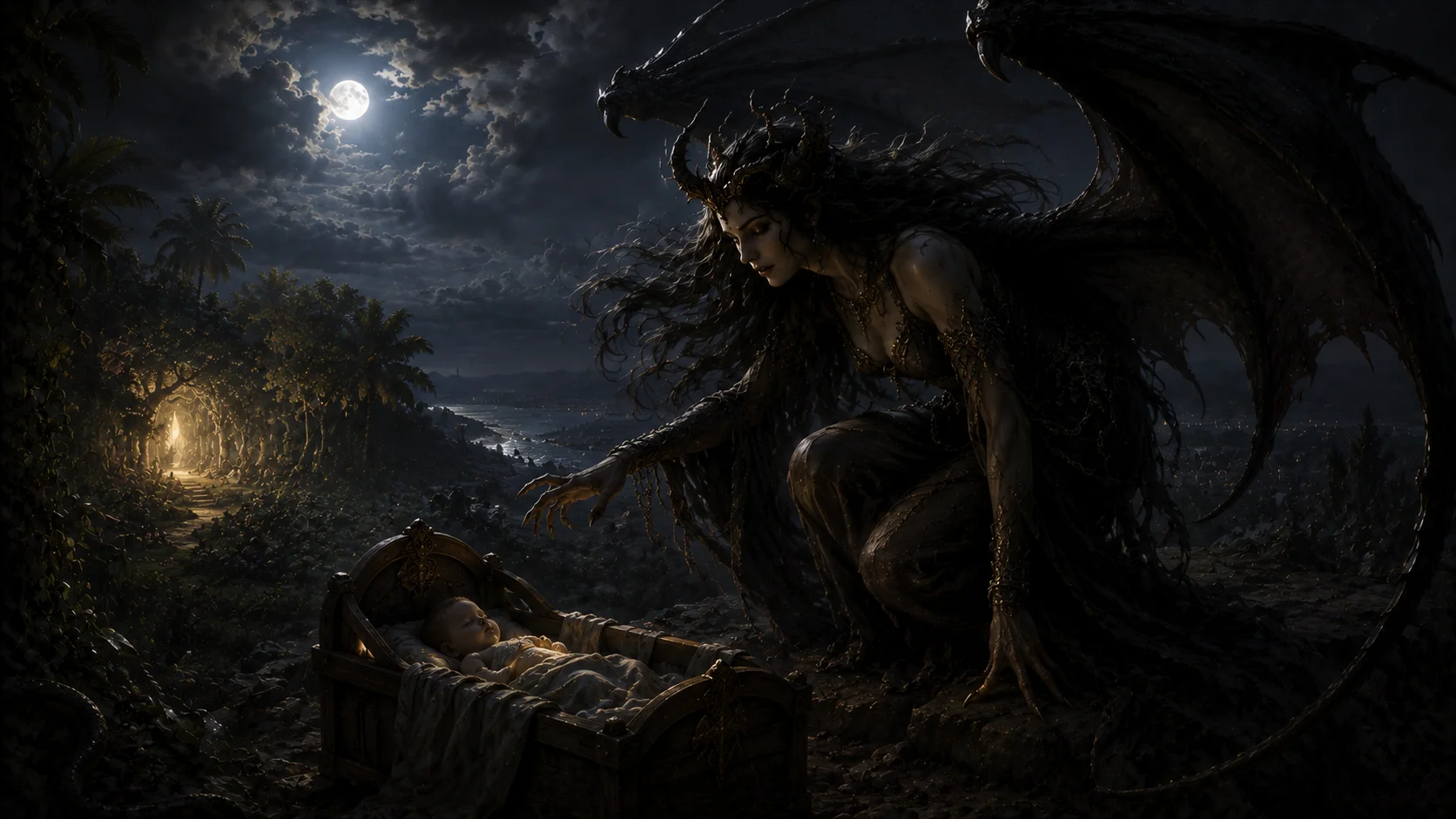
Lilith is the great female demon of Jewish folklore and mysticism: the night-demoness, the first wife of Adam who refused to submit and fled Eden, the slayer of newborn children and the seductress of men in their sleep, the queen of demons and the dark feminine of the tradition. From a marginal figure she grew into one of the most powerful and resonant of all demonic beings.
The First Wife of Adam
Lilith’s most famous legend, told in the medieval Alphabet of Ben Sira, makes her the first wife of Adam — created, like him, from the earth, and therefore his equal. When Adam sought to dominate her and she refused to lie beneath him, insisting on equality, Lilith spoke the secret name of God and flew away from Eden, abandoning Adam to dwell by the Red Sea among the demons. God sent three angels to bring her back, but she refused to return; and so, as a curse and a bargain, it was decreed that a hundred of her demon-children would die each day, and in revenge Lilith vowed to prey upon human infants — unless warded off by amulets bearing the names of the three angels.
The Slayer of Children and Seductress of Men
Lilith’s dread roles flow from this. She is the slayer of newborn children — the demoness blamed for infant death, miscarriage, and crib-death, who steals or strangles babies in the night — and against her, protective amulets, charms, and the names of the three angels (Senoy, Sansenoy, and Semangelof) were hung over the cradles of newborns and women in childbirth. She is also a succubus, who comes to men in their sleep to seduce them and to bear demon-children (the lilin) from their seed, and the mother of a host of night-demons. Older still, she derives from the lilitu, the night-demons of ancient Mesopotamia.
The Queen of Demons
In the Kabbalah, Lilith grew into a figure of cosmic significance — the queen of demons, the consort of Sammael (the great demon, the “other side”’s counterpart to God), the dark feminine of the demonic realm (the Qliphoth), the shadow-counterpart of the Shekhinah (the divine feminine presence). She became the embodiment of the dangerous, untamed, rebellious feminine, and in modern times a complex symbol reclaimed in many ways. From night-demon to first wife to queen of demons, Lilith is one of the most powerful and many-layered of all demonic figures. In Lilith, Jewish folklore and mysticism gave form to the dark and rebellious feminine — the first wife who would not submit and fled Eden, the night-demoness who slays children and seduces men, the queen of demons and consort of Samael, the most resonant and enduring of all the demon-figures of the tradition.
Older Than the Word Itself: Mesopotamian Origins
Two thousand years before the Alphabet of Ben Sira gave her a name and a husband to defy, a demon was already living in the folklore of Sumer and Babylon under the name lilitu. A Sumerian poem sometimes copied as an appendix to the Gilgamesh cycle tells of a huluppu-tree, torn from the bank of the Euphrates and replanted in a goddess’s garden, that grew wild and uncanny: a serpent nested at its roots, the monstrous Anzu-bird raised its young in the branches, and in the trunk dwelt a demon the text calls ki-sikil-lil-la-ke — the “maiden of the lil-spirit” — until Gilgamesh felled the tree and all three fled into the wild. Whether this shadowy figure is the direct ancestor of the later Jewish demon is still debated among Assyriologists, but the root of the name is the same, and the pattern — a female spirit haunting wild, liminal places — recurs for two thousand years afterward.
Akkadian exorcistic and medical texts do not describe one demon but a family of three: lilu, a male night-spirit; lilitu, his female counterpart; and ardat-lili, the “maiden of Lilu” — understood as the restless ghost of a young woman who died before she could marry or bear children, and who therefore begrudged the living what she had been denied. The incantations raised against them belong almost entirely to the domestic sphere: the man asleep in his bed, the woman in childbirth, the newborn — the exact spaces Lilith would go on haunting for millennia. Some scholars have connected this whole family of night-demons to the Old Babylonian terracotta relief now in the British Museum: a winged, nude woman with the taloned feet of an owl, flanked by owls, standing on the backs of two lions, and nicknamed the “Queen of the Night.” Others read the same plaque as Ishtar, or as Ereshkigal, queen of the underworld. The identification with Lilith remains unproven — but the owl feet and the wings became her visual signature regardless of which goddess or demon the relief first depicted.
One Word in Scripture, and a Warning from Qumran
Strip away every later legend and the Hebrew Bible itself gives Lilith exactly one line. Isaiah 34:14, describing the wasteland Edom will become, lists the creatures that will inhabit its ruins — goat-demons (se’irim), wildcats and hyenas, and “lilith,” who alone among them will find there a place to rest. Older English Bibles render the word as “screech owl,” following the ancient association between night-birds and night-demons; modern translations increasingly leave it untranslated, as a proper name. This single word is, in effect, the entire biblical Lilith: a demon assumed familiar enough to name in passing, with no story attached to her at all.
The story attached itself later, and not first in the Talmud. Among the Dead Sea Scrolls, the apotropaic hymns known as the Songs of the Sage (4Q510–511), copied somewhere between 30 BCE and 30 CE, instruct the reciter to frighten off a roster of terrifying spirits — bastard spirits, demons, Lilith, howlers and desert-dwellers — through the sheer terror of God’s glory. It is the earliest surviving Jewish text to set her name inside a ritual of protection rather than a prophecy of ruin, centuries ahead of the Talmudic references, and it shows a community already reciting against her much as later households would hang an amulet over a cradle.
A Demon Before She Was a Wife: Traces in the Talmud
The Talmud knows Lilith long before the Alphabet of Ben Sira makes her Adam’s equal and rival, and what it knows is oddly clinical. In tractate Shabbat the rabbis warn that a man who sleeps alone in a house is liable to be seized by Lilith. In Eruvin her long hair is listed among her defining features; in Niddah her name functions almost as a diagnosis rather than a proper noun, where a miscarriage bearing a human face but also wings is ruled upon simply as something born “in the likeness of Lilith.” In this period the word still hovers between a species of demon and a specific one — evidence that Lilith began as a category of dread before she consolidated into a single character.
A separate rabbinic legend, told in Genesis Rabbah and in Eruvin, adds a strange coda to the story of Eden: in the hundred and thirty years between the death of Abel and the birth of Seth, Adam lived apart from Eve, and in that time he is said to have fathered spirits, demons and lilin. Medieval Kabbalists would later read this obscure aside as the missing bridge between the Genesis narrative and Lilith’s displacement from it — the rabbinic imagination had already populated Adam’s exile with exactly the kind of demonic offspring the Ben Sira legend would go on to lay at her feet.
The Court of Demons: Naamah, Agrat bat Mahlat, and Eisheth Zenunim
Kabbalah did not leave Lilith alone at the summit of the Other Side. Zoharistic tradition surrounds her with a court of four demon queens, named together as consorts of Samael and remembered as the mothers of demons. Beside Lilith stands Naamah — a name lifted from a single genealogical line in Genesis 4, where she is the sister of Tubal-cain, and reimagined as a seductress of sleeping men and the mother of Asmodeus himself. With them are Agrat bat Mahlat, who according to tractate Pesachim rides out on the nights before Wednesday and the Sabbath with eighteen myriads of destroying angels at her back, and Eisheth Zenunim, “woman of whoredoms,” whose very name is an accusation.
The thirteenth-century Treatise on the Left Emanation, attributed to Rabbi Isaac ben Jacob ha-Kohen, is the text usually credited with first pairing Samael and Lilith as a couple — a mirror-image Adam and Eve ruling the demonic side of creation. It also performs a piece of unusually explicit theological housekeeping. Finding more than one Lilith already loose in the tradition, it formalises the split rather than resolving it: Lilith ha-Gedolah, “Lilith the Elder,” mate of Samael, and Lilith ha-Ketanah, “Lilith the Younger,” consort instead to Asmodeus — and coveted, the treatise adds, by Samael. It is a rare glimpse of medieval mystics noticing that their own tradition had generated a surplus of Liliths, and choosing to multiply her officially rather than argue her back into one.
Bowls Buried Upside-Down, and the Shape of an Owl
Amulets bearing the names of the three angels were not the only defence built against her. Across Sassanid-era Mesopotamia, Jewish communities inscribed incantation bowls — ordinary clay vessels covered in a spiralling Aramaic text, often circling a crude drawing of a bound demon at the centre — and set them upside-down beneath the floors, corners and thresholds of their houses, to trap whatever spirit the text had named. A large group of them was excavated at Nippur and published by James Montgomery in 1913, and bowls of this kind are still being catalogued today. Many name Lilith explicitly; some address not one Lilith but a plural crowd of them — “liliths” — which suggests that ordinary households feared not a single demon-queen but an entire species of her, multiplying wherever a house was left unguarded.
The owl endured as her emblem across this whole span, from the taloned feet of the Old Babylonian relief to Isaiah’s “screech owl” to the winged, clawed figures scratched onto incantation bowls a thousand years later. A bird that hunts in darkness, sees what people cannot, and calls with a sound many cultures found unbearable was, across the ancient Near East, the natural shorthand for a demon that did all three.
From Walpurgis Night to Lilith Fair
The legend did not stay confined to Jewish sources. In Goethe’s Faust, during the witches’ sabbath on the Brocken, Faust asks who the beautiful woman in the crowd is, and Mephistopheles tells him: Adam’s first wife, and beware of her hair. It is the Ben Sira legend, filtered through centuries of transmission, resurfacing in the heart of German Romanticism as a passing warning about a dangerous beauty rather than as a theological rebellion.
The Pre-Raphaelites seized on the same detail — the hair as the weapon. Dante Gabriel Rossetti’s Lady Lilith, painted between 1866 and 1868, and its companion sonnet “Body’s Beauty” from the sequence The House of Life, cast her as the archetype of physical seduction, combing her hair out before a mirror: beauty entirely detached from virtue, and the very trait the Talmud had once flagged as her mark.
The twentieth century inverted the verdict. The American Jewish feminist magazine Lilith, founded in 1976, and the touring music festival Lilith Fair, launched by Sarah McLachlan in 1997, both took the name deliberately. What each reclaimed was the one detail the whole tradition agrees on and had always counted against her: that she left. Read as demonology, the Alphabet of Ben Sira is a story that explains a dead infant in the night. Read as a story, it is about a woman who would not stay. That double life is why she has outlasted almost every other demon of the tradition — the accusation and the emblem are the same sentence, and only the reader has changed.
Sources & traditions
- EncyclopediaWikipedia — Lilith
- TraditionJewish/Kabbalistic texts, grimoires and later commentary
Myths change from area to area and from time to time. This chronicle follows the most widely told versions; tellings in other villages, regions and eras may differ.