Belial — “Worthlessness” or “Without Yoke” — is a great demon and personification of wickedness, lawlessness, and rebellion in Jewish lore: a name that began as an abstract term for worthlessness and evil and grew into one of the most important of the demonic princes, the very embodiment of lawless wickedness and the enemy of God, prominent above all in the Dead Sea Scrolls. He is wickedness itself made a demon.
The Worthless One
Belial (Beliar) is a Hebrew word meaning “worthlessness,” “wickedness,” or “without worth/yoke” — and in the Hebrew scriptures it appears first as an abstract term, “sons of Belial” meaning “worthless, wicked men.” But over time Belial was personified into a being — a demon, a fallen angel, the very personification of evil, lawlessness, and rebellion against God. He embodies the rejection of all law and yoke, the spirit of wickedness, corruption, and rebellion in its purest form.
The Prince of Darkness in the Scrolls
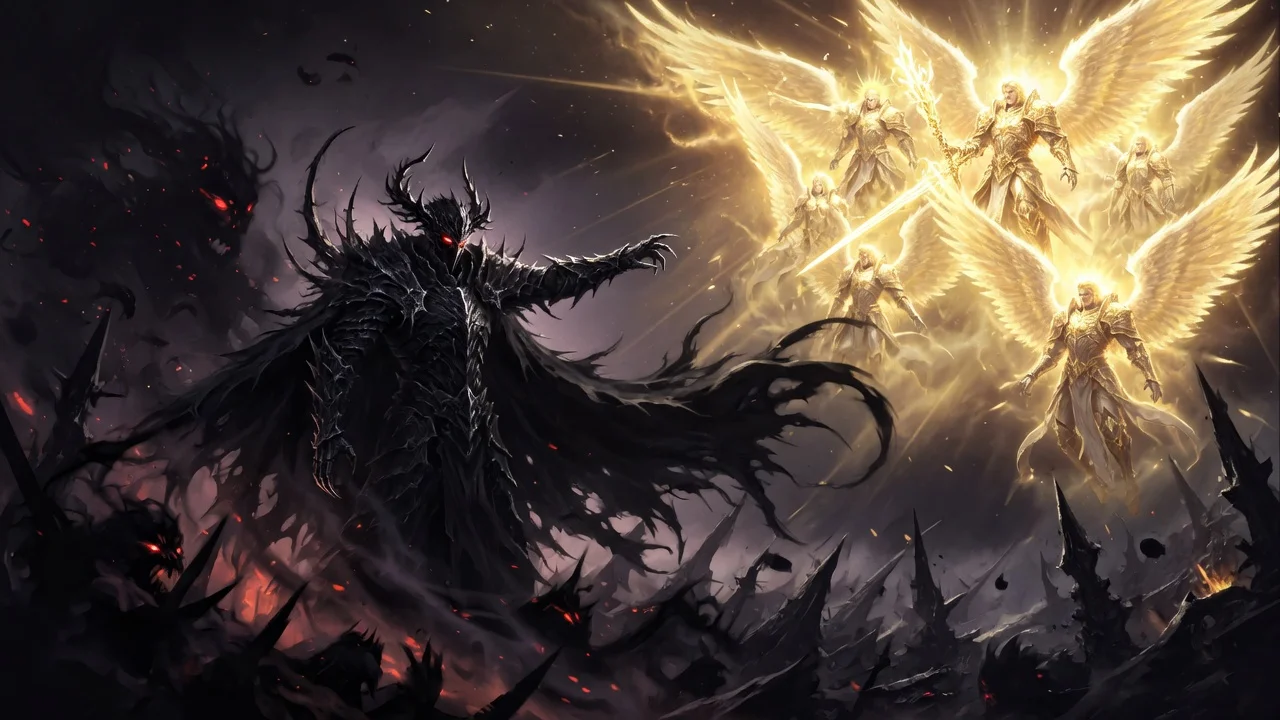
Belial rose to supreme importance in the Dead Sea Scrolls (the writings of the Qumran community). There he is the great adversary — the Prince of Darkness, the leader of the forces of darkness and the “sons of darkness” in the cosmic war against the “sons of light” and the angels of God. The community saw the world as a battleground between the spirits of light, led by the Prince of Light, and the spirits of darkness, led by Belial, who works to corrupt, ensnare, and destroy the righteous. He is the chief of evil, the dark counterpart to the divine, the enemy who will be defeated at the end of days.
The Embodiment of Lawlessness
Belial thus represents lawlessness, wickedness, and rebellion against the divine order in their most absolute form — the rejection of all that is good and holy. In later demonology and in Christian tradition, Belial became one of the great demon-kings and princes of hell, sometimes identified with Satan or numbered among the chief fiends. A being who grew from an abstract word for evil into a personified prince of darkness, Belial is one of the most significant of the demonic figures. In Belial, Jewish lore gave form to wickedness and lawlessness themselves — the Worthless One, the personification of evil and rebellion, the Prince of Darkness of the Dead Sea Scrolls who leads the forces of darkness against the light, the demon who embodies the absolute rejection of the divine yoke.
Before the Prince: Belial in the Hebrew Bible
Long before Belial had a face, he had a rap sheet. Centuries before the Qumran community made him commander of the sons of darkness, the phrase “sons of Belial” (benei beliyaal) was already a stock accusation running through the historical books of the Hebrew Bible — not a name flung at a demon, but an insult flung at men. It names the mob that surrounds a house at Gibeah demanding a traveller be handed over to violence (Judges 19–20); it names the sons of the priest Eli, who “knew not the LORD” and treated the sacrifices of the sanctuary with contempt (1 Samuel 2:12); it names Nabal, the churlish landowner who insults David’s messengers to his own ruin (1 Samuel 25:17, 25); it names Shimei, cursing King David as he flees Jerusalem (2 Samuel 16:7); it names Sheba, who leads a rebellion against David’s throne (2 Samuel 20:1); and it names the two false witnesses hired to perjure Naboth to death so that Ahab can seize his vineyard (1 Kings 21:10–13). In every case the word does the same job: it marks a person as having thrown off every restraint — law, kinship, hospitality, loyalty to God — that holds a community together.
The poetry goes further than the history books dare to. In 2 Samuel 22:5 and its twin in Psalm 18:4, the Hebrew speaks of the nachalei beliyaal, the torrents of Belial, closing over a drowning man — usually softened in translation to “floods of ungodly men” or “torrents of destruction.” The image is a wadi: a dry desert channel that fills without warning and takes everything with it. And in that verse the word stands in parallel with Death and Sheol, so that beliyaal is doing duty not as a description of bad men but as a name for the undertow of the grave itself. By the time a sectarian community in the Judaean desert needed a proper name for the general of the armies of darkness, they were not coining one. They were promoting a word that had spent centuries as everyone’s favourite insult into a job it had been quietly auditioning for the whole time.
Paul’s Rhetorical Question
The New Testament mentions Belial exactly once, and never explains who he is — because by the middle of the first century CE, among Greek-speaking Jews and the early Christian communities that grew out of them, no explanation was needed. Writing to the church at Corinth, Paul asks: “What concord hath Christ with Belial? or what part hath he that believeth with an infidel?” (2 Corinthians 6:15). The line is pure rhetorical architecture — light against darkness, Christ against Belial, believer against unbeliever — and it only works if “Belial” can stand, unglossed, as the opposite number to Christ himself. There is a quiet joke in the setting, too: the passage opens by warning the Corinthians not to be “unequally yoked” with unbelievers, and Belial is the one who wears no yoke at all. A word that began its life meaning nothing more exotic than “worthless” had travelled far enough in Jewish thought to serve, in a single Greek sentence sent to a Roman colony, as a name that needed no footnote.
The Prince of Deceit in the Testaments
Qumran’s Belial fights a war with armies and battle lines. A different body of Jewish literature gives him a subtler job: he does not besiege the righteous, he seduces them. The Testaments of the Twelve Patriarchs — a set of pseudepigraphal farewell speeches put in the mouths of Jacob’s twelve sons as they lie dying — return again and again to the spirit of Beliar as the hidden author of specific vices: envy, drunkenness, sexual sin, avarice, deceit, uncontrolled anger. The pattern is confessional. Simeon, accounting for what he and his brothers did to Joseph, does not plead circumstance; he says that the prince of deceit sent out the spirit of envy and blinded his mind. One patriarch after another names his own worst failing, traces it back to a spirit working through him, and warns his descendants that it is still in the room with them.
This is Belial recast as a psychological hazard rather than a battlefield commander — less the leader of a hostile nation than the whisper that talks a good man into a bad decision, one temptation at a time. It is worth noticing that the two portraits were never sealed off from one another: Hebrew and Aramaic fragments of material related to the Testaments turned up among the Dead Sea Scrolls themselves. The cosmic warlord and the private tempter were being read by the same people. They are one figure, described by writers asking different questions — how will this war end, and why did I do that.
The Matricide King
One strand of this literature does something bolder: it points at a living man and calls him Belial. The Ascension of Isaiah, a composite Jewish-Christian apocalypse, describes Beliar as “the great ruler, the king of this world,” who will descend “in the likeness of a man, a lawless king, the slayer of his mother,” and persecute the young church before the end. Commentators read the matricide detail as unmistakable. The emperor Nero had arranged the murder of his mother, Agrippina; he died by his own hand in 68 CE; and the conviction that he was not really dead, or would come back, circulated for decades afterwards. The Sibylline Oracles carry a related figure — a Beliar who will come “from the Sebastenoi,” work signs and wonders, and lead many astray, the faithful among them. Where he comes from has never been settled: readers have taken Sebastenoi to mean the line of Sebastos, the Greek title of Augustus, and therefore the imperial house itself, and others to mean the people of Sebaste, which is to say Samaria. The ambiguity sits in the Greek, not in the translation. Either way the move is the same one, and it is the interesting part: the oracle is not describing a monster. It is describing a man with an address. This is among the oldest threads later woven into the Christian idea of the Antichrist — not a new invention, but the ancient personification of lawlessness given, for one frightened generation, an emperor’s face.
King of Hell: Belial in the Grimoires
By the late Renaissance, Belial had been promoted again — from cosmic rebel to bureaucrat. The Dutch physician Johann Weyer catalogued him among hell’s kings in the Pseudomonarchia Daemonum, appended in 1577 to De praestigiis daemonum, a book arguing that the women being burned as witches were deluded or ill rather than guilty. Weyer was, in other words, publishing a directory of demons as part of an argument that the people accused of commanding them had done nothing. The seventeenth-century grimoire tradition that followed — culminating in the Lesser Key of Solomon’s Ars Goetia — kept him on the list, as the sixty-eighth of its seventy-two spirits and a King “created next after Lucifer.” The staging is theatrical: he appears as two beautiful angels seated in a chariot of fire, speaks with what the text calls a comely voice, distributes titles and offices and the favour of friends, and claims he fell from among the worthier sort of angels, those ranked before Michael.
Then comes the warning, and it is the reason the entry is worth reading. The exorcist must present Belial with offerings, sacrifices and gifts, or he will not give true answers at all — and even bought, the truth has a shelf life: he does not stay in it an hour unless he is constrained by divine power. Three thousand years of theology compress into a procedural note. The being whose name means worthless can be made to speak, at a price, and still must not be believed.
Milton’s Belial: The Eloquence of Doing Nothing
When Milton assembles his fallen angels in Paradise Lost, he gives each one a vice to embody, and Belial draws the quietest and, in its way, the most damning: not rage, not ambition, but sloth dressed as wisdom. Introduced in Book I as a spirit “than whom a Spirit more lewd / Fell not from Heaven,” he rises in Book II to speak in the great debate over what hell should do next — after Moloch, who wants open war, and before Mammon, who wants to stop fighting and build a rival kingdom out of the materials to hand. Belial argues for none of it. He argues for waiting: for enduring, for letting time and God’s cooling anger do the work, and for calling that patience. Milton refuses to let the performance pass. Belial’s tongue, he says, dropped manna, and could make the worse appear the better reason — but all was false and hollow. It is a small, exact inheritance from scripture and grimoire alike: give worthlessness a beautiful voice, and it will always argue for staying exactly where it is.
Why “Worthlessness” Needed a Face
Most demons begin as monsters and have theology added later. Belial ran the opposite direction. He began as a judgement — a word an outraged neighbour or a betrayed king reached for when the ordinary vocabulary was not harsh enough — and only became a person because enough communities, under enough real pressure, needed lawlessness itself to have an address. Qumran’s sectarians, bracing for what they believed was the final war; the Corinthian church, told to keep its distance from a corrupting world; the readers of the Ascension of Isaiah, living after an emperor who had killed his own mother — each generation reached for the same old insult, because the alternative was worse. The alternative was to admit that the lawlessness they feared had no author, no name, and therefore no end.
That is also why Belial never grew the physical folklore that clings to a werewolf or a vampire: no forest, no bite, no grave to open and check. There was nothing to see. He was never really outside the community he haunted — he is the name that community gives to the part of itself that has decided the yoke no longer applies.
Sources & traditions
- EncyclopediaWikipedia — Belial
- TraditionJewish/Kabbalistic texts, grimoires and later commentary
Myths change from area to area and from time to time. This chronicle follows the most widely told versions; tellings in other villages, regions and eras may differ.