Camael — “He Who Sees God” — is the archangel of strength, courage, and divine severity in Jewish mysticism: a fierce warrior-angel who leads the celestial hosts in the defense of the divine order, the angel of holy war and of the stern justice of heaven, associated in the Kabbalah with the sefirah of Gevurah (Severity/Strength). He is the iron will of heaven.
The Angel of Strength and Severity
Camael (Kamael, Qemuel, Chamuel in some confusions) is the archangel of strength, power, courage, and divine severity — the fierce, martial angel who embodies the stern and forceful aspect of the divine. In the Kabbalah, he is associated with the sefirah of Gevurah (also called Din, “Judgment”) on the Tree of Life — the attribute of God’s severity, strength, judgment, and the rigorous justice that restrains and punishes, the necessary counterweight to mercy. Camael is the angelic embodiment of this divine power and severity.
The Leader of the Hosts
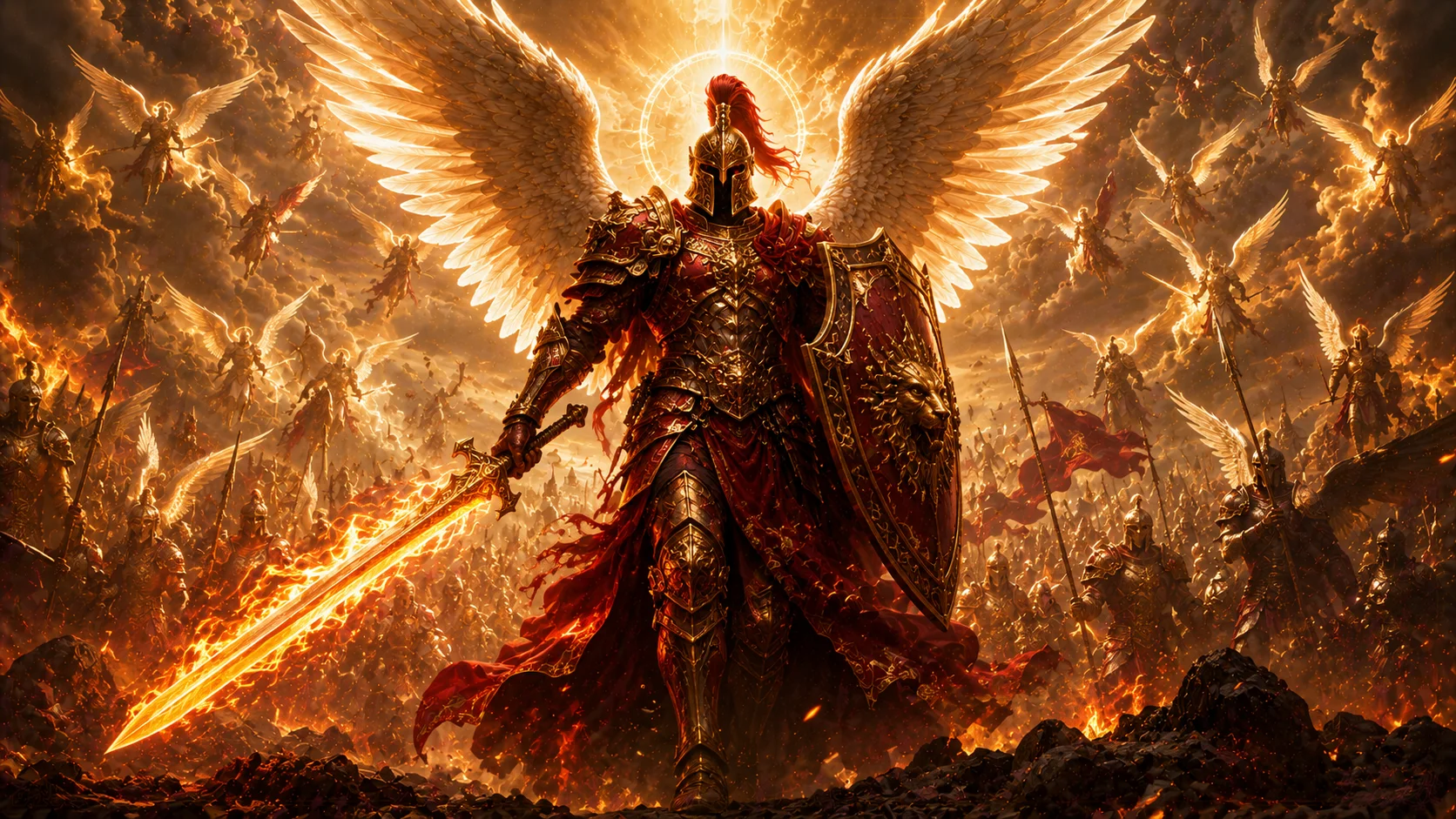
Camael is a warrior-angel and a leader of the celestial armies — the commander (in some traditions) of the angelic hosts called the Powers, the legions who defend the divine order and wage war against the forces of chaos and evil. He is fierce and mighty, the angel of holy war, of divine wrath against the wicked, and of the strength to overcome. He stands among the great archangels and the rulers of the heavens, a being of formidable power. (His fierceness is so great that one tradition tells of him as a terrifying guardian whom even Moses had to overcome to receive the Torah.)
The Severity of Heaven
Camael embodies the truth that the divine order is upheld not only by mercy and love but by strength, judgment, and severity — the rigorous justice that punishes evil and defends the good. He is invoked for courage, strength, and protection in conflict, and for the will to overcome adversity. As the angel of Gevurah, he holds an essential place in the Kabbalistic vision of the divine attributes. In Camael, Jewish mysticism gave form to divine strength and severity — the fierce warrior-archangel of Gevurah who leads the celestial hosts, embodies the stern justice and might of heaven, and grants courage and strength to those who face the battles of the soul.
The Name Behind the Name
Before it belonged to an archangel, “Kemuel” was an unremarkable human name in the Hebrew Bible, borne by ordinary men whom scripture barely pauses over. In Genesis, Kemuel is a son of Nahor — Abraham’s brother — and the father of Aram: a link in a genealogy and nothing more. In Numbers, a different Kemuel is the prince of the tribe of Ephraim, named only because he was appointed to help apportion the land of Canaan among the tribes. Neither man does anything remarkable. Neither is a spirit, a messenger, or a warrior. It is this small, dry, genealogical name that Jewish mystical writers later lifted into heaven — the ascent literature gives it to the fearsome porter stationed at the gate of the firmament, and the Kabbalists gave it to the archangel of severity. The drift from a minor prince who helped survey a border to the commander of the hosts of judgment is one of the stranger journeys in Jewish angelology: a name detaching itself completely from the men who wore it, then being refilled with a meaning none of them ever carried.
Gevurah Wears Red: Camael and the Planet Mars
By the time the Hermetic occult revival of the late nineteenth century set about systematising the Kabbalah into a working magical technology, Camael had been given a second address: the planet Mars. The logic was already latent in the older tradition — Gevurah is the sphere of force, discipline, and righteous violence, and Mars had carried exactly that character in astrology for millennia — so the ceremonial magicians simply completed the equation. In the correspondence tables of the Golden Dawn and the societies that grew out of it, Geburah is the fifth sphere, its colour a hard and unmixed red, its metal iron; and the archangel presiding over it — spelled variously Khamael, Kamael, or Camael — becomes the personification of that entire cluster of ideas. Force pared down to its essentials, without ornament and without hesitation.
Invoking Camael, in this tradition, was never a request for comfort. It was a deliberate appeal to whatever in the self, or in the cosmos, is capable of decisive and even violent action in the service of a higher order — the same quality the Kabbalists had located in him centuries earlier, now issued a planet and a colour to wear.
A Name Divided: Camael, Samael, and the Modern Chamuel
No archangel in this tradition carries a more confused identity, and the confusion runs in two opposite directions at once. On one side he has long been blurred together with Samael — the accusing angel, the angel of death, whose name Jewish tradition linked with poison and whose place in later Kabbalah is at the head of the demonic “other side” of the Tree. The overlap is not random. The seat of Mars is held by Camael in some systems and by Samael in others, so the two names have been competing for the same martial, left-hand territory for centuries, and the compilers of angel lists have not always troubled to keep them apart.
On the other side, and far more strangely, the last hundred years produced an almost total inversion. A popular devotional angelology, working from the similar-sounding Chamuel, recast him as the gentle archangel of unconditional love, of comfort, and of finding what has been lost. The angel who was once a terror at the gate of heaven became, in the glossy modern angel guide, a soft-spoken healer of broken relationships. Whether that Chamuel is the same being under a worn-down spelling or a genuinely separate figure is arguable; the direction of travel is not. Once a name leaves the technical vocabulary of mystics and enters the popular religious imagination, it is the sound of it that survives — and a comforting angel is a far easier thing to offer than a difficult, martial one.
A Prince Without a Portrait
Walk a gallery of medieval and Renaissance religious art and Michael is instantly recognisable — armoured, winged, a spear driven through the dragon underfoot — while Gabriel is just as legible, kneeling before Mary with a lily in hand. Camael has no equivalent visual signature. He belongs to a different current of religious life: not the public art of churches, commissioned to teach scripture to people who could not read it, but the closed, text-based world of Kabbalistic study and, later, of ceremonial magic, where diagrams, names, and correspondences mattered far more than pictures ever did.
Where he does appear at all — in occult manuals, in Tarot-adjacent illustration, in diagrams of the Tree of Life — it is almost always through colour rather than costume: the saturated red assigned to Geburah standing in for the being who rules it, sometimes beside the number five, sometimes beside emblems borrowed generically from war, a sword or a suit of armour with no particular face inside it. In the visual record he is less a portrait than a colour and a temperament — a way of marking a page as belonging to the register of strength rather than of mercy.
Why Heaven Keeps a General
There is a question that every tradition with a loving God has eventually to answer: who carries out the parts of justice that love will not do? Camael is one of the answers Jewish mysticism arrived at. The force, the punishment, the cold arithmetic of what is deserved — none of it is denied and none of it is softened. It is delegated. It is given a face, a name, a sphere, a planet, and a colour, so that it can be acknowledged as real and necessary without being laid directly at the feet of the God whose tenderness the same tradition insists upon. That is the quiet structural work Camael performs in every version of him, from the porter who bars the gate to the red-robed lord of Mars in a magician’s diagram: he is how a religion built on love keeps a general on staff, and how it can hold, without contradiction, that both are exactly what holiness requires.
Sources & traditions
- EncyclopediaWikipedia — Camael
- TraditionJewish/Kabbalistic texts, grimoires and later commentary
Myths change from area to area and from time to time. This chronicle follows the most widely told versions; tellings in other villages, regions and eras may differ.