Chamuel — also rendered Kemuel, Camael, and Camiel across the manuscript traditions that carry his name — occupies one of the more contested corners of Jewish angelology. He is claimed at once as a fierce throne-guardian of the highest heavens, a stern angel of severity presiding over Gevurah on the Kabbalistic Tree of Life, and, in far later devotional literature, a gentle patron of love and reconciliation. These are not three faces of one settled figure so much as three separate accretions layered onto a name whose earliest attestation was not angelic at all.
A Human Name Before an Angelic One
Before Kemuel ever named an angel, it named a man. Numbers 34:24 lists Kemuel son of Shiphtan as a tribal leader of Ephraim, appointed to help divide the land of Canaan among the tribes of Israel. Genesis 22:21 gives the name again, this time to a son of Nahor, Abraham's brother, counted among Nahor's descendants born to his wife Milcah. Neither passage has anything to do with angels; both are genealogical and administrative notices, the ordinary furniture of biblical record-keeping. The angelic Chamuel of later tradition is a reapplication of this human name to a celestial being, not a direct biblical angelic attestation. Popular angelological compendia often blur this distinction, presenting Chamuel as though the Bible itself named him among the heavenly host. It does not. The distance between a tribal leader's name in Numbers and a throne-guarding angel in later mystical literature is centuries wide, and worth stating plainly rather than smoothing over.
The Terror at the Seventh Palace
The fullest textual foundation for an angel actually called Kemuel comes not from the Talmud but from the Hekhalot literature — the "palace" texts of early Jewish mysticism that describe the ascent of the mystic through seven heavenly halls to the divine throne. In 3 Enoch (Sefer Hekhalot), Kemuel is listed among the throne-guarding angelic princes, and some recensions describe him as a fierce, terrifying gatekeeper stationed at the seventh and innermost heavenly palace. This is not a comforting portrait. The Hekhalot tradition as a whole is preoccupied with the danger of the ascent, known in its own vocabulary as yeridah la-merkavah, the "descent" to the chariot-throne — a paradoxical term for a journey upward, reflecting how perilous and disorienting the mystics understood it to be. Angelic princes in this literature do not simply usher the visionary through; they test, they block, and in some tellings they destroy the unworthy. Kemuel's placement as gatekeeper of the seventh palace situates him precisely at this theological pressure point: the boundary where divine proximity is guarded rather than freely given, where even the righteous cannot presume easy passage.
The Angel Who Stood Against Moses
Later tradition, including strands reflected in the Zohar's angelology and subsequent Kabbalistic compendia, tells that Kemuel was demoted or destroyed and replaced when Moses ascended to receive the Torah, having opposed that ascent. This is a distinct aggadic motif, and its attachment to Kemuel specifically is one of several variant tellings scattered across midrashic angel-lists — it is not a fixed, single narrative. The more widely told version of angelic opposition to Moses appears in the Babylonian Talmud, Shabbat 88b–89a, and is expanded in later midrashim such as Pesikta Rabbati and Midrash Tanchuma, where the angel most commonly named in this role is Kanzafoni, or simply "the angels" collectively, sometimes alongside figures such as Hadarniel or Kanzafoni and Chemah in still other retellings. The primary Talmudic passage itself does not name Kemuel explicitly; his appearance in this role belongs to the fluid, non-standardized naming conventions that characterize this motif as it passed through different compilations over centuries. What stays constant across every variant, whichever angel is named, is the theological point being made: that Torah was given to Moses, a human being, and not to angels — a recurring rabbinic theme sometimes read as a deliberate polemic against over-elevating angelic mediators above the human recipients of revelation. Whether the angel who lost that argument is named Kemuel, Kanzafoni, or Hadarniel, the moral is the same — the supremacy of Torah, and of the human who receives it, over the celestial hierarchy that would guard it.
Severity on the Tree of Life
In post-Hekhalot angelological schemes that mapped archangels onto the ten sefirot of the Kabbalistic Tree of Life, Chamuel or Camael is assigned in some tables to Gevurah, the sefirah of Severity, Strength, and Judgment. This placement casts him as an angel of stern discipline and forceful courage, in keeping with Gevurah's broader association with the rigor of divine judgment as distinct from the expansive mercy of Chesed opposite it. It bears repeating that this sefirotic assignment is one of several competing correlation tables found in later Kabbalistic and Renaissance Christian-Hebraic angel-hierarchy literature — no single unanimous doctrine fixes which angel governs which sefirah, and different compendia populate the tree differently. Still, the Gevurah association is the thread that ties together nearly everything else attributed to this figure: the fearsome gatekeeper of 3 Enoch, the angel invoked for courage in later folk practice, and the general sense across the sources that this is a being of force rather than gentleness — at least in his older and better-attested guise.
Kemuel Seraph, Kemuel Guardian
The variant spellings attached to this figure are numerous: Kemuel, Camael, Camiel, and in rarer transliterations Cancel or Chancel. Some grimoire-adjacent literature refers to "Seraph Kemuel," assigning him rank among the Seraphim, the highest order of angels in certain hierarchies — though like the Gevurah correlation, this seraphic rank is itself a variant attribution rather than a point of universal agreement across sources. The proliferation of spellings and ranks is itself telling: it marks a figure who was never pinned down by a single authoritative text, but who instead accumulated identity piecemeal, compendium by compendium, each compiler drawing on whichever earlier list came to hand and adding a detail of their own.
Counted Among the Seven, When the Seven Agree
Some angel-list compendia place Chamuel among the traditional Seven Archangels, alongside better-attested figures such as Michael, Gabriel, Raphael, and Uriel. But the composition of that sevenfold list itself varies considerably across Jewish, Christian, and syncretic sources; no single canonical Jewish text fixes a definitive roster of seven archangels. Rival versions of the list substitute other names in Chamuel's place — Zadkiel, Jophiel, Raguel, or a doubling of Sariel and Uriel under different transliterations. Chamuel's inclusion, where it occurs, is one variant among several rival sevenfold enumerations rather than settled doctrine, and readers encountering him named as one of "the" seven archangels should understand that phrase as pointing to one tradition among competing ones, not a fixed and universally accepted count.
A Comparatively Thin Textual Record
Set beside Michael, Gabriel, and Raphael — angels with clear, repeated, and relatively stable roles across biblical and post-biblical literature — Chamuel's textual foundation is markedly thinner. No direct, unambiguous classical Talmudic passage names an angel Chamuel or Kemuel functioning exactly as later Kabbalistic and esoteric compendia go on to describe. The fullest basis available is the Hekhalot material of 3 Enoch and its related throne-room texts, combined with the later reapplication of the biblical human name from Numbers and Genesis onto an angelic figure. The love-and-relationships role and the specific Gevurah correlation are later systematizations layered atop that thin foundation, not attested features of the earliest sources. This comparative thinness is worth stating plainly rather than papering over with confident detail borrowed from later, less authoritative compendia — a caution that applies to more than one angelic figure whose name resembles a biblical human one, and is worth bearing in mind whenever such names surface elsewhere in the same literature.
A Late and Gentler Reimagining
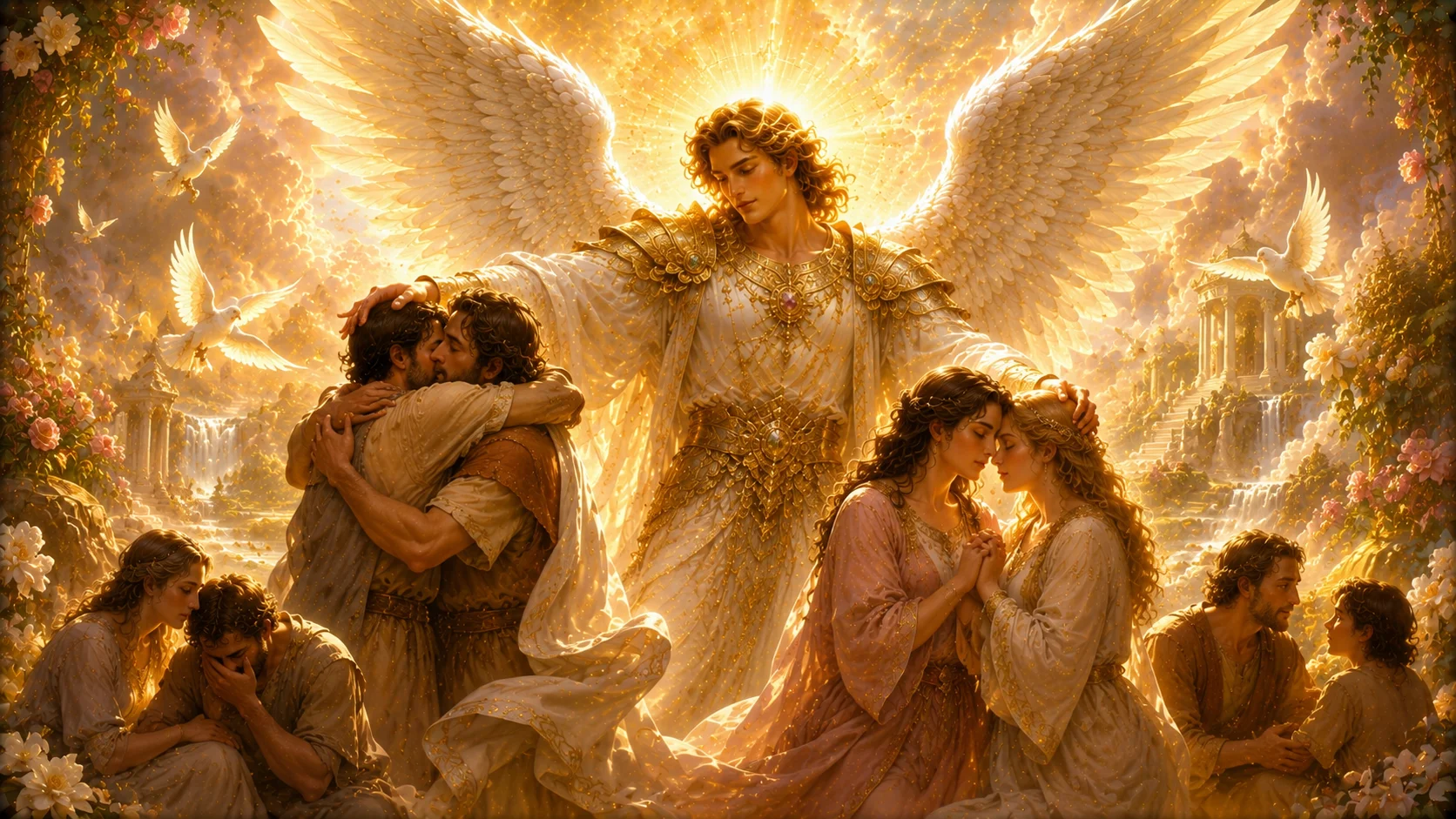
Alongside the fierce gatekeeper of the Hekhalot texts, a wholly different Chamuel emerges in broadly post-medieval, syncretic Jewish-Christian angel lore: an angel associated with love, relationships, and the finding of what is lost. This gentler, relational Chamuel is the version most familiar to readers of popular angel literature today, but it is important to be precise about its age and grounding. This "angel of love" association is a distinctly late accretion, largely a nineteenth- and twentieth-century, New Age-adjacent development, and it has weak grounding in classical Jewish sources. It should be understood as a modern reinterpretation built loosely on the name's disputed etymology — "he who sees God" or "he who seeks God" — rather than as continuous or traditional doctrine reaching back to the Hekhalot texts or the Kabbalistic hierarchies. The two Chamuels, stern gatekeeper and gentle finder of what is lost, sit uneasily side by side in the popular imagination, but the honest account keeps them separated by the centuries and the very different kinds of literature that produced them.
What His Name May Mean
The etymology of Chamuel is itself disputed among angelological sources. Read as Kamu-El, the name has been plausibly glossed as "he who sees God" or "he who seeks God"; other etymological proposals render it "he who is like God," echoing the grammatical pattern found in names such as Michael. No single reading commands consensus, and the uncertainty extends even to the most basic question of what the name was originally meant to convey. Given how much later material — the love-and-relationships role especially — leans on the "seeker of God" reading for its plausibility, the disputed etymology is not a minor footnote; it is part of why that later reinterpretation should be held loosely rather than treated as settled fact.
Invoked for Courage, Outside the Halakhic Mainstream
In certain Kabbalistic magical and practical handbooks — segulot, amulet literature, and angel-invocation texts that stand outside normative halakhic practice — Chamuel's name is invoked for protection in conflict, or for courage before difficult encounters. This usage sits consistently with the Gevurah, strength-and-severity association discussed above, rather than with the later love-and-reconciliation role; a petitioner reaching for Chamuel's name before a confrontation was drawing on the older current of fierce, guarding strength, not the gentler modern reinterpretation. It is worth stressing again that this is folk-practice tradition, explicitly outside mainstream halakhic or classical liturgical use — the kind of devotional practice that circulates in amulets and private handbooks rather than in the normative legal and liturgical texts that anchor mainstream Jewish observance.
A Name Carried Across Contradictory Traditions
Taken together, the record for Chamuel is less a single coherent biography than a name that different eras and different kinds of literature filled with different content: a genealogical notice in Genesis and Numbers naming a man, not an angel; a terrifying gatekeeper in the Hekhalot palace-ascent texts, embodying the danger of approaching the divine; a variant angel in the aggadic memory of opposition to Moses, one name among several told for that role; a stern presence on the Tree of Life under Gevurah in some Kabbalistic tables and absent from others; a name invoked for courage in folk amulet practice; and, only in the last two centuries, a reimagined angel of love and reconciliation with little grounding in the older strata. Reading Chamuel honestly means holding all of these together without collapsing them into one tidy figure — recognizing a name that different generations of tradition kept reaching for, and kept filling with whatever meaning their moment required.
Sources & traditions
- EncyclopediaWikipedia — Camael
- TraditionJewish/Kabbalistic texts, grimoires and later commentary
Myths change from area to area and from time to time. This chronicle follows the most widely told versions; tellings in other villages, regions and eras may differ.