Zadkiel — “the Righteousness of God” — is the archangel of mercy, benevolence, and divine grace in Jewish mysticism: the gentle angel of forgiveness and compassion, associated in the Kabbalah with the sefirah of Chesed (Loving-kindness/Mercy), and identified in tradition as the angel who stayed Abraham’s hand from sacrificing Isaac. He is the loving-kindness of heaven.
The Angel of Mercy
Zadkiel (Tzadkiel, Sachiel) is the archangel of mercy, benevolence, forgiveness, and divine grace — the angel who embodies the gentle, loving, and compassionate aspect of the divine. In the Kabbalah, he is associated with the sefirah of Chesed (Loving-kindness, Mercy, Grace) on the Tree of Life — the attribute of God’s boundless love, generosity, and mercy, the expansive and giving force that complements the severity of Camael’s Gevurah. Zadkiel is the angelic embodiment of this divine loving-kindness, the patron of mercy, forgiveness, and compassion.
The Stayer of Abraham’s Hand
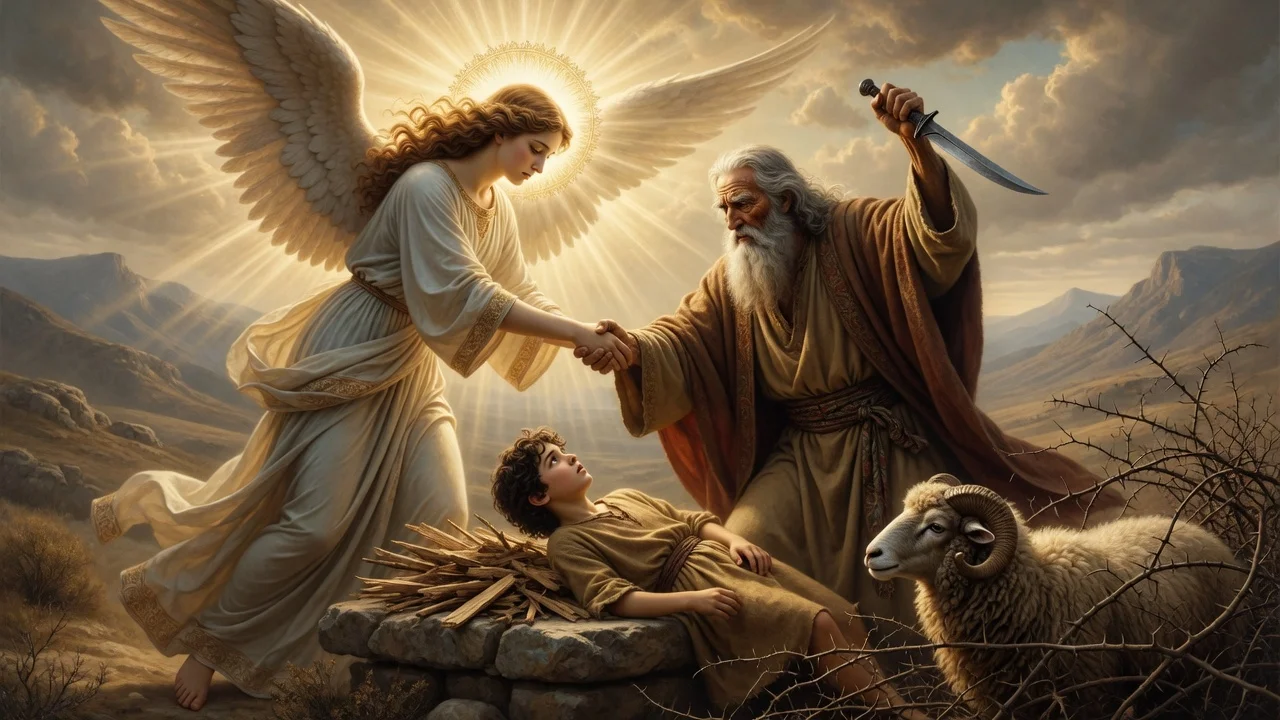
Zadkiel is identified in one important tradition as the angel who intervened at the binding of Isaac (the Akedah) — the angel who called out from heaven to stay Abraham’s hand as he raised the knife to sacrifice his son, sparing Isaac and providing the ram caught in the thicket. This act of mercy — the stopping of the sacrifice, the sparing of the innocent — perfectly embodies Zadkiel’s nature as the angel of mercy and divine grace, and it is one of the great moments of the Hebrew scriptures. (Other traditions assign this role to the angel Michael or another.)
The Loving-Kindness of Heaven
Zadkiel is invoked for mercy, forgiveness, compassion, and divine grace, and for the easing of judgment and the granting of benevolence. As the angel of Chesed, he holds an essential place in the Kabbalistic vision of the divine attributes, the loving-kindness that balances and tempers the severity of judgment. He is honoured as one of the great archangels, the gentle and merciful power of heaven. In Zadkiel, Jewish mysticism gave form to divine mercy and loving-kindness — the archangel of Chesed who embodies the boundless grace and compassion of heaven, the angel who stayed Abraham’s hand from the sacrifice, the gentle power of forgiveness and divine love.
An Angel Without a Scripture
Search the Hebrew Bible for the name Zadkiel and it is not there — not in Genesis, not in the Prophets, not anywhere among the books that Jewish and Christian communities eventually agreed to keep. The absence is worth sitting with, because the company he keeps in later tradition is not shy about scripture. Michael stands in the book of Daniel as the great prince who guards Israel. Gabriel interprets visions in that same book and, centuries later, announces two births in Luke’s gospel. Raphael walks the roads of Media under an assumed name in the book of Tobit, curing blindness and arranging a marriage as he goes. Even the Enochic literature of the last centuries before the common era already knows a working roster of named archangels — Michael, Gabriel, Raphael and Uriel among them — each with a domain and a job description. Zadkiel is on none of these lists.
His name belongs instead to the angelology that grew up beside the canon rather than inside it: the mystical and magical compendia of celestial names that Jewish tradition accumulated over centuries. That is not a flaw in the record; it is how the tradition actually worked. The angelic hierarchy did not arrive complete. It accreted, generation by generation, as mystics and scribes reached for names to put on the attributes of God they wanted to personify. By the time Chesed needed a face, the naming habit was old and thoroughly established — and Zadkiel is what mercy came to be called.
Institutionally, that lateness cost him something. In 745 a council at Rome under Pope Zachary examined a Frankish preacher, Aldebert, whose prayers invoked eight angels by name. Seven of the eight were unknown to scripture; the council pronounced those seven demons, ordered his writings burned, and ruled that Christians should address only the angels the Bible actually names — Michael, Gabriel and Raphael. Uriel, old and popular and on Aldebert’s list, lost his standing in the Latin West that day. Names that arrived later — Camael, and eventually Zadkiel — were never even in contention for a place. Zadkiel’s mercy needed no permission to be invoked. It simply never won a seat on the official bench.
The Angel of Jupiter
Here is a coincidence that is not a coincidence at all. The planet English calls Jupiter is Tzedek in Hebrew — righteousness, justice — and the name is old enough to appear among the planets discussed in the Babylonian Talmud. It is the same root, letter for letter, that gives Zadkiel his own name. A being called righteousness and a planet called righteousness were always going to end up entangled, and the astrology shared across Jewish, Islamic and Latin learning made the match irresistible: Jupiter was the Greater Benefic, the most fortunate and expansive of the seven classical planets, the one held to bring abundance, honour and growth.
Renaissance ceremonial magic turned that affinity into a filing system — though the filing systems did not agree with each other. The grimoire known as the Heptameron parcels out the week among angels: Michael for the Sun and Sunday, Gabriel for the Moon and Monday, Raphael for Mercury and Wednesday, and Thursday, Jupiter’s day, to Sachiel. Cornelius Agrippa’s scale of the number seven ranks the planetary angels differently, and there it is Zadkiel who holds Jupiter, with Raphael moved up to the Sun and Michael down to Mercury. Two of the most influential occult compilations in Europe, and they cannot agree which archangel owns the Sun. What they never dispute is the Jupiter seat — held under two closely related names for a single idea. A practitioner who wanted honour, wealth, friendship, or a hard situation smoothed into a generous outcome knew exactly which day of the week to ask on.
Isaac, Ishmael, and the Angel Who Is Not Named
Ask which son Abraham very nearly sacrificed and the answer depends entirely on which scripture shaped the question. Genesis is unambiguous that it is Isaac. The Quran tells a related but distinct story — a father commanded in a dream, a son who consents to his own binding, a great sacrifice offered in his place — and never names the son at all. Early Muslim exegetes were genuinely divided about him: al-Tabari, among the most authoritative of them, recorded traditions on both sides and himself inclined towards Isaac. The dominant later view settled on Ishmael, and the divergence carries real weight in how each tradition reads its own founding covenant.
What is just as telling is what the Quranic account does not do. There is no angel in it. The call that stops the knife comes from God directly, with no intermediary who might one day need a name and a personality of his own. Genesis supplies the intermediary but leaves him anonymous — simply the angel of the Lord, calling out of heaven. Everything after that is commentary: the long habit of naming, which took an unclaimed act of mercy in the text and gave it, eventually, an identity, a sefirah, a planet and a following. Remove the naming instinct and there is no Zadkiel at all.
Zadkiel in Print: A Victorian Best-Seller
For much of the nineteenth century, a British household wanting to know when to sow, what the weather would do, or which way a war might turn could reach for an annual pamphlet signed with the name of an archangel of mercy. Richard James Morrison (1795–1874), a retired Royal Navy lieutenant turned professional astrologer, took Zadkiel as his pen name and issued The Herald of Astrology in 1831. It became Zadkiel’s Almanac, and it sold by the tens of thousands every year — in some years running to editions of two hundred thousand copies — mixing weather forecasts, political predictions and horoscopic commentary in a format ordinary readers actually bought and kept.
The fame eventually drew a challenge, and it had nothing to do with almanacs. In 1863 Morrison sued Admiral Sir Edward Belcher for libel over a letter in the Daily Telegraph that dismissed him as the crystal-globe seer who had gulled the nobility. Morrison won. The jury awarded him twenty shillings, and the court denied him his costs. It is hard to imagine a verdict more precisely worded: technically vindicated, publicly priced. He died in 1874, and the almanac outlived him by decades under later editors who kept the borrowed archangel’s name on the cover long after the man who chose it was gone — a thoroughly secular afterlife for a figure out of Kabbalistic mysticism.
The Violet Flame
Walk into a contemporary metaphysical bookshop and Zadkiel has acquired a colour. In the Ascended Master teachings that spread out of Theosophy across the twentieth century, and in the mass-market angel literature that followed them, every archangel is assigned a ray of light and an office. Zadkiel’s is the seventh ray, violet; he is paired there with a feminine counterpart named Holy Amethyst; and his portfolio has widened from mercy alone to forgiveness, memory, and the transmutation of old pain into freedom. Practitioners in this lineage reach for him not at an altar but in meditation and prayer circles, asking to be released from guilt or from the past — which is, in a wholly different idiom, close to what Kabbalists asked of Chesed when they wanted judgment tempered with grace.
It is a long way from a sefirah on the Tree of Life to a violet candle in a living room, and purists of either tradition might wince at the other. The throughline is real all the same: an angel first named in order to give divine mercy a face has spent most of a millennium being asked, in one language after another, for exactly that.
Why Mercy Arrives Last
It is worth noticing which angels get named early and which get named late. Destruction, plague and death attract names almost immediately — a catastrophe demands an explanation now, a face to address, someone to bargain with before the next one arrives. Mercy has never worked that way. It does not act; it withholds an action, and a withholding is far harder to notice, let alone to name, while it is happening. Zadkiel’s absence from the earliest scriptures, and his slow arrival by way of Kabbalah, a Renaissance grimoire, a Victorian almanac and a modern meditation circle, is not a gap in the record so much as an honest measure of how long a culture takes to build a vocabulary for its own relief. The knife stops. Isaac lives. It is centuries before anyone thinks to ask who exactly stopped it — and when the answer finally arrives, it comes already carrying the name of the most fortunate planet in the ancient sky.
Sources & traditions
- EncyclopediaWikipedia — Zadkiel
- TraditionJewish/Kabbalistic texts, grimoires and later commentary
Myths change from area to area and from time to time. This chronicle follows the most widely told versions; tellings in other villages, regions and eras may differ.